




• Psychological Safety
  • Organisational Training
    • – Ignite: Senior Leaders
    • – Impact: Team Workshop
    • – Delivering Feedback
    • – Culture and Neurodiversity
    • – CRM for Non-Aviation Teams
    • – HOP: Human and Organisational Performance
    • – Train the Trainer
    • – Action Learning Sets
  • Online Workshops
    • – Train the Trainer
    • – Fundamentals
    • – Practices
    • – Leadership
    • – Advanced
    • – Measurement
    • – Workshop Facilitation
    • – HOP
    • – Delivering Feedback
    • – Thinking Like an Ecologist
  • Resources
    • – Tool Kits
    • – Free Resources
    • – Newsletter
    • – Articles
    • – Research
    • – Shop
    • – Community
    • – Practices
    • – What is Psychological Safety?
  • Measure Psychological Safety
  • About Us
  • Contact
  • Search
  • Org Training
    • Ignite for Senior Leaders
    • Impact Team Workshop
    • Management Masterclass
    • Delivering Effective Feedback
    • Cultural and Neurodiversity
    • HOP: Human and Organisational Performance
    • CRM for Non-Aviation Teams
    • Train the Trainer
    • Action Learning Sets
  • Live Workshops
    • Full Live Course
    • Psychological Safety Fundamentals
    • Practice Masterclass
    • Leadership & Management
    • Advanced Psychological Safety
    • Measuring Psychological Safety
    • Workshop Design and Facilitation
    • HOP Fundamentals
    • Delivering Effective Feedback
    • Thinking Like an Ecologist: A Field Guide for Organisational change
  • On-Demand
    • Psychological Safety 101
psych safety logo white
  • Resources
    • Measure Psychological Safety
    • Tool Kits
    • Free Resources
    • Newsletter
    • Shop
    • Podcasts & Talks
    • Videos
    • Community
    • Events & Psych Safety Days
    • The Field Guide
  • Articles
    • What is Psychological Safety?
    • The History of Psychological Safety
    • Psychological Safety Practices
    • Psychological Safety In The Workplace
    • Research
    • Human and Organisational Performance (HOP)
  • The Psych Safety Team
    • Contact Us
    • About The Team
    • Tom Geraghty
    • Jade Garratt
  • Org Training
    • Ignite for Senior Leaders
    • Impact Team Workshop
    • Management Masterclass
    • Delivering Effective Feedback
    • Cultural and Neurodiversity
    • HOP: Human and Organisational Performance
    • CRM for Non-Aviation Teams
    • Train the Trainer
    • Action Learning Sets
  • Live Workshops
    • Full Live Course
    • Psychological Safety Fundamentals
    • Practice Masterclass
    • Leadership & Management
    • Advanced Psychological Safety
    • Measuring Psychological Safety
    • Workshop Design and Facilitation
    • HOP Fundamentals
    • Delivering Effective Feedback
    • Thinking Like an Ecologist: A Field Guide for Organisational change
  • On-Demand
    • Psychological Safety 101
psych safety logo white
  • Resources
    • Measure Psychological Safety
    • Tool Kits
    • Free Resources
    • Newsletter
    • Shop
    • Podcasts & Talks
    • Videos
    • Community
    • Events & Psych Safety Days
    • The Field Guide
  • Articles
    • What is Psychological Safety?
    • The History of Psychological Safety
    • Psychological Safety Practices
    • Psychological Safety In The Workplace
    • Research
    • Human and Organisational Performance (HOP)
  • The Psych Safety Team
    • Contact Us
    • About The Team
    • Tom Geraghty
    • Jade Garratt
Human and Organisational Performance (HOP)  ·  Newsletter  ·  Psychological Safety  ·  Psychological Safety In The Workplace

Crisis-Ready Teams

August 27, 2026 • by Jade Garratt

Crisis-Ready Teams

I’m by no means a serial corporate dinner attendee, but I do feel I’ve sat through my fair share of after-dinner leadership talks. The speakers are usually held up as shining examples of courage, resilience and leadership under pressure. Their stories have a reliable shape, generally including a man, a mountain and some frostbitten fingers – the typical hero’s journey. They run longer than scheduled. As my colleague put it the morning after one particularly arduous tale, by the end of the evening we felt we’d been up and down the mountain with him.

I don’t want to be too dismissive, because the power of storytelling is huge. Hearing stories of extreme peril offers an inspiring reminder that people can act well under extraordinary pressure and that teams can hold together when everything is falling apart. Stories like these, told well, are worth hearing. The problem is that these stories tend to gloss over the most helpful parts for anyone trying to build a team that will actually perform in a crisis. The mountain story always focuses on the leader’s heroism at the moment of peak drama, but the evidence about what makes a difference for teams in crisis points somewhere else entirely.

Mary J. Waller and Seth A. Kaplan’s Crisis-Ready Teams draws on ten studies, nine of which compare high and low performing teams under crisis conditions. What emerges from that body of research cuts against the mountain-summit view of crisis leadership: performance under pressure is shaped less by what happens at the peak than by what happens before it. 

annapurna sanctuary sunrise

Setting the tone

For teams that work together already, the patterns of behaviour that will matter in a crisis are built – or not – in ordinary working conditions. Whatever interaction patterns they settle into will be the ones they fall back on when things get hard; they are unlikely to change once pressure mounts. 

In contrast, in ‘swift-starting teams’ – groups brought together specifically to manage a crisis such as an accident response team – there are no established patterns to fall back on. These teams are usually composed of experts; highly trained people who may not know one another already, but must immediately “engage in the immediate interdependent performance of complex tasks.” What distinguishes the high performing from the low performing swift-starting teams turns out to be remarkably similar – it’s still about what happens first, but in this case that means how deliberately and effectively they set the tone for working well together in the very short opening phase of their teaming.

You can see this in a simulation study into medical teams that only met for a short period before a patient arrived for resuscitation. The teams with more balanced communication during that initial window went on to engage in higher levels of implicit coordination – the kind of fluid, almost wordless teamwork that looks, from the outside, like a well-oiled machine. However, teams where the lead physician dominated that early forming time by monologuing at their new teammates performed less well. A parallel finding in flight crew research found that greater reciprocity and stability in pre-flight conversations predicted higher performance in the air. The teams who hadn’t been able to have open and reciprocal communication from the start struggled to perform in their respective crisis contexts.

But what does ‘balanced’ communication mean? There is nuance here, and balance does not mean enforced equal airtime, where everyone must contribute the same number of words or talk for the exact same amount of time before the meeting can end. But it is about giving everyone a chance to speak and making sure everyone’s voice is heard. Connected to this, ‘reciprocity’, another early indicator of later performance, is about responsiveness – a pattern of exchange in which information offered is acknowledged and built on by other team members, rather than landing in silence or being cut across.

So establishing from the start how the team will work together matters. What we want to hear is a balance of voices with no single voice dominating, and people listening and responding to each other. 

The phases teams go through

Research into multidisciplinary crisis management teams found that they naturally move through three recognisable stages when they come together: 

  1. Structuring – clarifying roles, knowing who will do what
  2. Information sharing – finding out what each person knows about the situation, and what they can find out
  3. Decision making – deciding what to do with this information to try to solve the problem

Interestingly, high performing teams appeared slower at getting going, tending to spend longer in both structuring and information sharing phases. This, it turns out, is especially important when we bring together individuals from diverse professional backgrounds; they might individually come to quite different conclusions about similar information, so we actually need those interpretations to be spoken and shared so that other team members can “compare the voiced interpretations with their own understanding and, if needed, correct or add to this interpretation.” The outcome is a better overall understanding of the situation than any single team member could have reached by themselves.

Lower performing teams moved far quicker to decision making, but with little shared understanding to build on, their decision making was laboured and often inconclusive, a kind of meandering indecision. Because they’d never fully established how to best work together, they struggled to make good decisions as the situation unfolded.

A helpful way of thinking about it is that crisis-ready teams carry multiple shared mental models, including one that they’ve constructed together about how to best work together. They understand that a crisis is not a single moment requiring one quick response, but a sequence of phases, where their understanding of the situation and therefore the ‘best next thing’ to do will keep changing.  There is no space in this picture for a competing-for-the-right-answer dynamic, where team members vie for power, and there’s also no room for the unilateral hero, who pushes forward with a solution without discussing it with or listening to the rest of the team.

During the crisis

So the research is clear that adaptability is essential, and crisis-ready teams need to do far more than simply execute a plan. This requires an ability to let go of existing work structures and move into active, collective sensemaking – to co-construct a shared understanding of what is actually happening, rather than what was anticipated.

The pull in the opposite direction is threat-rigidity: the tendency, under pressure, to fall back on established patterns even when those patterns no longer fit. As Staw, Sandelands and Dutton (1981) found, under threat a team restricts the information it takes in, narrowing its attention to a few dominant cues, and it also constricts control, so that power and decision-making concentrate upwards to whoever sits highest in the hierarchy. This is unsurprisingly corrosive for psychological safety and can tip a team into solution fixation: it locks onto an early answer, and few voices are able to challenge it. Yet crisis situations keep moving, so a fixed answer defended by a single voice is unlikely to remain the best answer. The reflex to shift authority upwards and narrow who gets heard strikes just at the point that teams need to be able to gather wide input and have many eyes, minds and voices working together to come up with solutions. 

Adapting well starts with going out to meet the changing situation. In Waller’s (1999) aviation study, the difference that stood out during the crisis itself was that the high performing crews collected and moved information between each other earlier: they built a picture of the situation as it unfolded, passed it quickly to the people who needed it, and were faster to sort what mattered from what did not.

And this prioritisation of the information in the room is also key. In their own research, described in the book, Waller and Kaplan and their colleagues studied mine rescue teams and found that the faster-acting teams did two things more than the slower ones. They used more closed-loop communication, in which the sender speaks their message, the receiver reads it back and the sender confirms that they have it correct. While it might seem slow, this makes it clear to all what has been heard, not just what has been said. 

Related to this, the faster teams also used more explicit coordination, spelling guidance out in detail rather than leaving it to be inferred. This looks like it should contradict the earlier point about implicit coordination being the marker of a well-functioning team, but as Waller and Kaplan argue, implicit coordination only works when the whole team already shares the same picture. In a novel crisis situation, you cannot count on that, so the faster teams say the thing rather than assume it goes without saying and have to repair the misunderstanding later. This is low-context communication under pressure, the explicit, spelled-out kind I’ve written about before. The kind of explicit communication that already earns its place in ordinary work, for reasons of clarity, inclusion and psychological safety, matters even more in a crisis.

What the research actually shows

The after-dinner speaker is not wrong that crisis performance is visible in the moment, whether that’s up the mountain, in surgery or managing a critical incident. But we miss the most important part if we don’t pay more attention to what gets built before that. The team that moves fluidly through a crisis shares information, speaks up, listens, builds on each other’s ideas and adapts without freezing – and that team has been working on this since they first started working together. The mountain story locates the heroism in the ascent. Waller and Kaplan locate it in the preparation, the patterns, the reciprocity, the quality of the communication and the willingness to structure before acting. It’s less dramatic, perhaps, and not such a compelling story. But it is far more effective.

Further Reading

Reading the air: high and low context communication in teams

Déformation professionnelle 

Crisis-Ready Teams by Mary J. Waller and Seth A. Kaplan

Zijlstra, F. R. H., Waller, M., & Phillips, S. (2012). Setting the tone: early interaction patterns in swift starting teams as a predictor of effectiveness. European Journal of Work and Organizational Psychology, 21(5), 749-777. https://doi.org/10.1080/1359432X.2012.690399

Uitdewilligen S, Waller MJ. Information sharing and decision-making in multidisciplinary crisis management teams. J Organ Behav. 2018; 39: 731–748. https://doi.org/10.1002/job.2301

Staw, B. M., Sandelands, L. E., & Dutton, J. E. (1981). Threat Rigidity Effects in Organizational Behavior: A Multilevel Analysis. Administrative Science Quarterly, 26(4), 501–524. https://doi.org/10.2307/2392337

Waller, M. J. (1999). The timing of adaptive group responses to nonroutine events. Academy of Management Journal, 42(2), 127–137. https://doi.org/10.2307/257088

Su, L., Kaplan, S., Burd, R., Winslow, C., Hargrove, A., & Waller, M. (2017). Trauma resuscitation: can team behaviours in the prearrival period predict resuscitation performance?. BMJ simulation & technology enhanced learning, 3(3), 106–110. https://doi.org/10.1136/bmjstel-2016-000143

See how this article connects
Explore its relationships with other ideas in the knowledge network.
Explore in network →

crisishigh-performing teamsHOPHuman organisational performanceincidentspsychological safetyteams

Jade Garratt

Jade Garratt is co-founder of Psych Safety, a Senior Fellow of the Higher Education Academy, and a PhD researcher at the University of Nottingham. She writes about psychological safety, power and what it actually means to create systems that work for people, not against them.

Related Articles


psychological safety and belonging
Psychological Safety  ·  Psychological Safety In The Workplace
Psychological Safety and Belonging
May 11, 2023
Measuring psychological safety
Measure  ·  Newsletter  ·  Psychological Safety  ·  Psychological Safety In The Workplace
How to Measure Psychological Safety: A Practical Guide
August 24, 2020
psychological safety survey report "On this team I feel safe offering new ideas, even if they aren't fully formed plans yet."
Measuring psychological safety - the Psych Safety Survey Tool
Previous Article
mushrooms on log substrate
The Organisational Substrate
Next Article
  • Subscribe to the Psychological Safety Newsletter

  • organisational training
  • Discover our training options for Human and Organisational Performance and CRM for non-aviation teams.

    If you're a trainer, consultant or facilitator, get certified in our Train the Trainer complete online programme and download the Training Materials for Facilitators and Trainers.

  • theres no such thing as too much psychological safety
    Grab Psychological Safety Stickers from our Online Shop!
  • psychological safety trainer toolkit
  • Psych Safety Day

    Find out more about our Psych Safety Days - in-person and virtual events.

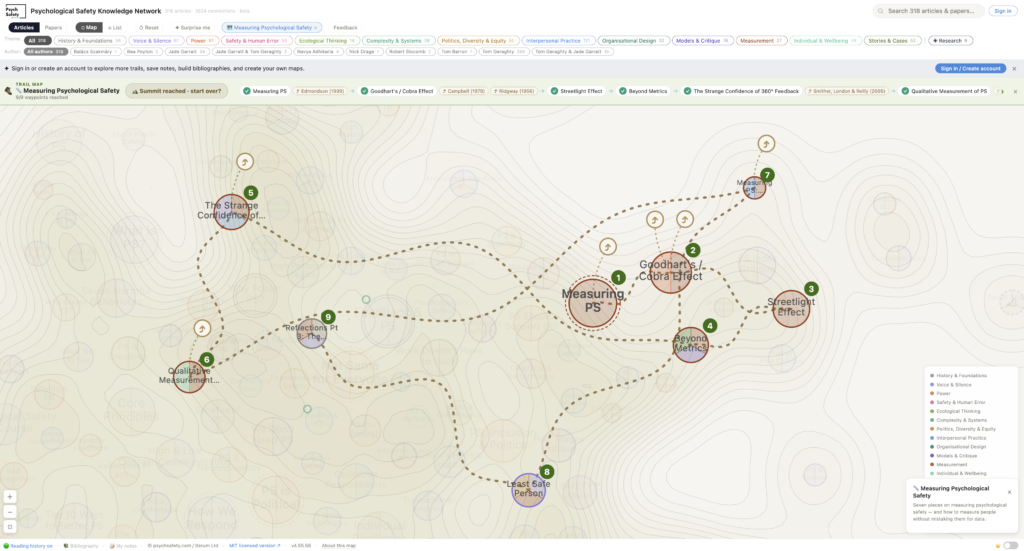
  • psych safety knowledge map measurement trail

    Use the Trail Guide to Psychological Safety to explore hundreds of articles, papers, resources and tools. 

  • Categories

    • Newsletter
    • Psychological Safety
      • Create and Maintain
      • Human and Organisational Performance (HOP)
      • In Technology
      • Learning and Development
      • Measure
      • Psychological Safety In The Workplace
      • Theory and Research
  • Recent Posts

    • Mistaks we've made (so far)
      Mistaks we've made (so far)
      October 7, 2026
    • The Case for Less Eye Contact
      The Case for Less Eye Contact
      September 11, 2026
    • New to psychological safety? Start here.
      New to psychological safety? Start here.
      September 8, 2026
    • The Organisational Substrate
      The Organisational Substrate
      September 1, 2026
    • Crisis-Ready Teams
      Crisis-Ready Teams
      August 27, 2026
    • Measuring psychological safety - the Psych Safety Survey Tool
      Measuring psychological safety - the Psych Safety Survey Tool
      August 25, 2026
    • Body Language and Non-Verbal Communication

      Body Language and Non-Verbal Communication
      August 20, 2026
    • The Four Stages of Psychological Safety: a Six-Stage Critique

      The Four Stages of Psychological Safety: a Six-Stage Critique
      August 7, 2026
    • Organisational Indicator Species: being an Organisational Ecologist

      Organisational Indicator Species: being an Organisational Ecologist
      August 6, 2026
    • Psych Safety Day / Week 2027
      Psych Safety Day / Week 2027
      August 4, 2026
    • Parachutes and “Evidence based” thinking

      Parachutes and “Evidence based” thinking
      July 31, 2026
    • The Psychological Safety Fieldbook
      The Psychological Safety Fieldbook
      July 31, 2026
    • Principles of Ethical Measurement in Organisations

      Principles of Ethical Measurement in Organisations
      July 10, 2026
    • Safety, Stat!
      Safety, Stat!
      June 26, 2026
    • The Strange Confidence of 360 Degree Feedback

      The Strange Confidence of 360 Degree Feedback
      June 25, 2026
    • Reading the air: high and low context communication in teams

      Reading the air: high and low context communication in teams
      June 8, 2026
    • Who gets to decide if psychological safety matters?
      Who gets to decide if psychological safety matters?
      June 5, 2026
    • Accountability
      Accountability
      May 29, 2026
    • Qualitative Measurement of Psychological Safety

      Qualitative Measurement of Psychological Safety
      May 22, 2026
    • The Field Guide to Psychological Safety
      The Field Guide to Psychological Safety
      May 15, 2026
    • Ambiguity, predictability, and psychological safety

      Ambiguity, predictability, and psychological safety
      May 1, 2026
    • The Calculus of Voice
      The Calculus of Voice
      April 23, 2026
    • Contracting and recontracting
      Contracting and recontracting
      April 16, 2026
    • The Vasa
      The Vasa
      April 1, 2026
    • Learning from Error, or Punishing It?
      Learning from Error, or Punishing It?
      March 27, 2026
    • The “Utility” of Psychological Safety
      The “Utility” of Psychological Safety
      March 20, 2026
    • Psychological Flexibility
      Psychological Flexibility
      March 19, 2026
    • Be soft to each other, and hard on the system

      Be soft to each other, and hard on the system
      March 12, 2026
    • "Fake it till you make it"
      "Fake it till you make it"
      March 12, 2026
    • The SANE Effect
      The SANE Effect
      February 20, 2026
    • Learning Teams
      Learning Teams
      January 30, 2026
    • The Tenerife Disaster of 1977: “We're Going”
      The Tenerife Disaster of 1977: “We're Going”
      January 23, 2026
    • ST.R.E.A.M: Status Rules Everything Around Me
      ST.R.E.A.M: Status Rules Everything Around Me
      January 23, 2026
    • Growth Mindset
      Growth Mindset
      January 16, 2026
    • The Streetlight Effect
      The Streetlight Effect
      January 8, 2026
    • The "Fist of Five"
      The "Fist of Five"
      December 19, 2025
    • Psychological Bravery
      Psychological Bravery
      December 18, 2025
    • Psych Safety Book List 2025
      Psych Safety Book List 2025
      December 18, 2025
    • Psych Safety 2025 Unwrapped
      Psych Safety 2025 Unwrapped
      December 15, 2025
    • Plan Continuation Bias
      Plan Continuation Bias
      December 12, 2025
    • Whistleblowing and Psychological Safety
      Whistleblowing and Psychological Safety
      December 4, 2025
    • How Childhood Socioeconomic Status Shapes Psychological Safety and Career Risk-Taking at Work
      How Childhood Socioeconomic Status Shapes Psychological Safety and Career Risk-Taking at Work
      November 27, 2025
    • Safety and the Myth of Self-Reliance
      Safety and the Myth of Self-Reliance
      November 24, 2025
    • The Watermelon Effect and "Greenwashing"

      The Watermelon Effect and "Greenwashing"
      November 7, 2025
    • Individual Resilience
      Individual Resilience
      October 31, 2025
    • Counterfactuals
      Counterfactuals
      October 24, 2025
    • Coaching and Psychological Safety
      Coaching and Psychological Safety
      October 17, 2025
    • Five Ecological Concepts for Working in Organisational Change

      Five Ecological Concepts for Working in Organisational Change
      October 9, 2025
    • The Sharp End & Blunt End of Education
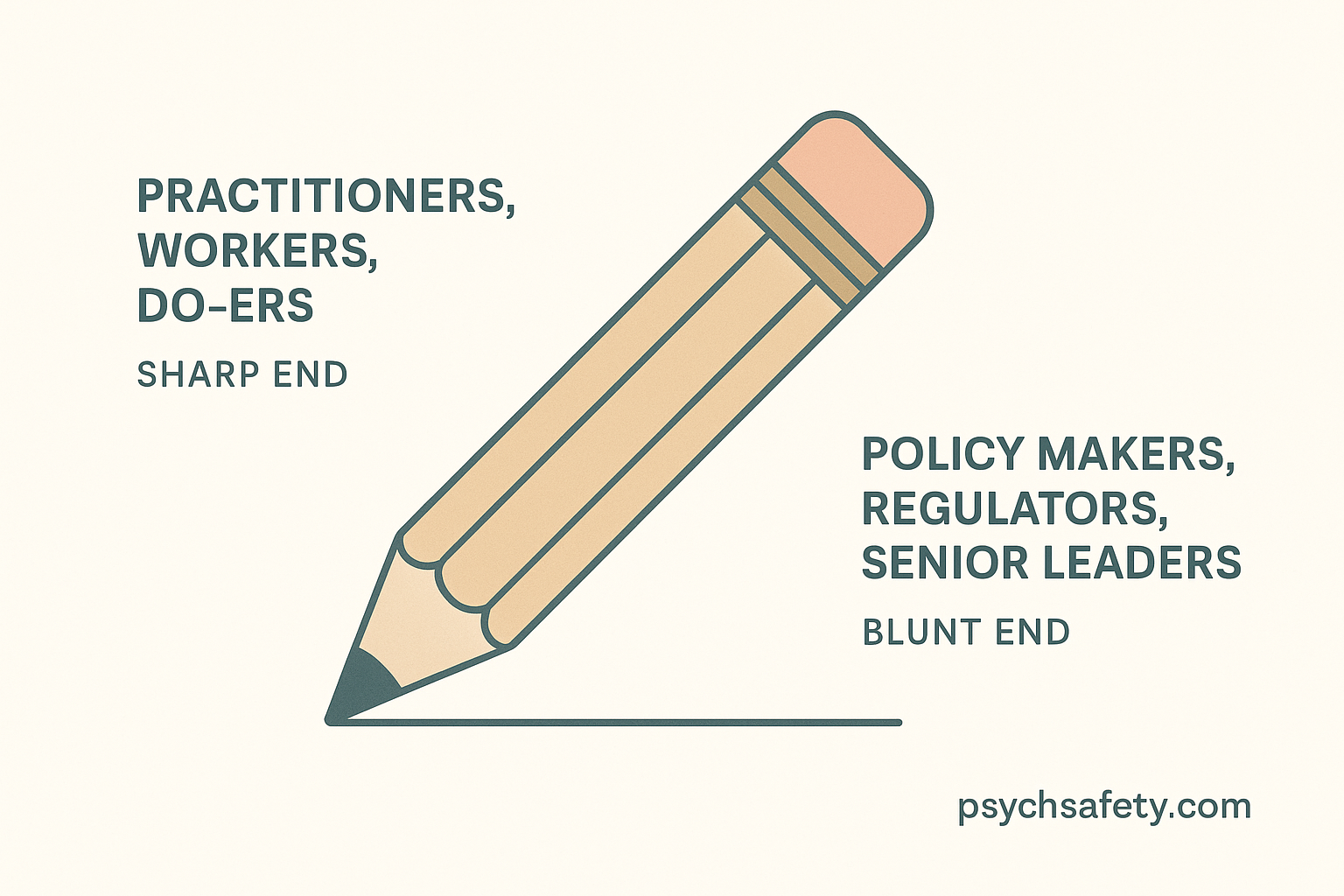
      The Sharp End & Blunt End of Education
      October 3, 2025
    • Forced Vulnerability
      Forced Vulnerability
      September 26, 2025
    • New Sticker Drop! "Zombies Are Scary"
      New Sticker Drop! "Zombies Are Scary"
      September 22, 2025
    • Reflections - Part Four: A Rights-Based Approach

      Reflections - Part Four: A Rights-Based Approach
      September 16, 2025
    • Reflections - Part Three: The Safety to Dissent
      Reflections - Part Three: The Safety to Dissent
      September 12, 2025
    • Reflections - Part Two: Power and Difference
      Reflections - Part Two: Power and Difference
      September 4, 2025
    • The Psychological Safety Trainer Toolkit
      The Psychological Safety Trainer Toolkit
      September 1, 2025
    • Twitter
    • LinkedIn


Sign up to our newsletter & get weekly insights and research

About

The Psych Safety™ Team
Our Mission
Our Core Principles
Privacy Policy
Terms of Business

Learn

Corporate Training
Online Workshops
Newsletter
Professional Certification
Explore our semantic knowledge map

Tools

Tool Kits
Articles
What is Psychological Safety?
The History of Psychological Safety

Get Connected

Contact us
Attend a Meetup
Join the Community
Connect with us on LinkedIn
View our YouTube Channel
© Iterum Ltd. Psych Safety™ is an unregistered trade mark of Iterum Ltd.
We support LGBTQ+ rights all year round. But we also celebrate pride too.
We support LGBTQ+ rights all year round. But we also celebrate pride!
Content on this website is CC BY-NC-SA
Written by humans, not by AI