- Org Training
- Live Workshops
- Full Live Course
- Psychological Safety Fundamentals
- Practice Masterclass
- Leadership & Management
- Advanced Psychological Safety
- Measuring Psychological Safety
- Workshop Design and Facilitation
- HOP Fundamentals
- Delivering Effective Feedback
- Thinking Like an Ecologist: A Field Guide for Organisational change
- On-Demand

- Org Training
- Live Workshops
- Full Live Course
- Psychological Safety Fundamentals
- Practice Masterclass
- Leadership & Management
- Advanced Psychological Safety
- Measuring Psychological Safety
- Workshop Design and Facilitation
- HOP Fundamentals
- Delivering Effective Feedback
- Thinking Like an Ecologist: A Field Guide for Organisational change
- On-Demand
The History of Psychological Safety
On the 10th of August 1628, the warship Vasa sailed barely a kilometre into Stockholm harbour, heeled over in a light gust, took water through her open lower gun ports, and sank. She was the most powerful warship Sweden had ever built, the pride of a king at war, and she had been at sea for a matter of minutes.
The Vasa didn’t sink because nobody knew about the problems in the build. She was lost because the people who thought it would sink felt unable to be heard. The term psychological safety wouldn’t be coined for another three centuries, but the dynamics were as real in 1628 as they are in today’s workplaces.
The question is older still. The Greeks had a word for the honest speech that holds power to account — parrhesia — and counted it a civic virtue, because the problem of who can safely say the difficult thing is as old as organised human life itself.
Psychological safety has been discovered, named, evolved and rediscovered many times. What makes its history particularly interesting is not a single intellectual lineage, but the convergence: psychologists, organisational theorists, quality thinkers, safety scientists, engineers and practitioners in very different industries repeatedly encountered versions of the same underlying problem, often without using the same language or knowing much about each other’s work. That convergence is the actual history of the concept, and it is more interesting, and more cautionary, than the familiar arc from Rogers to Edmondson to Google to our organisation’s next leadership programme.
This is not a neutral history. We’ve been working in this field since 2019, building what we believe is a genuinely rigorous body of knowledge that resists the concept’s recurring vulnerability of being flattened into a checklist, a survey, or a keynote. Understanding where psychological safety came from and what keeps happening to it matters for understanding what it actually is.
Different people, solving different problems, kept discovering that the social conditions surrounding voice, error, learning and dissent matter enormously.
The first coining: Carl Rogers and Creativity
The term “psychological safety” itself was, we believe, first coined in 1954 by the humanistic psychologist Carl Rogers, in a paper later compiled in P E Vernon’s 1970 collection on creativity.
Rogers described psychological safety as a condition in which an individual feels they possess unconditional worth (accepted without conditions) in an environment deliberately free of external evaluation. For Rogers, safety was a prerequisite for creativity, authentic self-expression, and growth. It was, in its original form, personal and explicitly anti-evaluative. The person should not be measured. The environment must not judge.
The field that eventually inherited this concept would spend much of its energy designing measurement instruments and evaluation frameworks. The distance between Rogers’ original formulation and the contemporary psychological safety industry is part of the story.
Parallel traditions: the groundwork
Rogers was not alone. In the mid-twentieth century, several adjacent traditions were independently developing ideas that converged on what we now call psychological safety, each with its own politics, assumptions, and blind spots.
Kurt Lewin (1936), often called the father of social psychology, contributed the equation B = f(P,E) — behaviour is a function of person and environment — and developed the “unfreeze–change–refreeze” model of organisational change, which depended on creating conditions safe enough for people to relinquish existing patterns. Douglas McGregor supplied the corollary three decades later, in The Human Side of Enterprise (1960): that the environment is largely authored by whoever holds authority. His Theory X and Theory Y are usually flattened into two kinds of manager, but the durable insight is a loop, not a taxonomy. The assumptions a manager holds about people get built into structures of control and surveillance, and those structures then elicit the very behaviour the assumptions predicted, which appears to confirm them. Low-safety climates are stable precisely because they manufacture their own evidence.
Chris Argyris, from the 1960s onward, developed the concepts of defensive routines and double-loop learning. Without safety, organisations trap themselves in single-loop adaptation: fixing the symptom, but not the cause. Argyris was particularly interested in the gap between espoused theory (what organisations claim to value) and theory-in-use (what their structures actually reward).
The Tavistock Institute in London was developing socio-technical systems thinking, drawing on studies of coal mining and healthcare to demonstrate we can’t address change in solely technological or social terms – it has to be both.
Edgar Schein and Warren Bennis gave the concept its first explicit organisational definition in 1965, in their book Personal and Organisational Change Through Group Methods. For Schein and Bennis, psychological safety reduced “a person’s anxiety about being basically accepted and worthwhile.”
“A person’s anxiety about being basically accepted and worthwhile is reduced through psychological safety.” — Schein & Bennis (1965)
Working in the same period, Eric Berne was developing Transactional Analysis: a framework for the transactions between people, and for how explicit contracting and shared expectations reduce the ambiguity that makes candid interaction feel unsafe. It is an early articulation of something the practice still relies on — that predictability between people is what makes honesty between them affordable.
W. Edwards Deming, in his 1982 book Out of the Crisis, made the same argument from the opposite direction — not from psychology but from quality management. His eighth point: “Drive out fear, so that everyone may work effectively for the company.” Fear suppresses information. Workers who fear consequences will hide defects, pass on problems, and tell managers what they want to hear. The result is systematic failure masquerading as normal operations.
“Drive out fear, so that everyone may work effectively for the company.” — W. Edwards Deming (1982)
This convergence is important. None of these traditions needed the term psychological safety to encounter the underlying phenomenon. Humanistic psychology arrived through creativity and acceptance; organisational learning through defensive routines; quality management through fear and information; sociotechnical thinking through the relationship between people and systems. Different starting points, different vocabularies, but a remarkably similar conclusion: when interpersonal or organisational conditions make candour costly, information is suppressed, learning deteriorates, and the system becomes less able to adapt.
Safety science, aviation, and the sharp end
While the organisational psychology tradition was developing, parallel and largely separate work was underway in safety science.
In nuclear power, aviation, and healthcare, researchers were studying why some organisations maintained exceptional safety despite operating under conditions of extreme risk and complexity. The literature on High Reliability Organisations (HROs) — developed by Karl Weick, Kathleen Sutcliffe, and others through the 1990s — emphasised open communication, deference to expertise regardless of hierarchy, and the systematic reporting of near-misses. All of this is impossible without psychological safety, though the HRO literature rarely used the term because it wasn’t in use yet.
In aviation, Crew Resource Management (CRM) developed from the late 1970s in direct response to disasters, most notably Tenerife in 1977, still the deadliest accident in aviation history. The popular telling is that a junior crew failed to challenge a senior captain. That is not quite what the cockpit voice recorder shows. KLM’s flight engineer did voice his doubt, querying whether the Pan Am aircraft was still on the runway ahead of them – “That Pan Am, is he clear?”. The captain, the airline’s own chief 747 instructor, overrode him, and the aircraft began its takeoff roll into the fog. Tenerife is less a story about silence than about attenuated speech: a concern raised quietly, against a steep authority gradient, and brushed aside. CRM set out to create conditions where everyone can speak up to power when they see something wrong. The term “psychological safety” wasn’t used; instead the field spoke of “attenuated speech” or “safety silence” as descriptors of what we would now call its absence.
In healthcare. These were not only problems of the cockpit. In 2005, Elaine Bromiley died during what should have been a routine operation, after her anaesthetic team lost her airway and could not regain it. The nurses in the room recognised the emergency and had readied the equipment for it; what they could not find was a way to communicate this to senior clinicians who had narrowed onto the task in front of them and lost track of how much time had passed. Elaine’s husband, Martin, was an airline pilot. He recognised the accident pattern at once — fixation, hierarchy, the steep power gradient between consultants and nurses — and went on to bring human factors and crew resource management into healthcare, making the case one of the most influential in British patient safety. It is the same lesson as Tenerife, stripped of the spectacle: the people who could see the danger were not able to voice it.
Space Travel. If Tenerife and the Bromiley case show a concern raised and overridden, Challenger and Columbia show something more insidious: a concern that never reached the point of being raised at all. The flaw in the Space Shuttle’s Solid Rocket Booster O-rings was known for years; because each launch survived it, the risk was quietly reclassified as acceptable, in what Diane Vaughan called the normalisation of deviance. By the eve of the launch there was no live alarm left to override, because the danger had been absorbed into normal practice. NASA did not fully learn it: in 2003, Columbia was lost to a foam-strike risk that had been normalised in a similar way. The failure was structural, not a shortage of brave individuals, but an organisation with no remaining channel through which a long-tolerated risk could be made urgent again.
Manufacturing. One structural answer to all of this was, by then, already being built on a different continent. The Toyota Production System embedded the same principles into the machinery itself, most famously through the Andon Cord. The popular version (any worker can halt the entire line) is very much a simplification, and the real mechanism is more nuanced. The point is not heroics but obligation, pulling the cord is a duty, and a positive thing to do. The system is engineered so that raising a concern is the default action and someone is always required to come and listen. It does not ask workers to feel safe enough to speak up; it builds speaking up into the process, and normalises it.
Safety. All of this belongs to a larger shift in safety science: away from behavioural-based safety, which located accidents in the unsafe acts of individuals, and towards the view — articulated by Erik Hollnagel, Sidney Dekker and others — that human adaptation is the source of safety far more often than its undoing. That shift is the foundation of Human and Organisational Performance (HOP): error is normal, blame fixes nothing, and it is the system that must change. Psychological safety is what that principle looks like at the level of teams and relationships.
William Kahn and the individual dimension
William Kahn’s 1990 paper, “Psychological Conditions of Personal Engagement and Disengagement at Work”, renewed academic interest in psychological safety. Kahn defined it as:
“the sense of being able to show and employ one’s self without fear of negative consequences to self-image, status or career.” (Kahn, 1990, p.705)
Kahn’s formulation was primarily individual — a personal sense of safety — rather than the group phenomenon Schein and Bennis had described. He embedded it in a broader framework of psychological engagement, arguing that people bring more or less of themselves to their work depending on three conditions: meaningfulness, availability, and safety.
Kahn’s work was theoretically rich but empirically limited. It would take another decade and a very different methodological approach to establish the concept’s empirical foundations.
Amy Edmondson and the empirical turn
A key turning point came with Amy Edmondson’s 1999 study of hospital nursing teams, published in Administrative Science Quarterly. Working from an apparently odd finding — teams that reported better relationships also reported more errors — Edmondson demonstrated empirically that psychological safety predicts learning behaviours and, through learning, team performance.
Edmondson explicitly defined it as a team-level construct: “a shared belief that the team is safe for interpersonal risk-taking.” By locating psychological safety at the team level and providing a measurement instrument, she made the concept empirically study-able and researchable, and more importantly, practical in a way it had never been before.
Google, the New York Times, and hitting the mainstream
Google’s Project Aristotle (2012–2016) identified psychological safety as the most significant predictor of team effectiveness across Google’s hundreds of teams. The 2016 New York Times article “What Google Learned From Its Quest to Build the Perfect Team” brought the concept to a business audience that had never encountered Kahn or Edmondson.
Edmondson’s 2018 book The Fearless Organization cemented psychological safety as a global management imperative. Google Ngram data (below) shows the term remaining relatively stable until around 2000, then climbing steadily, with dramatic acceleration between 2013 and 2022.
Structured timeline
1628 — The warship Vasa sinks in Stockholm harbour minutes into her maiden voyage. The phenomenon exists long before the name.
1954 — Carl Rogers coins “psychological safety” in Toward a Theory of Creativity. The original formulation: unconditional worth, freedom from external evaluation.
1960s — Argyris develops defensive routines and double-loop learning. Fear suppresses organisational learning.
1965 — Schein & Bennis define psychological safety as a group-level phenomenon.
Late 1970s — Aviation develops Crew Resource Management in response to hierarchy-driven disasters (Tenerife, 1977).
1982 — Deming publishes Out of the Crisis: “Drive out fear.” Quality management arrives at the same conclusion via a different route.
1990 — Kahn defines psychological safety at the individual level in Academy of Management Journal.
1990s — HRO literature emerges (Weick & Sutcliffe). High reliability requires open information flow, which requires safety.
1999 — Edmondson publishes Psychological Safety and Learning Behavior in Work Teams. The empirical turn.
2012–2016 — Google’s Project Aristotle identifies PS as the primary predictor of team performance.
2016 — New York Times article brings the concept into mainstream management discourse.
2018 — Edmondson publishes The Fearless Organization. Global management imperative — and the beginning of its most intensive period of commodification.
2019 — psychsafety.com launches. We begin building a body of work that tries to hold the concept’s complexity while engaging seriously with the literature.
2020 — COVID-19 exposes psychological safety as infrastructural rather than aspirational.
2021 — ISO 45003, the first international standard for psychological health and safety at work.
2022 — Australia WHS Regulations make psychosocial hazard management a legal requirement.


The recent landscape: regulation, DEI, and what remains contested
Recent years have brought important developments, not all of them straightforwardly positive.
ISO 45003 (2021) and Australia’s Work Health and Safety Regulations (2022) represent the regulatory crystallisation of psychological safety. Floors matter: they protect people who might otherwise have no recourse. But regulation also crystallises concepts at a particular level of development. Once psychological safety is defined in a statutory instrument, the incentive to deepen understanding diminishes. What organisations often seek is compliance, not genuine transformation, and compliance-oriented psychological safety looks worryingly like a policy, a survey, and a checklist.
The intersection with diversity, equity, and inclusion has been one of the more productive recent developments. Without psychological safety, marginalised voices are silenced; without genuine inclusion, safety is incomplete. The research is increasingly clear that psychological safety is not equally distributed within teams and organisations — it correlates with power, and those with the least power experience the least of it.
Our own LinkedIn discourse analysis found that scepticism about psychological safety on professional networks correlates reliably with markers of relative privilege: senior, managerial, and demographically dominant positions. Scepticism about psychological safety is, in part, a luxury position available to those whose safety has generally not been the problem.
Where we’ve taken it — and where the field needs to go
Over the past five years, we’ve watched the research and practice of psychological safety evolve, spread, and achieve extraordinary impact. We’ve also watched it drift, become commodified, and risk being hollowed out.
Perhaps the most compelling thing this history shows is that psychological safety did not spread outward from a single source. Again and again, different fields independently discovered that people and systems function differently when it is safe to surface information, uncertainty, dissent and error.
When we strip back the noise, what remains is this: psychological safety is not a diagnostic, a programme, a KPI, or a leadership fad. It is an emergent property of human systems, shaped by power, behaviour, context, difference and dissent. It is fostered not by roadmaps or surveys, but by learning, curiosity, empathy and care.
The next phase will be less about spreading awareness and more about deepening our collective understanding of what psychological safety actually means in practice. That means moving away from simple checklists and models, and attending to the complexity of human systems: attending to power gradients, embracing difference, and treating psychological safety as something that arises from lived interactions rather than from top-down initiative.
It also means a shift in focus from teams in isolation to the organisational fabric itself — the messy interfaces and organisational ecotones where most dysfunction, and most innovation, actually arises. Systems survive and thrive not through compliance but through constant human adaptation. That is an ecological observation, and it is why we consistently find ecological thinking useful here: not as metaphor, but as analytical lens.
This means, above all, a rights-based approach. Psychological safety is not simply a tool for optimising human performance. It is a right — a fundamental condition of human dignity at work.
The Vasa sank because everyone who could see the danger was looking up a gradient too steep to speak across. You can’t fix a secret. The collective task, four centuries on, is to keep psychological safety porous and evolving, to resist its commodification, and to build organisations where everyone, especially those with the least power, can speak up in the way that works for them, be truly heard, and know that their voice makes a difference.
Further reading and references
THE ORIGINAL SOURCES
Rogers, C. (1954). Towards a Theory of Creativity. ETC: A Review of General Semantics, 11(4), 249–260; reprinted in Vernon (ed.), Creativity (1970). The original coining, and still the most radical formulation. Original text (open access) · our commentary.
Lewin, K. (1936). Principles of Topological Psychology. Where B = f(P,E) comes from. (discussed here)
Trist, E. L., & Bamforth, K. W. (1951). Some Social and Psychological Consequences of the Longwall Method of Coal-Getting. Human Relations, 4(1), 3–38. The Tavistock coal-mining study that founded socio-technical systems thinking.
McGregor, D. (1960). The Human Side of Enterprise. Theory X and Theory Y, and the self-fulfilling loop between a manager’s assumptions and the climate they produce.
Berne, E. (1961). Transactional Analysis in Psychotherapy. The interpersonal machinery: contracting, shared expectations, and the reduction of ambiguity that makes candid interaction affordable.
Schein, E. H., & Bennis, W. (1965). Personal and Organizational Change Through Group Methods. (open access) The first definition of psychological safety as a group-level phenomenon.
Argyris, C., & Schön, D. (1978). Organizational Learning: A Theory of Action Perspective. (open access) Defensive routines, double-loop learning, and the gap between espoused theory and theory-in-use.
Deming, W. E. (1982). Out of the Crisis. Quality management arrives at the same destination by a different route: drive out fear. (the fourteen points)
Kahn, W. A. (1990). Psychological Conditions of Personal Engagement and Disengagement at Work. Academy of Management Journal, 33(4), 692–724. The concept’s return to the academy, at the level of the individual.
Edmondson, A. C. (1999). Psychological Safety and Learning Behavior in Work Teams. Administrative Science Quarterly, 44(2), 350–383. The empirical turn. (full text PDF)
Edmondson, A. C. (2018). The Fearless Organization. The concept as global management imperative, for better and worse.
SAFETY SCIENCE AND HIGH RELIABILITY
Perrow, C. (1984). Normal Accidents: Living with High-Risk Technologies. Why tightly-coupled, complex systems fail in ways no individual chose.
Reason, J. (2000). Human Error: Models and Management. BMJ, 320(7237), 768–770. (open access) The latent-conditions and “Swiss cheese” account, in brief.
Weick, K., & Sutcliffe, K. (2001). Managing the Unexpected. How high reliability organisations sustain the information flow that safety depends on.
Vaughan, D. (1996). The Challenger Launch Decision. The definitive account of how risk becomes normalised inside an organisation. (our summary)
Dekker, S. (2014). The Field Guide to Understanding ‘Human Error’. The new view: error as a symptom of the system, not its cause.
Hollnagel, E., Wears, R. L., & Braithwaite, J. (2015). From Safety-I to Safety-II: A White Paper. (open access) The shift that underpins Human and Organisational Performance.
THE EMPIRICAL PSYCHOLOGICAL SAFETY LITERATURE
Edmondson, A. C. (2002). Managing the Risk of Learning: Psychological Safety in Work Teams. (open access) Distinguishes psychological safety from trust, and names the four interpersonal risks that inhibit learning.
Edmondson, A. C., & Lei, Z. (2014). Psychological Safety: The History, Renaissance, and Future of an Interpersonal Construct. Annual Review of Organizational Psychology and Organizational Behavior, 1, 23–43. The best single overview of the field.
Edmondson, A. C., & Bransby, D. P. (2023). Psychological Safety Comes of Age: Observed Themes in an Established Literature. Annual Review of Organizational Psychology and Organizational Behavior, 10, 55–78. Where the research stands now.
Newman, A., Donohue, R., & Eva, N. (2017). Psychological Safety: A Systematic Review of the Literature. Human Resource Management Review, 27(3), 521–535.
Frazier, M. L., Fainshmidt, S., Klinger, R. L., Pezeshkan, A., & Vracheva, V. (2017). Psychological Safety: A Meta-Analytic Review and Extension. Personnel Psychology, 70(1), 113–165.
Morrison, E. W., & Milliken, F. J. (2000). Organizational Silence: A Barrier to Change and Development in a Pluralistic World. Academy of Management Review, 25(4), 706–725.
Detert, J. R., & Burris, E. R. (2007). Leadership Behavior and Employee Voice: Is the Door Really Open? Academy of Management Journal, 50(4), 869–884.
Nembhard, I. M., & Edmondson, A. C. (2006). Making It Safe: The Effects of Leader Inclusiveness and Professional Status on Psychological Safety. Human Relations, 59(7), 941–969.
ON THIS SITE
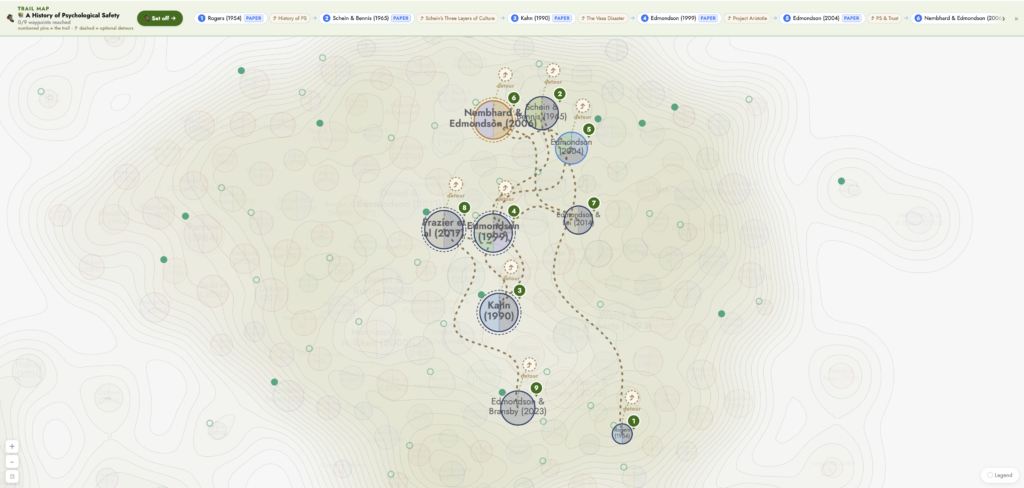
The cases and concepts in this history, in more depth. The whole network of 260+ articles and nearly 100 key papers, and the relationships between them, lives in the semantic knowledge map.
Cases and disasters
- The Vasa Disaster — the lesson, three centuries before the name
- Tenerife, 1977 — attenuated speech and the steepest of authority gradients
- Aviation lessons in healthcare — the context for the Elaine Bromiley case
- Normalisation of deviance — Challenger, Columbia, and how risk becomes routine
- Chernobyl — authoritarian culture and the suppression of voice
- The Amagasaki Disaster — production pressure and fear culture on the railways
- Learning from error, or punishing it? — why accountability without context is blame
Concepts and mechanisms
- What is psychological safety? — our working definition and the debates around it
- Defining psychological safety — the team-level construct, and where it drifts
- Psychological safety and power — why the leader-centric model is part of the problem
- Reducing power gradients — the central practical lever
- Sociological safety — Lewin’s environment variable, taken seriously
- Sociotechnical theory — the Tavistock inheritance: never only social, never only technical
- The Andon Cord — structural safety in the Toyota Production System
- Crew Resource Management — aviation’s contribution to the field
- Human and Organisational Performance — what this all looks like as practice
- Complexity and psychological safety — why simple frameworks fail complex systems
- The organisational fabric & organisational ecotones — where dysfunction and innovation both live
- Google’s Project Aristotle — the study that mainstreamed the term
- A rights-based approach — psychological safety as a condition of dignity, not a performance lever
- Thinking like an ecologist — the lens we bring to all of the above
Sign up to our newsletter for weekly insights, research, and practice — written for practitioners who want to go deeper.
Sign up to our newsletter for weekly insights, research, and practice — written for practitioners who want to go deeper.
Sign up to our newsletter & get weekly insights and research

