

Guest Post By Jason Rawding Humour and Psychological Safety Being funny at work can feel a bit risky – especially in front of a group, or in an email that many people will see In trying to make others laugh, […]...

Self-Organised Criticality (SOC) During my ecology degree, whilst studying ecosystem and habitat change, I learned about Self-Organised Criticality (SOC), and I was fascinated by how it explained the precursors to seemingly dramatic changes We first discussed Self-Organised Criticality in this [&hel...

We all are Do only leaders influence psychological safety Is psychological safety “done to us” Well, yes and no Leaders have a significant influence on psychological safety, but they’re not the only contributor, by a very long way Firstly, psychological […]...

Comfort vs Need by Tom Geraghty What do we do when the things that help some people in the team feel psychologically safer don’t work for everyone Perhaps one person says they need time away from the main meeting group […]...

The Organisational Fabric of Psychological Safety (AKA psychological safety is more than just a team phenomenon) By Tom Geraghty When we talk about psychological safety, the definition we usually use is something along the lines of “a shared belief that […]...
Colution (noun)A solution that emerges through genuine collaboration, where all parties contribute ideas, insights, and perspectives to co-create an outcome that none could have achieved alone Usage Examples in Sentences...

All Feedback Is Subjective By Jade Garratt … And Why That Matters for Psychological Safety “No person in the world is so privileged as to have access to a ‘ground truth’ against which all other people’s understanding can be proven […]...
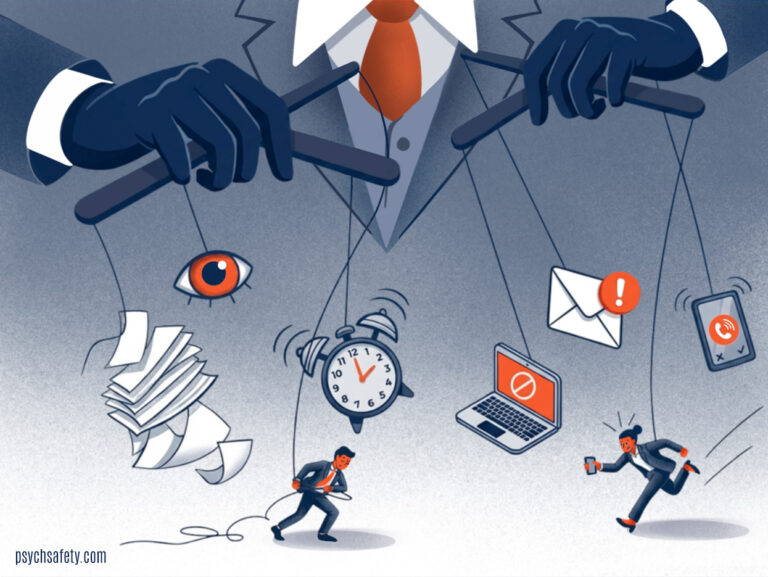
Psychological Safety and Micromanagement By Jade Garratt Those who have followed our work at Psych Safety for a while will know that we believe exploring not just what to do – the behaviours and practices that support psychological safety – […]...
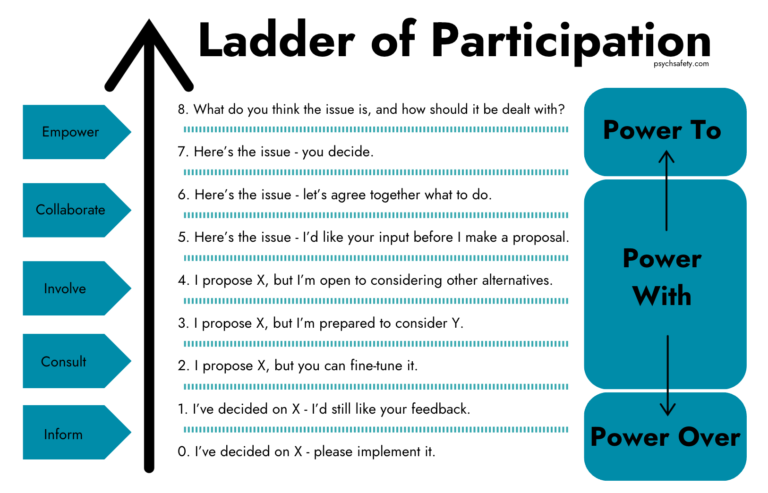
The Spectrum of Participation by Jade Garratt Engagement and participation are terms we often throw around to mean “getting people’s take on issues that affect them” But not all participation is created equal Sometimes, “inviting participation” amounts to little more […]...

Psychological Safety in Practice Team Learning in the Field: An Organizing Framework and Avenues for Future Research This excellent paper from Amy Edmondson and Jean-François Harvey affirms that teams learn most effectively when members feel safe to speak up, take interpersonal risks, [&h...

Déformation professionnelle By Tom Geraghty “Every specialist, owing to a well-known professional bias, believes that he understands the entire human being, while in reality he only grasps a tiny part of him” Alexis Carrel, Nobel laureate We all see the […]...

by Navya Adhikarla When we talk about creating inclusive workplaces, we often discuss accessibility and psychological safety as separate initiatives Accessibility (also abbreviated as a11y) focuses on removing physical and digital barriers, while psychological safety addresses the emotional and soci...
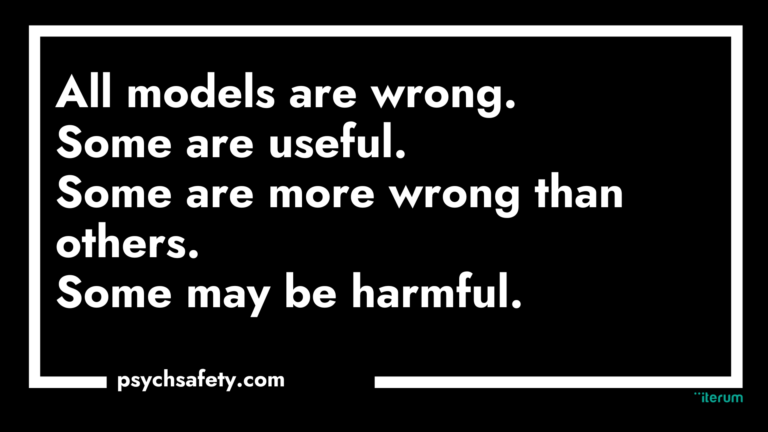
All Models Are Wrong, and Some Are Useful By Tom Geraghty This is one of my favourite, and most often used, aphorisms It’s attributed to George Box, a British statistician, from a 1976 paper on Science and Statistics, though the […]...

Reducing Power Gradients By Jade Garratt In our experience, the most effective lever for increasing psychological safety within a team is flattening the power gradient – the gap between those with the most power and those with the least In […]...

Efficiency vs Resilience By Tom Geraghty Standardisation is often used as a way to increase organisational efficiency and scalability Through reducing variation, we can standardise our tools, training, processes and more, enabling us to optimise systems and better achieve our desired […]...
An Exploration of Dan Radecki’s SAFETY™ Model Psychological safety is a deceptively simple idea: people feel able to speak up with questions, concerns, or mistakes without fear of embarrassment or reprisal Amy Edmondson’s now-canonical definition captures this precisely, grounding dec...

The Speaking up Myth By Jade Garratt In the world of psychological safety, we focus a lot, maybe even too much, on the speaking up side of the equation How do we make sure people speak up with their ideas, […]...

Why silence often wins over voice When someone chooses not to speak up at work, whether it’s to raise a concern, ask a question, or offer a dissenting view, it’s easy to assume they’ve rationally performed the mental cost-benefit calculation […]...

Addressing Power through “Flattening” Organisations Steep power gradients are one of the most significant factors that contribute to reducing psychological safety These steep differentials in perceived power have contributed to many disasters including the Tenerife Airport disaster in 1977, Cher...

Work doesn’t have to suck By Jade Garratt The start of a new year seems like a good time to reflect on how work feels, and how we feel about work For too many of us, going to work isn’t […]...

