

In a word, yes The importance of mental health and well-being is now being recognised in the workplace Some would even argue it’s being respected Though not universal in its reach, this new attitude is seeing employers investing in a […]...

A few issues ago, we covered various kinds of retrospective – the practice of looking back and learning from work, as well as some of the conditions and requirements for effective retrospectives One of those points was about the “weak […]...
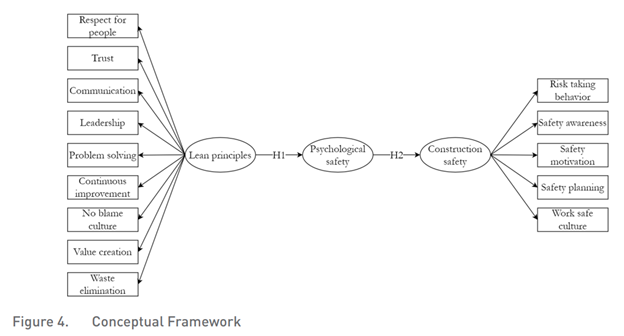
Psychological Safety at Work Lean and psychological safety Here’s a great analysis by Ben Hutchinson of a paper examining the relationship between Lean and psychological safety in construction projects in the US This combines two of my favourite subjects so […]...

John Boyd and The OODA Loop John Boyd’s OODA loops are more than just an esoteric strategic concept; they’ve earned a huge following online and around the world In this article, I highlight key points about OODA loops along with a glimpse into […]...

Telling the boss bad news twice Soon after I graduated from university with my degree in ecology, I got a job as an Experimentalist at Jealott’s Hill Research Station, Berkshire I worked in a department called “Weed Science” (yes, it does […]...

Team performance isn't the only reason that we foster psychological safety We also do it because we want people to feel fulfilled in their jobs, we don’t want people to leave a team because they don’t feel included, we want people to experience less unnecessary stress and have greater mental wel...

Crew Resource Management (CRM) and the Centrality of Psychological Safety CRM was developed in the 1970s and operationalised psychological safety in safety-critical, complex environments Crew Resource Management (CRM) recognised, as a result of accidents such as Tenerife in 1977, that […]...

Psychological Safety in 2023 Thanks so much for all your support, feedback, encouragement, ideas, insights and collaboration over 2023! It’s genuinely a privilege to be able to do this work, and I appreciate every single one of you I recently […]...

The Theory of Constraints (ToC) A long time ago, I read a book that profoundly changed the way I think about work That book was The Goal, written by Eli Goldratt in 1984, The story revolves around Alex Rogo, a […]...

Guest post by Nick Drage, Strategy Lead and Game Designer at Path Dependence Limited, co-author of “The Handbook of Cyber Wargames: Wargaming the 21st Century” At its most abstract level a wargame is a “representation of conflict or competition in […]...

Learning From Work In the spirit of looking back and learning, I thought it’d be nice to dive into a few different practices of learning from the work we do In this issue, we’re going to have a look at […]...

The Adaptive Cycle This is a great paper for the ecological and complexity geeks, like me The adaptive cycle: More than a metaphor Thanks to Christina Bowen for sharing The adaptive cycle is a conceptual framework used to understand the dynamics […]...

Tool: Foster psychological safety We realised recently that the Google Project Aristotle page for their guide on team effectiveness and building psychological safety was 404’ing, so for anyone looking for it, we went over to the Way Back Machine and […]...

The Whitehall Studies and The Social Gradient of Health The relationship between formal or positional power (seniority & status) and psychological safety is strong In general, we know that people holding more senior and higher status roles often feel safer […]...

The First Org Chart In 1855, Brigadier General Daniel McCallum, later to become a Civil War officer renowned for “strict precision and stern discipline” as well as for his innovative engineering, created the world’s first organisational chart This chart was […]...

We cannot adequately respond to changes, incidents or threats if we’re operating at capacity And it applies to people, machines, computers, traffic and more - whether you’re running a factory floor, a busy kitchen, a software development team, or a hospital ER, percentage utilisation is impactin...

Guest post by Navya Adhikarla, graduate student in the Master of Engineering Management program at Duke University (Don’t) Look me in the Eye: The Challenge of Eye Contact “Look me in the eye and tell me you are not lying,” […]...

15/5 Reports To manage teams in a way that fosters psychological safety requires clear communication and feedback channels Team members should have well-defined platforms to share achievements, voice concerns, and seek assistance Ideally, these feedback mechanisms will be consistent, high-caden...

Stutters and Stammers I’ve written previously about my experience growing up with dyspraxia, which I was diagnosed with at an early age My dyspraxia made it difficult for me to pronounce and articulate certain sounds (called phonemes), and meant that I […]...

Deming’s 14 Points of Management I’m a Deming fan, and sad that I never got to meet him or attend any of his lectures W E Deming is possibly most well known for his “PDCA” (Plan-Do-Check-Act) cycle, which is actually […]...

