

• Psychological Safety
  • Organisational Training
    • – Ignite: Senior Leaders
    • – Impact: Team Workshop
    • – Delivering Feedback
    • – CRM for Non-Aviation Teams
    • – HOP: Human and Organisational Performance
  • Online Workshops
    • – Train the Trainer
    • – Fundamentals
    • – Practices
    • – Leadership
    • – Advanced
    • – Measurement
    • – Workshop Facilitation
    • – HOP
    • – Delivering Feedback
  • Resources
    • – Tool Kits
    • – Free Resources
    • – Newsletter
    • – Articles
    • – Research
    • – Shop
    • – Community
    • – Practices
    • – What is Psychological Safety?
  • About Us
  • Contact
  • Search
  • Tool Kits
    • Action Pack
    • Trainer Toolkit
    • Practitioner Bundle
    • Practice Playbook: Feedback​
    • Practice Playbook: Technology​
    • Practice Playbook: Inclusion​
    • Practice Playbook: Education​
    • Practice Playbook: Healthcare​
  • Organisational Training
    • Ignite for Senior Leaders
    • Impact Team Workshop
    • Management Masterclass
    • Delivering Effective Feedback
    • HOP: Human and Organisational Performance
    • CRM for Non-Aviation Teams
    • Train the Trainer
  • Online Workshops
    • Complete Online Course
    • Psychological Safety Fundamentals
    • Practice Masterclass
    • Leadership & Management
    • Advanced Psychological Safety
    • Measuring Psychological Safety
    • Workshop Design and Facilitation
    • HOP Fundamentals
    • Delivering Effective Feedback
psych safety logo white
  • Resources
    • Tool Kits
    • Free Resources
    • Newsletter
    • Research
    • Shop
    • Podcasts & Talks
    • Videos
    • Community
    • Events & Psych Safety Days
  • Articles
    • Search
    • What is Psychological Safety?
    • The History of Psychological Safety
    • Psychological Safety Practices
    • Psychological Safety In The Workplace
    • Research
    • Measure Psychological Safety
    • Human Organisational Performance (HOP)
  • The Psych Safety Team
    • Contact Us
    • About The Team
    • Tom Geraghty
    • Jade Garratt
  • Tool Kits
    • Action Pack
    • Trainer Toolkit
    • Practitioner Bundle
    • Practice Playbook: Feedback​
    • Practice Playbook: Technology​
    • Practice Playbook: Inclusion​
    • Practice Playbook: Education​
    • Practice Playbook: Healthcare​
  • Organisational Training
    • Ignite for Senior Leaders
    • Impact Team Workshop
    • Management Masterclass
    • Delivering Effective Feedback
    • HOP: Human and Organisational Performance
    • CRM for Non-Aviation Teams
    • Train the Trainer
  • Online Workshops
    • Complete Online Course
    • Psychological Safety Fundamentals
    • Practice Masterclass
    • Leadership & Management
    • Advanced Psychological Safety
    • Measuring Psychological Safety
    • Workshop Design and Facilitation
    • HOP Fundamentals
    • Delivering Effective Feedback
psych safety logo white
  • Resources
    • Tool Kits
    • Free Resources
    • Newsletter
    • Research
    • Shop
    • Podcasts & Talks
    • Videos
    • Community
    • Events & Psych Safety Days
  • Articles
    • Search
    • What is Psychological Safety?
    • The History of Psychological Safety
    • Psychological Safety Practices
    • Psychological Safety In The Workplace
    • Research
    • Measure Psychological Safety
    • Human Organisational Performance (HOP)
  • The Psych Safety Team
    • Contact Us
    • About The Team
    • Tom Geraghty
    • Jade Garratt
Human Organisational Performance (HOP)  ·  Newsletter  ·  Psychological Safety  ·  Psychological Safety In The Workplace  ·  Theory and Research

Amplifying Weak Signals

February 1, 2024

A few issues ago, we covered various kinds of retrospective – the practice of looking back and learning from work, as well as some of the conditions and requirements for effective retrospectives. One of those points was about the “weak signals” that we might surface in a retrospective practice. In this issue, we’re looking at those weak signals, what they are, how we identify them, and how to amplify them.


The Black Cat in the Matrix (Warner Bros.)

Remember the black cat in the Matrix? In this scene, it’s Neo’s first time entering the Matrix after his emancipation. He sees a black cat walk past, then another, seemingly identical one, and experiences deja vu. That cat was a weak signal. Neo didn’t interpret it as such, but, crucially, did notice it. Because novices (and, apparently, people with autism) tend to use explicit practice and observe more details than experts, who instead become adept at using heuristic shortcuts and pattern matching, novices may be more likely to spot anomalies, but importantly, may be less likely to interpret them. However, when Neo mentions his deja vu, and the cat, to Trinity and Morpheus, they immediately interpret it as a sign that the agents have changed something. Trinity and Morpheus have the experience and expertise to identify that Neo’s simple black cat observation indicates something far more significant. As Charles Perrow noted in a line in Normal Accidents that could have been lifted straight out of The Matrix, “seeing is not always believing; sometimes we must believe before we can see.”*

The black cat, like any weak signal:

  • Was a subtle indicator. An easily missable anomaly, not overtly threatening, but suggesting that something is amiss.
  • Was an indication of a larger issue. Weak signals can be early indicators of more complex and potentially dangerous issues.
  • Had to be interpreted. A weak signal on its own doesn’t mean much. But when we combine it with past experience and expertise, along with other signals, we can understand its potential implications.
  • Made sense in retrospect. Weak signals may be ambiguous, confusing, even contradictory, until seen in retrospect, where they (usually) make sense in the wider context of the outcome, particularly when combined with expert judgement and insight.
  • Was a trigger for action. In the Matrix, the black cat prompts Morpheus and the others to take immediate action and escape through the walls. When we believe we’ve identified a weak signal, we should take action to prevent something more catastrophic from occurring. 

A weak signal may be seemingly unconnected to other information, a piece of data that makes little sense on its own. It might be an unexpected or unexplainable alarm or spike in data, or an observation by a colleague. Weak signals you may be familiar with in your day-to-day life include things like a small damp spot in an otherwise dry place in your house, a light that blows bulbs more often than others, or your car beginning to use a bit more fuel than it usually does. All of these may be nothing to worry about – maybe someone spilled a drink, you had a bad batch of bulbs, or you’ve been doing more short journeys recently. 

But they may be signals of something more sinister, such as a leaking roof, an arcing electrical connection, or an engine fault in your car. 

The Signal and the Noise

Nate Silver, in The Signal and The Noise, describes another weak signal that was, ultimately, dismissed – but not straight away. In April 2009, a series of small tremors were noticed in the town of L’Aquila, Italy. Small earthquakes are relatively common here, but this series of tremors were around a hundred times more frequent than usual. At the same time, Giampaolo Giuliani, a technician at Italy’s National Institute of Nuclear Physics, detected unusually high levels of radon, which might be a precursor to an earthquake. He warned the mayor, who ordered vans to drive around and warn residents of the threat, but when no earthquake occurred, Giuliani was reported to local authorities and punished for “procurato allarme” (bringing about alarm) and told to keep his concerns to himself. A 6.3 magnitude earthquake hit L’Aquila 7 days later, killing more than 300 people, leaving 65,000 homeless, and causing $16billion in damage. Don’t be too hasty to dismiss a weak signal.

We should be careful not to disregard warnings or concerns from “outsiders” or non-experts too. For example, prior to the Aberfan disaster in Wales in 1966, residents raised questions about the safety of the tip, but their concerns were dismissed because they were not considered credible. 

At work, in order to identify and proactively address issues before they cause real harm, we need to create the competencies and capabilities to identify weak signals in our teams and organisations, but it doesn’t end there. Importantly, we need to amplify those weak signals. As Lars Axelsson points out in Resilience Engineering, Concepts and Precepts, “…a problem that stays with whoever discovers it, is a problem that remains unknown”, and Amy Edmondson highlights in The Right Kind of Wrong: weak signals may be ignored (as in Aberfan example above), diluted as they traverse the hierarchy (as in the Challenger disaster) or downplayed (as in the 737 MAX), so we should amplify them to ensure that they can be heard and interpreted correctly. Gene Kim and Steve Spear also include the amplification of signals as a core mechanism for success in their new book “Wiring the winning organisation”. They describe “amplification” as a core vignette in organisational learning: amplification flags, earlier and more frequently, that problems exist which require people’s ingenuity to solve. And the continued existence of these signals makes it evident that these problems have potentially not been seen and successfully solved. 

This is a great example of a selection of weak signals from the LFI team at Shell.

Amplifying Weak Signals

Amplification involves boosting signals that may indicate that an issue exists, as opposed to suppressing them. This approach prevents problems from lingering or escalating into more significant problems or disasters. We can do this via:

  • Increasing Awareness: Make sure that everyone is aware of what weak signals may be and are actively looking for them. Use examples of what weak signals may look like, and ensure that people know what mechanisms exist for highlighting them.
  • Enhancing Feedback Loops: Create systems where information about weak signals is quickly disseminated and acted upon within the organisation. These systems could range from real-time practices such as the Andon Cord, to events including regular meetings to share and examine signals and look for patterns. 
  • Generative Leadership: Leaders play a crucial role in amplifying weak signals by setting an example, praising and encouraging reporting, and ensuring that reported issues are taken seriously and addressed promptly and openly. Crucially, leaders should also ensure that people are not punished for reporting false alarms – instead we should use false alarms as learning opportunities to reduce false alarms in the future. 
  • Embracing Complexity: Recognise that life, the work we do and the systems we use are complex and that understanding these dynamics requires continuous effort, communication and adaptation, and on occasion, failure. Adopt both quantitative and qualitative practices to surface insights.
  • Valuing Diverse Perspectives: Encourage diverse viewpoints and interpretations to enrich the sensemaking processes. This means ensuring that everyone can speak up with an observation, not just those who have the loudest voice or are considered experts in the field.

Psychological safety creates an environment where employees feel safe to report weak signals, even at risk of reporting a false alarm. Indeed, a false alarm itself is an opportunity to learn and improve the clarity and integrity of systems so that weak signals can be better identified amongst the noise.

We’re never going to pick up all the signals, and nor do we probably want to, since processing and evaluating them all would be prohibitively difficult. “The only way to guarantee to detect all signals is to devote attention entirely and continuously to the one process on which the critical signals are expected to appear.” (Moray and Inagaki, in The Field Guide to Understanding Human Error by Sidney Dekker).

Sensemaking

Karl Weick’s concept of “Sensemaking in Organizations” revolves around how people construct reality in uncertain and complex environments, which involves interpreting and giving meaning to events. I feel that this idea is fundamental to the practice of Amplifying Weak Signals.

Key aspects of Weick’s sensemaking include:

Enactment: This involves individuals taking actions and then interpreting the world around them based on these actions. In the context of weak signals, this could mean noticing an anomaly (action) and then constructing a narrative around its potential implications (interpretation).

Retrospective Meaning: Weick emphasises that sensemaking is generally retrospective: we make sense of events only after they happen. Recognising weak signals may involve looking back at a series of small, perhaps seemingly unrelated events, and piecing them together to understand a larger connection.

Social Context: Sensemaking is a social process, and requires a psychologically safe, and ideally diverse group, where team members feel comfortable sharing their interpretations and perspectives. This is vital for building a collective understanding of, and amplifying, weak signals.

Ongoing Process: Sensemaking is an ongoing process. As new information emerges, we can update our interpretation and understanding of the signals. This is essential in monitoring and responding to weak signals and emerging patterns over time.

The amplification of weak signals can be seen as a fundamental part of Weick’s sensemaking process. By encouraging open communication and interpretation of signals, we can amplify these signals, connect them to other signals, identify and interpret patterns, and take appropriate action.

Psychological Safety and Weak Signals

While Weick’s primary focus isn’t on psychological safety per se, his ideas about the social and interpretative nature of sensemaking require psychological safety as a foundation if it’s to be successful. Psychological safety ensures that employees feel safe to share their observations and interpretations, a key element in sensemaking. In environments lacking psychological safety, crucial information that could be used for sensemaking, such as weak signals, might be withheld due to fear of negative consequences.

I think it’s useful to draw again on Nate Silver’s work, in separating “the Signal and the Noise”: the main theme of Silver’s work is distinguishing between signal (meaningful data or patterns) and noise (random or irrelevant data). In the context of weak signals, this translates to identifying subtle yet important indicators amidst everything else that we observe in our daily work. It also means being careful to avoid the seductive trap of simply gathering more and more data in the hope that we discover insights: rather than finding the needle in the haystack, organisations are often guilty of simply making the haystack bigger. 

Identifying the weak signal, the needle in the haystack, means working to overcome our existing biases, and fostering psychological safety in order that we may hear the quiet voices as well as the weak signals. Silver describes success as getting “less and less and less wrong” by continually looking for signals, adapting our models, learning from successful (and unsuccessful) predictions and interpretations, and ensuring a cross-disciplinary approach in order to mitigate our own organisational blind spots.

Amplifying weak signals is not just a technical challenge, it’s a cultural one, deep in the organisational substrate, and founded in the way we perceive and react to the subtle hints of potential issues. Teams and organisations that practise this well stand a far better chance of averting disasters and capitalising on opportunities. Sensemaking and amplifying weak signals are core components of the Observe and Orient capacities of OODA loops.

The challenge with weak signals, unlike other aspects of psychological safety, is that we may have no idea whether the weak signal is a signal at all. It may well be nothing of significance, so the benefit of speaking up is far less certain. This makes our mental cost/benefit calculation of whether it’s worth speaking up more difficult. The key lies in ensuring that we create a psychologically safe enough environment where people can speak up, even if they have no idea whether what they’re seeing is important. Because it just might be absolutely critical, like if you think you saw the same cat twice. 

Thanks to Chris Bliss for the Amplify Weak Signals graphic, which you can now purchase as a sticker in our online shop! 

*In contrast to Wonko The Sane who says “a scientist must also be absolutely like a child. If he sees a thing, he must say that he sees it, whether it was what he thought he was going to see or not. See first, think later, then test. But always see first. Otherwise you will only see what you were expecting.“
(Douglas Adams, in So Long, and Thanks for All the Fish)

Related articles

The strategic strength of weak signal analysis

Organizing and the Process of Sensemaking

Tacit knowledge and weak signals in organization learning: managing knowledge to create sustainable competitive advantage

Two Nordstrom Case Studies from The DevOps Handbook through the Lens of Slowification, Simplification, Amplification

Early warnings, weak signals and learning from healthcare disasters

Building HyperAwareness: How to Amplify Weak External Signals for Improved Strategic Agility

Wild cards, weak signals and organisational improvisation

How to Make Sense of Weak Signals

Filters of weak signals hinder foresight: Monitoring weak signals efficiently in corporate decision-making

Drifting into failure: theorising the dynamics of disaster incubation

Resilience Engineering : Concepts and Precepts

The collapse of sensemaking in organizations: The Mann Gulch disaster. 

Making Sense of Sensemaking in Organization Studies

Related psychsafety.com articles:

Normalisation of Deviance

Normal Accidents

Retrospectives

Statistical Process Control: Understanding Variation

Complexity


Psychological Safety Workshops

You can now book on each of the psychological safety online workshops! Options include Intermediate, Advanced, Management, Measurement, Practices, and the new Train-The-Trainer supplementary workshop. 


Psychsafety.com courses all now come with Credly Badges! After completion of the course, you’ll receive an email to claim your badge, which you can use to evidence your CPD and share on your LinkedIn profile.

Note: in addition to affordability based pricing, we now offer one free scholarship place on every workshop we deliver. If you would like to request one of these free spaces, email me (tom@psychsafety.com). The scholarship is intended for those for whom any payment at all is out of reach. Preference is given to people in lower-income countries and from disadvantaged or under-represented groups. 


Psychological Safety at Work

Every year, NASA holds a Day of Remembrance to commemorate and remember those people lost, reflect on why we explore space, and (re)commit to safety practices. Here is a recording of the live stream of the NASA Safety Town Hall for the Day of Remembrance 2024, remembering the crews of Apollo 1, space shuttles Challenger and Columbia, and all members of the NASA family who lost their lives while furthering the cause of exploration and discovery. This is an incredible event, and I strongly recommend watching the recording – I believe events like these serve as visceral reminders of what can happen if we allow ourselves to passively descend into groupthink, normalisation of deviance and organisational silence, and serve to prevent such disasters in the future.

In reflection on the organisational culture leading up to the Challenger disaster and the concerns surrounding the SRB O-rings that became brittle in low temperatures, NASA Administrator Bill Nelson states, “They begged their management, and their management ignored it.“


“Whatever the technical reason is, the real reason is a lack of communication. And especially a lack of communication between those on the line, with the upper levels that’ll ultimately make the final decision to go.“


And this is an incredible piece by Heather Burns with some powerful observations about NASA’s annual day of remembrance, “Those who choose not to heal.“:

“…it’s remarkable that in this world, despite all that, there are leaders who choose, every year, to stand up in front of the people they lead, and choose not to heal. Not out of self-pity, not out of attention-seeking, and not out of any emotionally manipulative moves for control. They do that because they’re fundamentally good people.

They deny themselves the opportunity to heal so that no one, sitting in front of them, will ever hurt like that again.
“


Thanks to Andrew Doran for sharing Heather’s article with me.


This is a fantastic piece by Wendy Grossman on the ongoing troubles at Boeing, in context of wider issues in the aviation industry, particuarly in the US, regarding capacity pressures and resourcing. Wendy critiques Boeing’s culture shift towards prioritising profits over engineering excellence, a change attributed in the main though its merger with McDonnell Douglas in 1997. The recent series of safety incidents at Boeing has led to increased scrutiny and regulatory action, suggesting Boeing must undergo a (re)transformation back towards that engineering culture.


“The blame and discipline culture that we have is the biggest obstacle to everything else…. We have to undo what we have created.“
This is a great episode of the Leading Safely podcast with Georgina Poole, titled “Blame Fixes Nothing”, with Nicole Zerbel Ivers. Worth a listen.

And here’s a podcast from the Royal College of Paediatrics and Child Health on patient safety, and how if staff feel psychologically safe, children are safer in their care.


This week’s poem

Theodore Roosevelt’s “The Man in the Arena”, from a speech delivered at the Sorbonne, Paris, April 23, 1910.

“It is not the critic who counts; not the man who points out how the strong man stumbles, or where the doer of deeds could have done them better. The credit belongs to the man who is actually in the arena, whose face is marred by dust and sweat and blood; who strives valiantly; who errs, who comes short again and again, because there is no effort without error and shortcoming; but who does actually strive to do the deeds; who knows great enthusiasms, the great devotions; who spends himself in a worthy cause; who at the best knows in the end the triumph of high achievement, and who at the worst, if he fails, at least fails while daring greatly, so that his place shall never be with those cold and timid souls who neither know victory nor defeat.”

This, I understand, was the inspiration for Brene Brown’s work on courage and daring. 


amplificationlearningperformancepsychological safetysafetysensemakingsignalstechnologythe matrixweak signals

Tom Geraghty

Tom Geraghty, co-founder and delivery lead at Iterum Ltd, is an expert in high performing teams and psychological safety. Leveraging his unique background in ecological research and technology, Tom has held CIO/CTO roles in a range of sectors from tech startups to global finance firms. He holds a degree in Ecology, an MBA, and a Masters in Global Health. His mission is to make workplaces safer, higher performing, and more inclusive. Tom has shared his insights at major events such as The IT Leaders Summit, the NHS Senior Leadership Conference, and EHS Global Conferences. Connect with him on LinkedIn or email tom@psychsafety.com

Related Articles


a great workplace is worth working for
Create and Maintain  ·  Measure  ·  Newsletter  ·  Psychological Safety  ·  Psychological Safety In The Workplace  ·  Theory and Research
The Benefits of Psychological Safety
March 28, 2020
worker at toyota pulling the andon cord
Newsletter  ·  Psychological Safety  ·  Psychological Safety In The Workplace
Psychological Safety Newsletter: 184
October 25, 2024
lean and psychological safety
Psychological Safety Newsletter #145
Previous Article
Do attachment styles impact leaders (and therefore psychological safety) in the workplace?
Next Article
  • Subscribe to the Psychological Safety Newsletter

  • psychological safety train the trainer
  • Get Certified! Join online workshops, or explore training and consultancy for leaders, teams and organisations.

    Discover our training options for Human and Organisational Performance and CRM for non-aviation teams.

    If you're a trainer, consultant or facilitator, get certified in our Train the Trainer complete online programme and download the Training Materials for Facilitators and Trainers.

  • human and organisational performance training
  • building and maintaining psychological safety for your team
    Download the complete Practitioners' guide to psychological safety
  • psychological safety trainer toolkit
  • Download the Psychological Safety Trainer Toolkit. Containing powerful resources that you can use to deliver your own training and workshops!

  • psych safety logo

    Sponsorship and advertising. Reach over 11,000 weekly readers and 500,000 online visitors with your message in our newsletter.

  • theres no such thing as too much psychological safety
    Grab Psychological Safety Stickers from our Online Shop!
  • Psych Safety Day

    Find out more about our Psych Safety Days - in-person and virtual events to share, learn, and connect with other enthusiasts, practitioners and researchers on psychological safety and related topics.

  • Categories

    • Newsletter
    • Psychological Safety
      • Create and Maintain
      • Human Organisational Performance (HOP)
      • In Technology
      • Learning and Development
      • Measure
      • Psychological Safety In The Workplace
      • Theory and Research
    • Random
  • Recent Posts

    • The "Fist of Five"
      The "Fist of Five"
      December 19, 2025
    • Psychological Bravery
      Psychological Bravery
      December 18, 2025
    • Psych Safety Book List 2025
      Psych Safety Book List 2025
      December 18, 2025
    • Psych Safety 2025 Unwrapped
      Psych Safety 2025 Unwrapped
      December 15, 2025
    • Plan Continuation Bias
      Plan Continuation Bias
      December 12, 2025
    • Whistleblowing and Psychological Safety
      Whistleblowing and Psychological Safety
      December 4, 2025
    • How Childhood Socioeconomic Status Shapes Psychological Safety and Career Risk-Taking at Work
      How Childhood Socioeconomic Status Shapes Psychological Safety and Career Risk-Taking at Work
      November 27, 2025
    • Safety and the Myth of Self-Reliance
      Safety and the Myth of Self-Reliance
      November 24, 2025
    • The Watermelon Effect and "Greenwashing"

      The Watermelon Effect and "Greenwashing"
      November 7, 2025
    • Individual Resilience
      Individual Resilience
      October 31, 2025
    • Counterfactuals
      Counterfactuals
      October 24, 2025
    • Coaching and Psychological Safety
      Coaching and Psychological Safety
      October 17, 2025
    • Five Ecological Concepts for Working in Organisational Change

      Five Ecological Concepts for Working in Organisational Change
      October 9, 2025
    • The Sharp End & Blunt End of Education
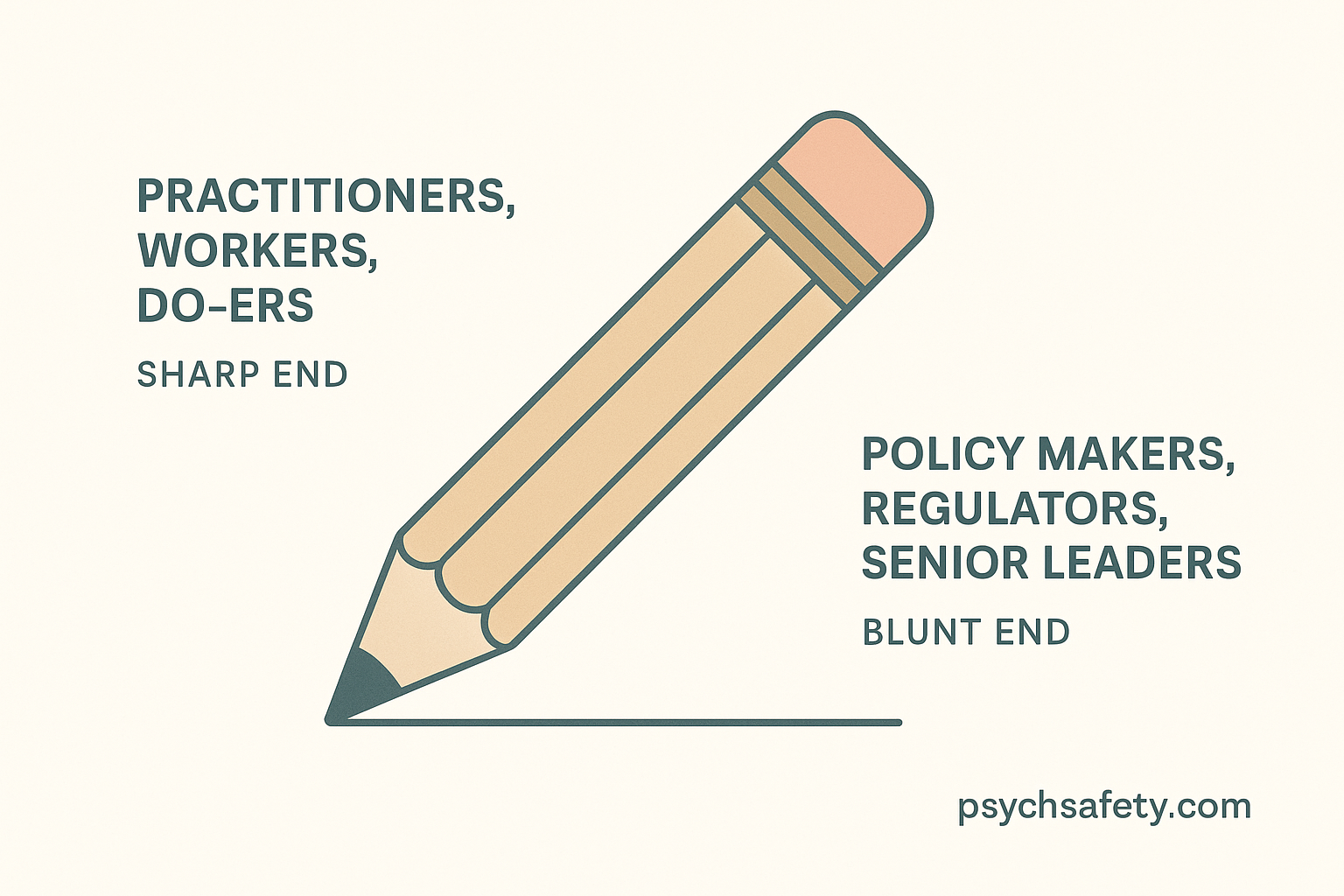
      The Sharp End & Blunt End of Education
      October 3, 2025
    • Forced Vulnerability
      Forced Vulnerability
      September 26, 2025
    • New Sticker Drop! "Zombies Are Scary"
      New Sticker Drop! "Zombies Are Scary"
      September 22, 2025
    • Reflections - Part Four: A Rights-Based Approach

      Reflections - Part Four: A Rights-Based Approach
      September 16, 2025
    • Reflections - Part Three: The Safety to Dissent
      Reflections - Part Three: The Safety to Dissent
      September 12, 2025
    • Reflections - Part Two: Power and Difference
      Reflections - Part Two: Power and Difference
      September 4, 2025
    • The Psychological Safety Trainer Toolkit
      The Psychological Safety Trainer Toolkit
      September 1, 2025
    • Reflections on Psychological Safety: Five Years of Learning
      Reflections on Psychological Safety: Five Years of Learning
      August 29, 2025
    • Not Feeling Seen: Eye Contact and Psychological Safety
      Not Feeling Seen: Eye Contact and Psychological Safety
      August 21, 2025
    • Psychological Safety Isn't Enough
      Psychological Safety Isn't Enough
      August 15, 2025
    • Psych Safety Day / Week 2026
      Psych Safety Day / Week 2026
      August 11, 2025
    • The Amagasaki Disaster
      The Amagasaki Disaster
      August 8, 2025
    • Psychological safety isn't the same for everyone
      Psychological safety isn't the same for everyone
      August 4, 2025
    • Psychological Safety Books for Children
      Psychological Safety Books for Children
      August 1, 2025
    • Psychological Safety and Creativity
      Psychological Safety and Creativity
      July 25, 2025
    • The State of Psychological Safety Survey: 2025
      The State of Psychological Safety Survey: 2025
      July 19, 2025
    • Barriers to Psychological Safety
      Barriers to Psychological Safety
      July 18, 2025
    • How you respond matters.
      How you respond matters.
      July 11, 2025
    • Practices that Foster Psychological Safety
      Practices that Foster Psychological Safety
      July 4, 2025
    • Feedback in the workplace
      Feedback in the workplace
      June 27, 2025
    • Psych Safety Day 2025
      Psych Safety Day 2025
      June 21, 2025
    • Job Security and Psychological Safety
      Job Security and Psychological Safety
      June 20, 2025
    • How familiar are people with the concept of psychological safety?
      How familiar are people with the concept of psychological safety?
      June 13, 2025
    • Learning at Psych Safety
      Learning at Psych Safety
      June 13, 2025
    • Why do We Foster Psychological Safety?
      Why do We Foster Psychological Safety?
      June 6, 2025
    • Psychological Safety in Aviation - Special Edition
      Psychological Safety in Aviation - Special Edition
      May 30, 2025
    • Rebuilding Psychological Safety When It's Broken
      Rebuilding Psychological Safety When It's Broken
      May 30, 2025
    • Just Culture
      Just Culture
      May 23, 2025
    • Transactional Analysis
      Transactional Analysis
      May 15, 2025
    • Comfort vs Need
      Comfort vs Need
      May 9, 2025
    • Sociological Safety
      Sociological Safety
      May 2, 2025
    • Humour and Psychological Safety
      Humour and Psychological Safety
      May 1, 2025
    • Safety-Organised Criticality
      Safety-Organised Criticality
      April 25, 2025
    • Leaders are not solely responsible for psychological safety.
      Leaders are not solely responsible for psychological safety.
      April 21, 2025
    • Psychological Safety in Our Personal Lives
      Psychological Safety in Our Personal Lives
      April 17, 2025
    • The Organisational Fabric of Psychological Safety
      The Organisational Fabric of Psychological Safety
      April 10, 2025
    • Colution
      April 7, 2025
    • All Feedback Is Subjective
      All Feedback Is Subjective
      April 4, 2025
    • Micromanagement
      Micromanagement
      March 21, 2025
    • Rewetting Organisations
      Rewetting Organisations
      March 14, 2025
    • Spectra of Participation
      Spectra of Participation
      March 7, 2025
    • Learning Types and Toxic Leadership
      Learning Types and Toxic Leadership
      February 28, 2025
    • Twitter
    • LinkedIn


Sign up to our newsletter & get weekly insights and research

About

The Psychological Safety Team
Our Mission
Our Core Principles
Privacy Policy
Terms of Business

Learn

Corporate Training
Online Workshops
Newsletter
Professional Certification

Tools

Tool Kits
Articles
What is Psychological Safety?
The History of Psychological Safety

Get Connected

Contact us
Attend a Meetup
Join the Community
Connect with us on LinkedIn
View our YouTube Channel
© 2025 Iterum Ltd
We support LGBTQ+ rights all year round. But we also celebrate pride too.
We support LGBTQ+ rights all year round. But we also celebrate pride!
Content on this website is CC BY-NC-SA
Written by humans, not by AI