

• Psychological Safety
  • Organisational Training
    • – Ignite: Senior Leaders
    • – Impact: Team Workshop
    • – Delivering Feedback
    • – Culture and Neurodiversity
    • – CRM for Non-Aviation Teams
    • – HOP: Human and Organisational Performance
    • – Train the Trainer
    • – Action Learning Sets
  • Online Workshops
    • – Train the Trainer
    • – Fundamentals
    • – Practices
    • – Leadership
    • – Advanced
    • – Measurement
    • – Workshop Facilitation
    • – HOP
    • – Delivering Feedback
    • – Thinking Like an Ecologist
  • Resources
    • – Tool Kits
    • – Free Resources
    • – Newsletter
    • – Articles
    • – Research
    • – Shop
    • – Community
    • – Practices
    • – What is Psychological Safety?
  • Measure Psychological Safety
  • About Us
  • Contact
  • Search
  • Org Training
    • Ignite for Senior Leaders
    • Impact Team Workshop
    • Management Masterclass
    • Delivering Effective Feedback
    • Cultural and Neurodiversity
    • HOP: Human and Organisational Performance
    • CRM for Non-Aviation Teams
    • Train the Trainer
    • Action Learning Sets
  • Live Workshops
    • Full Live Course
    • Psychological Safety Fundamentals
    • Practice Masterclass
    • Leadership & Management
    • Advanced Psychological Safety
    • Measuring Psychological Safety
    • Workshop Design and Facilitation
    • HOP Fundamentals
    • Delivering Effective Feedback
    • Thinking Like an Ecologist: A Field Guide for Organisational change
  • On-Demand
    • Psychological Safety 101
psych safety logo white
  • Resources
    • Measure Psychological Safety
    • Tool Kits
    • Free Resources
    • Newsletter
    • Shop
    • Podcasts & Talks
    • Videos
    • Community
    • Events & Psych Safety Days
    • The Field Guide
  • Articles
    • What is Psychological Safety?
    • The History of Psychological Safety
    • Psychological Safety Practices
    • Psychological Safety In The Workplace
    • Research
    • Human and Organisational Performance (HOP)
  • The Psych Safety Team
    • Contact Us
    • About The Team
    • Tom Geraghty
    • Jade Garratt
  • Org Training
    • Ignite for Senior Leaders
    • Impact Team Workshop
    • Management Masterclass
    • Delivering Effective Feedback
    • Cultural and Neurodiversity
    • HOP: Human and Organisational Performance
    • CRM for Non-Aviation Teams
    • Train the Trainer
    • Action Learning Sets
  • Live Workshops
    • Full Live Course
    • Psychological Safety Fundamentals
    • Practice Masterclass
    • Leadership & Management
    • Advanced Psychological Safety
    • Measuring Psychological Safety
    • Workshop Design and Facilitation
    • HOP Fundamentals
    • Delivering Effective Feedback
    • Thinking Like an Ecologist: A Field Guide for Organisational change
  • On-Demand
    • Psychological Safety 101
psych safety logo white
  • Resources
    • Measure Psychological Safety
    • Tool Kits
    • Free Resources
    • Newsletter
    • Shop
    • Podcasts & Talks
    • Videos
    • Community
    • Events & Psych Safety Days
    • The Field Guide
  • Articles
    • What is Psychological Safety?
    • The History of Psychological Safety
    • Psychological Safety Practices
    • Psychological Safety In The Workplace
    • Research
    • Human and Organisational Performance (HOP)
  • The Psych Safety Team
    • Contact Us
    • About The Team
    • Tom Geraghty
    • Jade Garratt
Create and Maintain  ·  Human and Organisational Performance (HOP)  ·  Newsletter  ·  Psychological Safety  ·  Psychological Safety In The Workplace

PACE: Graded Assertiveness

April 5, 2024 • by Tom Geraghty

Psychological safety is about creating a climate in which we feel able to take interpersonal risks in order to communicate our ideas, concerns and issues – and we want to be able to speak up in a way that we feel comfortable to. But that doesn’t mean we shouldn’t make an effort to articulate what we want to say in clear, accessible ways that allow the recipient to understand our intention and act on it appropriately. PACE was created as part of CRM, in response to disasters such as Tenerife in 1977.

We want to communicate in ways that give the recipient the best chance of hearing and understanding the message. So it’s important to avoid communicating in ways that can come off as aggressive or rude; partly because it’s good to be kind, but also because most of us struggle to receive information that’s delivered aggressively or harshly – we’re more likely to become defensive in those cases – hearing not *what* is said, but *how* it was said instead.

But sometimes time is of the essence, and we need to quickly communicate an important message. This can be especially challenging if we’re communicating with someone across a power gradient such as to a surgeon in an operating theatre or the captain in a cockpit of a passenger plane. How can we do this respectfully and effectively, ensuring our words have the intended impact?

PACE: Probe, Alert, Challenge, Emergency

One way is to use “graded assertiveness”, which there are various models for (including a good one called CUSS), but my personal favourite is PACE. PACE allows us to begin with a low-threat question (a “Probe”). This may well be enough to cause the recipient to pause, consider and adjust their course of action. If it’s not, we can incrementally escalate to higher levels of urgency and assertiveness. It also means that if we’re wrong about our concern, beginning with a simple probe reduces the interpersonal cost of that mistake, and poses less risk of causing a so-called “cry wolf” incident by going straight to emergency-level communication with a mistaken concern.

Using PACE, we first “Probe”, then “Alert”, then “Challenge” if necessary, and if we have to, we can resort to “Emergency”. I recently delivered a talk at a national highways safety conference, and introduced PACE as a method to effectively raise concerns to colleagues and peers as below:

PACE

As an example, let’s say Jane has noticed that her colleague, Bob, looks very tired and has already necked two cans of Red Bull. He has just climbed into the cab of his truck to begin a long journey. Jane believes that Bob is too tired to drive safely, and knows she should speak up, but wants to make sure the message is received well.

This is how Jane might use the PACE framework:

Probe – “Hey, Bob, you’ve got a long drive ahead, are you feeling rested enough to do this journey?”

Bob says he’s fine, and continues to prepare the cab of the truck, so Jane escalates to:

Alert – “Bob, I’m concerned that you might be too tired to complete this journey safely. Maybe you should take some time to rest before heading off.”

Of course, Bob wants to get cracking, so insists he’s ok and fires up the engine. Jane needs to make it clear that she’s not comfortable with Bob driving this tired, so moves to:

Challenge – “Wait Bob. I don’t think this is safe. Take a rest first.”

Bob’s lack of sleep is probably making him a bit irritable too, so he again dismisses Jane’s concern, and belts up ready to go. Jane knows this is her last chance to prevent a potential accident, so escalates to the emergency level:

Emergency – “Bob, STOP. You’re not safe to drive.”

At this point, there’s no ambiguity. Bob knows that he’s about to do something dangerous if he drives off, so stops the engine and gets out of the cab. Whilst Bob might be a little put out at having to rest before doing his drive, we’ve avoided potential disaster. 

PACE: Probe, Alert, Challenge, Emergency

Of course, hopefully in most situations, we don’t have to escalate all the way to Emergency. Probing in itself can be a very effective trigger to cause someone to consider their actions or pause long enough to check they’re safe. It can be any low threat question that raises the issue at hand:

  • “Are we on track with the patient’s breathing management?”
  • “Have we successfully executed all the integration tests on this code?”
  • “Do we have ATC clearance for departure?”

Alerting can take many forms too, and can be enough to prevent an incident. It’s where we clearly point out our concern:

  • “Oxygen is down to 90%.”
  • “This release hasn’t yet passed all the integration tests.”
  • “ATC say wait for clearance.”

Challenging someone in authority can itself be challenging, but knowing this framework and going through the steps can make it easier to do so, and bring a situation under control. For this, we clearly state the concern and suggest an action:

  • “This is the fourth attempt at intubation. We should ask for assistance now.” 
  • “Deploying this code now could saturate our load balancers and bring down the service. Let’s pause and run further tests.”
  • “We don’t have clearance. Hold position.”

And if these don’t work, we can escalate to the Emergency level, with an unambiguous, decisive and forceful command. This can be uncomfortable, but it is much easier to do if we’ve already taken the previous steps. This usually consists of a decisive “STOP. This isn’t safe.” or similar.

Advantages of PACE

The very existence of a framework like PACE signals to people that it’s ok, and even expected that we speak up before something reaches an emergency state. Of course there might be extreme time-critical situations in which we need to escalate straight to emergency, (if there’s a fire, it’s ok to shout “Fire! Everyone get out!“) but when there is time to make a more considered and graded intervention, PACE is an invaluable tool. 

Another distinct advantage of PACE is that once we’ve learned it, we may recognise when others are using it with us. That in itself is a powerful signal that they’re trying to draw our attention to something important, and we can catch it before they have to escalate to emergency communication.

Because it’s most valuable in crisis or pre-crisis situations, it’s best to try to make it second nature before you find yourself in those situations, so practise it in simulations with your team, or if that’s not possible, simply practise it yourself so that it comes more naturally should you need to employ it. You can also display it on posters and discuss it with colleagues to help others to adopt it. 

As a framework, PACE is used extensively in healthcare, aviation, maritime, and other domains. The PACE framework serves as a valuable tool for fostering psychological safety and effective communication about things that are important or safety-critical in high-stakes contexts. By structuring the escalation of concerns, PACE facilitates clear, respectful dialogue even across power gradients, and can significantly improve safety as well as day-to-day collaboration.

PACE: Graded Assertiveness


Further Links:
Psychological Safety: Structure and Power
Healthcare and CRM
Amplifying Weak Signals
Civility Saves Lives
Normalisation of Deviance
PSIRF in Healthcare
Speaking up at work
Psychological Safety in Aviation
Types of Human Error
The Andon Cord
Non-Violent Communication
Power over and power to


Psychological Safety in practice

Quality and Safety in Health and Care

The “Cambridge Elements” series of guides to key approaches to improving quality & safety in health & care are written by leading authors and open access. They offer a comprehensive and authoritative overview of various improvement approaches, exploring the thinking behind them, examining evidence for each approach, and identifying areas of debate.

Topics include Statistical process control (which we also covered in this newsletter issue), Health economics, Simulations, Positive Deviance and more. Element 7 on workplace conditions was written by the fabulous Jill Maben, Jane Ball and Amy Edmondson. Thanks to Mary Dixon-Woods for sharing.


Psychological Safety in Education

Our wonderful placement student Bea finished her placement last week, and we’re going to really miss her. After some great conversations about what psychological safety looks and feels like from a student perspective, she’s shared her own experiences in this fantastic article. It’s a personal reflection, but makes points which I suspect will resonate with student and teachers alike.


Error-catching Centaurs

This issue of Pluralistic by Cory Doctorow, on AI, is a great read, and relevant to many of us in the safety, performance and quality fields: Humans are not perfectly vigilant. Cory describes the idea of a “centaur”: a human head with a powerful robot body, which echoes the TPS concept of Jidoka; automation with a human touch. Centaurs, and the concept of Jidoka, make use of the strengths of humans to solve tricky problems and deal with complexity and uncertainty, whilst machines can do what humans are not good at – doing something the same way every time. This is also why we address automation and human factors in our psychological safety work – to foster cultures where we can identify and learn from mistakes, we must also implement systems that catch the errors that fallible humans inevitably make. 

However, Cory rightfully points out that with AI (well, LLMs really), it’s humans that have to be the error-detecting and correcting component. AIs are so prone to mistakes and hallucinations that it’s us humans that need to check it for accuracy. Instead of centaurs, we’ve created reverse centaurs that require us humans to check it for mistakes and errors, which is not something humans are generally good at. The solution to this, according to the AI firms currently burning through cash, is to add vastly more training data. But a lot of that training data (content on the internet) has, already, been created by AI’s (including their resultant mistakes and hallucinations), and this, I fear, is creating a feedback loop that will ultimately make AI tools only ever more confidently wrong.


Authoritarianism and Psychological Safety


Tim Harford’s Cautionary Tales might be the podcast I share most often because it’s not only excellent but covers stories and ideas that are core to this newsletter – learning from mistakes and the complex causes of disaster. This episode gets into salami-slicing, hypochondria and authoritarianism, and psychological safety, using the example of Paul O’Neill at Alcoa, in contrast to the authoritarian dictatorships of Stalin, and others.


Psychological Safety, DevOps and Agile

A while back, I had a wonderful conversation with John Ruppel for DASA and this is a write up of our conversation about psychological safety, DevOps & Agile. We covered loads of stuff, from unintended consequences to personal user manuals, and highlighted Weak Signals: “The concept of amplifying “weak signals” is a way to identify subtle signs of failure. Weak signals on their own may appear irrelevant or insignificant, but can actually signal much larger issues lurking – so creating the conditions and capabilities to detect and act on weak signals is key to success: and this requires psychological safety.”


This week’s poem:

Jerez at Easter, by Robert Bly

Please tell me why the lamb is in love with the wolf
And why the child’s finger calls the hammer down
And why at dusk Alexander walks toward his enemies.

Tell me why the gazelle grazes so close to the lion
And why the rat makes up games on the snake’s tail
And why the student bends his head when he’s attacked.

One meadow in the redwoods can contain a thousand ferns.
By this we deduce we are living in the serpent’s home.
Each curly fern is his tongue unfolding.

The poet makes a meadow from each leaf.
Each curve of language turns into a lamb’s ear,
Because a genius is a child in the house of suffering.

None of us is free from a certain bend in the knee.
The caws from the oak-bound ravens in the trees
Around our house guide Alexander toward the night.

The old man’s voice breaks as he sings at Easter.
In between the clapping, there’s always a voice breaking.
Last night in Jerez some people lived, some people died. 

See how this article connects
Explore its relationships with other ideas in the knowledge network.
Explore in network →

communicationcrmeducationHealthcarePractices that help foster psychological safetypsychological safetysafety

Tom Geraghty

Tom Geraghty, co-founder and organisational ecologist. Tom has previously held CTO roles in a range of sectors and holds a degree in Ecology, and postgraduate degrees in business and Global Health. Now studying for a PhD. Email tom@psychsafety.com

Related Articles


Newsletter  ·  Psychological Safety  ·  Psychological Safety In The Workplace
Flat Organisations, Hierarchy and Power
January 17, 2025
Human and organisational performance (HOP) core principles
Human and Organisational Performance (HOP)  ·  Newsletter  ·  Psychological Safety
The Core Principles of Human Organisational Performance
October 1, 2024
Socioeconomic background affects our appetite to take interpersonal risks at work.
Previous Article
psychological safety icebreakers
Icebreakers
Next Article
  • Subscribe to the Psychological Safety Newsletter

  • organisational training
  • Discover our training options for Human and Organisational Performance and CRM for non-aviation teams.

    If you're a trainer, consultant or facilitator, get certified in our Train the Trainer complete online programme and download the Training Materials for Facilitators and Trainers.

  • theres no such thing as too much psychological safety
    Grab Psychological Safety Stickers from our Online Shop!
  • psychological safety trainer toolkit
  • Psych Safety Day

    Find out more about our Psych Safety Days - in-person and virtual events.

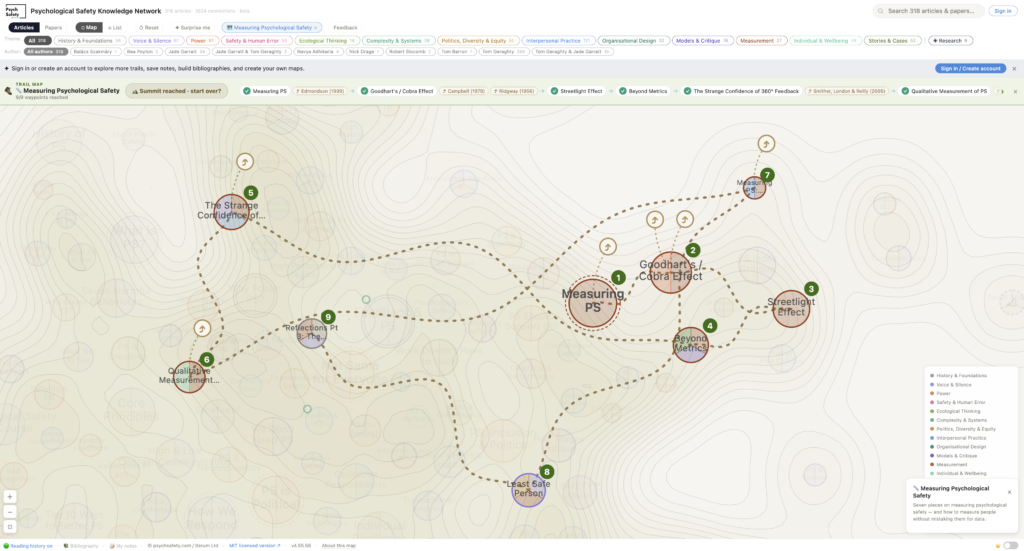
  • psych safety knowledge map measurement trail

    Use the Trail Guide to Psychological Safety to explore hundreds of articles, papers, resources and tools. 

  • Categories

    • Newsletter
    • Psychological Safety
      • Create and Maintain
      • Human and Organisational Performance (HOP)
      • In Technology
      • Learning and Development
      • Measure
      • Psychological Safety In The Workplace
      • Theory and Research
  • Recent Posts

    • The Case for Less Eye Contact
      The Case for Less Eye Contact
      September 11, 2026
    • New to psychological safety? Start here.
      New to psychological safety? Start here.
      September 8, 2026
    • The Organisational Substrate
      The Organisational Substrate
      September 1, 2026
    • Crisis-Ready Teams
      Crisis-Ready Teams
      August 27, 2026
    • Measuring psychological safety - the Psych Safety Survey Tool
      Measuring psychological safety - the Psych Safety Survey Tool
      August 25, 2026
    • Body Language and Non-Verbal Communication

      Body Language and Non-Verbal Communication
      August 20, 2026
    • The Four Stages of Psychological Safety: a Six-Stage Critique

      The Four Stages of Psychological Safety: a Six-Stage Critique
      August 7, 2026
    • Organisational Indicator Species: being an Organisational Ecologist

      Organisational Indicator Species: being an Organisational Ecologist
      August 6, 2026
    • Psych Safety Day / Week 2027
      Psych Safety Day / Week 2027
      August 4, 2026
    • Parachutes and “Evidence based” thinking

      Parachutes and “Evidence based” thinking
      July 31, 2026
    • The Psychological Safety Fieldbook
      The Psychological Safety Fieldbook
      July 31, 2026
    • Principles of Ethical Measurement in Organisations

      Principles of Ethical Measurement in Organisations
      July 10, 2026
    • Safety, Stat!
      Safety, Stat!
      June 26, 2026
    • The Strange Confidence of 360 Degree Feedback

      The Strange Confidence of 360 Degree Feedback
      June 25, 2026
    • Reading the air: high and low context communication in teams

      Reading the air: high and low context communication in teams
      June 8, 2026
    • Who gets to decide if psychological safety matters?
      Who gets to decide if psychological safety matters?
      June 5, 2026
    • Accountability
      Accountability
      May 29, 2026
    • Qualitative Measurement of Psychological Safety

      Qualitative Measurement of Psychological Safety
      May 22, 2026
    • The Field Guide to Psychological Safety
      The Field Guide to Psychological Safety
      May 15, 2026
    • Ambiguity, predictability, and psychological safety

      Ambiguity, predictability, and psychological safety
      May 1, 2026
    • The Calculus of Voice
      The Calculus of Voice
      April 23, 2026
    • Contracting and recontracting
      Contracting and recontracting
      April 16, 2026
    • The Vasa
      The Vasa
      April 1, 2026
    • Learning from Error, or Punishing It?
      Learning from Error, or Punishing It?
      March 27, 2026
    • The “Utility” of Psychological Safety
      The “Utility” of Psychological Safety
      March 20, 2026
    • Psychological Flexibility
      Psychological Flexibility
      March 19, 2026
    • Be soft to each other, and hard on the system

      Be soft to each other, and hard on the system
      March 12, 2026
    • "Fake it till you make it"
      "Fake it till you make it"
      March 12, 2026
    • The SANE Effect
      The SANE Effect
      February 20, 2026
    • Learning Teams
      Learning Teams
      January 30, 2026
    • The Tenerife Disaster of 1977: “We're Going”

      The Tenerife Disaster of 1977: “We're Going”
      January 23, 2026
    • ST.R.E.A.M: Status Rules Everything Around Me
      ST.R.E.A.M: Status Rules Everything Around Me
      January 23, 2026
    • Growth Mindset
      Growth Mindset
      January 16, 2026
    • The Streetlight Effect
      The Streetlight Effect
      January 8, 2026
    • The "Fist of Five"
      The "Fist of Five"
      December 19, 2025
    • Psychological Bravery
      Psychological Bravery
      December 18, 2025
    • Psych Safety Book List 2025
      Psych Safety Book List 2025
      December 18, 2025
    • Psych Safety 2025 Unwrapped
      Psych Safety 2025 Unwrapped
      December 15, 2025
    • Plan Continuation Bias
      Plan Continuation Bias
      December 12, 2025
    • Whistleblowing and Psychological Safety
      Whistleblowing and Psychological Safety
      December 4, 2025
    • How Childhood Socioeconomic Status Shapes Psychological Safety and Career Risk-Taking at Work
      How Childhood Socioeconomic Status Shapes Psychological Safety and Career Risk-Taking at Work
      November 27, 2025
    • Safety and the Myth of Self-Reliance
      Safety and the Myth of Self-Reliance
      November 24, 2025
    • The Watermelon Effect and "Greenwashing"

      The Watermelon Effect and "Greenwashing"
      November 7, 2025
    • Individual Resilience
      Individual Resilience
      October 31, 2025
    • Counterfactuals
      Counterfactuals
      October 24, 2025
    • Coaching and Psychological Safety
      Coaching and Psychological Safety
      October 17, 2025
    • Five Ecological Concepts for Working in Organisational Change

      Five Ecological Concepts for Working in Organisational Change
      October 9, 2025
    • The Sharp End & Blunt End of Education
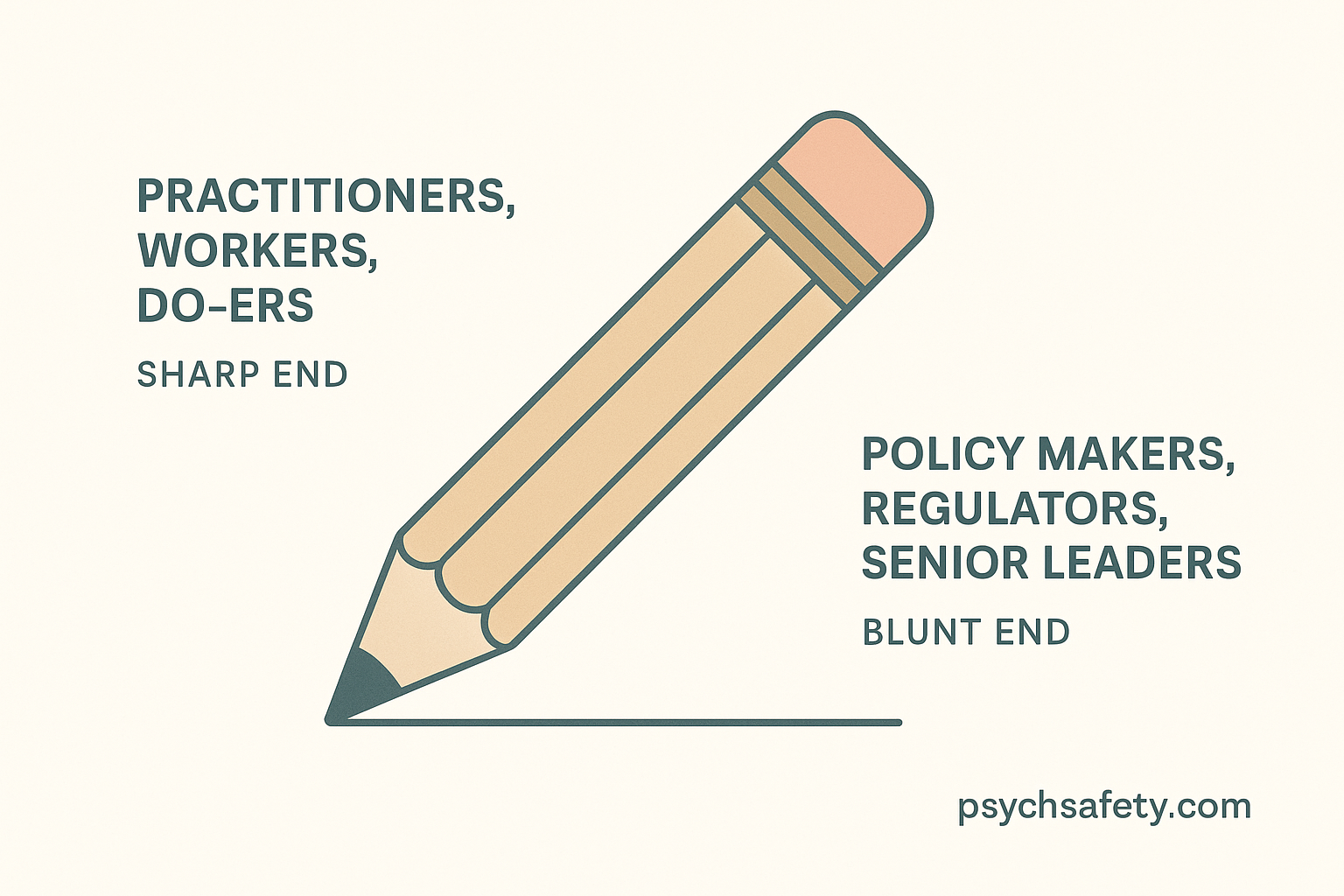
      The Sharp End & Blunt End of Education
      October 3, 2025
    • Forced Vulnerability
      Forced Vulnerability
      September 26, 2025
    • New Sticker Drop! "Zombies Are Scary"
      New Sticker Drop! "Zombies Are Scary"
      September 22, 2025
    • Reflections - Part Four: A Rights-Based Approach

      Reflections - Part Four: A Rights-Based Approach
      September 16, 2025
    • Reflections - Part Three: The Safety to Dissent
      Reflections - Part Three: The Safety to Dissent
      September 12, 2025
    • Reflections - Part Two: Power and Difference
      Reflections - Part Two: Power and Difference
      September 4, 2025
    • The Psychological Safety Trainer Toolkit
      The Psychological Safety Trainer Toolkit
      September 1, 2025
    • Reflections on Psychological Safety: Five Years of Learning
      Reflections on Psychological Safety: Five Years of Learning
      August 29, 2025
    • Twitter
    • LinkedIn


Sign up to our newsletter & get weekly insights and research

About

The Psych Safety™ Team
Our Mission
Our Core Principles
Privacy Policy
Terms of Business

Learn

Corporate Training
Online Workshops
Newsletter
Professional Certification
Explore our semantic knowledge map

Tools

Tool Kits
Articles
What is Psychological Safety?
The History of Psychological Safety

Get Connected

Contact us
Attend a Meetup
Join the Community
Connect with us on LinkedIn
View our YouTube Channel
© Iterum Ltd. Psych Safety™ is an unregistered trade mark of Iterum Ltd.
We support LGBTQ+ rights all year round. But we also celebrate pride too.
We support LGBTQ+ rights all year round. But we also celebrate pride!
Content on this website is CC BY-NC-SA
Written by humans, not by AI