

• Psychological Safety
  • Organisational Training
    • – Ignite: Senior Leaders
    • – Impact: Team Workshop
    • – Delivering Feedback
    • – Culture and Neurodiversity
    • – CRM for Non-Aviation Teams
    • – HOP: Human and Organisational Performance
    • – Train the Trainer
    • – Action Learning Sets
  • Online Workshops
    • – Train the Trainer
    • – Fundamentals
    • – Practices
    • – Leadership
    • – Advanced
    • – Measurement
    • – Workshop Facilitation
    • – HOP
    • – Delivering Feedback
    • – Thinking Like an Ecologist
  • Resources
    • – Tool Kits
    • – Free Resources
    • – Newsletter
    • – Articles
    • – Research
    • – Shop
    • – Community
    • – Practices
    • – What is Psychological Safety?
  • Measure Psychological Safety
  • About Us
  • Contact
  • Search
  • Org Training
    • Ignite for Senior Leaders
    • Impact Team Workshop
    • Management Masterclass
    • Delivering Effective Feedback
    • Cultural and Neurodiversity
    • HOP: Human and Organisational Performance
    • CRM for Non-Aviation Teams
    • Train the Trainer
    • Action Learning Sets
  • Live Workshops
    • Full Live Course
    • Psychological Safety Fundamentals
    • Practice Masterclass
    • Leadership & Management
    • Advanced Psychological Safety
    • Measuring Psychological Safety
    • Workshop Design and Facilitation
    • HOP Fundamentals
    • Delivering Effective Feedback
    • Thinking Like an Ecologist: A Field Guide for Organisational change
  • On-Demand
    • Psychological Safety 101
psych safety logo white
  • Resources
    • Measure Psychological Safety
    • Tool Kits
    • Free Resources
    • Newsletter
    • Shop
    • Podcasts & Talks
    • Videos
    • Community
    • Events & Psych Safety Days
    • The Field Guide
  • Articles
    • What is Psychological Safety?
    • The History of Psychological Safety
    • Psychological Safety Practices
    • Psychological Safety In The Workplace
    • Research
    • Human and Organisational Performance (HOP)
  • The Psych Safety Team
    • Contact Us
    • About The Team
    • Tom Geraghty
    • Jade Garratt
  • Org Training
    • Ignite for Senior Leaders
    • Impact Team Workshop
    • Management Masterclass
    • Delivering Effective Feedback
    • Cultural and Neurodiversity
    • HOP: Human and Organisational Performance
    • CRM for Non-Aviation Teams
    • Train the Trainer
    • Action Learning Sets
  • Live Workshops
    • Full Live Course
    • Psychological Safety Fundamentals
    • Practice Masterclass
    • Leadership & Management
    • Advanced Psychological Safety
    • Measuring Psychological Safety
    • Workshop Design and Facilitation
    • HOP Fundamentals
    • Delivering Effective Feedback
    • Thinking Like an Ecologist: A Field Guide for Organisational change
  • On-Demand
    • Psychological Safety 101
psych safety logo white
  • Resources
    • Measure Psychological Safety
    • Tool Kits
    • Free Resources
    • Newsletter
    • Shop
    • Podcasts & Talks
    • Videos
    • Community
    • Events & Psych Safety Days
    • The Field Guide
  • Articles
    • What is Psychological Safety?
    • The History of Psychological Safety
    • Psychological Safety Practices
    • Psychological Safety In The Workplace
    • Research
    • Human and Organisational Performance (HOP)
  • The Psych Safety Team
    • Contact Us
    • About The Team
    • Tom Geraghty
    • Jade Garratt
Newsletter  ·  Psychological Safety  ·  Psychological Safety In The Workplace

The HiPPO

July 4, 2024 • by Tom Geraghty

The Highest Paid Person’s Opinion.

One of the (many) barriers to speaking up is the knowledge or perception that your voice doesn’t carry as much weight as someone else’s. This can be particularly common when in the presence of those who are higher up in the formal or organisational hierarchy. Sometimes it can feel as if there’s not much point even engaging because it will only be the Highest Paid Person’s Opinion, or HiPPO, that counts.

Also known as authority bias, whatever this person says is given extra credence and importance because of their status. And this can happen even if those “lower down” have greater expertise and experience on the matter. This dynamic is a corollary of the effect that power can have on psychological safety: that people are less likely to speak up against a power gradient.


Photo by Stefan Steinbauer on Unsplash

The HiPPO effect can be at play even in the most throwaway comments. I was once chatting to a CEO who experienced how cautious they needed to be about this first hand: shortly after becoming CEO, they visited a regional office and noticed the decor was a little subdued. They made an off the cuff comment about how nice it would be if the walls were colourful, maybe pink. They were really just making small talk, but the next time they visited, they found all the walls had been painted pink. Not necessarily a problem in this instance – pink walls are arguably pretty harmless – but worth bearing in mind that too much weight can be ascribed to the HiPPO. 

I’ve found myself both a victim of the HiPPO and in the HiPPO position myself before, and neither are healthy for a team or organisation. 

Ways to counter the HiPPO:

  1. Acknowledge the HiPPO in the room – use the term “HiPPO” to name the problem, so that you can be explicit about your intention not to fall into that trap.
  2. Probe when you suspect it might be at play – are we at risk of just going with the HiPPO here? Is there a bit of a HiPPO phenomenon at play? If you’re the HiPPO, you’re even better placed to call this out. 
  3. In a discussion, invite and record all people’s contributions before getting into any kind of back and forth as to which to go with.
  4. Take time to map out not only what people have said but also what unique perspective they have on the matter – e.g. do they work most closely with this client? Have they had the most hands-on experience of delivering a similar objective? Have they worked in another organisation that did a similar thing?
  5. When you find yourself going with the HiPPO, stop and ask, why are we doing this? What’s our rationale? Challenge any assumptions that it’s the right thing to do simply because the authority figure said so, and make sure the decision is a sound one on the basis of all the available information.

It’s important to take explicit measures to counteract the HiPPO, but the first thing to do is acknowledge that it exists.

Further reading

Psychological Safety: Structure and Power
How to Run Psychologically Safe Meetings
PACE: Graded Assertiveness
Power and Psychological Safety
Seven Examples of Damaging Psychological Safety in The Workplace


Psychological Safety in Practice

To err is human. To blame someone else is politics.

We’re out in NYC right now, having a few meetings and doing some research on potential workshop locations. I saw this excellent sticker of a Hubert Humphrey quote on a post box in Greenpoint, Brooklyn. “To err is human. To blame someone else is politics.“

And I’m super happy to share this, thanks to my doppelgänger Pete Rushmer for inviting me onto his “A half dozen things” podcast where we talked all things psychological safety, and in particular how organisational values and principles might always align with the espoused and lived values of the people within it. 


This week’s poem:

Hidden Things, by C. P. Cavafy (translated by Edmund Keeley and Philip Sherrard)

From all I did and all I said
let no one try to find out who I was.
An obstacle was there distorting
the actions and the manner of my life.
An obstacle was often there
to stop me when I’d begin to speak.
From my most unnoticed actions,
my most veiled writing—
from these alone will I be understood.
But maybe it isn’t worth so much concern,
so much effort to discover who I really am.
Later, in a more perfect society,
someone else made just like me
is certain to appear and act freely. Inspired by this mural that we spotted in at National Sawdust, Brooklyn, NY.

See how this article connects
Explore its relationships with other ideas in the knowledge network.
Explore in network →

HiPPOinclusionPractices that help foster psychological safetypsychological safety

Tom Geraghty

Tom Geraghty, co-founder and organisational ecologist. Tom has previously held CTO roles in a range of sectors and holds a degree in Ecology, and postgraduate degrees in business and Global Health. Now studying for a PhD. Email tom@psychsafety.com

Related Articles


Newsletter  ·  Psychological Safety
Psychological Safety: Fuck-ups and Feedback
January 21, 2022
Logo for the action pack - building and maintaining psychological safety for your team
Newsletter
Psychological Safety #8: Resilience Engineering and Building Communities
April 16, 2021
psychological safety and wellbeing
Psychological Safety And Wellbeing
Previous Article
Provisional Model for the Emergence and Temporal Dynamics of Psychological Safety
The Emergence and Dynamics of Psychological Safety Over Time
Next Article
  • Subscribe to the Psychological Safety Newsletter

  • organisational training
  • Discover our training options for Human and Organisational Performance and CRM for non-aviation teams.

    If you're a trainer, consultant or facilitator, get certified in our Train the Trainer complete online programme and download the Training Materials for Facilitators and Trainers.

  • measure psychological safety
  • theres no such thing as too much psychological safety
    Grab Psychological Safety Stickers from our Online Shop!
  • psychological safety trainer toolkit
  • Psych Safety Day

    Find out more about our Psych Safety Days - in-person and virtual events.

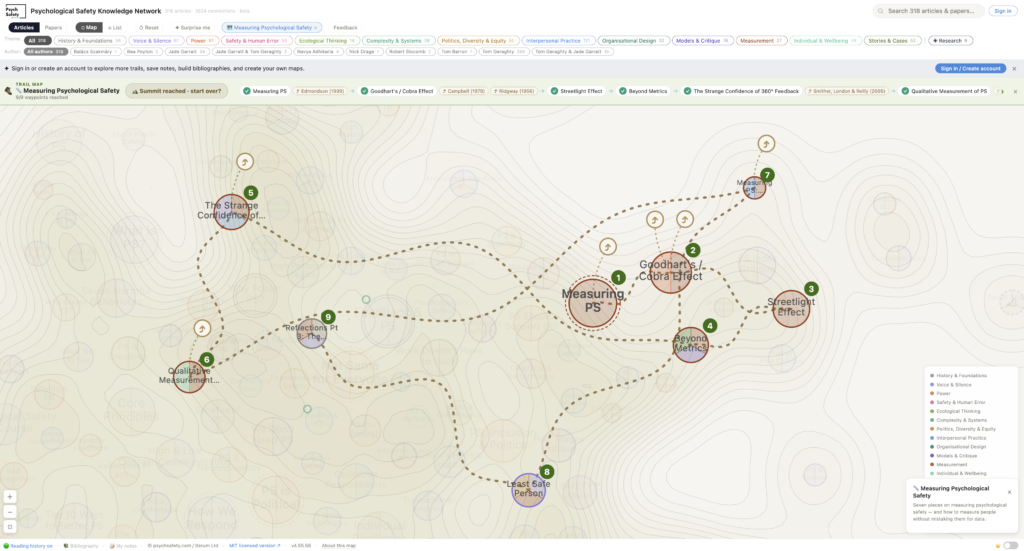
  • psych safety knowledge map measurement trail

    Use the Trail Guide to Psychological Safety to explore hundreds of articles, papers, resources and tools. 

  • Categories

    • Newsletter
    • Psychological Safety
      • Create and Maintain
      • Human and Organisational Performance (HOP)
      • In Technology
      • Learning and Development
      • Measure
      • Psychological Safety In The Workplace
      • Theory and Research
  • Recent Posts

    • Measure Psychological Safety - The Platform
      Measure Psychological Safety - The Platform
      October 13, 2026
    • Mistaks we've made (so far)
      Mistaks we've made (so far)
      October 7, 2026
    • The Case for Less Eye Contact
      The Case for Less Eye Contact
      September 11, 2026
    • New to psychological safety? Start here.
      New to psychological safety? Start here.
      September 8, 2026
    • The Organisational Substrate
      The Organisational Substrate
      September 1, 2026
    • Crisis-Ready Teams
      Crisis-Ready Teams
      August 27, 2026
    • Measuring psychological safety - the Psych Safety Survey Tool
      Measuring psychological safety - the Psych Safety Survey Tool
      August 25, 2026
    • Body Language and Non-Verbal Communication

      Body Language and Non-Verbal Communication
      August 20, 2026
    • The Four Stages of Psychological Safety: a Six-Stage Critique

      The Four Stages of Psychological Safety: a Six-Stage Critique
      August 7, 2026
    • Organisational Indicator Species: being an Organisational Ecologist

      Organisational Indicator Species: being an Organisational Ecologist
      August 6, 2026
    • Psych Safety Day / Week 2027
      Psych Safety Day / Week 2027
      August 4, 2026
    • Parachutes and “Evidence based” thinking

      Parachutes and “Evidence based” thinking
      July 31, 2026
    • The Psychological Safety Fieldbook
      The Psychological Safety Fieldbook
      July 31, 2026
    • Principles of Ethical Measurement in Organisations

      Principles of Ethical Measurement in Organisations
      July 10, 2026
    • Safety, Stat!
      Safety, Stat!
      June 26, 2026
    • The Strange Confidence of 360 Degree Feedback

      The Strange Confidence of 360 Degree Feedback
      June 25, 2026
    • Reading the air: high and low context communication in teams

      Reading the air: high and low context communication in teams
      June 8, 2026
    • Who gets to decide if psychological safety matters?
      Who gets to decide if psychological safety matters?
      June 5, 2026
    • Accountability
      Accountability
      May 29, 2026
    • Qualitative Measurement of Psychological Safety

      Qualitative Measurement of Psychological Safety
      May 22, 2026
    • The Field Guide to Psychological Safety
      The Field Guide to Psychological Safety
      May 15, 2026
    • Ambiguity, predictability, and psychological safety

      Ambiguity, predictability, and psychological safety
      May 1, 2026
    • The Calculus of Voice
      The Calculus of Voice
      April 23, 2026
    • Contracting and recontracting
      Contracting and recontracting
      April 16, 2026
    • The Vasa
      The Vasa
      April 1, 2026
    • Learning from Error, or Punishing It?
      Learning from Error, or Punishing It?
      March 27, 2026
    • The “Utility” of Psychological Safety
      The “Utility” of Psychological Safety
      March 20, 2026
    • Psychological Flexibility
      Psychological Flexibility
      March 19, 2026
    • Be soft to each other, and hard on the system

      Be soft to each other, and hard on the system
      March 12, 2026
    • "Fake it till you make it"
      "Fake it till you make it"
      March 12, 2026
    • The SANE Effect
      The SANE Effect
      February 20, 2026
    • Learning Teams
      Learning Teams
      January 30, 2026
    • The Tenerife Disaster of 1977: “We're Going”

      The Tenerife Disaster of 1977: “We're Going”
      January 23, 2026
    • ST.R.E.A.M: Status Rules Everything Around Me
      ST.R.E.A.M: Status Rules Everything Around Me
      January 23, 2026
    • Growth Mindset
      Growth Mindset
      January 16, 2026
    • The Streetlight Effect
      The Streetlight Effect
      January 8, 2026
    • The "Fist of Five"
      The "Fist of Five"
      December 19, 2025
    • Psychological Bravery
      Psychological Bravery
      December 18, 2025
    • Psych Safety Book List 2025
      Psych Safety Book List 2025
      December 18, 2025
    • Psych Safety 2025 Unwrapped
      Psych Safety 2025 Unwrapped
      December 15, 2025
    • Plan Continuation Bias
      Plan Continuation Bias
      December 12, 2025
    • Whistleblowing and Psychological Safety
      Whistleblowing and Psychological Safety
      December 4, 2025
    • How Childhood Socioeconomic Status Shapes Psychological Safety and Career Risk-Taking at Work
      How Childhood Socioeconomic Status Shapes Psychological Safety and Career Risk-Taking at Work
      November 27, 2025
    • Safety and the Myth of Self-Reliance
      Safety and the Myth of Self-Reliance
      November 24, 2025
    • The Watermelon Effect and "Greenwashing"

      The Watermelon Effect and "Greenwashing"
      November 7, 2025
    • Individual Resilience
      Individual Resilience
      October 31, 2025
    • Counterfactuals
      Counterfactuals
      October 24, 2025
    • Coaching and Psychological Safety
      Coaching and Psychological Safety
      October 17, 2025
    • Five Ecological Concepts for Working in Organisational Change

      Five Ecological Concepts for Working in Organisational Change
      October 9, 2025
    • The Sharp End & Blunt End of Education
      The Sharp End & Blunt End of Education
      October 3, 2025
    • Forced Vulnerability
      Forced Vulnerability
      September 26, 2025
    • New Sticker Drop! "Zombies Are Scary"
      New Sticker Drop! "Zombies Are Scary"
      September 22, 2025
    • Reflections - Part Four: A Rights-Based Approach

      Reflections - Part Four: A Rights-Based Approach
      September 16, 2025
    • Reflections - Part Three: The Safety to Dissent
      Reflections - Part Three: The Safety to Dissent
      September 12, 2025
    • Reflections - Part Two: Power and Difference
      Reflections - Part Two: Power and Difference
      September 4, 2025
    • Twitter
    • LinkedIn


Sign up to our newsletter & get weekly insights and research

About

The Psych Safety™ Team
Our Mission
Our Core Principles
Privacy Policy
Terms of Business

Learn

Corporate Training
Online Workshops
Newsletter
Professional Certification
Explore our semantic knowledge map

Tools

Tool Kits
Articles
What is Psychological Safety?
The History of Psychological Safety

Get Connected

Contact us
Attend a Meetup
Join the Community
Connect with us on LinkedIn
View our YouTube Channel
© Iterum Ltd. Psych Safety™ is an unregistered trade mark of Iterum Ltd.
We support LGBTQ+ rights all year round. But we also celebrate pride too.
We support LGBTQ+ rights all year round. But we also celebrate pride!
Content on this website is CC BY-NC-SA
Written by humans, not by AI