

• Psychological Safety
  • Organisational Training
    • – Ignite: Senior Leaders
    • – Impact: Team Workshop
    • – Delivering Feedback
    • – CRM for Non-Aviation Teams
    • – HOP: Human and Organisational Performance
  • Online Workshops
    • – Train the Trainer
    • – Fundamentals
    • – Practices
    • – Leadership
    • – Advanced
    • – Measurement
    • – Workshop Facilitation
    • – HOP
    • – Delivering Feedback
  • Resources
    • – Tool Kits
    • – Free Resources
    • – Newsletter
    • – Articles
    • – Research
    • – Shop
    • – Community
    • – Practices
    • – What is Psychological Safety?
  • About Us
  • Contact
  • Search
  • Tool Kits
    • Action Pack
    • Trainer Toolkit
    • Practitioner Bundle
    • Practice Playbook: Feedback​
    • Practice Playbook: Technology​
    • Practice Playbook: Inclusion​
    • Practice Playbook: Education​
    • Practice Playbook: Healthcare​
  • Organisational Training
    • Ignite for Senior Leaders
    • Impact Team Workshop
    • Management Masterclass
    • Delivering Effective Feedback
    • HOP: Human and Organisational Performance
    • CRM for Non-Aviation Teams
    • Train the Trainer
  • Online Workshops
    • Complete Online Course
    • Psychological Safety Fundamentals
    • Practice Masterclass
    • Leadership & Management
    • Advanced Psychological Safety
    • Measuring Psychological Safety
    • Workshop Design and Facilitation
    • HOP Fundamentals
    • Delivering Effective Feedback
psych safety logo white
  • Resources
    • Tool Kits
    • Free Resources
    • Newsletter
    • Research
    • Shop
    • Podcasts & Talks
    • Videos
    • Community
    • Events & Psych Safety Days
  • Articles
    • Search
    • What is Psychological Safety?
    • The History of Psychological Safety
    • Psychological Safety Practices
    • Psychological Safety In The Workplace
    • Research
    • Measure Psychological Safety
    • Human Organisational Performance (HOP)
  • The Psych Safety Team
    • Contact Us
    • About The Team
    • Tom Geraghty
    • Jade Garratt
  • Tool Kits
    • Action Pack
    • Trainer Toolkit
    • Practitioner Bundle
    • Practice Playbook: Feedback​
    • Practice Playbook: Technology​
    • Practice Playbook: Inclusion​
    • Practice Playbook: Education​
    • Practice Playbook: Healthcare​
  • Organisational Training
    • Ignite for Senior Leaders
    • Impact Team Workshop
    • Management Masterclass
    • Delivering Effective Feedback
    • HOP: Human and Organisational Performance
    • CRM for Non-Aviation Teams
    • Train the Trainer
  • Online Workshops
    • Complete Online Course
    • Psychological Safety Fundamentals
    • Practice Masterclass
    • Leadership & Management
    • Advanced Psychological Safety
    • Measuring Psychological Safety
    • Workshop Design and Facilitation
    • HOP Fundamentals
    • Delivering Effective Feedback
psych safety logo white
  • Resources
    • Tool Kits
    • Free Resources
    • Newsletter
    • Research
    • Shop
    • Podcasts & Talks
    • Videos
    • Community
    • Events & Psych Safety Days
  • Articles
    • Search
    • What is Psychological Safety?
    • The History of Psychological Safety
    • Psychological Safety Practices
    • Psychological Safety In The Workplace
    • Research
    • Measure Psychological Safety
    • Human Organisational Performance (HOP)
  • The Psych Safety Team
    • Contact Us
    • About The Team
    • Tom Geraghty
    • Jade Garratt
Human Organisational Performance (HOP)  ·  Newsletter  ·  Psychological Safety In The Workplace

Safe To Fail Experiments

May 26, 2023

What is “Safe to Fail”?

Recently, I failed a motorbike test. This might sound like a mistake, but I fully expected to fail. In the UK, you must pass multiple tests before you’re allowed out on the roads on a motorbike, and one involves a number of fast and slow manoeuvres in a test area, away from public roads.  

This test itself takes about 30 minutes and is rather cheap to do. Lessons, on the other hand, are expensive! In order to best prepare for the test in the future, what better way than to have an attempt at one without any expectation to pass? In this case, there were no negative consequences of failure, only learning: I got feedback on the errors you made and where I could improve. And I got first-hand experience of the test, without the pressure of feeling like I should pass (I figured that if I somehow passed, it would simply be a bonus!).


Safe to fail experiments

In this sense, the test was a “safe to fail” experiment. There is great power in defining what is “safe to fail”, because it helps us shape our efforts and experiments so that we can gain maximum learning at minimal cost of failure. In our workshops with teams, defining what is safe-to-fail is a core part of improving performance and making it safer to take intelligent risks.

In the Technology Team Practice Playbook, we also include a “safe to fail” canvas to help you shape experiments and minimise the impact of failure. It’s not just a practice for technology teams though!

On the theme of making intentional mistakes, or at least running safe-to-fail experiments, at home, we’re currently reading one idea each night from this book called “How To Live” by Derek Sivers. It’s a fascinating and rather poetic exploration of 27 different ways to live a life, from being a pioneer or letting random chance decide your path, to being devoutly religious. My personal favourite so far has been “making a million mistakes”. I’m summarising some of Derek’s key ideas from it here:

  • Always learn from your mistakes. Keep a log of them.
  • Make deliberate mistakes.
  • Aim high, be prepared to make big mistakes – some of them might even work.
  • Try to be wrong: look for lessons that surprise you and disprove your existing beliefs.
  • Create predicaments and get into good trouble.
  • If you’re never wrong, you never change. Keep making mistakes, so you keep changing, learning and growing.
  • Share your stories from your mistakes for the benefit of others.
  • Even a plane crash makes the next one less likely.


What safe-to-fail experiments could you take? How could you make some of your existing goals safe-to-fail?


Psychological safety at work:


I’ve just watched “Working: What We Do All Day” on Netflix, and I absolutely loved it. Hosted by Barack Obama, this short series looks at three different industries: home care, tech, and hospitality, following the experiences of 12 different people. A number of things really stood out to me, including the dramatic income gap between those at the frontline of work and those in senior leadership or highly specialised knowledge roles. It was also fascinating to see the positive impact of employment law, unions, and social security safety nets on people’s work experience. Well worth a watch – catch the trailer here.

I was honoured to be asked to join Bala on his excellent podcast “Agility Awakenings”. We really got into it, and discussed complexity, systems thinking, and psychological safety frameworks – the difference between theoretical and practical frameworks, and whether we need any more theoretical frameworks of psychological safety!


I love this toxic leadership cartoon from Wumo, and thanks to Balazs for sharing it with me!

In a recent Rebranding Safety podcast, we discussed “banter” in the workplace, and this study from Irwin Mitchell highlights that it’s a bigger problem than we may have thought: around a third of people have experienced bullying in the workplace disguised as (or intended to be) “banter”.

Last week, I shared that Elita Silva had translated my leadership vs management graphic into Portuguese, and this week, the fabulous Ana Aneiros Vivas, Safety Culture Consultant has translated it into Spanish!

Thanks so much to the awesome Cherisa Zafft for facilitating this week’s psychological safety meetup, and all the wonderful people who attended. It was fab; we had some great conversations and I learned a lot from the amazing folks there. You can listen to Cherisa’s summary of the event in this awesome video, and check out the great wordcloud below that we generated in the meetup 🙂


This week’s poem:

The Hill We Climb, by Amanda Gorman

When day comes, we ask ourselves where can we find light in this never-ending shade?
The loss we carry, a sea we must wade.
We’ve braved the belly of the beast.
We’ve learned that quiet isn’t always peace,
and the norms and notions of what “just” is isn’t always justice.
And yet, the dawn is ours before we knew it.
Somehow we do it.
Somehow we’ve weathered and witnessed a nation that isn’t broken,
but simply unfinished.
We, the successors of a country and a time where a skinny Black girl descended from slaves and raised by a single mother can dream of becoming president, only to find herself reciting for one.

‘Never been more optimistic’: speeches, songs and celebrations cap Biden’s inauguration day – as it happened
Read more
And yes, we are far from polished, far from pristine,
but that doesn’t mean we are striving to form a union that is perfect.
We are striving to forge our union with purpose.
To compose a country committed to all cultures, colors, characters, and conditions of man.
And so we lift our gazes not to what stands between us, but what stands before us.
We close the divide because we know, to put our future first, we must first put our differences aside.
We lay down our arms so we can reach out our arms to one another.
We seek harm to none and harmony for all.
Let the globe, if nothing else, say this is true:
That even as we grieved, we grew.
That even as we hurt, we hoped.
That even as we tired, we tried.
That we’ll forever be tied together, victorious.
Not because we will never again know defeat, but because we will never again sow division.

Scripture tells us to envision that everyone shall sit under their own vine and fig tree and no one shall make them afraid.
If we’re to live up to our own time, then victory won’t lie in the blade, but in all the bridges we’ve made.
That is the promise to glade, the hill we climb, if only we dare.
It’s because being American is more than a pride we inherit.
It’s the past we step into and how we repair it.
We’ve seen a force that would shatter our nation rather than share it.
Would destroy our country if it meant delaying democracy.
This effort very nearly succeeded.
But while democracy can be periodically delayed,
it can never be permanently defeated.
In this truth, in this faith, we trust,
for while we have our eyes on the future, history has its eyes on us.
This is the era of just redemption.
We feared it at its inception.
We did not feel prepared to be the heirs of such a terrifying hour,
but within it, we found the power to author a new chapter, to offer hope and laughter to ourselves.
So while once we asked, ‘How could we possibly prevail over catastrophe?’ now we assert, ‘How could catastrophe possibly prevail over us?’

We will not march back to what was, but move to what shall be:
A country that is bruised but whole, benevolent but bold, fierce and free.
We will not be turned around or interrupted by intimidation because we know our inaction and inertia will be the inheritance of the next generation.
Our blunders become their burdens.
But one thing is certain:
If we merge mercy with might, and might with right, then love becomes our legacy and change, our children’s birthright.

So let us leave behind a country better than the one we were left.
With every breath from my bronze-pounded chest, we will raise this wounded world into a wondrous one.
We will rise from the golden hills of the west.
We will rise from the wind-swept north-east where our forefathers first realized revolution.
We will rise from the lake-rimmed cities of the midwestern states.
We will rise from the sun-baked south.
We will rebuild, reconcile, and recover.
In every known nook of our nation, in every corner called our country,
our people, diverse and beautiful, will emerge, battered and beautiful.
When day comes, we step out of the shade, aflame and unafraid.
The new dawn blooms as we free it.
For there is always light,
if only we’re brave enough to see it.
If only we’re brave enough to be it.


Amanda Gorman’s amazing poem that she read at Joe Biden’s inauguration has been restricted at a Florida school, and will now only be accessible to middle school students at the Bob Graham Education Center in Miami Lakes, Florida.


failurelearningperformancePractices that help foster psychological safetypsychological safety

Tom Geraghty

Tom Geraghty, co-founder and delivery lead at Iterum Ltd, is an expert in high performing teams and psychological safety. Leveraging his unique background in ecological research and technology, Tom has held CIO/CTO roles in a range of sectors from tech startups to global finance firms. He holds a degree in Ecology, an MBA, and a Masters in Global Health. His mission is to make workplaces safer, higher performing, and more inclusive. Tom has shared his insights at major events such as The IT Leaders Summit, the NHS Senior Leadership Conference, and EHS Global Conferences. Connect with him on LinkedIn or email tom@psychsafety.com

Related Articles


Everything is an experiment poster
Learning and Development  ·  Psychological Safety  ·  Psychological Safety In The Workplace
Psychological Safety Poster Pack
September 21, 2020
psychological safety playbooks
Human Organisational Performance (HOP)  ·  Newsletter
Psychological Safety & High-Performing Teams
June 1, 2023
someone climbing and being belayed by someone else
How to Foster Psychological Safety: Behaviours
Previous Article
psychological safety playbooks
Psychological Safety & High-Performing Teams
Next Article
  • Subscribe to the Psychological Safety Newsletter

  • psychological safety train the trainer
  • Get Certified! Join online workshops, or explore training and consultancy for leaders, teams and organisations.

    Discover our training options for Human and Organisational Performance and CRM for non-aviation teams.

    If you're a trainer, consultant or facilitator, get certified in our Train the Trainer complete online programme and download the Training Materials for Facilitators and Trainers.

  • human and organisational performance training
  • building and maintaining psychological safety for your team
    Download the complete Practitioners' guide to psychological safety
  • psychological safety trainer toolkit
  • Download the Psychological Safety Trainer Toolkit. Containing powerful resources that you can use to deliver your own training and workshops!

  • psych safety logo

    Sponsorship and advertising. Reach over 11,000 weekly readers and 500,000 online visitors with your message in our newsletter.

  • theres no such thing as too much psychological safety
    Grab Psychological Safety Stickers from our Online Shop!
  • Psych Safety Day

    Find out more about our Psych Safety Days - in-person and virtual events to share, learn, and connect with other enthusiasts, practitioners and researchers on psychological safety and related topics.

  • Categories

    • Newsletter
    • Psychological Safety
      • Create and Maintain
      • Human Organisational Performance (HOP)
      • In Technology
      • Learning and Development
      • Measure
      • Psychological Safety In The Workplace
      • Theory and Research
    • Random
  • Recent Posts

    • The "Fist of Five"
      The "Fist of Five"
      December 19, 2025
    • Psychological Bravery
      Psychological Bravery
      December 18, 2025
    • Psych Safety Book List 2025
      Psych Safety Book List 2025
      December 18, 2025
    • Psych Safety 2025 Unwrapped
      Psych Safety 2025 Unwrapped
      December 15, 2025
    • Plan Continuation Bias
      Plan Continuation Bias
      December 12, 2025
    • Whistleblowing and Psychological Safety
      Whistleblowing and Psychological Safety
      December 4, 2025
    • How Childhood Socioeconomic Status Shapes Psychological Safety and Career Risk-Taking at Work
      How Childhood Socioeconomic Status Shapes Psychological Safety and Career Risk-Taking at Work
      November 27, 2025
    • Safety and the Myth of Self-Reliance
      Safety and the Myth of Self-Reliance
      November 24, 2025
    • The Watermelon Effect and "Greenwashing"

      The Watermelon Effect and "Greenwashing"
      November 7, 2025
    • Individual Resilience
      Individual Resilience
      October 31, 2025
    • Counterfactuals
      Counterfactuals
      October 24, 2025
    • Coaching and Psychological Safety
      Coaching and Psychological Safety
      October 17, 2025
    • Five Ecological Concepts for Working in Organisational Change

      Five Ecological Concepts for Working in Organisational Change
      October 9, 2025
    • The Sharp End & Blunt End of Education
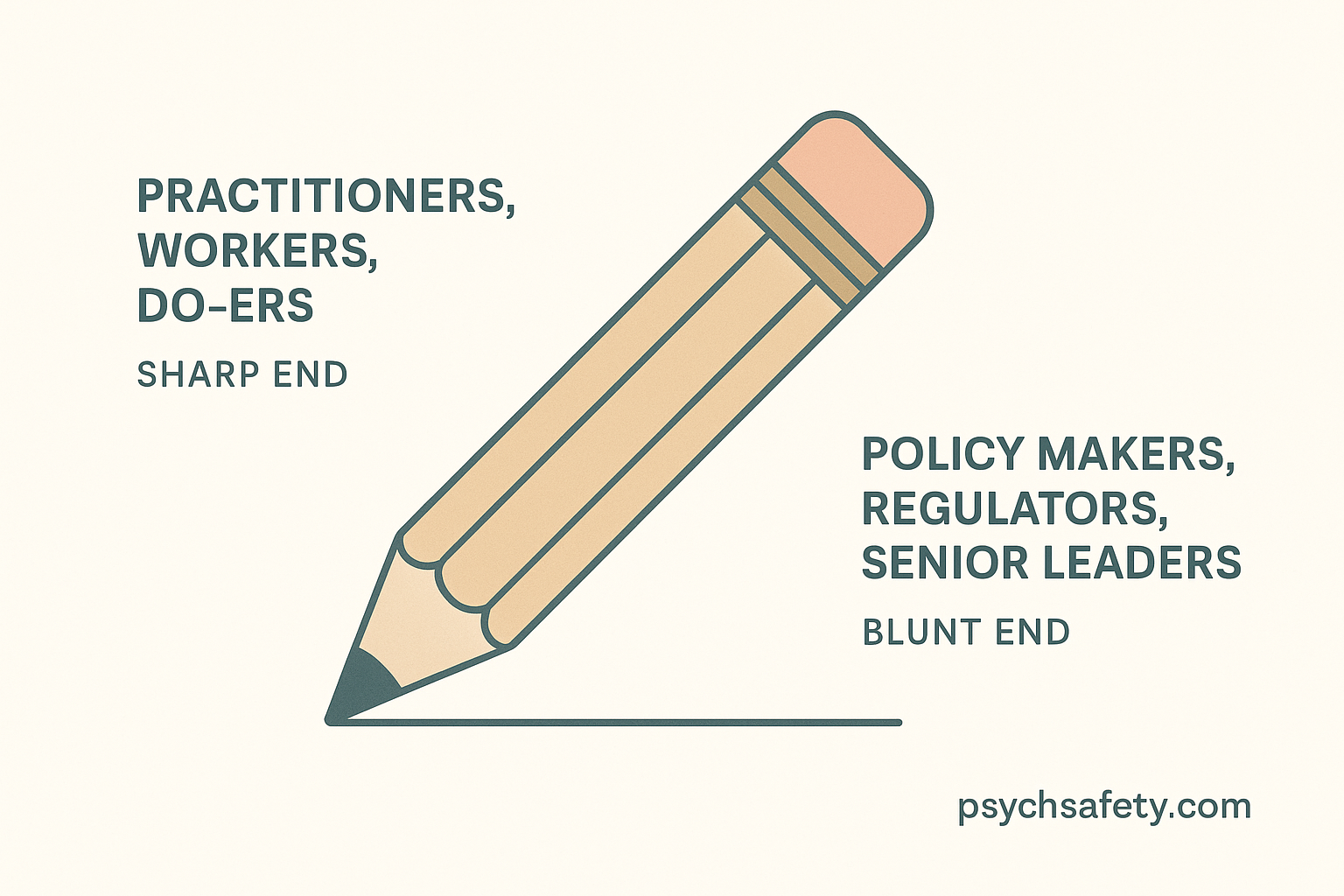
      The Sharp End & Blunt End of Education
      October 3, 2025
    • Forced Vulnerability
      Forced Vulnerability
      September 26, 2025
    • New Sticker Drop! "Zombies Are Scary"
      New Sticker Drop! "Zombies Are Scary"
      September 22, 2025
    • Reflections - Part Four: A Rights-Based Approach

      Reflections - Part Four: A Rights-Based Approach
      September 16, 2025
    • Reflections - Part Three: The Safety to Dissent
      Reflections - Part Three: The Safety to Dissent
      September 12, 2025
    • Reflections - Part Two: Power and Difference
      Reflections - Part Two: Power and Difference
      September 4, 2025
    • The Psychological Safety Trainer Toolkit
      The Psychological Safety Trainer Toolkit
      September 1, 2025
    • Reflections on Psychological Safety: Five Years of Learning
      Reflections on Psychological Safety: Five Years of Learning
      August 29, 2025
    • Not Feeling Seen: Eye Contact and Psychological Safety
      Not Feeling Seen: Eye Contact and Psychological Safety
      August 21, 2025
    • Psychological Safety Isn't Enough
      Psychological Safety Isn't Enough
      August 15, 2025
    • Psych Safety Day / Week 2026
      Psych Safety Day / Week 2026
      August 11, 2025
    • The Amagasaki Disaster
      The Amagasaki Disaster
      August 8, 2025
    • Psychological safety isn't the same for everyone
      Psychological safety isn't the same for everyone
      August 4, 2025
    • Psychological Safety Books for Children
      Psychological Safety Books for Children
      August 1, 2025
    • Psychological Safety and Creativity
      Psychological Safety and Creativity
      July 25, 2025
    • The State of Psychological Safety Survey: 2025
      The State of Psychological Safety Survey: 2025
      July 19, 2025
    • Barriers to Psychological Safety
      Barriers to Psychological Safety
      July 18, 2025
    • How you respond matters.
      How you respond matters.
      July 11, 2025
    • Practices that Foster Psychological Safety
      Practices that Foster Psychological Safety
      July 4, 2025
    • Feedback in the workplace
      Feedback in the workplace
      June 27, 2025
    • Psych Safety Day 2025
      Psych Safety Day 2025
      June 21, 2025
    • Job Security and Psychological Safety
      Job Security and Psychological Safety
      June 20, 2025
    • How familiar are people with the concept of psychological safety?
      How familiar are people with the concept of psychological safety?
      June 13, 2025
    • Learning at Psych Safety
      Learning at Psych Safety
      June 13, 2025
    • Why do We Foster Psychological Safety?
      Why do We Foster Psychological Safety?
      June 6, 2025
    • Psychological Safety in Aviation - Special Edition
      Psychological Safety in Aviation - Special Edition
      May 30, 2025
    • Rebuilding Psychological Safety When It's Broken
      Rebuilding Psychological Safety When It's Broken
      May 30, 2025
    • Just Culture
      Just Culture
      May 23, 2025
    • Transactional Analysis
      Transactional Analysis
      May 15, 2025
    • Comfort vs Need
      Comfort vs Need
      May 9, 2025
    • Sociological Safety
      Sociological Safety
      May 2, 2025
    • Humour and Psychological Safety
      Humour and Psychological Safety
      May 1, 2025
    • Safety-Organised Criticality
      Safety-Organised Criticality
      April 25, 2025
    • Leaders are not solely responsible for psychological safety.
      Leaders are not solely responsible for psychological safety.
      April 21, 2025
    • Psychological Safety in Our Personal Lives
      Psychological Safety in Our Personal Lives
      April 17, 2025
    • The Organisational Fabric of Psychological Safety
      The Organisational Fabric of Psychological Safety
      April 10, 2025
    • Colution
      April 7, 2025
    • All Feedback Is Subjective
      All Feedback Is Subjective
      April 4, 2025
    • Micromanagement
      Micromanagement
      March 21, 2025
    • Rewetting Organisations
      Rewetting Organisations
      March 14, 2025
    • Spectra of Participation
      Spectra of Participation
      March 7, 2025
    • Learning Types and Toxic Leadership
      Learning Types and Toxic Leadership
      February 28, 2025
    • Twitter
    • LinkedIn


Sign up to our newsletter & get weekly insights and research

About

The Psychological Safety Team
Our Mission
Our Core Principles
Privacy Policy
Terms of Business

Learn

Corporate Training
Online Workshops
Newsletter
Professional Certification

Tools

Tool Kits
Articles
What is Psychological Safety?
The History of Psychological Safety

Get Connected

Contact us
Attend a Meetup
Join the Community
Connect with us on LinkedIn
View our YouTube Channel
© 2025 Iterum Ltd
We support LGBTQ+ rights all year round. But we also celebrate pride too.
We support LGBTQ+ rights all year round. But we also celebrate pride!
Content on this website is CC BY-NC-SA
Written by humans, not by AI