
We cannot adequately respond to changes, incidents or threats if we’re operating at capacity. And it applies to people, machines, computers, traffic and more – whether you’re running a factory floor, a busy kitchen, a software development team, or a hospital ER, percentage utilisation is impacting how well your team can adapt to a changing environment.

Psychological Safety

Guest post by Navya Adhikarla, graduate student in the Master of Engineering Management program at Duke University (Don’t) Look me in the Eye: The Challenge of Eye Contact “Look me in the eye and tell me you are not lying,” […]

15/5 Reports To manage teams in a way that fosters psychological safety requires clear communication and feedback channels. Team members should have well-defined platforms to share achievements, voice concerns, and seek assistance. Ideally, these feedback mechanisms will be consistent, high-cadence and […]

Stutters and Stammers I’ve written previously about my experience growing up with dyspraxia, which I was diagnosed with at an early age. My dyspraxia made it difficult for me to pronounce and articulate certain sounds (called phonemes), and meant that I […]

Deming’s 14 Points of Management I’m a Deming fan, and sad that I never got to meet him or attend any of his lectures. W. E. Deming is possibly most well known for his “PDCA” (Plan-Do-Check-Act) cycle, which is actually […]

Bad Management It’s important that we learn from our own mistakes and failures, and self-reflect in order to improve. However, there’s also a lot we can learn from things others get wrong. That, after all, is partly why psychological safety is such […]

Crew Resource Management In preparing for my conference talk this week, I was reading up further on the 1977 Tenerife disaster and the history of Crew Resource Management (CRM), and came across this excellent paper: The Evolution of Crew Resource Management Training […]

Verbally Speaking Up at Work Speaking with a client this week, we surfaced an interesting organisational antipattern to psychological safety. Sometimes, within an organisation, there exists an unwritten rule: voice your concerns, but only do it verbally in a call or meeting where […]
A critique of Eldor, L., Hodor, M. and Cappelli, P., 2023. The limits of psychological safety: Nonlinear relationships with performance. Organizational Behavior and Human Decision Processes, 177, p.104255. Occasionally, the slightly absurd notion emerges that teams could have “too much” […]

Reason’s theory holds that most accidents can be traced to one or more of four levels of failure:
Organisational influences,
Unsafe supervision,
Preconditions for unsafe acts, and
The unsafe acts themselves.

Executive Summary This pilot study explored the relationship between employment protections—in law and organisational policy—and psychological safety at work. Drawing on 84 responses from participants across multiple countries, the research sought to understand whether stronger employment rights correlate with greater […]

Normal Accidents Charles Perrow is regarded as a pivotal figure in the theory of why and how things fail. He served as a sociology professor at Yale and Stanford and was primarily focused on the influence of large organisations on […]

Psychological Safety in Teaching The way incidents are managed in a system extends far beyond the individuals directly involved, impacting everyone within that system. This is illustrated in this recent case of a dedicated teacher whose punishment for a mistake highlights […]

Statistical Process Control and Understanding Variation In a chat with a great client this week, we got talking about different approaches to measurement and metrics. I introduced the concept of Statistical Process Control (SPC), so that’s what this week’s newsletter […]

Psychological Safety is not the goal Now, this might seem an odd thing to say for someone who makes a living by helping people understand and foster psychological safety, but it’s true. Psychological safety isn’t the goal; the goal is whatever your […]

Psychological Safety: What it isn’t. Psychological safety has become a hot topic recently, for good reason and hopefully this will result in better, safer, and more inclusive workplaces for everyone. However, the rise in its popularity has led to a […]

Burnout and psychological safety Burnout has many causes, most of them systemic and structural (such as organisational structures and job design), as well as broader societal pressures. Excessive workload, chronic time pressure, relational conflict, lack of control, and sustained cognitive […]

Employment Rights and Psychological Safety Thanks so much to newsletter reader Andrea Notch for pointing me at Mona Chalabi’s illustrations of statistical ideas and topics – while I was having a look at Mona’s work, this one on unionisation stood […]

Data Visualisation In the psychsafety.com measurement workshop we cover a lot: research ethics, quantitative/qualitative approaches, longitudinal vs cross-sectional studies, formulating research questions, survey design, and communicating our findings. As part of that, we look at data visualisation, including this classic example: The Broad Street […]
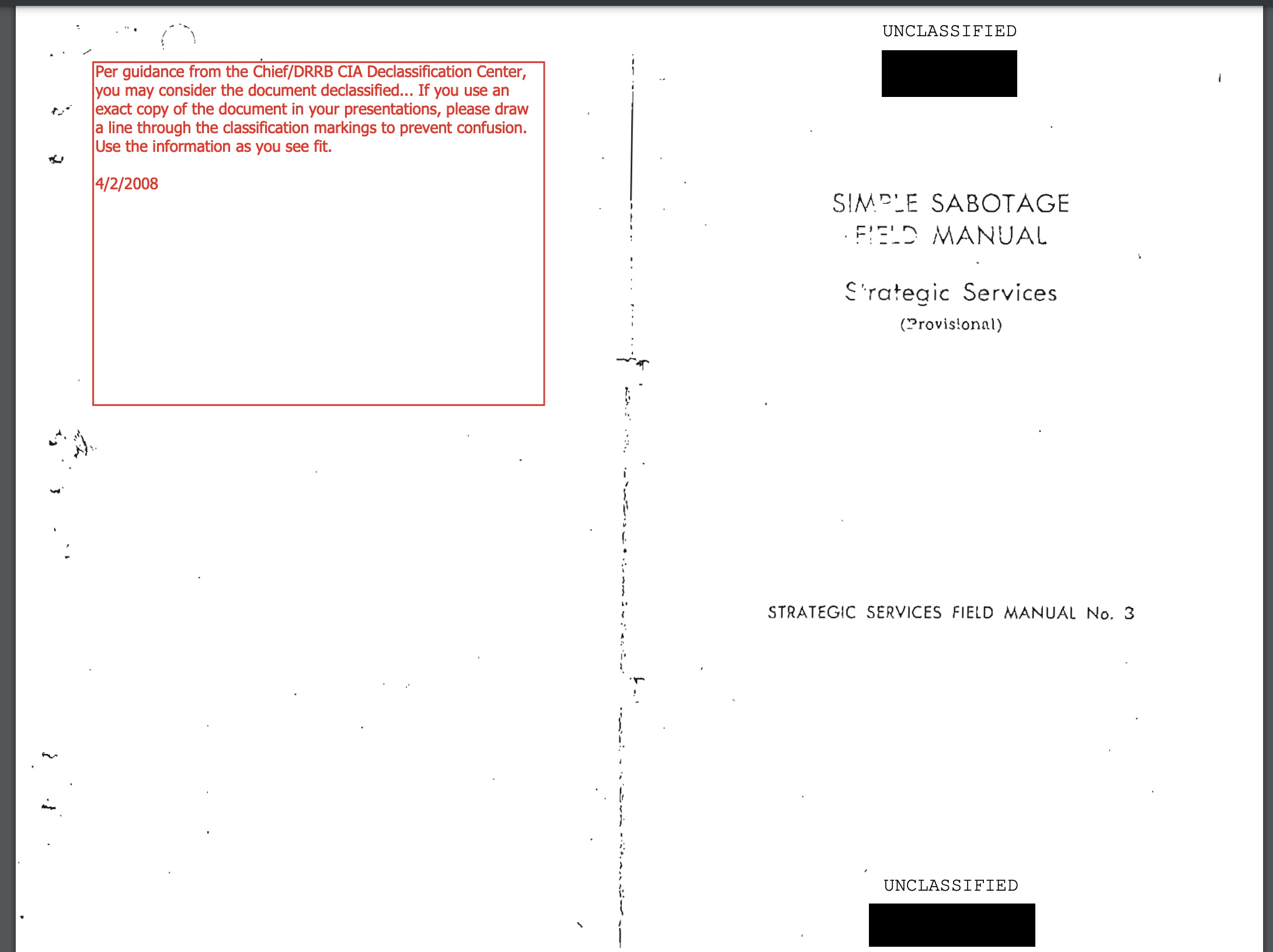
Ok, maybe this something *not* to try. This is the infamous CIA Simple Sabotage Field Manual from 1944, declassified (I believe) in 2008. It includes such gems as: How many of these have you observed in your workplace?

Local Rationality “People do reasonable things given their goals, knowledge, understanding of the situation and focus of attention at a particular moment.” We do things that make sense to us at the time. And a fundamental premise of psychological safety […]

A man goes out on the beach and sees that it is covered with starfish that have washed up in the tide. A little boy is walking along, picking them up and throwing them back into the water. “What are […]

Welcome to The State of Psychological Safety Survey 2023 – the annual survey of The Psychological Safety Newsletter. This is your chance to join thousands of voices, share your experiences, and inform the content of the next year of articles, resources, […]

Understanding and Implementing the Patient Safety Incident Response Framework (PSIRF) This week we’re having a look at the new NHS Patient Safety Incident Response Framework (PSIRF). Whilst this is clearly relevant to our UK healthcare readers, I believe that the […]
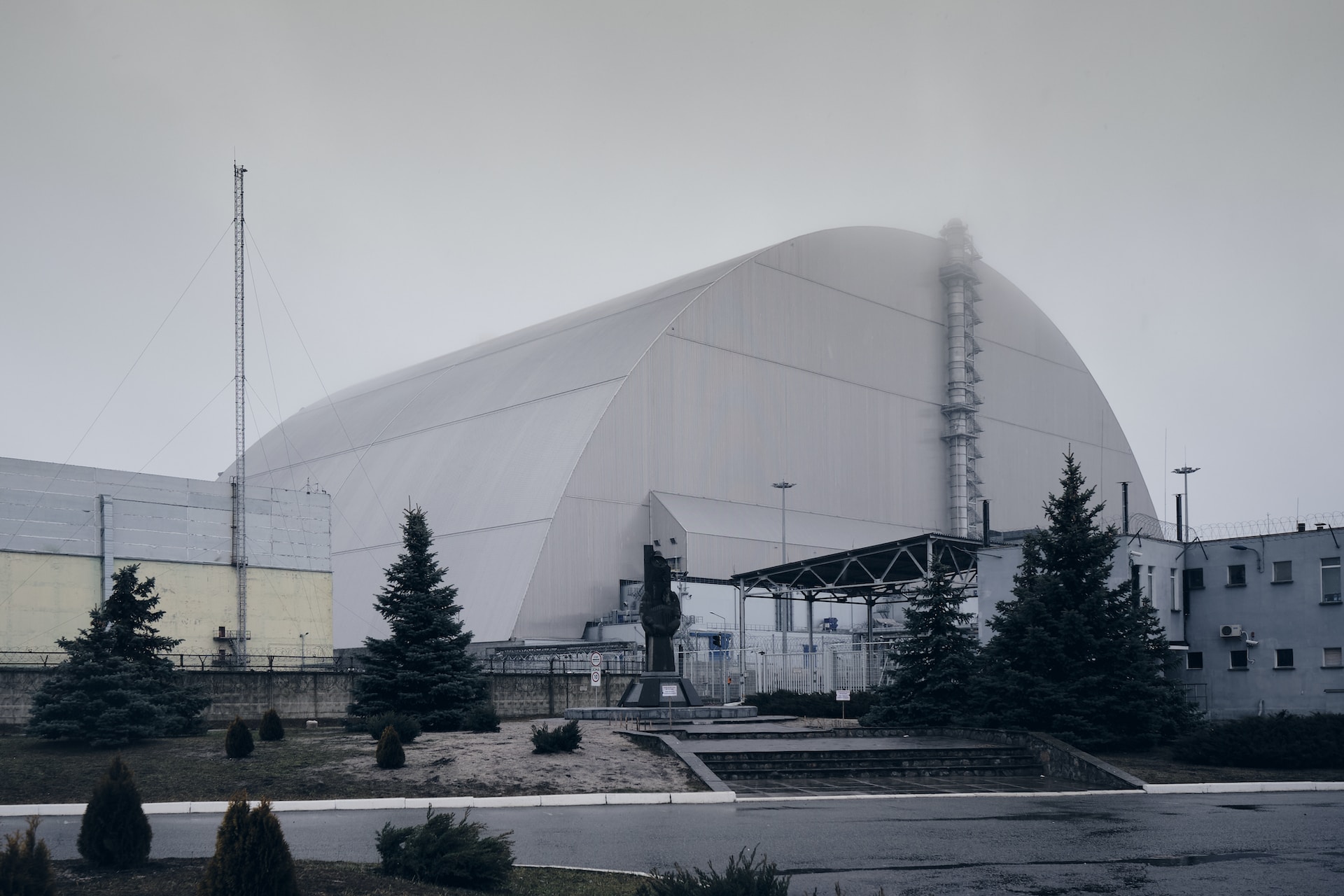
Causes of Disaster at Chernobyl: The Absence of Psychological Safety (See below for the complete article) In 1986, the nuclear power plant at Chernobyl in the Ukrainian SSR (the territory of modern Ukraine) suffered a catastrophic failure that directly killed […]
Page 7 of 13

