



• Psychological Safety
  • Organisational Training
    • – Ignite: Senior Leaders
    • – Impact: Team Workshop
    • – Delivering Feedback
    • – Culture and Neurodiversity
    • – CRM for Non-Aviation Teams
    • – HOP: Human and Organisational Performance
    • – Train the Trainer
    • – Action Learning Sets
  • Online Workshops
    • – Train the Trainer
    • – Fundamentals
    • – Practices
    • – Leadership
    • – Advanced
    • – Measurement
    • – Workshop Facilitation
    • – HOP
    • – Delivering Feedback
    • – Thinking Like an Ecologist
  • Resources
    • – Tool Kits
    • – Free Resources
    • – Newsletter
    • – Articles
    • – Research
    • – Shop
    • – Community
    • – Practices
    • – What is Psychological Safety?
  • About Us
  • Contact
  • Search
  • Org Training
    • Ignite for Senior Leaders
    • Impact Team Workshop
    • Management Masterclass
    • Delivering Effective Feedback
    • Cultural and Neurodiversity
    • HOP: Human and Organisational Performance
    • CRM for Non-Aviation Teams
    • Train the Trainer
    • Action Learning Sets
  • Live Workshops
    • Full Live Course
    • Psychological Safety Fundamentals
    • Practice Masterclass
    • Leadership & Management
    • Advanced Psychological Safety
    • Measuring Psychological Safety
    • Workshop Design and Facilitation
    • HOP Fundamentals
    • Delivering Effective Feedback
    • Thinking Like an Ecologist: A Field Guide for Organisational change
  • On-Demand
    • Psychological Safety 101
psych safety logo white
  • Resources
    • Tool Kits
    • Free Resources
    • Knowledge Network
    • Newsletter
    • Shop
    • Podcasts & Talks
    • Videos
    • Community
    • Events & Psych Safety Days
  • Articles
    • Search
    • What is Psychological Safety?
    • The History of Psychological Safety
    • Psychological Safety Practices
    • Psychological Safety In The Workplace
    • Research
    • Measure Psychological Safety
    • Human and Organisational Performance (HOP)
  • The Psych Safety Team
    • Contact Us
    • About The Team
    • Tom Geraghty
    • Jade Garratt
  • Org Training
    • Ignite for Senior Leaders
    • Impact Team Workshop
    • Management Masterclass
    • Delivering Effective Feedback
    • Cultural and Neurodiversity
    • HOP: Human and Organisational Performance
    • CRM for Non-Aviation Teams
    • Train the Trainer
    • Action Learning Sets
  • Live Workshops
    • Full Live Course
    • Psychological Safety Fundamentals
    • Practice Masterclass
    • Leadership & Management
    • Advanced Psychological Safety
    • Measuring Psychological Safety
    • Workshop Design and Facilitation
    • HOP Fundamentals
    • Delivering Effective Feedback
    • Thinking Like an Ecologist: A Field Guide for Organisational change
  • On-Demand
    • Psychological Safety 101
psych safety logo white
  • Resources
    • Tool Kits
    • Free Resources
    • Knowledge Network
    • Newsletter
    • Shop
    • Podcasts & Talks
    • Videos
    • Community
    • Events & Psych Safety Days
  • Articles
    • Search
    • What is Psychological Safety?
    • The History of Psychological Safety
    • Psychological Safety Practices
    • Psychological Safety In The Workplace
    • Research
    • Measure Psychological Safety
    • Human and Organisational Performance (HOP)
  • The Psych Safety Team
    • Contact Us
    • About The Team
    • Tom Geraghty
    • Jade Garratt
Human and Organisational Performance (HOP)  ·  Newsletter  ·  Psychological Safety  ·  Psychological Safety In The Workplace

Accountability

May 29, 2026 • by Tom Geraghty

Accountability

Accountability, quite literally, is the ability to give an account: account-ability. An account is a narrative – the telling of an honest story about what happened, why we did what we did, what was known at the time and what wasn’t, told from our particular position, and situated within the context of what was actually happening. To be accountable is to have the ability to give an account. This isn’t a wordplay or a clever rhetorical manoeuvre. It’s the simple etymology of the word – accountability is meant to be about our capacity for honest explanation. To be accountable is not the same as to be punishable.

But accountability has been colonised by blame. In the world of work, almost without us noticing, the meaning of accountability has been displaced by its near-opposite. The tell is the phrase “Someone must be held accountable” (or something similar), and what that usually means in practice is that someone should suffer consequences. It’s rarely used to mean that someone should be given the conditions in which they can honestly explain what happened, but that someone should bear the cost of it happening. Accountability has turned into blame with better marketing.

Roberts (1991) formalised accountability as a relational tension between an account giver and a recipient, and that framing is important. Accountability requires at least two parties, someone willing to give an account and someone capable of receiving it; it’s relational and dynamic. Philip Tetlock’s work on accountability and cognition shows why the receiving end is so consequential. What he found was interesting but unsurprising: when people know who they’re accountable to and can anticipate what that audience wants, the account they give is shaped accordingly – designed to satisfy the audience rather than give the truest description of events as they actually happened. Every performance review, every post-incident investigation, every board report is subject to this dynamic. The account we receive is the account that the teller believed the audience wanted.

Accountability as a construct has been studied extensively across public administration (Bovens), organisational behaviour (Tetlock, Frink & Ferris), philosophy (O’Neill), and safety science (Dekker), and what strikes anyone who reads across these fields is how rarely any of them mean the same thing by it. The kaleidoscopic definitional confusion is part of the core problem with accountability. Even the classic RACI matrix (the popular tool that gives the appearance of clarity while achieving the texture of a spreadsheet) gets accountability wrong. Much of that confusion is semantic and probably unavoidable, but some of it has structural consequences. The most significant conflation is between accountability and responsibility. Ieraci (2007, via Parris, 2025) draws the distinction clearly: responsibility involves doing, accountability involves reporting. Responsibility is about the work itself, and accountability is about the account of the work. They overlap and interact, but they are not the same thing, and treating them as synonyms has problematic consequences. 

Misunderstanding Accountability

Accountability and responsibility have been used interchangeably for so long that even legislation gets it wrong. This isn’t just pedantry. The conflation matters because once accountability is understood to mean “being responsible for outcomes,” the logical next step is: if the outcome was bad, the accountable person is at fault. Consequence then follows automatically and the account (the narrative, the context, the conditions that were actually present) gets dismissed before it can be heard. And accountability for outcomes is, in any case, the wrong target. Outcomes are partly beyond any of our control. What we can reasonably ask people to account for is their reasoning, their decisions, and their actions, situated within their context. Not the outcome.

“People aren’t just people, they are people surrounded by circumstances.”
― Terry Pratchett

Karl Weick’s sensemaking work is useful here, and shows why this is even worse than it first appears. Accountability in organisations is almost always exercised retrospectively, after the outcome is already known, and hindsight does much of the work before the inquiry begins. The account becomes a post-hoc justification exercise rather than a genuine rendering – an attempt to prove innocence in a process that has already assumed guilt. Structural bias is at play, and the knowledge of the outcome contaminates the inquiry before it begins.

Parris’s example from maritime law shows both mechanisms operating at once. New Zealand’s Maritime Transport Act assigns responsibility to vessel Masters where it clearly means accountability in the liability sense, and the confusion has structural consequences for who gets blamed when things go wrong. The Master at the sharp end becomes legally exposed for outcomes shaped by systemic decisions made at the blunt end. The legislative conflation and the retrospective framing work together: context and conditions get set aside because the outcome is already known, and the law reaches for the nearest human rather than the most relevant cause.

“…they took the captain to court, even though there was not a thing I could have done to have stopped it, to have known about it, or anything… I was held accountable… But I wasn’t responsible.”
Parris, 2025 pp.35

And here’s the crux: responsibility is actually closer to what organisations think they mean by accountability. Responsibility is about roles, obligations, and the act of doing. We can assign responsibility, but we cannot assign accountability – an account is given, not extracted, and every organisational system built around ‘holding people accountable’ rests on a category error with real-world consequences. If accountability cannot be assigned, only taken, then the pressure organisations apply in its name does not produce genuine accounts. It only produces performances of them.

Accountability without context is blame

When we strip the account (the narrative, the context, the local rationality of the person who was there) and retain only the assignment of fault, we haven’t done accountability. We’ve dressed something much older and more primitive in accountability’s clothes.

Blametropism is the organisational tendency to orient toward fault, the way a plant orients toward light, regardless of whether finding fault serves any operational (rather than emotional) use. The organisational or political apparatus of accountability (the investigation, the finding, the consequence) is seldom deployed to truly understand what happened, but instead to locate where the fault should land. The true account is rarely sought; what’s more often sought is a name, a goat that we can expel from the village, laden with our sins. Accountability-as-blame is blametropism in its business suit. It gives the impression of rigour while reliably producing the outcomes of blame.

Marilyn Paul’s systems framing captures the consequences well: blame generates fear, fear generates cover-up, cover-up degrades information quality, degraded information produces more errors, more errors generate more blame. The feedback cycle is self-sustaining and self-defeating, and as reliable as it is depressing. An organisation that uses accountability as a pressure tool destroys its own capacity to learn what’s really happening inside it.

When people learn that giving an account: an honest one, with all its uncertainty and complexity and acknowledgement of error, leads to punishment, they naturally stop giving honest accounts. Instead they give performed accounts – narratives designed to survive scrutiny rather than enable learning.

And the demand for a single account is itself part of the problem. Real situations are experienced differently from different positions within a system. The account of the nurse who administered the wrong medicine, the ward manager who created the rota, the software developer who designed the drug cabinet interface, and the executive who approved the staffing budget are all partial, all genuine, and all necessary. Accountability-as-blame doesn’t just suppress honest accounts. It demands that a complex, plural reality be rendered as a single story with a single author. 

Take the cases of Hadiza Bawa-Garba and RaDonda Vaught: both clinicians who made errors in systemically compromised conditions, both of whom were honest about what happened, and both of whom were subsequently prosecuted. In both cases, the logic was that someone had to be held to account. Investigations were conducted, findings were made and severe consequences followed. What was not sought, in any meaningful sense, was a genuine account. Both clinicians were already carrying the burden of what happened before their prosecutions even began, and the prosecutions compounded an existing problem by converting private grief into public liability. The systemic conditions and the context behind the errors (staffing levels, equipment failures, normalised workarounds and more) were noted but set aside. The apparatus of “accountability” produced the outcome that blame always produces: a conclusion that foreclosed rather than opened inquiry.

The lesson that clinicians drew from both cases was not “be more careful.” It was “be less transparent.” That is what accountability without context reliably produces. Onora O’Neill saw the same mechanism from a different vantage point: systems designed to demonstrate transparency often produce performances of transparency rather than the thing itself. The safety audit, the Ofsted inspection and the compliance checklist all create the appearance of account-giving while systematically degrading the conditions in which genuine accounts are possible. The mechanism defeats its own purpose.

An organisation that punishes honest accounts will eventually receive only dishonest ones.

You can’t assign accountability, only take it

The moment an account is compelled, demanded, or extracted under threat of consequence, it ceases to be an account and becomes testimony. Modern societies do not treat confessions given under duress as genuine, and for good reason –  what is said under compulsion is shaped more by the compulsion than by the truth. The same mechanism operates inside organisations. Forced accountability produces self-protection, not transparency. A performance of accountability, not learning. It’s worth noting in this light that we tend to call the most common formal accountability mechanism in organisations an “annual performance review”.

“Currently fashionable methods of accountability damage rather than repair trust.”
– Onora O’Neill

A genuine account has to be a voluntary act. It requires the account-giver to be willing to be seen: to expose their reasoning, their uncertainty, their errors, and their context. That exposure carries real interpersonal and career risk, and where candour carries significant risk but little benefit, most of us will err on the side of caution and silence. This isn’t a character flaw, it’s a rational response to the environment, and changing that calculus is the only reliable route to better accounts.

The distance between the account an organisation says it wants and the account it actually rewards is navigated through social inference: reading the room, calibrating our degree of honesty to the audience, knowing instinctively how much truth is too much. It’s also a skill that is unevenly distributed in most organisations. For many neurodivergent people, candour is simply how to communicate, not a choice to be weighed against consequences. An organisation that performs a desire for honesty while punishing it in practice fails those workers and risks actively deceiving them.

Cultivating the conditions for honesty is considerably more difficult than demanding it, and considerably more effective. The phrase “holding people accountable” implies a power that organisations do not have. We cannot hold someone else accountable. We can only nurture the organisational substrate in which people are able and willing to give an honest account.

What real accountability looks like

Real accountability is dialogic rather than monologic. Roberts draws on Senge’s distinction between discussion and dialogue: discussion in this sense, is like a debate, with positions defended and a winner declared. Dialogue is different: meaning, nuance, context and information flow freely between parties, with the intention of surfacing something neither party could reach alone. Organisational accountability processes are almost universally structured as a defensive discussion – and a genuine account cannot be extracted through cross-examination. It can only emerge through a more open, reflective dialogue, which requires the account-giver to feel safe enough to think out loud, be uncertain, and say “I don’t know” without it becoming evidence against them. Both giving and receiving are equal components of accountability, and the receiving requires its own kind of discipline: the willingness to be changed by what we hear, rather than confirm what we already believed. Maybe the hardest part is the moment right after the event, when everyone is nervous and the pressure to find a name is enormous, and someone has to be the person who says: let’s slow down, let’s find out what actually happened.

Parris’s typology reinforces this binary. Backward/hierarchical accountability is structurally monologic: it already knows what it’s looking for. Forward/process accountability requires dialogue, because it’s genuinely interested in what the system contributed, which can only be discovered, rarely confirmed.

“But surely there have to be consequences sometimes?” Yes, but consequences and accountability are separate questions. We can impose consequences without ever actually receiving an honest account. And if negative consequences are attached to the account, we will never receive an honest one. Consequences cannot come first without contaminating everything that follows. The desire for consequence after failure is often a desire for justice, and that is a fundamental human impulse worth taking seriously. But retributive justice and learning are different projects, and the accountability mechanisms most organisations use are poorly designed for either.

The question after a failure, Dekker argues, is not just “who is accountable?” but (more importantly) “how do we learn?”, and answering the second question well requires the conditions that make genuine accounts possible. It follows that psychological safety and true accountability are mutually dependent. We cannot give a true account if we don’t feel safe, and accountability as punishment makes honesty unsafe. A genuine account shouldn’t feel like a confession. It should feel like a contribution to our collective understanding, and treating it as the former guarantees we will never receive it as the latter. Building the conditions in which genuine accounts are possible is what accountability, properly understood, actually requires.

Account-ability

In the vast majority of organisations, accountability is expected to flow upwards. The powerful receive accounts; whilst they are seldom required to honestly account for themselves to those ‘below’ them. And I’d argue that the most valuable accounts are actually those that flow sideways, worker to worker, where honesty isn’t calibrated to hierarchy.

We have collectively spent considerable energy perfecting the art of demanding honesty from the people for whom we have made honesty unsafe. “Accountability”, a word that belonged to everyone who needed to give an honest account, was appropriated by institutions that needed a more respectable name for blame. Blame is cognitively cheap, emotionally satisfying, and operationally useless. It produces a very clear answer to the question of what to do next, and it is almost always the wrong one.

However, blame is also often politically useful. Blame doesn’t just emotionally satisfy: it secures power. When the investigation concludes and the name is named, someone’s position is secured and someone else’s is eroded, or ended. The apparatus of “accountability” in this case is functioning exactly as designed, just for purposes that aren’t on the tin. 

This is why genuine accountability remains so rare. It asks the powerful to submit to the same conditions they currently use accountability to avoid: to give an honest account of themselves, to be uncertain in public, and to say “I don’t know” to the people they lead. In cultures where blame secures position, a genuine account risks it. The rarity of genuine accountability in organisations is its rational consequence.

Many organisations “hold people accountable” by imposing negative consequences for failure. The organisations that actually handle failure best are the ones that make it safe to give an honest account – they foster account-ability. They are not the same thing. They are, in fact, complete opposites.

References

Bovens, M. (2007) ‘Analysing and assessing accountability: a conceptual framework’, European Law Journal, 13(4), pp. 447–468.

Dekker, S.W.A. (2012) Just Culture: Balancing Safety and Accountability. Farnham: Ashgate. (See also: Dekker (2011) in the map)

Frink, D.D. and Ferris, G.R. (1998) ‘Accountability, impression management, and goal setting in the performance evaluation process’, Human Relations, 51(10), pp. 1259–1283.

Ieraci, S. (2007) ‘Responsibility versus accountability in a risk-averse culture’, Emergency Medicine Australasia, 19(1), pp. 63–64.

O’Neill, O. (2002) A Question of Trust. Cambridge: Cambridge University Press. → Explore in map

Parris, R. (2025) Accountability: A Lived Experience. MSc thesis. Lund University. → Explore in map

Paul, M. (2017) ‘Moving from blame to accountability’, The Systems Thinker.

Roberts, J. (1991) ‘The possibilities of accountability’, Accounting, Organizations and Society, 16(4), pp. 355–368. → Explore in map

Roberts, J. (1996) ‘From discipline to dialogue: individualizing and socializing forms of accountability’, in Accountability: Power, Ethos and the Technologies of Managing, pp. 40–61.

Tetlock, P.E. (1985) ‘Accountability: the neglected social context of judgment and choice’, Research in Organizational Behavior, 7, pp. 297–332. → Explore in map

Weick, K.E. (1995) Sensemaking in Organizations. Thousand Oaks, CA: Sage. (See also: Weick & Roberts (1993) and Weick (1993) Mann Gulch in the map)

See how this article connects
Explore its relationships with other ideas in the knowledge network.
Explore in network →

accountabilityblameblametropicperformancepsychological safetywork

Tom Geraghty

Tom Geraghty, co-founder and delivery lead at Iterum Ltd, is an expert in high performing teams and psychological safety. Leveraging his unique background in ecological research and technology, Tom has held CIO/CTO roles in a range of sectors from tech startups to global finance firms. He holds a degree in Ecology, an MBA, and a Masters in Global Health. His mission is to make workplaces safer, higher performing, and more inclusive. Tom has shared his insights at major events such as The IT Leaders Summit, the NHS Senior Leadership Conference, and EHS Global Conferences. Connect with him on LinkedIn or email tom@psychsafety.com

Related Articles


the fundamental attribution error
Create and Maintain  ·  Human and Organisational Performance (HOP)  ·  Newsletter  ·  Psychological Safety  ·  Psychological Safety In The Workplace
The Fundamental Attribution Error
October 11, 2024
Human and organisational performance (HOP) core principles
Human and Organisational Performance (HOP)  ·  Newsletter  ·  Psychological Safety  ·  Psychological Safety In The Workplace
How We Respond Matters
January 31, 2025
Hands holding a survey clipboard
Qualitative Measurement of Psychological Safety
Previous Article
  • Subscribe to the Psychological Safety Newsletter

  • psychological safety train the trainer
  • Get Certified! Join online workshops, or explore training and consultancy for leaders, teams and organisations.

    Discover our training options for Human and Organisational Performance and CRM for non-aviation teams.

    If you're a trainer, consultant or facilitator, get certified in our Train the Trainer complete online programme and download the Training Materials for Facilitators and Trainers.

  • psychological safety on-demand training
  • building and maintaining psychological safety for your team
    Download the complete Practitioners' guide to psychological safety
  • psychological safety trainer toolkit
  • Download the Psychological Safety Trainer Toolkit. Containing powerful resources that you can use to deliver your own training and workshops!

  • psych safety logo

    Sponsorship and advertising. Reach over 11,000 weekly readers and 500,000 online visitors with your message in our newsletter.

  • theres no such thing as too much psychological safety
    Grab Psychological Safety Stickers from our Online Shop!
  • Psych Safety Day

    Find out more about our Psych Safety Days - in-person and virtual events to share, learn, and connect with other enthusiasts, practitioners and researchers on psychological safety and related topics.

  • Psychological Safety Knowledge Network

    Use our Psych Safety Semantic Knowledge Map to explore hundreds of articles, papers, resources and tools. 

  • Categories

    • Newsletter
    • Psychological Safety
      • Create and Maintain
      • Human and Organisational Performance (HOP)
      • In Technology
      • Learning and Development
      • Measure
      • Psychological Safety In The Workplace
      • Theory and Research
  • Recent Posts

    • Accountability
      Accountability
      May 29, 2026
    • Qualitative Measurement of Psychological Safety

      Qualitative Measurement of Psychological Safety
      May 22, 2026
    • The Psych Safety Knowledge Map
      The Psych Safety Knowledge Map
      May 15, 2026
    • Ambiguity, predictability, and psychological safety

      Ambiguity, predictability, and psychological safety
      May 1, 2026
    • The Calculus of Voice
      The Calculus of Voice
      April 23, 2026
    • Contracting and recontracting
      Contracting and recontracting
      April 16, 2026
    • The Vasa
      The Vasa
      April 1, 2026
    • Learning from Error, or Punishing It?
      Learning from Error, or Punishing It?
      March 27, 2026
    • The “Utility” of Psychological Safety
      The “Utility” of Psychological Safety
      March 20, 2026
    • Psychological Flexibility
      Psychological Flexibility
      March 19, 2026
    • Be soft to each other, and hard on the system

      Be soft to each other, and hard on the system
      March 12, 2026
    • "Fake it till you make it"
      "Fake it till you make it"
      March 12, 2026
    • The SANE Effect
      The SANE Effect
      February 20, 2026
    • Learning Teams
      Learning Teams
      January 30, 2026
    • ST.R.E.A.M: Status Rules Everything Around Me

      ST.R.E.A.M: Status Rules Everything Around Me
      January 23, 2026
    • Growth Mindset
      Growth Mindset
      January 16, 2026
    • The Streetlight Effect
      The Streetlight Effect
      January 8, 2026
    • The "Fist of Five"
      The "Fist of Five"
      December 19, 2025
    • Psychological Bravery
      Psychological Bravery
      December 18, 2025
    • Psych Safety Book List 2025
      Psych Safety Book List 2025
      December 18, 2025
    • Psych Safety 2025 Unwrapped
      Psych Safety 2025 Unwrapped
      December 15, 2025
    • Plan Continuation Bias
      Plan Continuation Bias
      December 12, 2025
    • Whistleblowing and Psychological Safety
      Whistleblowing and Psychological Safety
      December 4, 2025
    • How Childhood Socioeconomic Status Shapes Psychological Safety and Career Risk-Taking at Work
      How Childhood Socioeconomic Status Shapes Psychological Safety and Career Risk-Taking at Work
      November 27, 2025
    • Safety and the Myth of Self-Reliance
      Safety and the Myth of Self-Reliance
      November 24, 2025
    • The Watermelon Effect and "Greenwashing"

      The Watermelon Effect and "Greenwashing"
      November 7, 2025
    • Individual Resilience
      Individual Resilience
      October 31, 2025
    • Counterfactuals
      Counterfactuals
      October 24, 2025
    • Coaching and Psychological Safety
      Coaching and Psychological Safety
      October 17, 2025
    • Five Ecological Concepts for Working in Organisational Change

      Five Ecological Concepts for Working in Organisational Change
      October 9, 2025
    • The Sharp End & Blunt End of Education
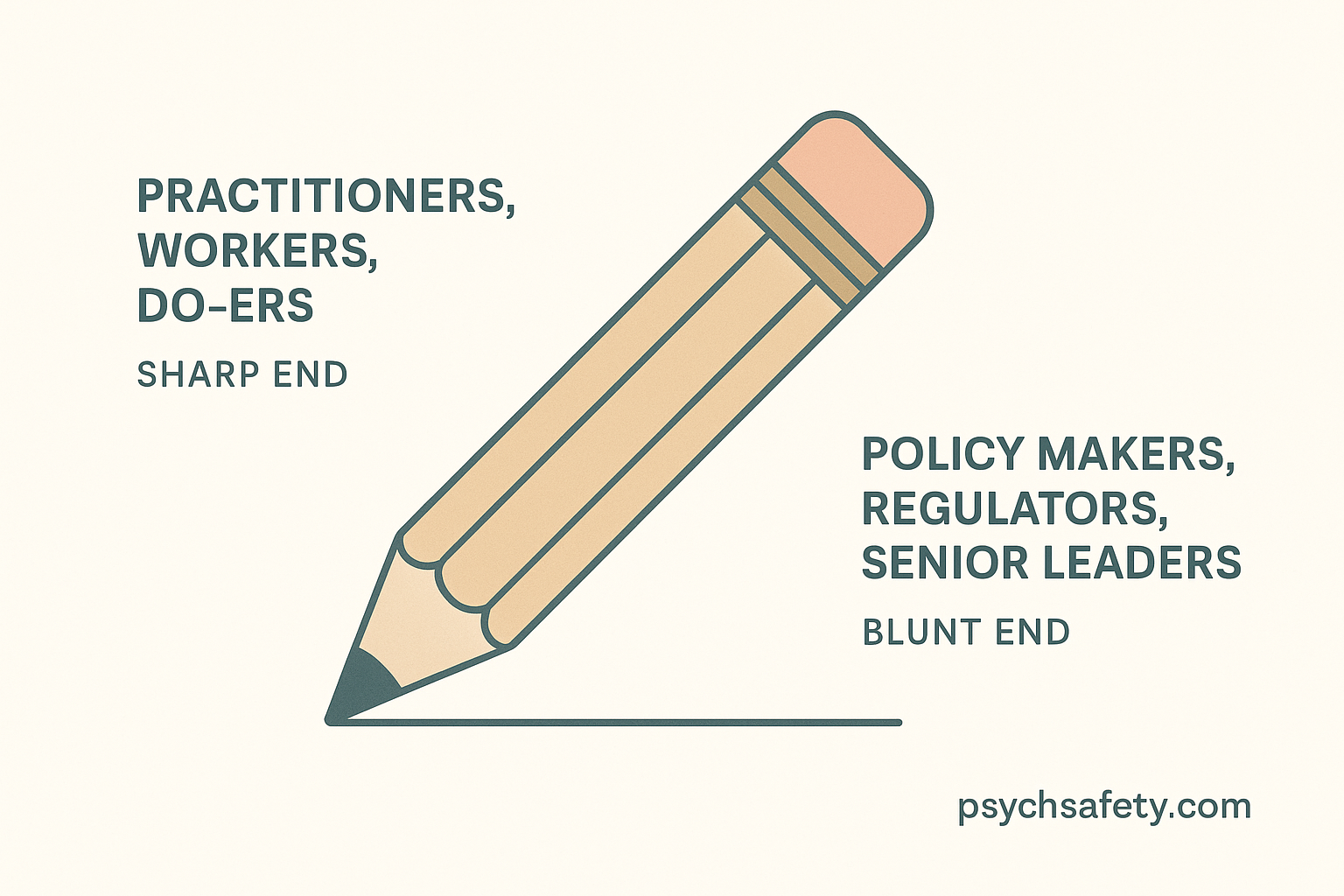
      The Sharp End & Blunt End of Education
      October 3, 2025
    • Forced Vulnerability
      Forced Vulnerability
      September 26, 2025
    • New Sticker Drop! "Zombies Are Scary"
      New Sticker Drop! "Zombies Are Scary"
      September 22, 2025
    • Reflections - Part Four: A Rights-Based Approach

      Reflections - Part Four: A Rights-Based Approach
      September 16, 2025
    • Reflections - Part Three: The Safety to Dissent
      Reflections - Part Three: The Safety to Dissent
      September 12, 2025
    • Reflections - Part Two: Power and Difference
      Reflections - Part Two: Power and Difference
      September 4, 2025
    • The Psychological Safety Trainer Toolkit
      The Psychological Safety Trainer Toolkit
      September 1, 2025
    • Reflections on Psychological Safety: Five Years of Learning
      Reflections on Psychological Safety: Five Years of Learning
      August 29, 2025
    • Not Feeling Seen: Eye Contact and Psychological Safety
      Not Feeling Seen: Eye Contact and Psychological Safety
      August 21, 2025
    • Psychological Safety Isn't Enough
      Psychological Safety Isn't Enough
      August 15, 2025
    • Psych Safety Day / Week 2026
      Psych Safety Day / Week 2026
      August 11, 2025
    • The Amagasaki Disaster
      The Amagasaki Disaster
      August 8, 2025
    • Psychological safety isn't the same for everyone
      Psychological safety isn't the same for everyone
      August 4, 2025
    • Psychological Safety Books for Children
      Psychological Safety Books for Children
      August 1, 2025
    • Carl Rogers, Psychological Safety and Creativity
      Carl Rogers, Psychological Safety and Creativity
      July 25, 2025
    • The State of Psychological Safety Survey: 2025
      The State of Psychological Safety Survey: 2025
      July 19, 2025
    • Barriers to Psychological Safety
      Barriers to Psychological Safety
      July 18, 2025
    • How you respond matters.
      How you respond matters.
      July 11, 2025
    • Practices that Foster Psychological Safety
      Practices that Foster Psychological Safety
      July 4, 2025
    • Feedback in the workplace
      Feedback in the workplace
      June 27, 2025
    • Psych Safety Day 2025
      Psych Safety Day 2025
      June 21, 2025
    • Job Security and Psychological Safety
      Job Security and Psychological Safety
      June 20, 2025
    • How familiar are people with the concept of psychological safety?
      How familiar are people with the concept of psychological safety?
      June 13, 2025
    • Learning at Psych Safety
      Learning at Psych Safety
      June 13, 2025
    • Why do We Foster Psychological Safety?
      Why do We Foster Psychological Safety?
      June 6, 2025
    • Twitter
    • LinkedIn


Sign up to our newsletter & get weekly insights and research

About

The Psychological Safety Team
Our Mission
Our Core Principles
Privacy Policy
Terms of Business

Learn

Corporate Training
Online Workshops
Newsletter
Professional Certification
Explore our semantic knowledge map

Tools

Tool Kits
Articles
What is Psychological Safety?
The History of Psychological Safety

Get Connected

Contact us
Attend a Meetup
Join the Community
Connect with us on LinkedIn
View our YouTube Channel
© 2025 Iterum Ltd
We support LGBTQ+ rights all year round. But we also celebrate pride too.
We support LGBTQ+ rights all year round. But we also celebrate pride!
Content on this website is CC BY-NC-SA
Written by humans, not by AI