

• Psychological Safety
  • Organisational Training
    • – Ignite: Senior Leaders
    • – Impact: Team Workshop
    • – Delivering Feedback
    • – Culture and Neurodiversity
    • – CRM for Non-Aviation Teams
    • – HOP: Human and Organisational Performance
    • – Train the Trainer
    • – Action Learning Sets
  • Online Workshops
    • – Train the Trainer
    • – Fundamentals
    • – Practices
    • – Leadership
    • – Advanced
    • – Measurement
    • – Workshop Facilitation
    • – HOP
    • – Delivering Feedback
    • – Thinking Like an Ecologist
  • Resources
    • – Tool Kits
    • – Free Resources
    • – Newsletter
    • – Articles
    • – Research
    • – Shop
    • – Community
    • – Practices
    • – What is Psychological Safety?
  • About Us
  • Contact
  • Search
  • Org Training
    • Ignite for Senior Leaders
    • Impact Team Workshop
    • Management Masterclass
    • Delivering Effective Feedback
    • Cultural and Neurodiversity
    • HOP: Human and Organisational Performance
    • CRM for Non-Aviation Teams
    • Train the Trainer
    • Action Learning Sets
  • Live Workshops
    • Full Live Course
    • Psychological Safety Fundamentals
    • Practice Masterclass
    • Leadership & Management
    • Advanced Psychological Safety
    • Measuring Psychological Safety
    • Workshop Design and Facilitation
    • HOP Fundamentals
    • Delivering Effective Feedback
    • Thinking Like an Ecologist: A Field Guide for Organisational change
  • On-Demand
    • Psychological Safety 101
psych safety logo white
  • Resources
    • Tool Kits
    • Free Resources
    • Knowledge Network
    • Newsletter
    • Shop
    • Podcasts & Talks
    • Videos
    • Community
    • Events & Psych Safety Days
  • Articles
    • Search
    • What is Psychological Safety?
    • The History of Psychological Safety
    • Psychological Safety Practices
    • Psychological Safety In The Workplace
    • Research
    • Measure Psychological Safety
    • Human and Organisational Performance (HOP)
  • The Psych Safety Team
    • Contact Us
    • About The Team
    • Tom Geraghty
    • Jade Garratt
  • Org Training
    • Ignite for Senior Leaders
    • Impact Team Workshop
    • Management Masterclass
    • Delivering Effective Feedback
    • Cultural and Neurodiversity
    • HOP: Human and Organisational Performance
    • CRM for Non-Aviation Teams
    • Train the Trainer
    • Action Learning Sets
  • Live Workshops
    • Full Live Course
    • Psychological Safety Fundamentals
    • Practice Masterclass
    • Leadership & Management
    • Advanced Psychological Safety
    • Measuring Psychological Safety
    • Workshop Design and Facilitation
    • HOP Fundamentals
    • Delivering Effective Feedback
    • Thinking Like an Ecologist: A Field Guide for Organisational change
  • On-Demand
    • Psychological Safety 101
psych safety logo white
  • Resources
    • Tool Kits
    • Free Resources
    • Knowledge Network
    • Newsletter
    • Shop
    • Podcasts & Talks
    • Videos
    • Community
    • Events & Psych Safety Days
  • Articles
    • Search
    • What is Psychological Safety?
    • The History of Psychological Safety
    • Psychological Safety Practices
    • Psychological Safety In The Workplace
    • Research
    • Measure Psychological Safety
    • Human and Organisational Performance (HOP)
  • The Psych Safety Team
    • Contact Us
    • About The Team
    • Tom Geraghty
    • Jade Garratt
Human and Organisational Performance (HOP)  ·  Newsletter  ·  Psychological Safety  ·  Psychological Safety In The Workplace

Plan Continuation Bias

December 12, 2025 • by Tom Geraghty

Plan Continuation Bias, or “Get-There-Itis”

I got pretty sick this week. I was wiped out with a nasty bout of tonsillitis – high temperature, exhausted and felt awful. The doctor put me on strong antibiotics, painkillers, and told me, in no uncertain terms, to rest up and take it easy. 

What felt even worse than the illness was having to cancel a client workshop. As far as I can remember, we haven’t cancelled one in about four years. We usually manage to build in enough redundancy for someone else to deliver it, but this time, for various logistical reasons, it just wasn’t possible.

And we really wrestled with it. We spent far too long trying to find a way to make it work. Maybe I could load up on painkillers and caffeine. Maybe the 3 hour drive there, delivering the workshop, driving back and then collapsing wouldn’t be that bad. Maybe I could just power through on adrenaline. 

Looking back, I can see all the forces pulling us toward keeping the plan on track: a worry about disappointing the client; all the preparation, travel planning and childcare we’d already arranged; and, if I’m honest, the deeply normalised idea that “pushing through” is the right thing to do. All of that created a powerful feeling that we should still try to deliver.

In reality it would have been a very bad idea for me, for the client, and for other road users! Eventually, we contacted the client, postponed the session… and they were perfectly fine about rescheduling.

This fierce desire to continue with the plan, even though it no longer makes any sense, or is actually unsafe to do so, is a great example of plan continuation bias.

What Is Plan Continuation Bias?

Plan continuation bias (also known as get-there-itis in aviation, course correction bias, or “summit fever” in mountaineering) is the cognitive tendency to stick with an existing plan even when the conditions have changed and the plan no longer makes sense or isn’t safe to continue.

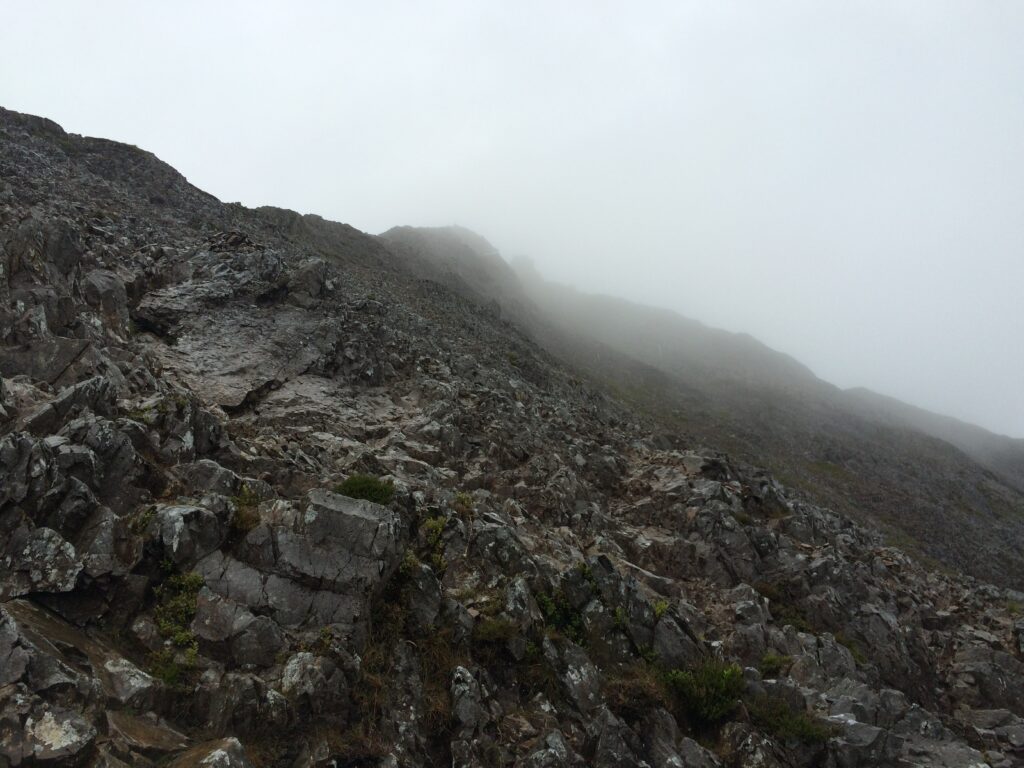
It’s best known in aviation, where get-there-itis means that pilots may press on with planned courses in bad weather, continue flights with marginal fuel, or persist with unstable approaches that should really demand a go-around. The same pattern is common in mountaineering, and I’ve got many experiences of this myself – I can particularly remember one occasion on Crib Goch where we reluctantly turned around after bad weather set in, but the decision itself was really hard, almost emotionally painful, because we were already well up onto the ridge.

climbing crib goch
crib goch ridge

It happens in healthcare too, where teams continue to attempt procedures when it’s time to stop or change (as in the tragic case of Elaine Bromiley), and we also see it in product or project teams, where people press on towards the original brief even though the context around them has completely changed.

It’s worth noting that plan continuation bias isn’t plain old stubbornness – it’s about how we humans make sense of the world, particularly when we’re under pressure, operating in uncertainty, and subject to social risk.

“You’ve got to know when to hold ’em, know when to fold ’em.”
— Kenny Rogers

Cognitive load and confirmation bias.

When we’re under high workload and time pressure, our attention naturally narrows on the task – the goal we’re trying to achieve. We may simply not have the bandwidth to process everything, and our confirmation bias means that we pay more attention to information that appears to support the plan, and discount, or don’t even see, information that suggests we should change course. So even when most of the signs point towards “turn back”, we cling to the scraps of evidence that say “it’ll be fine, keep going”.

This is one reason why we can often spot plan continuation in hindsight, and it can become something of a counterfactual, as “obviously wrong” after it’s already happened. Although to an outside observer afterwards, it seems obvious that we should have changed course, this may have been cognitively invisible to the person in the moment. 

Sunk cost fallacy

There’s a strong sunk cost element to plan continuation – when we’ve already invested time, money, effort, and reputation something, it means that stopping or changing direction feels like a failure: “We’ve put so much into this, we can’t stop now.”

But of course, that’s a fallacy, even though it feels right and noble to continue. It doesn’t make sense to keep pouring resources into something that’s no longer going to deliver value, or is actively unsafe to ourselves or others. Yet the more we have invested, and the closer we are to our goal, the more we tend to rationalise continuing.

Power, authority, and interpersonal risk

Plan continuation bias is compounded when the plan was defined by someone in power – a CEO, senior leader, major client, or powerful stakeholder. In these cases, we may well predict that challenging that goal is likely to incur interpersonal or career risk. None of us want to disappoint our boss, and challenging decisions that were made by someone with power over our employment status or career success is rarely easy. And of course, there are other risks too. We might worry that in raising concerns about the plan, we’ll be seen as a poor team player, as not being “committed enough”, or as the negative one in the group.

We humans tend to have a deep need for harmony and belonging, so continuing with the plan often feels more coherent, comfortable and socially safe than being the dissident who says, “We should stop.”

Symbolic goal fixation 

Some goals become symbolic of what overall “success” means – in mountaineering, it’s the summit, but in organisations, it might be a launch date, a target, or an OKR. This is especially true if that goal has been made public, or committed to with large posters and announcements. Sometimes organisations even use mountaineering metaphors to describe these lofty and ambitious goals. All this can mean that we drift into an all-or-nothing mindset where summit = success, and turning back = failure.

If you’ve read Jon Krakauer’s Into Thin Air about the Everest disaster in the ’90s (Everest is the colonial name for the mountain known locally as Sagarmāthā in Nepal and Qomolangma in Tibet), you’ll be familiar with this story: along with other errors and misjudgements, some climbers pushed for the summit even after bad weather set in and the safe window had closed. Summit fever, along with a great deal of sunk cost (it’s expensive to climb Everest, and climbers spend months preparing) meant that climbers became fixated on this singular goal of summiting Everest at any cost. For many of them, that cost was their lives. 

But as one of my climbing instructors used to say “Getting up is optional. Getting down is mandatory.” (I don’t think he was the first to say this!)

The same goes for organisations delivering projects and products: the real failure isn’t “we didn’t ship,” but shipping something that no longer makes sense and delivers no real value. It’s much wiser to be here the following day to try something new, than to risk the business, or our lives, on a potentially already failed project.

“Hazardous attitudes”

CRM (Crew Resource Management) in aviation talks about five “hazardous attitudes” that make plan continuation bias more likely:

  • Macho: “I can handle it. I’m the expert.” This is practically one of the definitions of toxic masculinity: a sense of superiority, or an anxious need to prove oneself in the face of adversity.
  • Impulsivity and a bias to action: “We should do something.” We often assume that action is better than inaction, and we tend to regret waiting, or pausing, more than we do taking a step – even a misguided one. In many organisations, people are punished more for not doing something (for holding back until they can make a better informed move) than for acting too quickly, even when it would make greater sense to pause and allow more information to surface.
  • Invulnerability: “It won’t happen to me.” Success can incubate failure. Just because it’s gone right in the past, doesn’t mean it will this time. Indeed, if it had gone wrong in the past, we possibly wouldn’t even be here to make this judgement.
  • Resignation: “What’s the use? I can’t change this.” We may feel that once we’ve settled on a plan, we’re stuck on the railway tracks, unable to change direction. But we are not trains – we can make decisions based on new information, and change direction. And even trains have brakes.
  • Anti-authority: “I’m special. The rules don’t apply to me.” In so many books and movies, the hero is the subversive renegade who breaks the rules and succeeds. But real life doesn’t always play out the way movies do. Ignoring new risks because we believe we’re the exception doesn’t actually make the risk go away. 

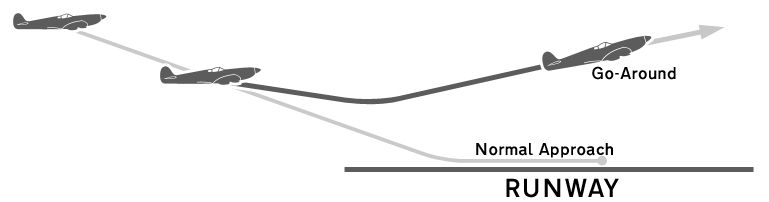
All of these can mean that we’re more likely to press on than to pause, turn back, or “go around”.

By Ericg – https://en.wikipedia.org/wiki/Image:Go-around.png. Public Domain

Organisational Examples: Projects, Products, and OKRs

In product teams this shows up all the time. We might carry on building a feature even after a competitor has released something better and captured most of the market. We may stick to an OKR even though conditions have shifted and the objective is no longer a good idea. We become so fixated on achieving the “key result” that we stop asking whether it’s still a useful or sensible result. 

If the objective is the summit and the key result is “Reach the summit camp by 3pm”, what happens when a storm rolls in at midday?

In other cases in organisations, we simply keep burning money and time on a project that clearly won’t deliver the hoped-for return. Often because the goal has been cascaded from “higher up”, and as with symbolic goal fixation, not hitting it is framed as failure. “We said we’d deliver X by date Y” becomes more important than checking “Is X still the right thing to do?” This pressure intensifies when goals are publicly announced, a tactic often intended to “motivate” teams to deliver but which frequently drives teams to chase the original commitment rather than pursue the best outcome

Without psychological safety and sound decision practices, teams will often keep climbing to the summit because that’s the OKR, even when it’s clearly unsafe or pointless.

A Plan Continuation Feedback Loop

Plan continuation bias is dangerous because it becomes a feedback loop:

  • The closer we get to the goal, the harder it feels to turn back.
  • The more we invest, the more we rationalise continuing.
  • The more things go wrong, the more urgent it feels to “just get it done”.

Research in aviation suggests that a large proportion of decision errors, (some suggest the majority of errors) are essentially plan continuation errors: pressing on when the safer option was to stop, divert, or go around. Charles West wrote about this goal proximity dynamic in “The Barn Door Effect”: pilots who would normally deviate widely around severe convective weather while en route often continue final approaches directly beneath dangerous thunderstorms when landing, simply because they can see the runway (the “barn door”) and because aircraft ahead of them have done so successfully (social proof of the Normalisation of Risk).

This certainly isn’t unique to pilots. It’s fundamental to how humans behave in dynamic, uncertain environments.

Where Psychological Safety Fits with Plan Continuation Bias

Psychological safety doesn’t magically remove plan continuation bias, but it can provide some counter-pressure that helps to interrupt this feedback loop. In groups with higher psychological safety, people are generally more willing to say things like “Are we still doing the right thing?”, and point out issues like a storm coming or a competitor’s similar product launch. People feel safer in pulling the Andon Cord, call to Stop Work, or suggest a go-around. 

However, in teams with lower psychological safety, plan continuation bias is structurally reinforced, because people are more likely to stay silent with those insights, perspectives or concerns. If we’re in a team with low psychological safety, we don’t want to disrupt the group harmony, offend someone in power, or risk damaging our own status or reputation. We may end up pressing ahead not because it’s the right thing to do, but because it feels less interpersonally risky than challenging the plan itself.

Photo by Mikhail Nilov: https://www.pexels.com/photo/a-close-up-shot-of-golf-cart-pedals-9207748/ 

How to Reduce Plan Continuation Bias

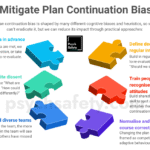
Plan continuation bias is a deeply human tendency shaped by many different cognitive biases and heuristics, so we can’t eradicate it, but we can reduce its impact through some practical approaches:

1. Define exit criteria in advance. We agree in advance that if certain criteria are met, we stop, change direction, or take an opportunity to re-evaluate. For example, if a competitor releases an equivalent or potentially better product, we reconsider the business case. Or if certain safety thresholds are crossed – deteriorating weather conditions or issues with the equipment – we pause or “go around”. Pre-defining the criteria for interrupting the loop takes some of the emotional and interpersonal load off making the call in the moment.

2. Establish decision points at regular intervals. Similar to above, we can also build in regular check-in points to re-evaluate and consider “Should we still be doing this?” or simply regularly ask ourselves “Do we continue, pivot, or stop?”. If we were climbing a mountain, we may check in every 30 minutes and simply ask “Are we all still good to go?” The point is to deliberately reopen the question, not simply assume the plan is still valid.

3. Invite dissent explicitly. Sometimes called “devil’s advocate”, but I prefer the less evocative and more straightforward practice of “inviting dissent” by asking things like “What are we missing?”, “How could we see this differently?”, or even “We’re not leaving this meeting until we’ve heard five reasons why this is a bad idea.” We may even designate a small “red team” whose job is to be strategically awkward: to poke holes in the plan and look for reasons we shouldn’t continue.

4. Train people to recognise hazardous attitudes. This is deeper work, often part of CRM and similar training, to help people notice these hazardous attitudes emerging – in themselves and in others. That might include an inappropriate bias to action, a sense of invulnerability, resignation or resistance to authority. The aim isn’t to blame or single people out, but to build shared literacy and the skill to spot and respond to the attitudes that make continuation bias more likely.

5. Build diverse teams. The more diverse the team in background, expertise, perspectives, and experience, the more likely it is that people in the team will see what others have missed. Diversity, in its many facets, increases the chances that someone will notice the storm building on the horizon.

6. Finally, normalise and reward course correction. This is perhaps the biggest cultural shift, and the most impactful (but rather more difficult, organisationally). Stopping, cancelling, or changing course when it no longer makes sense to continue should be seen as success, not failure. That might look like celebrating teams who say, “This project no longer makes sense so we’re stopping it and moving onto something of higher value,” or explicitly rewarding people who highlight new risks or factors reducing the value of a project. Storytelling can be a powerful tool here too, by having open discussions about times when not continuing saved money, delivered greater value, or saved lives. Fundamentally, changing the plan should be framed as competent, expert, adaptive behaviour, not as failure.

reduce plan continuation bias with these 6 practices

Summarising Plan Continuation Bias

Reflecting on this piece, I’d describe plan continuation bias like this: 

Plan continuation bias is the cognitive, emotional and social tendency to stick with an established plan even when new information or changing conditions mean it no longer makes sense, is unlikely to deliver value, or increases risk to intolerable levels. It’s amplified by confirmation bias, workload and pressure, ever higher sunk costs and proximity to the goal, symbolic goal fixation, power dynamics, and the myriad interpersonal risks of challenging the plan; and it often leads individuals and teams to press on long after they should adapt or stop.

And sometimes, avoiding it is as simple (and as difficult) as admitting that you might be too poorly to drive across the country and deliver a workshop.

Further resources on plan continuation bias:

Managing Plan Continuation Bias with Mike Adolph on the Delivering Adventure Podcast

Orasanu, J., Martin, L., Davison, J. and Null, C.H., 1998, January. Errors in aviation decision making: Bad decisions or bad luck?. In Fourth Conference on Naturalistic Decision Making. https://ntrs.nasa.gov/api/citations/20020063485/downloads/20020063485.pdf 

“Just a Routine Operation” Martin Bromiley.

Continuation Bias: SKYbrary Aviation Safety. https://skybrary.aero/articles/continuation-bias

West, C.A., 2009. The “Barn Door” Effect. In Proceedings of the 14th Conference on Aviation, Range, and Aerospace Meteorology. https://ams.confex.com/ams/pdfpapers/162457.pdf 

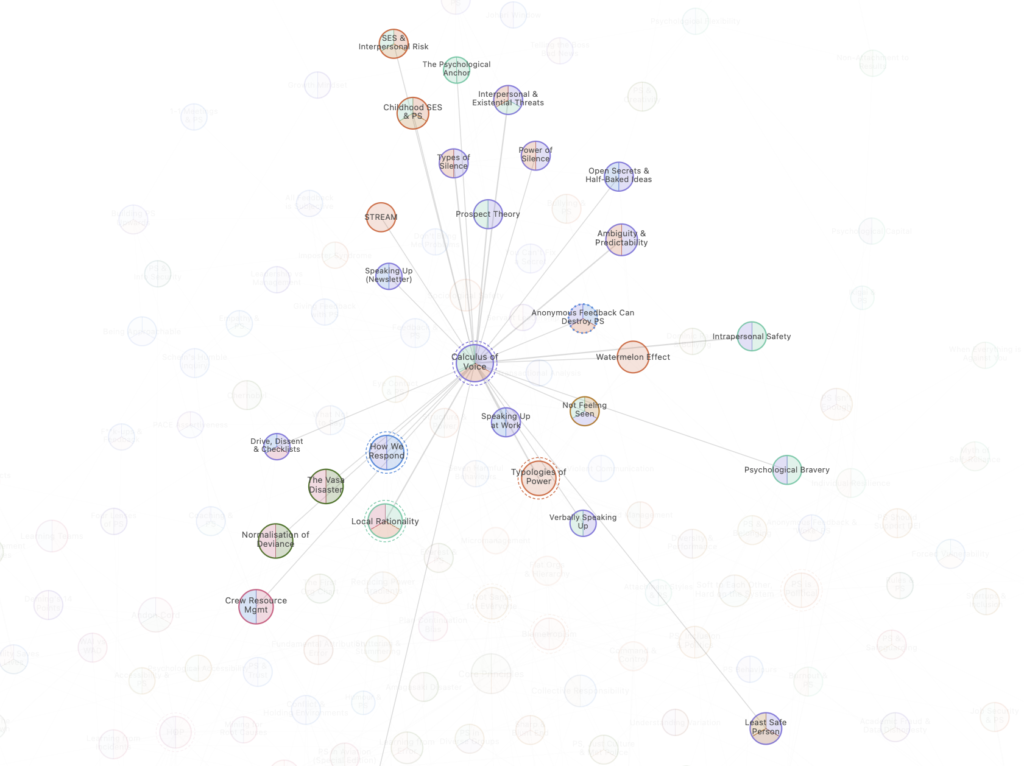
See how this article connects
Explore its relationships with other ideas in the knowledge network.
Explore in network →

blamecounterfactualshindsightHOPleadershipmanagementnormalisation of devianceplan continuation biaspsychological safetysafety

Tom Geraghty

Tom Geraghty, co-founder and delivery lead at Iterum Ltd, is an expert in high performing teams and psychological safety. Leveraging his unique background in ecological research and technology, Tom has held CIO/CTO roles in a range of sectors from tech startups to global finance firms. He holds a degree in Ecology, an MBA, and a Masters in Global Health. His mission is to make workplaces safer, higher performing, and more inclusive. Tom has shared his insights at major events such as The IT Leaders Summit, the NHS Senior Leadership Conference, and EHS Global Conferences. Connect with him on LinkedIn or email tom@psychsafety.com

Related Articles


kanban
Newsletter  ·  Psychological Safety
Psychological Safety: Making Work Visible
July 8, 2022
popular practices that foster psychological safety
Newsletter  ·  Psychological Safety  ·  Psychological Safety In The Workplace  ·  Theory and Research
Practices that Foster Psychological Safety
July 4, 2025
justice scales
Whistleblowing and Psychological Safety
Previous Article
Psych Safety 2025 Unwrapped
Next Article
  • Subscribe to the Psychological Safety Newsletter

  • psychological safety train the trainer
  • Get Certified! Join online workshops, or explore training and consultancy for leaders, teams and organisations.

    Discover our training options for Human and Organisational Performance and CRM for non-aviation teams.

    If you're a trainer, consultant or facilitator, get certified in our Train the Trainer complete online programme and download the Training Materials for Facilitators and Trainers.

  • psychological safety on-demand training
  • building and maintaining psychological safety for your team
    Download the complete Practitioners' guide to psychological safety
  • psychological safety trainer toolkit
  • Download the Psychological Safety Trainer Toolkit. Containing powerful resources that you can use to deliver your own training and workshops!

  • psych safety logo

    Sponsorship and advertising. Reach over 11,000 weekly readers and 500,000 online visitors with your message in our newsletter.

  • theres no such thing as too much psychological safety
    Grab Psychological Safety Stickers from our Online Shop!
  • Psych Safety Day

    Find out more about our Psych Safety Days - in-person and virtual events to share, learn, and connect with other enthusiasts, practitioners and researchers on psychological safety and related topics.

  • Psychological Safety Knowledge Network

    Use our Psych Safety Semantic Knowledge Map to explore hundreds of articles, papers, resources and tools. 

  • Categories

    • Newsletter
    • Psychological Safety
      • Create and Maintain
      • Human and Organisational Performance (HOP)
      • In Technology
      • Learning and Development
      • Measure
      • Psychological Safety In The Workplace
      • Theory and Research
  • Recent Posts

    • Reading the air: high and low context communication in teams

      Reading the air: high and low context communication in teams
      June 8, 2026
    • Who gets to decide if psychological safety matters?
      Who gets to decide if psychological safety matters?
      June 5, 2026
    • Accountability
      Accountability
      May 29, 2026
    • Qualitative Measurement of Psychological Safety

      Qualitative Measurement of Psychological Safety
      May 22, 2026
    • The Psych Safety Knowledge Map
      The Psych Safety Knowledge Map
      May 15, 2026
    • Ambiguity, predictability, and psychological safety

      Ambiguity, predictability, and psychological safety
      May 1, 2026
    • The Calculus of Voice
      The Calculus of Voice
      April 23, 2026
    • Contracting and recontracting
      Contracting and recontracting
      April 16, 2026
    • The Vasa
      The Vasa
      April 1, 2026
    • Learning from Error, or Punishing It?
      Learning from Error, or Punishing It?
      March 27, 2026
    • The “Utility” of Psychological Safety
      The “Utility” of Psychological Safety
      March 20, 2026
    • Psychological Flexibility
      Psychological Flexibility
      March 19, 2026
    • Be soft to each other, and hard on the system

      Be soft to each other, and hard on the system
      March 12, 2026
    • "Fake it till you make it"
      "Fake it till you make it"
      March 12, 2026
    • The SANE Effect
      The SANE Effect
      February 20, 2026
    • Learning Teams
      Learning Teams
      January 30, 2026
    • ST.R.E.A.M: Status Rules Everything Around Me

      ST.R.E.A.M: Status Rules Everything Around Me
      January 23, 2026
    • Growth Mindset
      Growth Mindset
      January 16, 2026
    • The Streetlight Effect
      The Streetlight Effect
      January 8, 2026
    • The "Fist of Five"
      The "Fist of Five"
      December 19, 2025
    • Psychological Bravery
      Psychological Bravery
      December 18, 2025
    • Psych Safety Book List 2025
      Psych Safety Book List 2025
      December 18, 2025
    • Psych Safety 2025 Unwrapped
      Psych Safety 2025 Unwrapped
      December 15, 2025
    • Plan Continuation Bias
      Plan Continuation Bias
      December 12, 2025
    • Whistleblowing and Psychological Safety
      Whistleblowing and Psychological Safety
      December 4, 2025
    • How Childhood Socioeconomic Status Shapes Psychological Safety and Career Risk-Taking at Work
      How Childhood Socioeconomic Status Shapes Psychological Safety and Career Risk-Taking at Work
      November 27, 2025
    • Safety and the Myth of Self-Reliance
      Safety and the Myth of Self-Reliance
      November 24, 2025
    • The Watermelon Effect and "Greenwashing"

      The Watermelon Effect and "Greenwashing"
      November 7, 2025
    • Individual Resilience
      Individual Resilience
      October 31, 2025
    • Counterfactuals
      Counterfactuals
      October 24, 2025
    • Coaching and Psychological Safety
      Coaching and Psychological Safety
      October 17, 2025
    • Five Ecological Concepts for Working in Organisational Change

      Five Ecological Concepts for Working in Organisational Change
      October 9, 2025
    • The Sharp End & Blunt End of Education
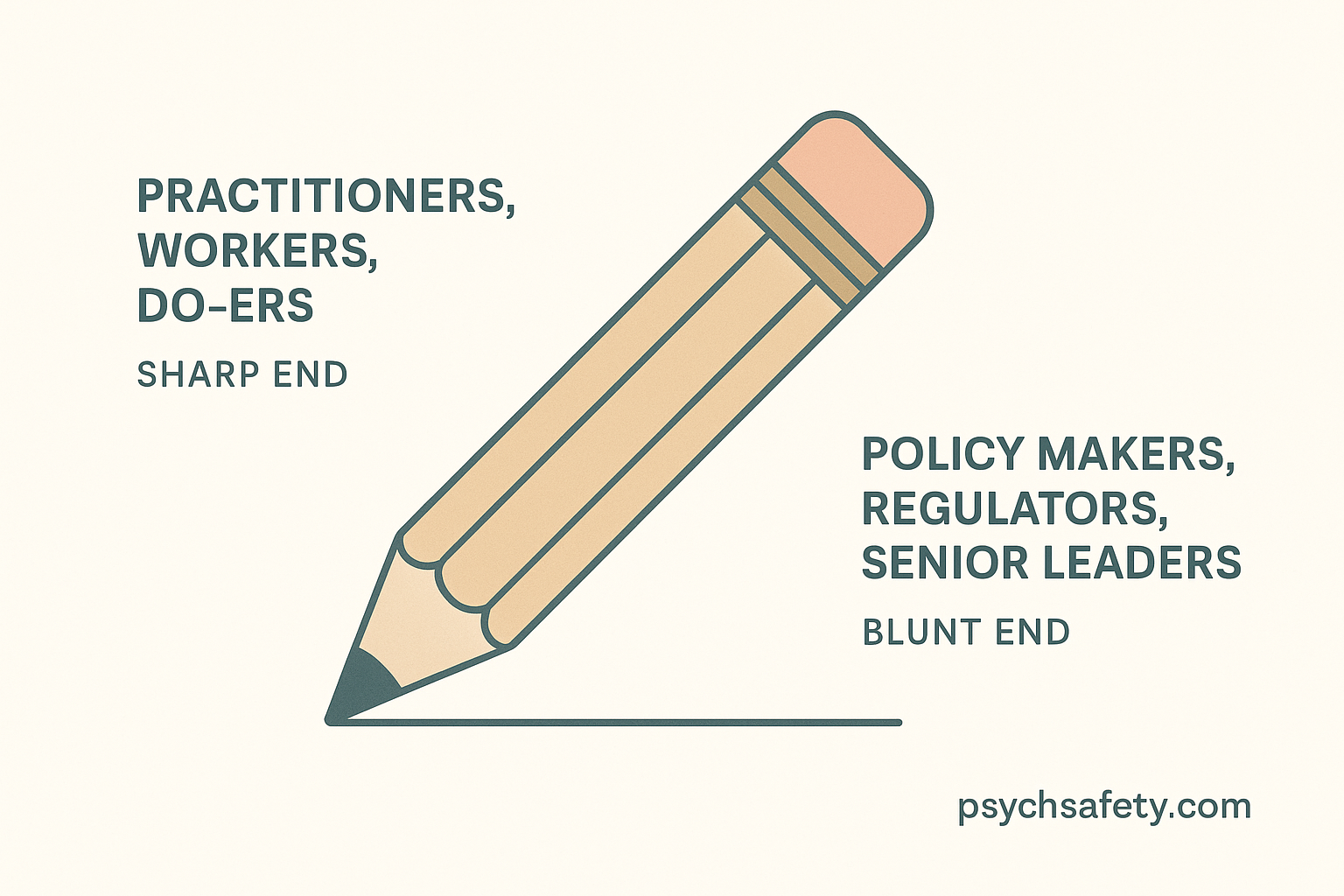
      The Sharp End & Blunt End of Education
      October 3, 2025
    • Forced Vulnerability
      Forced Vulnerability
      September 26, 2025
    • New Sticker Drop! "Zombies Are Scary"
      New Sticker Drop! "Zombies Are Scary"
      September 22, 2025
    • Reflections - Part Four: A Rights-Based Approach

      Reflections - Part Four: A Rights-Based Approach
      September 16, 2025
    • Reflections - Part Three: The Safety to Dissent
      Reflections - Part Three: The Safety to Dissent
      September 12, 2025
    • Reflections - Part Two: Power and Difference
      Reflections - Part Two: Power and Difference
      September 4, 2025
    • The Psychological Safety Trainer Toolkit
      The Psychological Safety Trainer Toolkit
      September 1, 2025
    • Reflections on Psychological Safety: Five Years of Learning
      Reflections on Psychological Safety: Five Years of Learning
      August 29, 2025
    • Not Feeling Seen: Eye Contact and Psychological Safety
      Not Feeling Seen: Eye Contact and Psychological Safety
      August 21, 2025
    • Psychological Safety Isn't Enough
      Psychological Safety Isn't Enough
      August 15, 2025
    • Psych Safety Day / Week 2026
      Psych Safety Day / Week 2026
      August 11, 2025
    • The Amagasaki Disaster
      The Amagasaki Disaster
      August 8, 2025
    • Psychological safety isn't the same for everyone
      Psychological safety isn't the same for everyone
      August 4, 2025
    • Psychological Safety Books for Children

      Psychological Safety Books for Children
      August 1, 2025
    • Carl Rogers, Psychological Safety and Creativity

      Carl Rogers, Psychological Safety and Creativity
      July 25, 2025
    • The State of Psychological Safety Survey: 2025
      The State of Psychological Safety Survey: 2025
      July 19, 2025
    • Barriers to Psychological Safety
      Barriers to Psychological Safety
      July 18, 2025
    • How you respond matters.
      How you respond matters.
      July 11, 2025
    • Practices that Foster Psychological Safety
      Practices that Foster Psychological Safety
      July 4, 2025
    • Feedback in the workplace
      Feedback in the workplace
      June 27, 2025
    • Psych Safety Day 2025
      Psych Safety Day 2025
      June 21, 2025
    • Job Security and Psychological Safety
      Job Security and Psychological Safety
      June 20, 2025
    • How familiar are people with the concept of psychological safety?
      How familiar are people with the concept of psychological safety?
      June 13, 2025
    • Twitter
    • LinkedIn


Sign up to our newsletter & get weekly insights and research

About

The Psychological Safety Team
Our Mission
Our Core Principles
Privacy Policy
Terms of Business

Learn

Corporate Training
Online Workshops
Newsletter
Professional Certification
Explore our semantic knowledge map

Tools

Tool Kits
Articles
What is Psychological Safety?
The History of Psychological Safety

Get Connected

Contact us
Attend a Meetup
Join the Community
Connect with us on LinkedIn
View our YouTube Channel
© 2025 Iterum Ltd
We support LGBTQ+ rights all year round. But we also celebrate pride too.
We support LGBTQ+ rights all year round. But we also celebrate pride!
Content on this website is CC BY-NC-SA
Written by humans, not by AI