
• Psychological Safety
  • Organisational Training
    • – Ignite: Senior Leaders
    • – Impact: Team Workshop
    • – Delivering Feedback
    • – Culture and Neurodiversity
    • – CRM for Non-Aviation Teams
    • – HOP: Human and Organisational Performance
    • – Train the Trainer
    • – Action Learning Sets
  • Online Workshops
    • – Train the Trainer
    • – Fundamentals
    • – Practices
    • – Leadership
    • – Advanced
    • – Measurement
    • – Workshop Facilitation
    • – HOP
    • – Delivering Feedback
    • – Thinking Like an Ecologist
  • Resources
    • – Tool Kits
    • – Free Resources
    • – Newsletter
    • – Articles
    • – Research
    • – Shop
    • – Community
    • – Practices
    • – What is Psychological Safety?
  • Measure Psychological Safety
  • About Us
  • Contact
  • Search
  • Org Training
    • Ignite for Senior Leaders
    • Impact Team Workshop
    • Management Masterclass
    • Delivering Effective Feedback
    • Cultural and Neurodiversity
    • HOP: Human and Organisational Performance
    • CRM for Non-Aviation Teams
    • Train the Trainer
    • Action Learning Sets
  • Live Workshops
    • Full Live Course
    • Psychological Safety Fundamentals
    • Practice Masterclass
    • Leadership & Management
    • Advanced Psychological Safety
    • Measuring Psychological Safety
    • Workshop Design and Facilitation
    • HOP Fundamentals
    • Delivering Effective Feedback
    • Thinking Like an Ecologist: A Field Guide for Organisational change
  • On-Demand
    • Psychological Safety 101
psych safety logo white
  • Resources
    • Measure Psychological Safety
    • Tool Kits
    • Free Resources
    • Newsletter
    • Shop
    • Podcasts & Talks
    • Videos
    • Community
    • Events & Psych Safety Days
    • The Field Guide
  • Articles
    • What is Psychological Safety?
    • The History of Psychological Safety
    • Psychological Safety Practices
    • Psychological Safety In The Workplace
    • Research
    • Human and Organisational Performance (HOP)
  • The Psych Safety Team
    • Contact Us
    • About The Team
    • Tom Geraghty
    • Jade Garratt
  • Org Training
    • Ignite for Senior Leaders
    • Impact Team Workshop
    • Management Masterclass
    • Delivering Effective Feedback
    • Cultural and Neurodiversity
    • HOP: Human and Organisational Performance
    • CRM for Non-Aviation Teams
    • Train the Trainer
    • Action Learning Sets
  • Live Workshops
    • Full Live Course
    • Psychological Safety Fundamentals
    • Practice Masterclass
    • Leadership & Management
    • Advanced Psychological Safety
    • Measuring Psychological Safety
    • Workshop Design and Facilitation
    • HOP Fundamentals
    • Delivering Effective Feedback
    • Thinking Like an Ecologist: A Field Guide for Organisational change
  • On-Demand
    • Psychological Safety 101
psych safety logo white
  • Resources
    • Measure Psychological Safety
    • Tool Kits
    • Free Resources
    • Newsletter
    • Shop
    • Podcasts & Talks
    • Videos
    • Community
    • Events & Psych Safety Days
    • The Field Guide
  • Articles
    • What is Psychological Safety?
    • The History of Psychological Safety
    • Psychological Safety Practices
    • Psychological Safety In The Workplace
    • Research
    • Human and Organisational Performance (HOP)
  • The Psych Safety Team
    • Contact Us
    • About The Team
    • Tom Geraghty
    • Jade Garratt
Human and Organisational Performance (HOP)  ·  Newsletter  ·  Psychological Safety In The Workplace

Complexity

July 7, 2023 • by Tom Geraghty

A man goes out on the beach and sees that it is covered with starfish that have washed up in the tide. A little boy is walking along, picking them up and throwing them back into the water. “What are you doing, son?” the man asks. “You see how many starfish there are? You’ll never make a difference.” The boy paused thoughtfully, and picked up another starfish and threw it into the ocean. “It sure made a difference to that one.”


This parable features in “Half The Sky, How to Change the World” by Nicholas Kristof and Sheryl Wudunn, which is an incredible book that makes a powerful case for investing in women and girls in order to address inequity and poor public health (especially of children). The authors refer to it as a Hawaiian parable told to them by a friend, although I’ve also seen it credited as adapted from “The Star Thrower” by Loren C. Eiseley. Maybe it’s both, but either way, I love it. They use it to highlight the need for action even when it seems it futile in the face of great challenges.

Sometimes complexity and scale can mean we see a problem as so big, so difficult, that we are put off even trying. We may feel that a single psychological safety practice isn’t going to transform an organisation, so why bother? But just like the starfish being thrown into the sea, that practice, exercise or small change may make a positive difference to some people, and that makes it worthwhile. Plus, we never know – sometimes the smallest acts can catalyse self-sustaining movements.


Models such as Cynefin (above) and Ralph Stacey’s Matrix (below), show us that we cannot pre-plan our whole way through complex organisational change. We can only take intelligent actions, experiment and learn: probe-sense-respond. We can plan, of course, but what we need to plan is a series of experiments.


Additionally, in a large, complex system, it’s often impossible to distinguish the effect of any one particular action or actor on the overall system, because there are too many variables at play. This can make it impractical to gauge the impact of a specific intervention. So maybe the best thing we can do is to act and try to help, in potentially small ways, and learn from the process of doing so. We can make small improvements to the organisational substrate. We can’t prove that a single practice transformed the organisation, but we can know that it made a difference to some people. This may also just become the thing that pushes the needle far enough for a great transformation to begin.

Credit: Virpi Oinonen


I’ve always liked the saying, “The person who says it cannot be done should not interrupt the person doing it.” (Often misattributed to George Bernard Shaw). Just because we can’t know for sure that we’ll be successful, or even be able to measure the impact of our actions, doesn’t mean we shouldn’t act. To loop back to our parable, we absolutely should throw the starfish into the sea.


As a demonstration of the power of small changes to have a large impact, I was thrilled to hear recently from Eileen McCarthy, who has now attended two of our Psychological Safety “Practice Masterclass” workshops. After attending last year, Eileen implemented a number of the practical ideas she took away from the session about improving psychological safety, one being the Andon Cord practice. You can read below her account of the incredible impact that it had on culture and patient safety.

After learning about the Andon cord story, I was awestruck.  The thought that an organization could be so immediately responsive to a defect changed my perspective on how we deal with patient safety issues in healthcare.  If a car manufacturer could respond so quickly and positively to an issue, why couldn’t we do the same in an industry where people’s lives are at stake?  I felt compelled to bring this practice to my organization as part of our journey to a Just Culture.
 
Over the course of a year, we introduced the Andon cord concept and worked with managers and front-line teams to develop similar practices in our Ambulatory Surgery Centers. Our key focus was creating a speak-up culture and immediate, positive team response.  As a result of our efforts, we have seen improvement in every domain of our Just Culture Survey from the previous year.  In some areas, we saw as much as a 30% improvement. 
 
Many of our staff and leaders reacted similarly to the Andon cord story as I did.  Staff are excited about the idea of a swarm response to a safety issue.  Imagine if we could provide the same safety net to our teams in the healthcare industry.  It could transform patient safety.


Eileen McCarthy, Patient Safety Program Manager at Kaiser Foundation Health Plan of the Mid-Atlantic States


Psychological safety and complexity

As you’ve probably gathered by now, the theme of this newsletter is not allowing complexity and scale to become a barrier to action – these articles and resources all speak to this idea… 

This is fantastic: “Explode on Impact” by Toby Lowe. In complex environments such as public service and social action, it is practically impossible for organisations to demonstrate their unique impact due to the intricate and interconnected nature of complex systems. When organisations (or people) are asked to quantify or justify their impact, it often leads to a ‘corruption of data’ or a false narrative that we tell ourselves and others, creating an unrealistic portrayal of our role in generating change. We make up a story – one that makes sense to us and others, but one that is ultimately not true. This can hinder further work rather than improve it. Instead of asking organisations to demonstrate their impact, we should experiment, learn, and adapt collaboratively. This more accurately represents how impact is achieved in complex environments and is also likely to lead to healthier systems and better outcomes.

This systems map of the outcome of obesity attempts to illustrate complexity and causality — however, it remains a narrow field representation of linear causality. A better visual representation of a complex system would probably be the below:

Photo by Nick Perez on Unsplash
Photo by Nick Perez on Unsplash: The Ecotone between a forest and the sea.

In this post, Tanmay Vora explores seven key aspects of Da Vinci’s mindset, inspired by a book by Michael Gelb, “How to Think Like Leonardo Da Vinci”. Aspect 4 is particularly relevant: Sfumato (Being Comfortable with Ambiguity).

Here, Greg Satell challenges the idea that we need to “break down” silos and hierarchies. Hierarchies can be a force for good (indeed, they often are), and silos can be too. “…instead of trying to break down silos, we need to connect them. Network science tells us that it takes just a small amount of boundary-spanning “random connections,” in order to bring social distance crashing down. We can’t just look at organizational charts, but need to focus on how meaningful relationships form in the real world.” Just as Toby Lowe describes, it is no longer possible to achieve results by simply planning and directing work; instead, we must empower, experiment, learn, and adapt.

Of course, the way we think a hierarchy works is rarely the way it works in practice. Commonly this is known as the difference between “formal structure” and “informal structure”. In this LinkedIn post, Valdis Krebs shares the difference between how an organisation might map or plan a formal structure, and how the emergent structure actually works in practice.

I love this piece by J. B. Rainsberger about false dichotomies. In this case, they explore the false dichotomy between leadership and management, which are interrelated and interdependent of each other, particularly in complex systems. J.B. highlights a way to look for alternative interpretations in order to identify false dichotomies like this, and also points out:

  • Lead when you can, manage when you must.
  • Manage systems, but lead people.


Finally, one of the best pieces about actually working in and with complexity that I’ve ever read, by Fred Hebert, staff SRE at Honeycomb.io. Fred touches on nominal and emergent structures (as Valdis alludes to above), work as imagined vs work as done, cognitive load, local rationality, feedback loops, and notes that none of this is possible without psychological safety. Basically Fred’s article is everything that we geek out on in this newsletter, wrapped in a blanket of complexity. 

See how this article connects
Explore its relationships with other ideas in the knowledge network.
Explore in network →

cognitive loadcomplexitycynefinpsychological safetyscale

Tom Geraghty

Tom Geraghty, co-founder and organisational ecologist. Tom has previously held CTO roles in a range of sectors and holds a degree in Ecology, and postgraduate degrees in business and Global Health. Now studying for a PhD. Email tom@psychsafety.com

Related Articles


Logo for the action pack - building and maintaining psychological safety for your team
In Technology  ·  Newsletter  ·  Psychological Safety  ·  Psychological Safety In The Workplace
Psychological Safety in Agile Teams
August 27, 2020
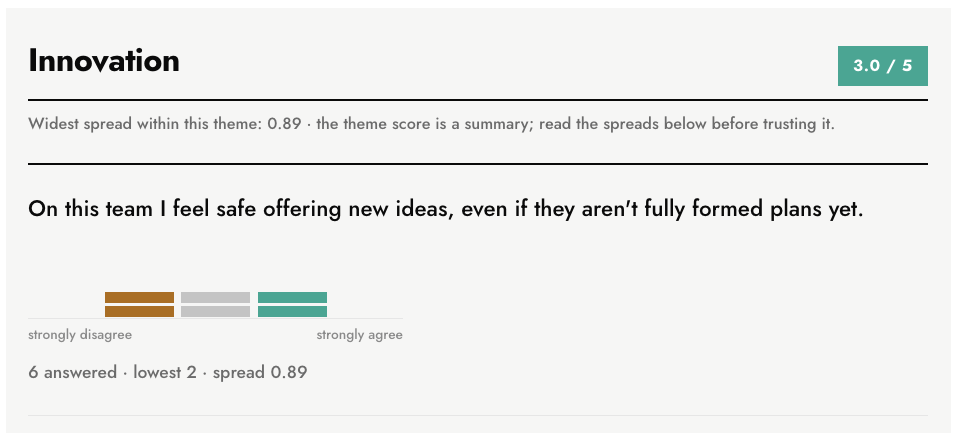
psychological safety survey report "On this team I feel safe offering new ideas, even if they aren't fully formed plans yet."
Measure  ·  Psychological Safety
Measuring psychological safety – the Psych Safety Survey Tool
August 25, 2026
State of psychological safety survey 2023
The State of Psychological Safety Survey: 2023
Previous Article
non attachment to results
Non-attachment to results
Next Article
  • Subscribe to the Psychological Safety Newsletter

  • organisational training
  • Discover our training options for Human and Organisational Performance and CRM for non-aviation teams.

    If you're a trainer, consultant or facilitator, get certified in our Train the Trainer complete online programme and download the Training Materials for Facilitators and Trainers.

  • measure psychological safety
  • theres no such thing as too much psychological safety
    Grab Psychological Safety Stickers from our Online Shop!
  • psychological safety trainer toolkit
  • Psych Safety Day

    Find out more about our Psych Safety Days - in-person and virtual events.

  • psych safety knowledge map measurement trail

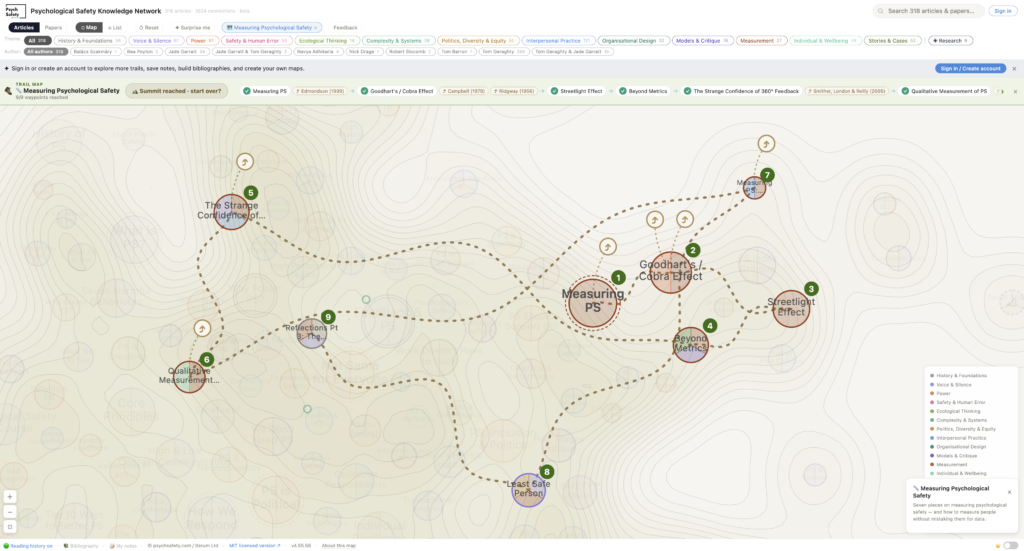
    Use the Trail Guide to Psychological Safety to explore hundreds of articles, papers, resources and tools. 

  • Categories

    • Newsletter
    • Psychological Safety
      • Create and Maintain
      • Human and Organisational Performance (HOP)
      • In Technology
      • Learning and Development
      • Measure
      • Psychological Safety In The Workplace
      • Theory and Research
  • Recent Posts

    • Measure Psychological Safety - The Platform
      Measure Psychological Safety - The Platform
      October 13, 2026
    • Mistaks we've made (so far)
      Mistaks we've made (so far)
      October 7, 2026
    • The Case for Less Eye Contact
      The Case for Less Eye Contact
      September 11, 2026
    • New to psychological safety? Start here.
      New to psychological safety? Start here.
      September 8, 2026
    • The Organisational Substrate
      The Organisational Substrate
      September 1, 2026
    • Crisis-Ready Teams
      Crisis-Ready Teams
      August 27, 2026
    • Measuring psychological safety - the Psych Safety Survey Tool
      Measuring psychological safety - the Psych Safety Survey Tool
      August 25, 2026
    • Body Language and Non-Verbal Communication

      Body Language and Non-Verbal Communication
      August 20, 2026
    • The Four Stages of Psychological Safety: a Six-Stage Critique

      The Four Stages of Psychological Safety: a Six-Stage Critique
      August 7, 2026
    • Organisational Indicator Species: being an Organisational Ecologist

      Organisational Indicator Species: being an Organisational Ecologist
      August 6, 2026
    • Psych Safety Day / Week 2027
      Psych Safety Day / Week 2027
      August 4, 2026
    • Parachutes and “Evidence based” thinking

      Parachutes and “Evidence based” thinking
      July 31, 2026
    • The Psychological Safety Fieldbook
      The Psychological Safety Fieldbook
      July 31, 2026
    • Principles of Ethical Measurement in Organisations

      Principles of Ethical Measurement in Organisations
      July 10, 2026
    • Safety, Stat!
      Safety, Stat!
      June 26, 2026
    • The Strange Confidence of 360 Degree Feedback

      The Strange Confidence of 360 Degree Feedback
      June 25, 2026
    • Reading the air: high and low context communication in teams

      Reading the air: high and low context communication in teams
      June 8, 2026
    • Who gets to decide if psychological safety matters?
      Who gets to decide if psychological safety matters?
      June 5, 2026
    • Accountability
      Accountability
      May 29, 2026
    • Qualitative Measurement of Psychological Safety

      Qualitative Measurement of Psychological Safety
      May 22, 2026
    • The Field Guide to Psychological Safety
      The Field Guide to Psychological Safety
      May 15, 2026
    • Ambiguity, predictability, and psychological safety

      Ambiguity, predictability, and psychological safety
      May 1, 2026
    • The Calculus of Voice
      The Calculus of Voice
      April 23, 2026
    • Contracting and recontracting
      Contracting and recontracting
      April 16, 2026
    • The Vasa
      The Vasa
      April 1, 2026
    • Learning from Error, or Punishing It?
      Learning from Error, or Punishing It?
      March 27, 2026
    • The “Utility” of Psychological Safety
      The “Utility” of Psychological Safety
      March 20, 2026
    • Psychological Flexibility
      Psychological Flexibility
      March 19, 2026
    • Be soft to each other, and hard on the system

      Be soft to each other, and hard on the system
      March 12, 2026
    • "Fake it till you make it"
      "Fake it till you make it"
      March 12, 2026
    • The SANE Effect
      The SANE Effect
      February 20, 2026
    • Learning Teams
      Learning Teams
      January 30, 2026
    • The Tenerife Disaster of 1977: “We're Going”

      The Tenerife Disaster of 1977: “We're Going”
      January 23, 2026
    • ST.R.E.A.M: Status Rules Everything Around Me
      ST.R.E.A.M: Status Rules Everything Around Me
      January 23, 2026
    • Growth Mindset
      Growth Mindset
      January 16, 2026
    • The Streetlight Effect
      The Streetlight Effect
      January 8, 2026
    • The "Fist of Five"
      The "Fist of Five"
      December 19, 2025
    • Psychological Bravery
      Psychological Bravery
      December 18, 2025
    • Psych Safety Book List 2025
      Psych Safety Book List 2025
      December 18, 2025
    • Psych Safety 2025 Unwrapped
      Psych Safety 2025 Unwrapped
      December 15, 2025
    • Plan Continuation Bias
      Plan Continuation Bias
      December 12, 2025
    • Whistleblowing and Psychological Safety
      Whistleblowing and Psychological Safety
      December 4, 2025
    • How Childhood Socioeconomic Status Shapes Psychological Safety and Career Risk-Taking at Work
      How Childhood Socioeconomic Status Shapes Psychological Safety and Career Risk-Taking at Work
      November 27, 2025
    • Safety and the Myth of Self-Reliance
      Safety and the Myth of Self-Reliance
      November 24, 2025
    • The Watermelon Effect and "Greenwashing"

      The Watermelon Effect and "Greenwashing"
      November 7, 2025
    • Individual Resilience
      Individual Resilience
      October 31, 2025
    • Counterfactuals
      Counterfactuals
      October 24, 2025
    • Coaching and Psychological Safety
      Coaching and Psychological Safety
      October 17, 2025
    • Five Ecological Concepts for Working in Organisational Change

      Five Ecological Concepts for Working in Organisational Change
      October 9, 2025
    • The Sharp End & Blunt End of Education
      The Sharp End & Blunt End of Education
      October 3, 2025
    • Forced Vulnerability
      Forced Vulnerability
      September 26, 2025
    • New Sticker Drop! "Zombies Are Scary"
      New Sticker Drop! "Zombies Are Scary"
      September 22, 2025
    • Reflections - Part Four: A Rights-Based Approach

      Reflections - Part Four: A Rights-Based Approach
      September 16, 2025
    • Reflections - Part Three: The Safety to Dissent
      Reflections - Part Three: The Safety to Dissent
      September 12, 2025
    • Reflections - Part Two: Power and Difference
      Reflections - Part Two: Power and Difference
      September 4, 2025
    • Twitter
    • LinkedIn


Sign up to our newsletter & get weekly insights and research

About

The Psych Safety™ Team
Our Mission
Our Core Principles
Privacy Policy
Terms of Business

Learn

Corporate Training
Online Workshops
Newsletter
Professional Certification
Explore our semantic knowledge map

Tools

Tool Kits
Articles
What is Psychological Safety?
The History of Psychological Safety

Get Connected

Contact us
Attend a Meetup
Join the Community
Connect with us on LinkedIn
View our YouTube Channel
© Iterum Ltd. Psych Safety™ is an unregistered trade mark of Iterum Ltd.
We support LGBTQ+ rights all year round. But we also celebrate pride too.
We support LGBTQ+ rights all year round. But we also celebrate pride!
Content on this website is CC BY-NC-SA
Written by humans, not by AI