• Psychological Safety
  • Organisational Training
    • – Ignite: Senior Leaders
    • – Impact: Team Workshop
    • – Delivering Feedback
    • – CRM for Non-Aviation Teams
    • – HOP: Human and Organisational Performance
  • Online Workshops
    • – Train the Trainer
    • – Fundamentals
    • – Practices
    • – Leadership
    • – Advanced
    • – Measurement
    • – Workshop Facilitation
    • – HOP
    • – Delivering Feedback
  • Resources
    • – Tool Kits
    • – Free Resources
    • – Newsletter
    • – Articles
    • – Research
    • – Shop
    • – Community
    • – Practices
    • – What is Psychological Safety?
  • About Us
  • Contact
  • Search
  • Tool Kits
    • Action Pack
    • Trainer Toolkit
    • Practitioner Bundle
    • Practice Playbook: Feedback​
    • Practice Playbook: Technology​
    • Practice Playbook: Inclusion​
    • Practice Playbook: Education​
    • Practice Playbook: Healthcare​
  • Organisational Training
    • Ignite for Senior Leaders
    • Impact Team Workshop
    • Management Masterclass
    • Delivering Effective Feedback
    • HOP: Human and Organisational Performance
    • CRM for Non-Aviation Teams
    • Train the Trainer
  • Online Workshops
    • Complete Online Course
    • Psychological Safety Fundamentals
    • Practice Masterclass
    • Leadership & Management
    • Advanced Psychological Safety
    • Measuring Psychological Safety
    • Workshop Design and Facilitation
    • HOP Fundamentals
    • Delivering Effective Feedback
psych safety logo white
  • Resources
    • Tool Kits
    • Free Resources
    • Newsletter
    • Research
    • Shop
    • Podcasts & Talks
    • Videos
    • Community
    • Events & Psych Safety Days
  • Articles
    • Search
    • What is Psychological Safety?
    • The History of Psychological Safety
    • Psychological Safety Practices
    • Psychological Safety In The Workplace
    • Research
    • Measure Psychological Safety
    • Human Organisational Performance (HOP)
  • The Psych Safety Team
    • Contact Us
    • About The Team
    • Tom Geraghty
    • Jade Garratt
  • Tool Kits
    • Action Pack
    • Trainer Toolkit
    • Practitioner Bundle
    • Practice Playbook: Feedback​
    • Practice Playbook: Technology​
    • Practice Playbook: Inclusion​
    • Practice Playbook: Education​
    • Practice Playbook: Healthcare​
  • Organisational Training
    • Ignite for Senior Leaders
    • Impact Team Workshop
    • Management Masterclass
    • Delivering Effective Feedback
    • HOP: Human and Organisational Performance
    • CRM for Non-Aviation Teams
    • Train the Trainer
  • Online Workshops
    • Complete Online Course
    • Psychological Safety Fundamentals
    • Practice Masterclass
    • Leadership & Management
    • Advanced Psychological Safety
    • Measuring Psychological Safety
    • Workshop Design and Facilitation
    • HOP Fundamentals
    • Delivering Effective Feedback
psych safety logo white
  • Resources
    • Tool Kits
    • Free Resources
    • Newsletter
    • Research
    • Shop
    • Podcasts & Talks
    • Videos
    • Community
    • Events & Psych Safety Days
  • Articles
    • Search
    • What is Psychological Safety?
    • The History of Psychological Safety
    • Psychological Safety Practices
    • Psychological Safety In The Workplace
    • Research
    • Measure Psychological Safety
    • Human Organisational Performance (HOP)
  • The Psych Safety Team
    • Contact Us
    • About The Team
    • Tom Geraghty
    • Jade Garratt
Newsletter  ·  Psychological Safety  ·  Psychological Safety In The Workplace  ·  Theory and Research

The Pac-Man Rule

June 21, 2024

The Pac-Man rule

One of the main reasons to go to a conference, event or meetup is to meet people and have interesting conversations. I’ve found myself at day-long conferences where I’ve not attended a single talk, and instead found myself having lots of great conversations with people instead.

I first learned about the “Pac-Man Rule” at a tech meetup in 2017. I don’t know for sure, but I think it was conceived by Eric Holscher, who observed that at conferences and other events, groups of people tend to form circles for conversations. This is great for the conversations, but those circles also make it very difficult for anyone else to join, since they form something like a defensive wall to any outsiders. 

Psychological safety is the belief that the environment is safe for interpersonal risk taking: that is, it is safe to interact with other people in the space. But that’s pretty hard to do if you’re physically excluded from the conversation, and excluding people is exactly what those closed circles of conversation do. This is where the Pac-Man rule (also known as the Open Circle Principle) comes in. 

The rule, quite simply, is: “When standing as a group of people, always leave room for one person to join your group.”

And of course, when another person joins your group, the group simply readjusts to make room for one more. In practice, it often looks like this:

Hence: the Pac-Man rule! 

It’s often hard enough for people to build up the courage to talk to strangers at events, and closed circles of conversation make it even more difficult. The Pac-Man rule makes it a little bit easier, especially if it’s made clear as an explicit part of the social contract or code of conduct. The Pac-Man rule provides the actual physical space for someone to join a conversation, and it also sends a strong signal that you are welcome here. That signal that you’re welcome to join and contribute to the conversation is a strong driver of psychological safety, and we’re far more likely to get involved as a result.

Of course, the Pac-Man rule isn’t just for formal or work events like conferences – it’s a great principle to adopt for social gatherings such as birthday parties, weddings or any other gathering. 

Finally, this isn’t just a practice, it’s a principle. When we talk about psychological safety and inclusion, we shouldn’t just be talking about the concept, we should be practising it. Inclusion means making space for people. Are you unintentionally excluding people from the group, or are you creating space for new people to join? The Pac-Man rule is one way of doing that.

Related reading:

Psychological Safety, Diversity & Inclusion
How to Run Psychologically Safe Meetings
Behaviours that Foster Psychological Safety
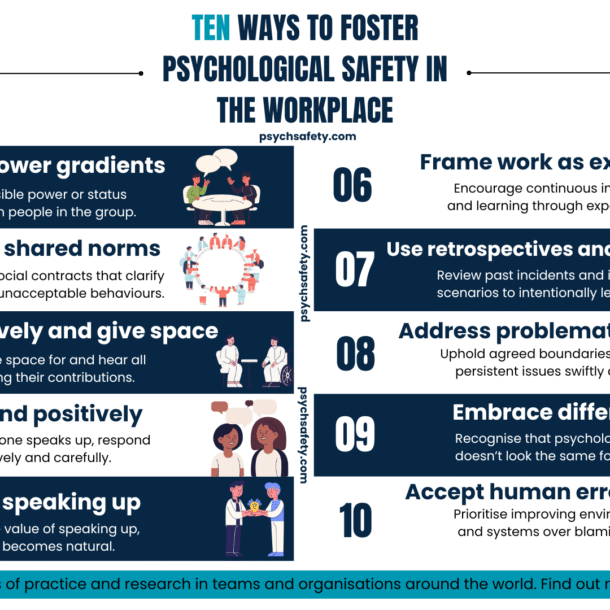
Top 10 Ways to Foster Psychological Safety in the Workplace


Version 3 of the Psychological Safety Action Pack!


Our comprehensive Psychological Safety Tool Kit is designed to help you study, measure, build, and maintain psychological safety in your teams and organisation. It’s perfect for team leaders, managers, HR and People professionals, and facilitators and trainers. Version 3 has been updated an improved as a result of four years of experience using it in organisations around the world, and feedback from over 3,000 practitioners using it with their teams.


What’s new in Version 3?

  • All the content has been refreshed and updated, with improved links to online resources and further reading.
  • A clearer structure for you to work through with your team, structured around the Psych Safety framework of Study – Measure – Build – Maintain – Reflect
  • A completely revised and updated section on Measuring Psychological Safety, including a comprehensive question bank of 30 questions to choose from, as well as ideas for alternative approaches to data collection and analysis. 
  • Resources that were previously part of the Psychological Safety “Managing Teams and People” Playbook have now been been updated and integrated into the Action Pack, including:
    • Personal User Manuals
    • Manager Manual
    • Social Contract
    • Team Charter 
  • There are also brand new resources and tools, including:
    • Psychologically Safer Meeting Practices
    • The Andon Cord 
    • TRIZ
    • Do / Discuss / Decide
  • Improved and updated self-reflection and coaching exercise
  • Refreshed poster images to reflect our values around diversity and inclusion

Download the Tool Kit now


Psychological Safety in Practice

Weaponised “compassion”

Rachel Clarke has written an excellent piece in the Guardian about the potential risks of “physician associates” – clinical practitioners with just two years of training, who are supposed to work under the supervision of doctors. There are concerns that physician associates are taking on the role of doctors without patients being made aware. As professionals in the NHS are raising concerns about this, they’re being accused of bullying and protectionism, whilst “Bradford District and Craven Health Partnership… thanked those doctors who had shown “care and compassion” when giving feedback. In so doing, it deployed a tactic increasingly used to try to silence frontline staff when we warn the public of the potential risks of addressing NHS workforce gaps by replacing highly trained doctors or nurses with less well trained (and cheaper) doctor or nurse substitutes.”

This is the absolute opposite of psychological safety. This is toxic positivity, weaponised compassion; the strategy adopted to avoid hearing things we don’t want to hear and silence people we don’t want to listen to. Whilst it’s the opposite end of aggression and punishment, it has the same effect: a suppressive silence that can result in serious harm to patients. 

Thanks to Steven Shorrock for the share.


Novels about (or relevant to) psychological safety

We maintain a list of the best books about psychological safety at psychsafety.com, which includes the excellent Unicorn Project by Gene Kim. Our friends at The Psychologist recently got in touch to ask if I knew of any other novels or fictional works that address psychological safety.

I wondered if The Circle by Dave Eggers might count, or maybe Catch-22 by Joseph Heller. Do you know of any novels that address psychological safety? Reply and let me know if so, and we can add them to the list!


The Psychological Safety Community

After relaunching a few weeks ago on our new Discord platform, we’re now at over 160 active members and we’ve already had an online meetup for folks in North America and similar timezones. Thanks to all you wonderful community members for contributing, sharing, learning from each other and generally being wonderful people. Join the fun here! 


Being Judgemental or Curious

This is a wonderful illustration by @researchdoodles on the spectrum of being judgemental to curious. Thanks to Jade for finding this gem whilst deep in the depths of PhD research!


Politeness and Civility

We’ve previously covered the Civility Saves Lives campaign, and explored the evidence that shows how basic civility not only improves our experience at work, but also saves lives. This is a great episode of Start The Week with Adam Rutherford, featuring Professor Louise Mullany of the University of Nottingham, on Politeness and Civility. It’s particularly interesting how what is considered “polite” changes significantly over time and contexts.


Accountability

My spidey sense tingles when I hear the word “accountability”, because it’s all too often used as a synonym for “blame” or “punishment”. I love this cartoon from Work Chronicles about the double standards we sometimes see in organisations when it comes to “accountability” and leadership.


Psychological safety and silence

In this Add Insight podcast episode, Emma Stenmark and Johan Rinman talk about psychological safety and silence. Why does it exist, what are the consequences, and what can we do about it? (In Swedish)


communicationinclusionPractices that help foster psychological safetypsychological safety

Tom Geraghty

Tom Geraghty, co-founder and delivery lead at Iterum Ltd, is an expert in high performing teams and psychological safety. Leveraging his unique background in ecological research and technology, Tom has held CIO/CTO roles in a range of sectors from tech startups to global finance firms. He holds a degree in Ecology, an MBA, and a Masters in Global Health. His mission is to make workplaces safer, higher performing, and more inclusive. Tom has shared his insights at major events such as The IT Leaders Summit, the NHS Senior Leadership Conference, and EHS Global Conferences. Connect with him on LinkedIn or email tom@psychsafety.com

Related Articles


two things at once
Newsletter
Psychological Safety Newsletter #39: Diversity and Ethical Behaviour
December 3, 2021
team charter canvas
Create and Maintain  ·  Psychological Safety  ·  Psychological Safety In The Workplace
Team Charter Canvas and Template
January 27, 2023
top ten ways to foster psychological safety
Top 10 Ways to Foster Psychological Safety in the Workplace
Previous Article
psychological safety and wellbeing
Psychological Safety And Wellbeing
Next Article
  • Subscribe to the Psychological Safety Newsletter

  • psychological safety train the trainer
  • Get Certified! Join online workshops, or explore training and consultancy for leaders, teams and organisations.

    Discover our training options for Human and Organisational Performance and CRM for non-aviation teams.

    If you're a trainer, consultant or facilitator, get certified in our Train the Trainer complete online programme and download the Training Materials for Facilitators and Trainers.

  • human and organisational performance training
  • building and maintaining psychological safety for your team
    Download the complete Practitioners' guide to psychological safety
  • psychological safety trainer toolkit
  • Download the Psychological Safety Trainer Toolkit. Containing powerful resources that you can use to deliver your own training and workshops!

  • psych safety logo

    Sponsorship and advertising. Reach over 11,000 weekly readers and 500,000 online visitors with your message in our newsletter.

  • theres no such thing as too much psychological safety
    Grab Psychological Safety Stickers from our Online Shop!
  • Psych Safety Day

    Find out more about our Psych Safety Days - in-person and virtual events to share, learn, and connect with other enthusiasts, practitioners and researchers on psychological safety and related topics.

  • Categories

    • Newsletter
    • Psychological Safety
      • Create and Maintain
      • Human Organisational Performance (HOP)
      • In Technology
      • Learning and Development
      • Measure
      • Psychological Safety In The Workplace
      • Theory and Research
    • Random
  • Recent Posts

    • The Streetlight Effect
      The Streetlight Effect
      January 8, 2026
    • The "Fist of Five"
      The "Fist of Five"
      December 19, 2025
    • Psychological Bravery
      Psychological Bravery
      December 18, 2025
    • Psych Safety Book List 2025
      Psych Safety Book List 2025
      December 18, 2025
    • Psych Safety 2025 Unwrapped
      Psych Safety 2025 Unwrapped
      December 15, 2025
    • Plan Continuation Bias
      Plan Continuation Bias
      December 12, 2025
    • Whistleblowing and Psychological Safety
      Whistleblowing and Psychological Safety
      December 4, 2025
    • How Childhood Socioeconomic Status Shapes Psychological Safety and Career Risk-Taking at Work
      How Childhood Socioeconomic Status Shapes Psychological Safety and Career Risk-Taking at Work
      November 27, 2025
    • Safety and the Myth of Self-Reliance
      Safety and the Myth of Self-Reliance
      November 24, 2025
    • The Watermelon Effect and "Greenwashing"

      The Watermelon Effect and "Greenwashing"
      November 7, 2025
    • Individual Resilience
      Individual Resilience
      October 31, 2025
    • Counterfactuals
      Counterfactuals
      October 24, 2025
    • Coaching and Psychological Safety
      Coaching and Psychological Safety
      October 17, 2025
    • Five Ecological Concepts for Working in Organisational Change

      Five Ecological Concepts for Working in Organisational Change
      October 9, 2025
    • The Sharp End & Blunt End of Education
      The Sharp End & Blunt End of Education
      October 3, 2025
    • Forced Vulnerability
      Forced Vulnerability
      September 26, 2025
    • New Sticker Drop! "Zombies Are Scary"
      New Sticker Drop! "Zombies Are Scary"
      September 22, 2025
    • Reflections - Part Four: A Rights-Based Approach

      Reflections - Part Four: A Rights-Based Approach
      September 16, 2025
    • Reflections - Part Three: The Safety to Dissent
      Reflections - Part Three: The Safety to Dissent
      September 12, 2025
    • Reflections - Part Two: Power and Difference
      Reflections - Part Two: Power and Difference
      September 4, 2025
    • The Psychological Safety Trainer Toolkit
      The Psychological Safety Trainer Toolkit
      September 1, 2025
    • Reflections on Psychological Safety: Five Years of Learning
      Reflections on Psychological Safety: Five Years of Learning
      August 29, 2025
    • Not Feeling Seen: Eye Contact and Psychological Safety
      Not Feeling Seen: Eye Contact and Psychological Safety
      August 21, 2025
    • Psychological Safety Isn't Enough
      Psychological Safety Isn't Enough
      August 15, 2025
    • Psych Safety Day / Week 2026
      Psych Safety Day / Week 2026
      August 11, 2025
    • The Amagasaki Disaster
      The Amagasaki Disaster
      August 8, 2025
    • Psychological safety isn't the same for everyone
      Psychological safety isn't the same for everyone
      August 4, 2025
    • Psychological Safety Books for Children
      Psychological Safety Books for Children
      August 1, 2025
    • Psychological Safety and Creativity
      Psychological Safety and Creativity
      July 25, 2025
    • The State of Psychological Safety Survey: 2025
      The State of Psychological Safety Survey: 2025
      July 19, 2025
    • Barriers to Psychological Safety
      Barriers to Psychological Safety
      July 18, 2025
    • How you respond matters.
      How you respond matters.
      July 11, 2025
    • Practices that Foster Psychological Safety
      Practices that Foster Psychological Safety
      July 4, 2025
    • Feedback in the workplace
      Feedback in the workplace
      June 27, 2025
    • Psych Safety Day 2025
      Psych Safety Day 2025
      June 21, 2025
    • Job Security and Psychological Safety
      Job Security and Psychological Safety
      June 20, 2025
    • How familiar are people with the concept of psychological safety?
      How familiar are people with the concept of psychological safety?
      June 13, 2025
    • Learning at Psych Safety
      Learning at Psych Safety
      June 13, 2025
    • Why do We Foster Psychological Safety?
      Why do We Foster Psychological Safety?
      June 6, 2025
    • Psychological Safety in Aviation - Special Edition
      Psychological Safety in Aviation - Special Edition
      May 30, 2025
    • Rebuilding Psychological Safety When It's Broken
      Rebuilding Psychological Safety When It's Broken
      May 30, 2025
    • Just Culture
      Just Culture
      May 23, 2025
    • Transactional Analysis
      Transactional Analysis
      May 15, 2025
    • Comfort vs Need
      Comfort vs Need
      May 9, 2025
    • Sociological Safety
      Sociological Safety
      May 2, 2025
    • Humour and Psychological Safety
      Humour and Psychological Safety
      May 1, 2025
    • Safety-Organised Criticality
      Safety-Organised Criticality
      April 25, 2025
    • Leaders are not solely responsible for psychological safety.
      Leaders are not solely responsible for psychological safety.
      April 21, 2025
    • Psychological Safety in Our Personal Lives
      Psychological Safety in Our Personal Lives
      April 17, 2025
    • The Organisational Fabric of Psychological Safety
      The Organisational Fabric of Psychological Safety
      April 10, 2025
    • Colution
      April 7, 2025
    • All Feedback Is Subjective
      All Feedback Is Subjective
      April 4, 2025
    • Micromanagement
      Micromanagement
      March 21, 2025
    • Rewetting Organisations
      Rewetting Organisations
      March 14, 2025
    • Spectra of Participation
      Spectra of Participation
      March 7, 2025
    • Twitter
    • LinkedIn


Sign up to our newsletter & get weekly insights and research

About

The Psychological Safety Team
Our Mission
Our Core Principles
Privacy Policy
Terms of Business

Learn

Corporate Training
Online Workshops
Newsletter
Professional Certification

Tools

Tool Kits
Articles
What is Psychological Safety?
The History of Psychological Safety

Get Connected

Contact us
Attend a Meetup
Join the Community
Connect with us on LinkedIn
View our YouTube Channel
© 2025 Iterum Ltd
We support LGBTQ+ rights all year round. But we also celebrate pride too.
We support LGBTQ+ rights all year round. But we also celebrate pride!
Content on this website is CC BY-NC-SA
Written by humans, not by AI