






• Psychological Safety
  • Organisational Training
    • – Ignite: Senior Leaders
    • – Impact: Team Workshop
    • – Delivering Feedback
    • – CRM for Non-Aviation Teams
    • – HOP: Human and Organisational Performance
  • Online Workshops
    • – Train the Trainer
    • – Fundamentals
    • – Practices
    • – Leadership
    • – Advanced
    • – Measurement
    • – Workshop Facilitation
    • – HOP
    • – Delivering Feedback
  • Resources
    • – Tool Kits
    • – Free Resources
    • – Newsletter
    • – Articles
    • – Research
    • – Shop
    • – Community
    • – Practices
    • – What is Psychological Safety?
  • About Us
  • Contact
  • Search
  • Tool Kits
    • Action Pack
    • Trainer Toolkit
    • Practitioner Bundle
    • Practice Playbook: Feedback​
    • Practice Playbook: Technology​
    • Practice Playbook: Inclusion​
    • Practice Playbook: Education​
    • Practice Playbook: Healthcare​
  • Organisational Training
    • Ignite for Senior Leaders
    • Impact Team Workshop
    • Management Masterclass
    • Delivering Effective Feedback
    • HOP: Human and Organisational Performance
    • CRM for Non-Aviation Teams
    • Train the Trainer
  • Online Workshops
    • Complete Online Course
    • Psychological Safety Fundamentals
    • Practice Masterclass
    • Leadership & Management
    • Advanced Psychological Safety
    • Measuring Psychological Safety
    • Workshop Design and Facilitation
    • HOP Fundamentals
    • Delivering Effective Feedback
psych safety logo white
  • Resources
    • Tool Kits
    • Free Resources
    • Newsletter
    • Research
    • Shop
    • Podcasts & Talks
    • Videos
    • Community
    • Events & Psych Safety Days
  • Articles
    • Search
    • What is Psychological Safety?
    • The History of Psychological Safety
    • Psychological Safety Practices
    • Psychological Safety In The Workplace
    • Research
    • Measure Psychological Safety
    • Human Organisational Performance (HOP)
  • The Psych Safety Team
    • Contact Us
    • About The Team
    • Tom Geraghty
    • Jade Garratt
  • Tool Kits
    • Action Pack
    • Trainer Toolkit
    • Practitioner Bundle
    • Practice Playbook: Feedback​
    • Practice Playbook: Technology​
    • Practice Playbook: Inclusion​
    • Practice Playbook: Education​
    • Practice Playbook: Healthcare​
  • Organisational Training
    • Ignite for Senior Leaders
    • Impact Team Workshop
    • Management Masterclass
    • Delivering Effective Feedback
    • HOP: Human and Organisational Performance
    • CRM for Non-Aviation Teams
    • Train the Trainer
  • Online Workshops
    • Complete Online Course
    • Psychological Safety Fundamentals
    • Practice Masterclass
    • Leadership & Management
    • Advanced Psychological Safety
    • Measuring Psychological Safety
    • Workshop Design and Facilitation
    • HOP Fundamentals
    • Delivering Effective Feedback
psych safety logo white
  • Resources
    • Tool Kits
    • Free Resources
    • Newsletter
    • Research
    • Shop
    • Podcasts & Talks
    • Videos
    • Community
    • Events & Psych Safety Days
  • Articles
    • Search
    • What is Psychological Safety?
    • The History of Psychological Safety
    • Psychological Safety Practices
    • Psychological Safety In The Workplace
    • Research
    • Measure Psychological Safety
    • Human Organisational Performance (HOP)
  • The Psych Safety Team
    • Contact Us
    • About The Team
    • Tom Geraghty
    • Jade Garratt
Create and Maintain  ·  Newsletter  ·  Psychological Safety  ·  Psychological Safety In The Workplace  ·  Theory and Research

The Johari Window

August 16, 2024

The Johari Window

Many people first encounter the Johari Window in leadership or personal development training. I was introduced to it in exactly that way – it was presented as a simple but powerful tool for self-awareness and managing feedback. It was used to demonstrate how feedback can help to reduce your “blind spots” about the way you are perceived by others. 

What is the Johari Window?

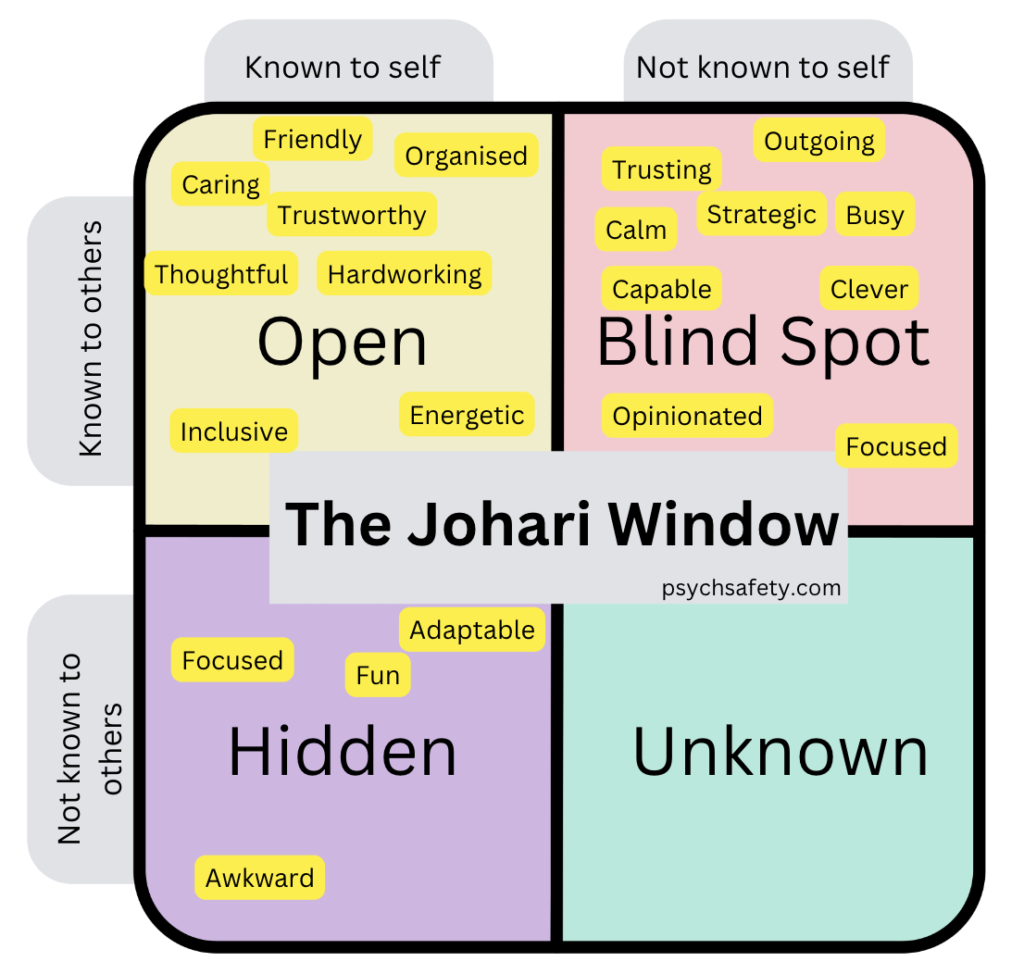
At it’s core, the Johari Window is a quadrant diagram, which plots what is “known to self” or “not known to self” against what is “known to others” or “not known to others”. The four quadrants (sometimes called the “four rooms”) are therefore:

  1. Open – what you and others know about you. Also called the area of “free activity”.
  2. Hidden – what you know about yourself, but choose not to share with others.
  3. Blind spot – what others know about you, but you may not yet recognise.
  4. Unknown – what neither you or others know about you yet, or, depending on how this tool is used, descriptors that do not apply to you.

Value of the Johari Window

As the saying goes, “all models are wrong and some are useful”. The Johari Window can certainly be one of the useful ones. For many of us, the idea of reducing blind spots through feedback is appealing. It gives us a simple framework for increasing our self-awareness and for reflecting on how our behaviour is perceived by others.

It also highlights how we might learn and grow in relationship with colleagues. In Johari terms, we often aim to expand the size of our open area – what’s shared and visible – while reducing what’s hidden or in our blind spot. Doing so can help us improve the way we work and communicate with others.

As Joseph Luft, co-creator of the model, brilliantly put it: 

“A centipede may be perfectly happy without awareness; but after all, he restricts himself to crawling under rocks.”

In other words, awareness can feel uncomfortable, but it opens up new possibilities.

That said, we do need to use the Johari Window with some care and caution. Here’s why…

A Brief History of the Johari Window

The Johari Window was developed in 1955 by two psychologists, Joseph Luft and Harrington Ingham, and first presented at a HR conference in California* (the name Johari comes from combining their shortened first names, and is pronounced as they are: Joe-Harry).

It seems it made an impact that neither of them were expecting,** and Luft wrote later that they were “surprised to find so many people, academicians and non-professionals alike, using, and tinkering with, the model.”

Interestingly, the Johari Window wasn’t originally designed as a diagram or model. It was first created as an exercise. Participants were given a list of adjectives, and asked to choose which best describe themselves. The same list was then given to their colleagues or peers, who would choose the adjectives that they felt best described that person.

Once both sets of choices were compared, the descriptors were sorted into the four quadrants:

  • Hidden – chosen only by the subject, not others
  • Open – chosen by both the subject and others
  • Blind spot – chosen only by others
  • Unknown – chosen by neither

The results can then be plotted into the Johari Window grid and might end up looking something like this: 

the johari window example

In this form, the Johari Window exercise is clearly about exploring how we perceive ourselves, what we choose to share and how others perceive us. Where there are differences, it opens the door to self-reflection and learning.

This might be especially useful if we’re doing some work on our “work persona” or our “leadership persona” and want to better understand how we come across to colleagues. By comparing what’s in our hidden area or blind spot with what others see, we can gain insight into how our behaviour and communication are experienced by the people around us.

For example, I might believe I’m very approachable, but be surprised to find when I do the Johari Window exercise that my team didn’t choose that word – or others I was expecting, like “supportive.” That alone might be a valuable starting point for change.

On the other hand, the exercise might show that certain aspects of my personality simply aren’t visible at work – perhaps I’m not sharing my more fun or light-hearted side. Seeing that difference can prompt me to reflect: is this something I want to keep hidden, or might showing a little more of it help me build stronger connections?

Different Applications of the Johari Window

Like any model, the Johari Window can be adapted to different contexts. There are multiple ways that the Johari Window can spark useful insights. 

One key use is as a visual reminder that everyone has a “Hidden” area. As we build relationships, we can intentionally choose what to disclose, over time perhaps shrinking our Hidden area and expanding our Open area. Equally important, the Johari Window reminds us we can be intentional about what we keep in our Hidden area. For instance, teachers might think very carefully about which aspects of their personal lives they want to share with students, and which remain in their Hidden area.

In this way, the Johari Window can connect well with practices such as developing Personal User Manuals or READMEs. Framing these tools through the Johari Window encourages us to be deliberate about what we bring into the Open area – what do we want colleagues to know about our working style, preferences and values?

Common Misunderstandings about the Johari Window

Where it’s perhaps problematic, is where we see the Johari Window presented not as a tool or exercise, but as a model of the self. A quick search online turns up multiple leadership and coaching articles claiming that the Johari Window helps to “reduce conscious and unconscious biases”, or urges people to eliminate blind spots and change their behaviour so that they can be judged more favourably by others. 

This is probably a stretch, for a number of reasons… 

Firstly, the Johari Window is about exploring perceptions – both our own and those of others. We don’t have to accept or internalise the descriptors others might choose for us. After all, people see us through the lens of their own prejudices, biases and stereotypes.

Secondly, what is “known” by others is still just their perception. It might be “their truth” but it is not an absolute or objective truth. The same behaviour can be perceived in radically different ways dependent on context. A woman expressing anger might be perceived as overly emotional, while a man doing the same might be considered passionate or full of conviction. This intersects with race too – a black woman might be labelled aggressive for behaviour that would be deemed “assertive” in a white man. The Johari Window doesn’t protect us from those biases.

And even if we do the exercise exactly as Luft and Ingham, the adjectives themselves may not provide anything we can recognise as clear, actionable “feedback”. For feedback to be truly useful, it needs to be specific, not just a list of vague descriptors.

psychological safety feedback sketchnote
Credit: Chris Spalton

From a psychological safety perspective, that’s especially important. If we give someone a list of adjectives without further explanation, it’s easy to see how it could increase anxiety: Why do they see me like that? Am I always that? Does everyone see me this way? Without context, the exercise risks undermining trust rather than building it.

The risks of misusing the Johari Window

When we give kind, clear and actionable feedback, we try to separate a discussion about someone’s behaviour from wider (and often unfair) assertions about their character. Misused, the Johari Window risks doing the opposite – blurring the line between feedback and identity, and reducing someone to a label rather than supporting their growth.

Learn more about the Johari Window, feedback models, and practical ways to build psychological safety in our online workshops.

References/ Further Reading:

Personal User Manuals

Psychological Safety and Giving Feedback

An interesting essay from William Bergquist on the Johari Window

Article from Joseph Luft on the Johari Window

*Despite our best detective work, we’ve not been able to track down and read the original paper for this, though plenty of articles online use the following citation: Luft, J., & Ingham, H. (1955). The Johari Window, a Graphic Model of Interpersonal Awareness. Proceedings of the Western Training Laboratory in Group Development, 246, 2014-03. The closest we’ve found (thanks to Charlie Gregson!) is this archived copy of a piece by Joseph Luft in the Human Relations Training News 1961) It seems that Joseph Luft later wrote about the Johari Window in his 1969 book ‘On Human Interaction’ which is also out of print and difficult to track down. If anyone has a copy of the original paper or book, let us know – we’d love to read it and update this piece accordingly!

**As a testament to this unexpected popularity, there is even an excellent Belgian Metalcore band called The Johari Window. Listen to them on Bandcamp here.


online workshops with CIPD badges

Psychological safety full online course

Our online psychological safety workshops cover everything from what psychological safety is to how to measure and build it in organisations. We offer a range of options to suit your needs, from foundational to advanced learning, for everyone from team members, senior leaders, consultants and trainers. All are highly engaging, inclusive and interactive learning experiences.

The workshops will help you to:

  • Understand the theory and evidence for psychological safety in relation to team performance.
  • Learn key practices for improving and maintaining psychological safety.
  • Find out how to measure psychological safety across your organisation or within teams.
  • Learn how to foster psychological safety in your teams, organisations, or your own clients.
  • Ignite your leadership and management teams with the benefits of psychological safety.
  • Use and apply the Psychological Safety Action Pack with teams to measure, build and maintain psychological safety
  • Deliver your own workshops and training sessions with tools and techniques gleaned from our experience running training sessions over the past few years.

All our training options and workshops provide certificated CPD hours and Credly badges to evidence your professional development.

Find out more and book here


Psychological Safety in Practice

What’s Psychological Safety, and Why Does Tech Need It Now?

“…how leaders conduct strategic reviews, and carry out layoffs, if necessary, should be guided and driven by the values they claim to adhere to as a business — including a commitment to psychological safety.”

This is an excellent piece by Joe Fay in The New Stack about psychological safety in Tech, and why it’s more important now than ever.


An Astronaut’s Advice on High-Stakes Collaboration

This is a fantastic listen – during her 24 years as a NASA astronaut, including a six-month stint on the ISS, Cady Coleman learned lessons about everything from managing stress and assessing risk to cross-cultural communication and navigating bias. Cady describes creating a psychologically safe environment where people “feel free to report safety issues or things that just don’t feel right or could be done better.“


Psychological ownership for overcoming departmental barriers to innovation: A Study of innovation handoffs.

Here’s a great open access study by Alf Steinar Sætre, Amy C. Edmondson, Oda Dregelid and Sofie Rud Zimmer, that examines how psychological ownership—a sense of personal ownership over a project—can facilitate successful innovation handoffs across departmental boundaries in organisations. The research highlights that psychological ownership motivates individuals to engage more deeply with projects, ensuring improved coordination and continuity during handoffs. However, it also highlights potential downsides, such as the “Not Invented Here” syndrome, where high ownership can lead departments to reject ideas from outside their own group.


Resilience Engineering and Adaptive Capacity

This article by John Allspaw on resilience engineering and adaptive capacity echoes many of the points and practices we espouse in our management training:

  • Resilience means improving how people can respond and learn from unexpected events and incidents. Fostering environments where people can openly share their perspectives is key to organisational learning. 
  • In organisations, we notice when things go wrong, but less so all the times that things go right. We tend to investigate the hell out of a failure, but rarely put the same effort into analysing success. We should.
  • Organisations are made up of many teams working together. It’s all well and good if a team is psychologically safe, but if two teams can’t work together as a group, the organisation will suffer. Being explicit about teams’ goals, constraints, needs and capabilities (i.e. through Team charters) fosters the capabilities for success.

Everything about Resilience Engineering in practice requires fostering psychological safety. 


feedbackjohari windowPractices that help foster psychological safetypsychological safetypsychology

Jade Garratt

Jade is all about crafting inclusive, healthy and psychologically safe educational environments that allow both educators and students to thrive. With 15 years of experience spanning classroom teaching, the charitable sector, higher education, and the private sector, she brings a unique blend of insights to the table. Trust, openness, and mutual respect are the cornerstones of her educational philosophy. Initially, Jade dedicated five years to teaching and middle leadership in schools in challenging contexts, alongside her studies for a Master’s in Educational Leadership. She then transitioned to coaching and leadership development with Teach First, a UK educational charity and social movement. More recently, she held a senior position in educational enhancement at the University of Nottingham. Her doctoral research focuses on the impact of students’ educational backgrounds on their university experience, through a social justice lens. With a Physics degree from Oxford University, a Master’s Degree in Educational Leadership, and ongoing PhD research in Educational Practice at the University of Nottingham, Jade’s passion for education is at the core of her work. She aims to ensure that everyone has the opportunity to succeed in a supportive environment. Her diverse expertise and commitment make her a valuable member of our team and the broader educational community

Related Articles


t shaped vs broken comb
Newsletter  ·  Psychological Safety
Psychological Safety: Command & Control
June 6, 2022
psychological safety in aviation - a go around
Human Organisational Performance (HOP)  ·  Newsletter  ·  Psychological Safety  ·  Theory and Research
Psychological Safety in Aviation
April 7, 2023
Photo by Alexander Grey on Unsplash
Psychological safety should support DEI, not replace it. 
Previous Article
Photo by CHUTTERSNAP on Unsplash
Experiments, bets and probes
Next Article
  • Subscribe to the Psychological Safety Newsletter

  • psychological safety train the trainer
  • Get Certified! Join online workshops, or explore training and consultancy for leaders, teams and organisations.

    Discover our training options for Human and Organisational Performance and CRM for non-aviation teams.

    If you're a trainer, consultant or facilitator, get certified in our Train the Trainer complete online programme and download the Training Materials for Facilitators and Trainers.

  • human and organisational performance training
  • building and maintaining psychological safety for your team
    Download the complete Practitioners' guide to psychological safety
  • psychological safety trainer toolkit
  • Download the Psychological Safety Trainer Toolkit. Containing powerful resources that you can use to deliver your own training and workshops!

  • psych safety logo

    Sponsorship and advertising. Reach over 11,000 weekly readers and 500,000 online visitors with your message in our newsletter.

  • theres no such thing as too much psychological safety
    Grab Psychological Safety Stickers from our Online Shop!
  • Psych Safety Day

    Find out more about our Psych Safety Days - in-person and virtual events to share, learn, and connect with other enthusiasts, practitioners and researchers on psychological safety and related topics.

  • Categories

    • Newsletter
    • Psychological Safety
      • Create and Maintain
      • Human Organisational Performance (HOP)
      • In Technology
      • Learning and Development
      • Measure
      • Psychological Safety In The Workplace
      • Theory and Research
    • Random
  • Recent Posts

    • The Streetlight Effect
      The Streetlight Effect
      January 8, 2026
    • The "Fist of Five"
      The "Fist of Five"
      December 19, 2025
    • Psychological Bravery
      Psychological Bravery
      December 18, 2025
    • Psych Safety Book List 2025
      Psych Safety Book List 2025
      December 18, 2025
    • Psych Safety 2025 Unwrapped
      Psych Safety 2025 Unwrapped
      December 15, 2025
    • Plan Continuation Bias
      Plan Continuation Bias
      December 12, 2025
    • Whistleblowing and Psychological Safety
      Whistleblowing and Psychological Safety
      December 4, 2025
    • How Childhood Socioeconomic Status Shapes Psychological Safety and Career Risk-Taking at Work
      How Childhood Socioeconomic Status Shapes Psychological Safety and Career Risk-Taking at Work
      November 27, 2025
    • Safety and the Myth of Self-Reliance
      Safety and the Myth of Self-Reliance
      November 24, 2025
    • The Watermelon Effect and "Greenwashing"

      The Watermelon Effect and "Greenwashing"
      November 7, 2025
    • Individual Resilience
      Individual Resilience
      October 31, 2025
    • Counterfactuals
      Counterfactuals
      October 24, 2025
    • Coaching and Psychological Safety
      Coaching and Psychological Safety
      October 17, 2025
    • Five Ecological Concepts for Working in Organisational Change

      Five Ecological Concepts for Working in Organisational Change
      October 9, 2025
    • The Sharp End & Blunt End of Education
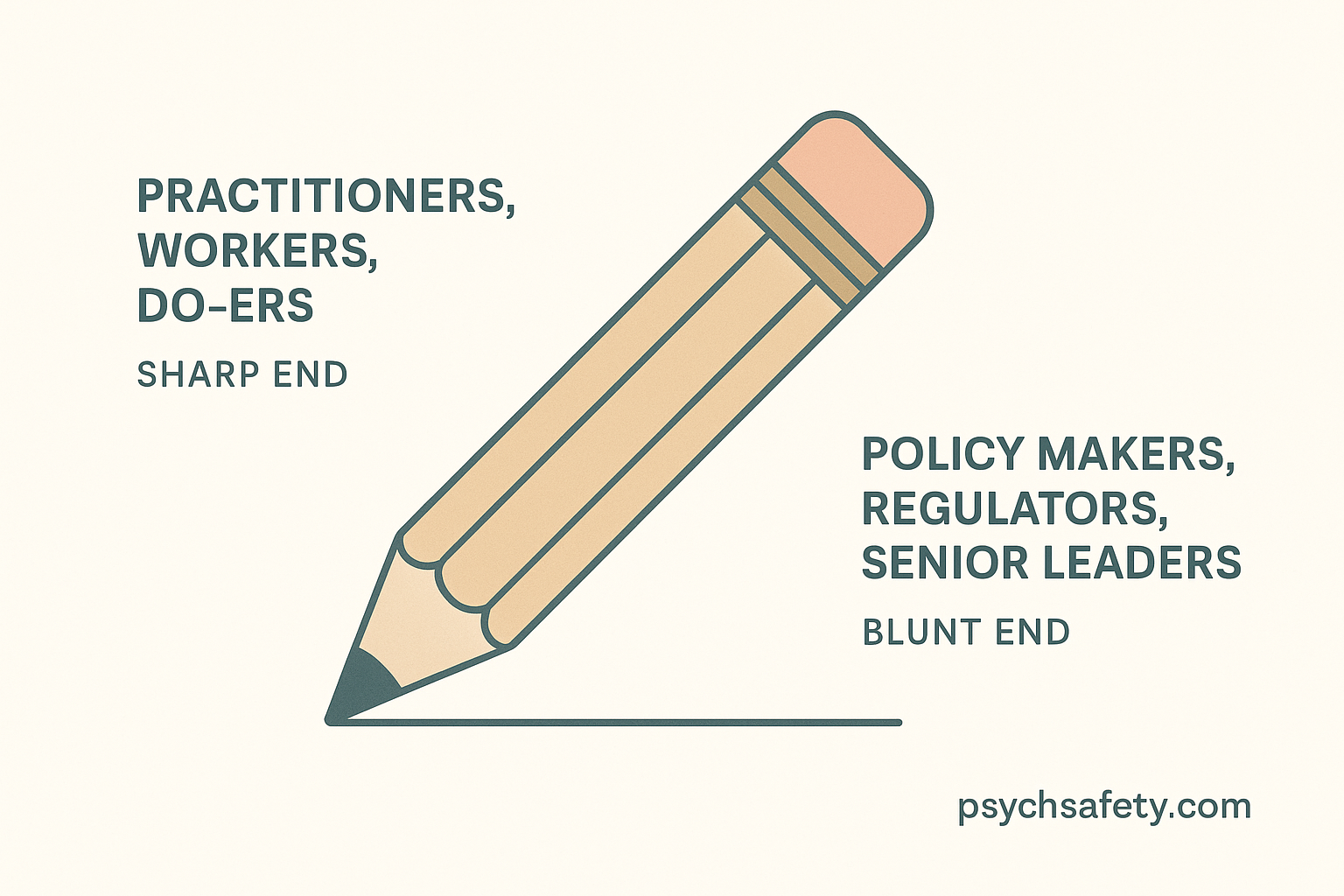
      The Sharp End & Blunt End of Education
      October 3, 2025
    • Forced Vulnerability
      Forced Vulnerability
      September 26, 2025
    • New Sticker Drop! "Zombies Are Scary"
      New Sticker Drop! "Zombies Are Scary"
      September 22, 2025
    • Reflections - Part Four: A Rights-Based Approach

      Reflections - Part Four: A Rights-Based Approach
      September 16, 2025
    • Reflections - Part Three: The Safety to Dissent
      Reflections - Part Three: The Safety to Dissent
      September 12, 2025
    • Reflections - Part Two: Power and Difference
      Reflections - Part Two: Power and Difference
      September 4, 2025
    • The Psychological Safety Trainer Toolkit
      The Psychological Safety Trainer Toolkit
      September 1, 2025
    • Reflections on Psychological Safety: Five Years of Learning
      Reflections on Psychological Safety: Five Years of Learning
      August 29, 2025
    • Not Feeling Seen: Eye Contact and Psychological Safety
      Not Feeling Seen: Eye Contact and Psychological Safety
      August 21, 2025
    • Psychological Safety Isn't Enough
      Psychological Safety Isn't Enough
      August 15, 2025
    • Psych Safety Day / Week 2026
      Psych Safety Day / Week 2026
      August 11, 2025
    • The Amagasaki Disaster
      The Amagasaki Disaster
      August 8, 2025
    • Psychological safety isn't the same for everyone
      Psychological safety isn't the same for everyone
      August 4, 2025
    • Psychological Safety Books for Children
      Psychological Safety Books for Children
      August 1, 2025
    • Psychological Safety and Creativity
      Psychological Safety and Creativity
      July 25, 2025
    • The State of Psychological Safety Survey: 2025
      The State of Psychological Safety Survey: 2025
      July 19, 2025
    • Barriers to Psychological Safety
      Barriers to Psychological Safety
      July 18, 2025
    • How you respond matters.
      How you respond matters.
      July 11, 2025
    • Practices that Foster Psychological Safety
      Practices that Foster Psychological Safety
      July 4, 2025
    • Feedback in the workplace
      Feedback in the workplace
      June 27, 2025
    • Psych Safety Day 2025
      Psych Safety Day 2025
      June 21, 2025
    • Job Security and Psychological Safety
      Job Security and Psychological Safety
      June 20, 2025
    • How familiar are people with the concept of psychological safety?
      How familiar are people with the concept of psychological safety?
      June 13, 2025
    • Learning at Psych Safety
      Learning at Psych Safety
      June 13, 2025
    • Why do We Foster Psychological Safety?
      Why do We Foster Psychological Safety?
      June 6, 2025
    • Psychological Safety in Aviation - Special Edition
      Psychological Safety in Aviation - Special Edition
      May 30, 2025
    • Rebuilding Psychological Safety When It's Broken
      Rebuilding Psychological Safety When It's Broken
      May 30, 2025
    • Just Culture
      Just Culture
      May 23, 2025
    • Transactional Analysis
      Transactional Analysis
      May 15, 2025
    • Comfort vs Need
      Comfort vs Need
      May 9, 2025
    • Sociological Safety
      Sociological Safety
      May 2, 2025
    • Humour and Psychological Safety
      Humour and Psychological Safety
      May 1, 2025
    • Safety-Organised Criticality
      Safety-Organised Criticality
      April 25, 2025
    • Leaders are not solely responsible for psychological safety.
      Leaders are not solely responsible for psychological safety.
      April 21, 2025
    • Psychological Safety in Our Personal Lives
      Psychological Safety in Our Personal Lives
      April 17, 2025
    • The Organisational Fabric of Psychological Safety
      The Organisational Fabric of Psychological Safety
      April 10, 2025
    • Colution
      April 7, 2025
    • All Feedback Is Subjective
      All Feedback Is Subjective
      April 4, 2025
    • Micromanagement
      Micromanagement
      March 21, 2025
    • Rewetting Organisations
      Rewetting Organisations
      March 14, 2025
    • Spectra of Participation
      Spectra of Participation
      March 7, 2025
    • Twitter
    • LinkedIn


Sign up to our newsletter & get weekly insights and research

About

The Psychological Safety Team
Our Mission
Our Core Principles
Privacy Policy
Terms of Business

Learn

Corporate Training
Online Workshops
Newsletter
Professional Certification

Tools

Tool Kits
Articles
What is Psychological Safety?
The History of Psychological Safety

Get Connected

Contact us
Attend a Meetup
Join the Community
Connect with us on LinkedIn
View our YouTube Channel
© 2025 Iterum Ltd
We support LGBTQ+ rights all year round. But we also celebrate pride too.
We support LGBTQ+ rights all year round. But we also celebrate pride!
Content on this website is CC BY-NC-SA
Written by humans, not by AI