
Psychological Safety Awards
Read more about Goodhart’s Law, Campbell’s Law and The Cobra Effect here.

Read more about Goodhart’s Law, Campbell’s Law and The Cobra Effect here.


Psychological Safety, Aviation Disasters and Crew Resource Management This week I’ve been reading “Confronting Mistakes” by Jan Hagen. This is a fantastic book, focusing on the human factors behind a multitude of aviation incidents. Jan highlights how miscommunication and failures to speak up

Welcome to the Psychological Safety newsletter and thanks for subscribing. You’re amazing. Having tried switching to a biweekly pattern, I’m now experimenting with alternating short-form and long-form newsletters each week. This week is a short form newsletter and highlights Just Culture,

Providing constructive feedback is one powerful way you can help people excel, achieve their goals and be happier in their work. Done well, it can create psychological safety and help teams and organisations perform at their best. However, feedback can

Contributed by Carolyn McKanders and Robert Garmston Teachers meet continuously as an expected part of school duties. They meet in pairs,in faculty groups, departments and grade level meetings. Facilitation practices arenecessary in all these venues. Essential to meeting success and

Updated September 2026: we’ve corrected our definitions of intrinsic and extraneous load, which didn’t perfectly match cognitive load theory, and added research on anxiety, collaboration and power. What does Cognitive Load have to do with Psychological Safety? Psychological safety helps

AKA: When you’re accustomed to privilege, equality feels like oppression. Not everyone is a fan of psychological safety. Sometimes that’s because people don’t yet understand what it is. Sometimes it’s because they do understand what it is, and yet they’re still

What is Conway’s Law? This week we’re diving into the concept of Conway’s Law, and its relation to psychological safety. Conway’s Law essentially describes the “force” that means how a team or organisation is structured will affect what the organisation

Resilience Engineering Today we’re diving into the field of Resilience Engineering. This subject ticks a lot of my interest boxes: from complexity and sociotechnicality to psychological safety and leadership. I hope you find it interesting too! Resilience Engineering is a
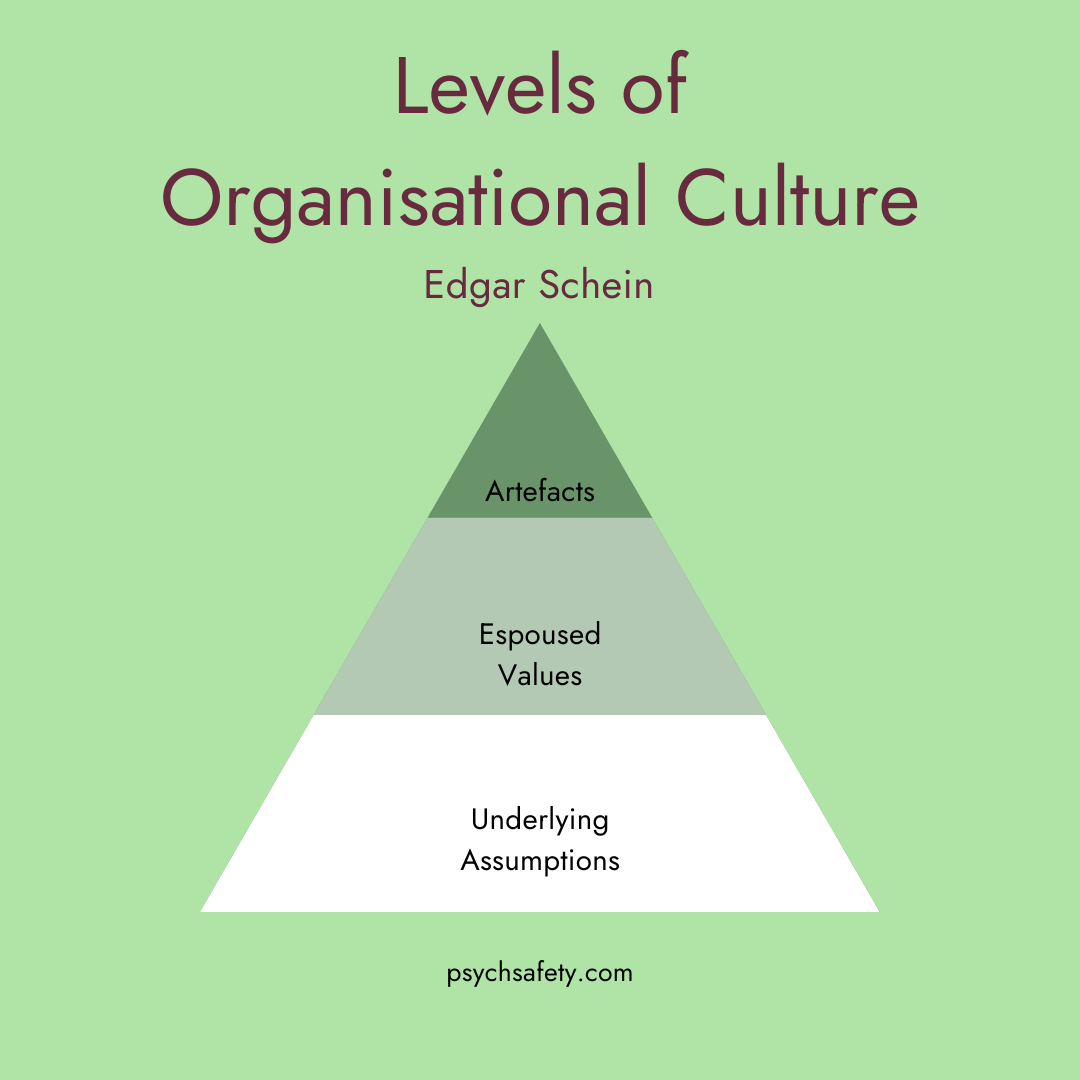
1- Artefacts. These describe any overt, visible, describable aspects of the organisation. Think things like branding and logos, office design, dress code, policies and tools. Things that you can see.
2- Espoused values. This is how people would describe the organisation, in current or aspirational terms. These include missions, goals, value statements, and social contracts.
3- Underlying assumptions. These are unconscious, unspoken, hard to articulate elements of the organisation, particularly from within.

Team charters are a fantastic way of creating alignment, cohesion and psychological safety in a team. They also help to onboard new team members, and enable teams to work together more effectively. This Psychological Safety Practice Playbook Add-on for the
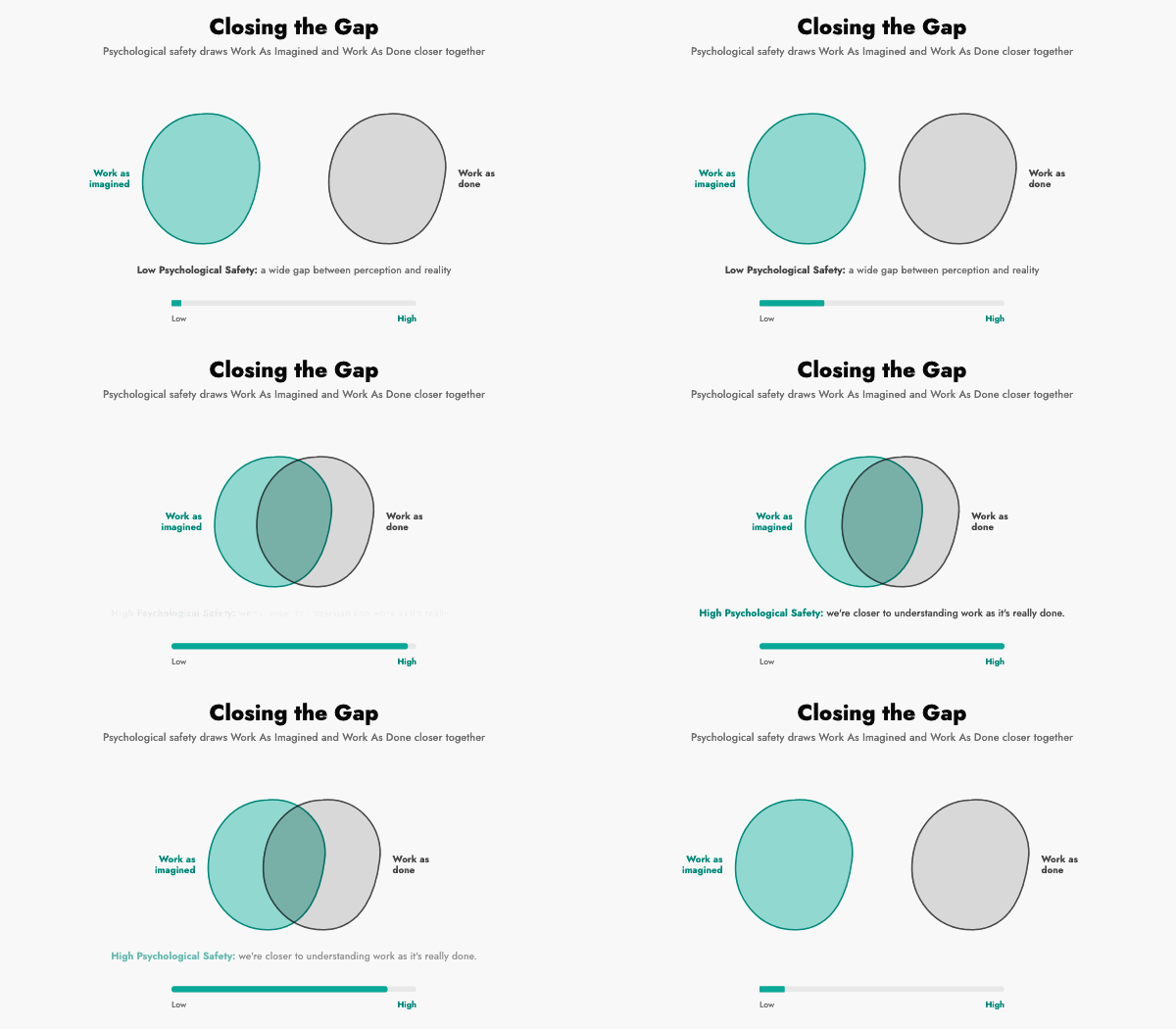
Work as Imagined vs Work as Done In our piece on human error, we looked at why and how people make mistakes. One of the categories of error we explored was “violations”, where people don’t carry out the work as per protocol or procedure. This is

Human Error We’ve covered failures before, but this week we’re focusing on errors. Failures can be preventable, complex, or “intelligent” – such as those resulting from experiments where we try something, intentionally, that might fail. However, errors, in this context, refer to the unwanted

Updated September 2026: this issue previously cited Dan Ariely’s “Human Capital Factor” as showing that companies whose staff feel better about them do better financially. That evidence came from a commercial white paper, and in 2021 a paper Ariely co-authored

Lean Coffee and Agenda-less Meetings In this issue, we’re discussing a way to run effective, agenda-less meetings, which helps to foster psychologically safe environments by ensuring everyone has the opportunity to speak up. You may have heard of Lean (as in Lean Manufacturing),

Welcome to the psychological safety newsletter and thanks for subscribing. You are amazing. This week discusses the top seven issues of 2022. Find out which ones were most popular below, and dive back in! If you enjoy reading this newsletter, please share it via your
Welcome to the psychological safety newsletter and thanks for subscribing. You are amazing. This week discusses how not to be Brent (Static work vs Generative work), plus great resources on autonomy, pedagogy, nursing, software engineering and human factors. Static Work vs Generative Work,

Welcome to the psychological safety newsletter and thanks for subscribing. You are amazing. This week discusses artificial intelligence and psychological safety. Psychological safety and safety culture workshops In the New Year, we’re running two new workshops! The first is a 2-hour Intermediate Psychological Safety Workshop on
Psychological Safety vs a “Safe Space” This tweet from Amy Edmondson asks a really important question: what’s the difference between “psychological safety” and a “safe space”? As Amy says, and as in my experience, the two are often conflated, but they’re certainly not the
Provan’s “safety of work” and “work of safety” are two different ways of thinking about occupational health and safety (OHS) in the workplace. While both are essential, understanding their differences and how they interconnect with modern theories like HOP and

Welcome to the psychological safety newsletter and thanks for subscribing. You are amazing. This week discusses the way in which aiming for zero defects can actually result in more defects, not fewer. Zero Defects. I’m currently reading “Boyd, the fighter pilot who

Tuckman’s Model We’ve recently covered team size, Dunbars number, and the effect that team sizes has on performance and psychological safety. In this issue, we’re going to take a little look at team longevity, the difference between short-lived and long-lived teams, and how the

Welcome to the psychological safety newsletter and thanks for subscribing. You are amazing. This week discusses some things to think about before measuring psychological safety. Measuring Psychological Safety I’ve had a lot of conversations recently about measuring psychological safety, and thought it’d be good to

It might be sometimes hard to tell whether people in a team feel psychologically safe, or how safe they feel. The more you hear these phrases, more psychologically safe they’re likely to be. Indicators of Psychological Safety in a Team

