psychological safety

speaking up at work - deisa tremarias

Speaking Up at Work

Psychological Safety: Speaking Up at Work Imagine an objectively psychologically safe workplace environment. People are praised, rewarded, and incentivised to speak up with ideas, questions, concerns and mistakes. The whole culture is geared towards an environment that isn’t just safe to

Read More »
intrapersonal safety

Intrapersonal safety and taking interpersonal risks

Interpersonal vs. Intrapersonal Dynamics in Psychological Safety: Balancing Self and Others in Organisational Contexts In the organisational behaviour and dynamics, understanding the interplay between interpersonal and intrapersonal dynamics is crucial for fostering a culture of psychological safety. While these terms

Read More »
affirmations for modern life

Psychological Safety & Bullying

Bullying at work If you’re in the UK, or even if not, you may have heard the news on Friday that Dominic Raab resigned from his post as Deputy Prime Minister as a result of multiple accusations and a resultant report that found him

Read More »
b17 bomber checklist

Psychological Safety: Checklists

Checklists I read Atul Gawande’s “Better” some time around 2008 and absolutely loved it, so when he published “The Checklist Manifesto” in 2009, I grabbed a copy immediately. The Checklist Manifesto describes the power of checklists in reducing human error and increasing effectiveness across various industries,

Read More »
psychological safety in aviation - a go around

Psychological Safety in Aviation

Psychological Safety, Aviation Disasters and Crew Resource Management This week I’ve been reading “Confronting Mistakes” by Jan Hagen. This is a fantastic book, focusing on the human factors behind a multitude of aviation incidents. Jan highlights how miscommunication and failures to speak up

Read More »
Sal Paradise

Psychological Safety: Just Culture and the Met Police

Welcome to the Psychological Safety newsletter and thanks for subscribing. You’re amazing. Having tried switching to a biweekly pattern, I’m now experimenting with alternating short-form and long-form newsletters each week. This week is a short form newsletter and highlights Just Culture,

Read More »
psychological safety feedback sketchnote

Psychological Safety & Giving Feedback

Providing constructive feedback is one powerful way you can help people excel, achieve their goals and be happier in their work.  Done well, it can create psychological safety and help teams and organisations perform at their best. However, feedback can

Read More »

Psychological Safety in Teacher Meetings

Contributed by Carolyn McKanders and Robert Garmston Teachers meet continuously as an expected part of school duties. They meet in pairs,in faculty groups, departments and grade level meetings. Facilitation practices arenecessary in all these venues. Essential to meeting success and

Read More »
cognitive load - psychsafety

Cognitive Load and Psychological Safety

What does Cognitive Load have to do with Psychological Safety? Psychological safety helps to reduce our cognitive load by allowing us to ask for help and worry less about the interpersonal risks we take. Conversely, high cognitive load can mean

Read More »
psychological safety, diversity and inclusion

Psychological Safety and Privilege

AKA: When you’re accustomed to privilege, equality feels like oppression.  Not everyone is a fan of psychological safety. Sometimes that’s because people don’t yet understand what it is. Sometimes it’s because they do understand what it is, and yet they’re still

Read More »

Conway’s Law

What is Conway’s Law? This week we’re diving into the concept of Conway’s Law, and its relation to psychological safety. Conway’s Law essentially describes the “force” that means how a team or organisation is structured will affect what the organisation

Read More »

Resilience Engineering

Resilience Engineering Today we’re diving into the field of Resilience Engineering. This subject ticks a lot of my interest boxes: from complexity and sociotechnicality to psychological safety and leadership. I hope you find it interesting too! Resilience Engineering is a

Read More »
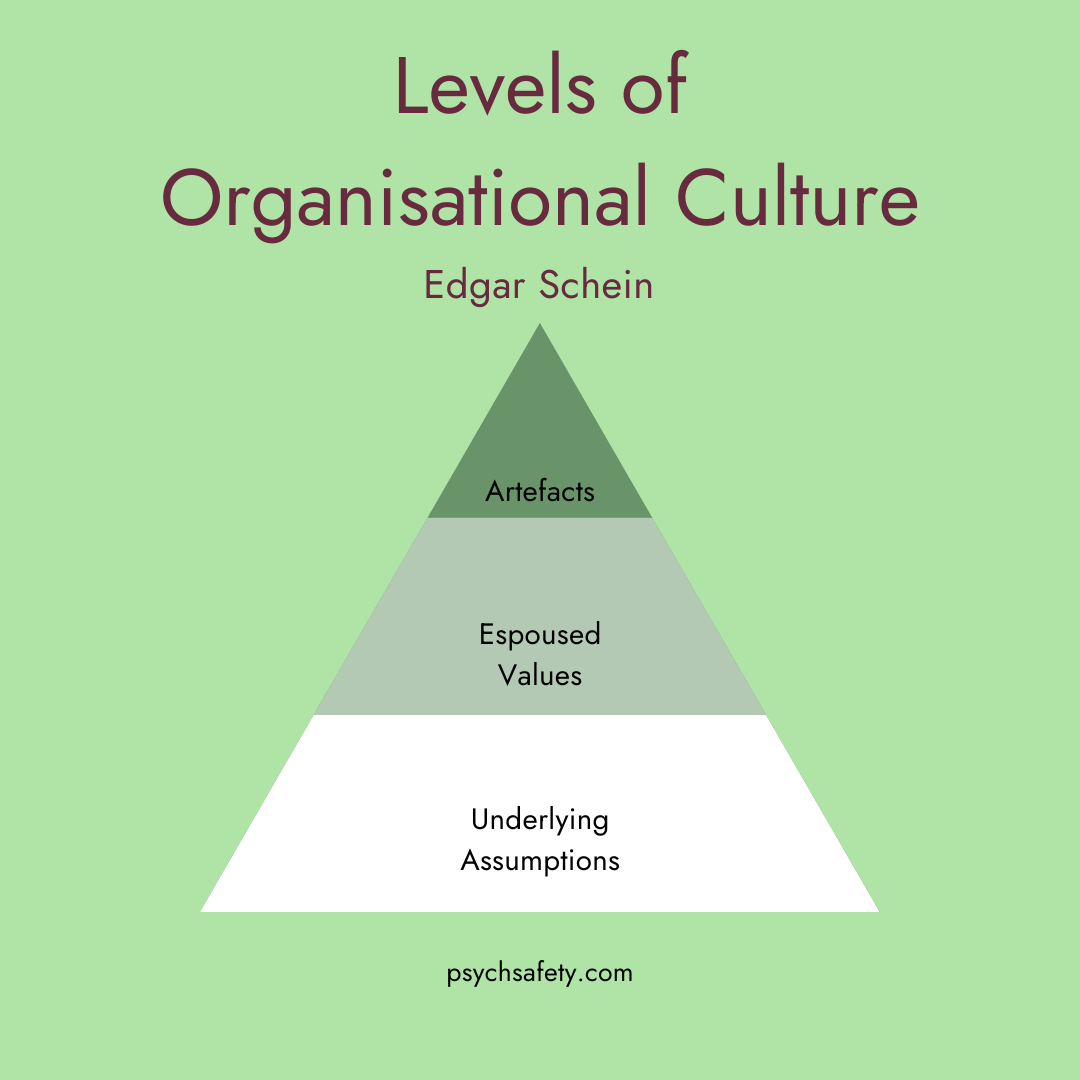
Schein's Levels of organisational culture

Edgar Schein’s Three Layers of Organisational Culture

1- Artefacts. These describe any overt, visible, describable aspects of the organisation. Think things like branding and logos, office design, dress code, policies and tools. Things that you can see.
2- Espoused values. This is how people would describe the organisation, in current or aspirational terms. These include missions, goals, value statements, and social contracts.
3- Underlying assumptions. These are unconscious, unspoken, hard to articulate elements of the organisation, particularly from within.

Read More »
team charter canvas

Team Charter Canvas and Template

Team charters are a fantastic way of creating alignment, cohesion and psychological safety in a team. They also help to onboard new team members, and enable teams to work together more effectively. This Psychological Safety Practice Playbook Add-on for the

Read More »
work as imagined vs work as done in high or low psychological safety

Work as Imagined vs Work as Done

Work as Imagined vs Work as Done In last week’s newsletter about human error, we looked at why and how people make mistakes. One of the categories of error we explored was “violations”, where people don’t carry out the work as per protocol or procedure. This

Read More »
"People do reasonable things given their goals, knowledge, understanding of the situation and focus of attention at a particular moment."

Types of Human Error

Human Error We’ve covered failures before, but this week we’re focusing on errors. Failures can be preventable, complex, or  “intelligent” – such as those resulting from experiments where we try something, intentionally, that might fail. However, errors, in this context, refer to the unwanted

Read More »
work types

Psychological Safety & Agile

Agile It seems like the word “Agile” gets thrown about a lot. Sometimes it refers to a more flexible approach to working hours and locations, sometimes it refers to Scrum practices, and sometimes it means taking an iterative, incremental project management style

Read More »
lean coffee

Lean Coffee

Lean Coffee and Agenda-less Meetings In this issue, we’re discussing a way to run effective, agenda-less meetings, which helps to foster psychologically safe environments by ensuring everyone has the opportunity to speak up. You may have heard of Lean (as in Lean Manufacturing),

Read More »
static work vs generative work

Psychological Safety: The Top 7

Welcome to the psychological safety newsletter and thanks for subscribing. You are amazing. This week discusses the top seven issues of 2022. Find out which ones were most popular below, and dive back in! If you enjoy reading this newsletter, please share it via your

Read More »
static work vs generative work

Psychological Safety: Static work vs Generative work

Welcome to the psychological safety newsletter and thanks for subscribing. You are amazing. This week discusses how not to be Brent (Static work vs Generative work), plus great resources on autonomy, pedagogy, nursing, software engineering and human factors. Static Work vs Generative Work,

Read More »
a pug feeling psychologically safe

Psychological Safety: Artificial Intelligence

Welcome to the psychological safety newsletter and thanks for subscribing. You are amazing. This week discusses artificial intelligence and psychological safety. Psychological safety and safety culture workshops In the New Year, we’re running two new workshops! The first is a 2-hour Intermediate Psychological Safety Workshop on

Read More »

Add an admin note