• Psychological Safety
  • Organisational Training
    • – Ignite: Senior Leaders
    • – Impact: Team Workshop
    • – Delivering Feedback
    • – CRM for Non-Aviation Teams
    • – HOP: Human and Organisational Performance
  • Online Workshops
    • – Train the Trainer
    • – Fundamentals
    • – Practices
    • – Leadership
    • – Advanced
    • – Measurement
    • – Workshop Facilitation
    • – HOP
    • – Delivering Feedback
  • Resources
    • – Tool Kits
    • – Free Resources
    • – Newsletter
    • – Articles
    • – Research
    • – Shop
    • – Community
    • – Practices
    • – What is Psychological Safety?
  • About Us
  • Contact
  • Search
  • Tool Kits
    • Action Pack
    • Trainer Toolkit
    • Practitioner Bundle
    • Practice Playbook: Feedback​
    • Practice Playbook: Technology​
    • Practice Playbook: Inclusion​
    • Practice Playbook: Education​
    • Practice Playbook: Healthcare​
  • Organisational Training
    • Ignite for Senior Leaders
    • Impact Team Workshop
    • Management Masterclass
    • Delivering Effective Feedback
    • HOP: Human and Organisational Performance
    • CRM for Non-Aviation Teams
    • Train the Trainer
  • Online Workshops
    • Complete Online Course
    • Psychological Safety Fundamentals
    • Practice Masterclass
    • Leadership & Management
    • Advanced Psychological Safety
    • Measuring Psychological Safety
    • Workshop Design and Facilitation
    • HOP Fundamentals
    • Delivering Effective Feedback
psych safety logo white
  • Resources
    • Tool Kits
    • Free Resources
    • Newsletter
    • Research
    • Shop
    • Podcasts & Talks
    • Videos
    • Community
    • Events & Psych Safety Days
  • Articles
    • Search
    • What is Psychological Safety?
    • The History of Psychological Safety
    • Psychological Safety Practices
    • Psychological Safety In The Workplace
    • Research
    • Measure Psychological Safety
    • Human Organisational Performance (HOP)
  • The Psych Safety Team
    • Contact Us
    • About The Team
    • Tom Geraghty
    • Jade Garratt
  • Tool Kits
    • Action Pack
    • Trainer Toolkit
    • Practitioner Bundle
    • Practice Playbook: Feedback​
    • Practice Playbook: Technology​
    • Practice Playbook: Inclusion​
    • Practice Playbook: Education​
    • Practice Playbook: Healthcare​
  • Organisational Training
    • Ignite for Senior Leaders
    • Impact Team Workshop
    • Management Masterclass
    • Delivering Effective Feedback
    • HOP: Human and Organisational Performance
    • CRM for Non-Aviation Teams
    • Train the Trainer
  • Online Workshops
    • Complete Online Course
    • Psychological Safety Fundamentals
    • Practice Masterclass
    • Leadership & Management
    • Advanced Psychological Safety
    • Measuring Psychological Safety
    • Workshop Design and Facilitation
    • HOP Fundamentals
    • Delivering Effective Feedback
psych safety logo white
  • Resources
    • Tool Kits
    • Free Resources
    • Newsletter
    • Research
    • Shop
    • Podcasts & Talks
    • Videos
    • Community
    • Events & Psych Safety Days
  • Articles
    • Search
    • What is Psychological Safety?
    • The History of Psychological Safety
    • Psychological Safety Practices
    • Psychological Safety In The Workplace
    • Research
    • Measure Psychological Safety
    • Human Organisational Performance (HOP)
  • The Psych Safety Team
    • Contact Us
    • About The Team
    • Tom Geraghty
    • Jade Garratt
Human Organisational Performance (HOP)  ·  Newsletter  ·  Psychological Safety  ·  Psychological Safety In The Workplace

Resilience Engineering

February 10, 2023

Resilience Engineering

Today we’re diving into the field of Resilience Engineering. This subject ticks a lot of my interest boxes: from complexity and sociotechnicality to psychological safety and leadership. I hope you find it interesting too!

Resilience Engineering is a multidisciplinary field associated with safety science, complexity, human factors and associated domains that focuses on understanding how complex adaptive systems cope with, and learn from, surprise.
 

TL;DR: In order to foster resilience, we must first create the conditions in which resilience can occur.
 

If you’ve read David Marquet’s “Turn The Ship Around” then you’ll be familiar with David’s story of taking command of the worst submarine in the US fleet, the USS Santa Fe, and transforming it and the crew into the most successful in the fleet. He did this by applying excellent leadership practices and fostering psychological safety so that crew members did not need to ask for permission or wait for orders. Instead, they declared their intent and possessed the agency to make important decisions. 

Whether or not you’ve read the book, hold the thought of that submarine. We’re going to come back to it.

The USS Santa Fe

What is Resilience Engineering?

Resilience Engineering (RE) addresses the ability of sociotechnical systems, such as teams, organisations, communities, nations, or even submarines, to anticipate, detect, respond and recover from disruptions. Those disruptions could be organisational changes, economic downturns, enemy threats, accidents, or pandemics. 

Resilience itself in RE terms, is “The intrinsic ability of a system to adjust its functioning prior to, during, or following changes and disturbances, so that it can sustain required operations under both expected and unexpected conditions.” – Prof Erik Hollnagel in Resilience Engineering in Practice, 2010. It is a field of study in its own right, and there’s even a Resilience Engineering Association. 

RE draws on a great range of domains including human factors, ergonomics, ecology, safety science, cognitive psychology, public health, and many more. Something you may hear quite often from RE practitioners is that “there is no root cause“, alongside a rejection of “human error” as a meaningful category of cause, as Erik Hollnagal writes in “The No View of Human Error”. Resilience engineering, like its companion subject of safety science, moves from seeing people as the problem, to the solution.

Because RE includes the word “engineering”, it can lead us to think of mechanical, structural, or software engineering, which is maybe a little misleading. In fact, at its core, RE is about people. As Erik Hollnagel has said repeatedly (Hollnagel & Woods, 2006), resilience is about what a system can do as opposed to something a system has. This includes considering a system’s capacity to anticipate, synchronise, respond and learn (From Resilience is a Verb by David D. Woods). In 2015, David Woods described organisational resilience as “sustained adaptive capacity” (from Reliability Engineering & System Safety). Resilience Engineering is becoming a core focus, and maybe the next evolution, of DevOps.
 

Resilience vs Robustness

Woods also helps to make a really important distinction between resilience and robustness as in this graphic from a great primer on Resilience Engineering by Lorin Hochstein. Robustness is the ability to sustain functioning despite disturbances, whilst resilience means dealing with unexpected challenges and learning from them. 

robustness vs resilience

If we think about the cynefin categorisation of system states, robustness could be seen as being able to deal well with known unknowns, and resilience as being able to deal well with unknown unknowns. 

The physical structure of a submarine may be robust: it needs to be able to withstand the impact of a torpedo, for example. But in combination with the people on board who can identify threats, make quick decisions, take action and also learn from their experiences, the submarine can be resilient. In the torpedo example, through the skill, experience, and proactive decision making of the crew, they can avoid detection, and thus avoid the need to withstand a torpedo threat at all. In doing so, they not only avoid the threat, but they learn valuable lessons for the next time a similar threat occurs and are able to respond even more effectively. True resilience is responding effectively to surprise.

Possibly the best example of resilience is Richard Cook’s excellent talk about the resilient capabilities of bone, that we featured in a previous newsletter in tribute to the great Dr Cook. Bone is strong, but to be robust enough to withstand any impact, bone would be far too heavy for us to be able to walk. Instead, bone adapts to impacts, stressors and breaks, and grows back stronger in the areas where it needs to. In this way, it anticipates, detects and responds to challenges. 

This is my elbow after a mountain bike crash a few years ago. You can see the fresh break in the elbow, along with a healed break from a few years previously. The bone is thicker and denser around the old break, and with a little assistance from a surgeon, the bone around the new break will grow back stronger than before.

Systems are made of people and things

Sociotechnical systems comprise structures, technology, rules, inputs and outputs, and most importantly, people. As John Allspaw of Adaptive Capacity Labs said on Twitter, “Resilience is about the creation and sustaining of various conditions that enable systems to adapt to unforeseen events. *People* are the adaptable element of those systems.” The crew of a submarine anticipate, synchronise, respond, and learn. It’s these capabilities of people that provide resilience to systems, including submarines.

To reiterate: Resilience is the capability of being able to:

  • Anticipate (by looking)
  • Detect (by sensing and synchronising)
  • Respond (by acting)
  • Learn (by introspection and investigation)

If Resilience Engineering is about “systems” both anticipating and adapting to unforeseen events, the psychological safety of the people who form part of these systems is an essential component of resilience, alongside expertise, equipment, etc. 

Psychological Safety

Psychological safety enables people to take risks and speak up when they notice something going wrong. This is particularly important because most significant disruptions happen unexpectedly, so the ability to respond quickly and effectively is key to resilience. Cultures of psychological safety also increase the ability of people to recognise potential threats, develop contingency plans, and conduct regular drills, simulations and exercises to improve readiness. This allows steps to be taken to ensure that the system (the organisation, or in our example, the submarine) is best placed to respond to whatever happens. 

Resilience Engineering also connects to the idea of a learning organisation. In a 2008 article in HBR called “Is Yours a Learning Organisation?”, David Garvin, Amy Edmondson, and Francesca Gino described how “A learning organization is continually adapting and adjusting to remain viable in a changing world”. Here they are referring to the adaptive capacity of the people within the organisation and to me, this sounds a lot like resilience. 

People are the human, adaptable, element of resilience. If we are to anticipate threats, we need people to speak up about potential threats on the horizon. If we are to detect issues, people must speak up about mistakes, problems, and concerns. Responding effectively requires people to speak up with new ideas and take intelligent risks without fear of failure. And we can only learn if people can have honest and candid conversations about work, failure, and lessons learned. An environment, a substrate, of psychological safety is therefore foundational to resilience.

Footnote: 

If you’ve read Nassim Taleb’s work on “Antifragility”, you might have a sense that we’re talking about the same thing, and in some ways, we are. I believe that Resilience Engineering existed as a field of study before Taleb wrote on antifragility, and I understand the two concepts to be intrinsically linked.


This newsletter is sponsored by Conflux

Conflux is the leading business consultancy worldwide helping organizations to navigate fast flow in software. We help organizations to adopt and sustain proven, modern practices for delivering software rapidly and safely.

‘The Fearless Organization’ by Amy Edmondson is considered by many to be essential reading on the topic of psychological safety. In this article, Sophie Weston, Principal at Conflux, has put together some key takeaways from the book.


Psychological Safety in the Workplace


I love this from Marissa Solomon Shandell (@researchdoodles) on Instagram. This doodle was inspired by a new visual measure for burnout published last year (Matches measure: A visual scale of job burnout. Muir, Calderwood, & Boncoeur, 2022). 
 

This is a great piece from Gareth Lock at The Human Diver about intentional deviation. He describes the practice of skilled divers deviating intentionally from the plan because their experience provides them with the insight to anticipate issues that could result from closely following the plan. As in our newsletter on human error, deviation from procedure can be classed as an error, but drawing on expertise to know when to deviate from a procedure can sometimes be the key to success.

Aside: This advice is actually really useful for anyone who needs to navigate in unknown territory, whether you’re diving, hiking or something else. If you’re trying to reach a point on a ridge, river, wall or similar, instead of heading straight for it, intentionally “aim off” – navigate some distance perpendicular to it. If you aim directly for the waypoint but can’t see it when you get there, you don’t know whether you’re too far left or right. Instead, aiming off means when you get to the river, you simply walk downstream a little and you’ll find your waypoint.
 

Aiming off


Thanks so much to Becky Thomas for inviting me to talk about psychological safety on the fantastic Leadership Log podcast! We got into the origins of psychological safety, and some practical ways to “do” psychological safety at work.


Thanks to Amy Edmondson for signposting to this sketchnote by the fab illustrator Tanmay Vora, about proactive inquiry – attributes of a powerful question. Amy dives into how situational humility and engaging in proactive inquiry fosters greater psychological safety in her book, The Fearless Organisation.
 

This Economist piece about why “pointing fingers is unhelpful” is behind a paywall I’m afraid, but I had to share it for the line about how “Shaggy cultures” show up in low share prices. So if you don’t have a subscription to the Economist, instead here’s Shaggy, with “It Wasn’t Me”.


This week’s poem:


It Wasn’t Me, By Simbo Rumblebelly

It wasn’t me who ate the cake 
Coincidence my belly aches 
I surely didn’t lick the cream 
I say it’s not all as it seems 
 
It wasn’t me who ate the pie
Would you believe I’d ever lie?
And as for eating up that stew
There’s still enough there left for you!
 
It wasn’t me who spilt the beer
It’s chance my empty mug is near
The floor it may be stained a bit
Just put the rug on top of it
 
It wasn’t me broke the door
I swear that it was broke before
I also haven’t lost the key
It’s just not where it’s meant to be
 
It wasn’t me who scared the cat
I’d never do a thing like that
And did I really scare the horse?
It’s always running off, of course!
 
It wasn’t me who did those things
It’s never trouble that I bring
It wasn’t me who did such wrong
Nothing to see, just move along
 
I tell you every word is true
I don’t do naught I shouldn’t do
So what it was that you did see
I tell you now, it wasn’t me!


leadershippsychological safetyresilience engineeringteams

Tom Geraghty

Tom Geraghty, co-founder and delivery lead at Iterum Ltd, is an expert in high performing teams and psychological safety. Leveraging his unique background in ecological research and technology, Tom has held CIO/CTO roles in a range of sectors from tech startups to global finance firms. He holds a degree in Ecology, an MBA, and a Masters in Global Health. His mission is to make workplaces safer, higher performing, and more inclusive. Tom has shared his insights at major events such as The IT Leaders Summit, the NHS Senior Leadership Conference, and EHS Global Conferences. Connect with him on LinkedIn or email tom@psychsafety.com

Related Articles


Newsletter
Psychological Safety: Human Debt
March 19, 2021
motorbike
Human Organisational Performance (HOP)  ·  Newsletter  ·  Psychological Safety In The Workplace
Safe To Fail Experiments
May 26, 2023
Schein's Levels of organisational culture
Edgar Schein's Three Layers of Organisational Culture
Previous Article
Conway's Law
Next Article
  • Subscribe to the Psychological Safety Newsletter

  • psychological safety train the trainer
  • Get Certified! Join online workshops, or explore training and consultancy for leaders, teams and organisations.

    Discover our training options for Human and Organisational Performance and CRM for non-aviation teams.

    If you're a trainer, consultant or facilitator, get certified in our Train the Trainer complete online programme and download the Training Materials for Facilitators and Trainers.

  • human and organisational performance training
  • building and maintaining psychological safety for your team
    Download the complete Practitioners' guide to psychological safety
  • psychological safety trainer toolkit
  • Download the Psychological Safety Trainer Toolkit. Containing powerful resources that you can use to deliver your own training and workshops!

  • psych safety logo

    Sponsorship and advertising. Reach over 11,000 weekly readers and 500,000 online visitors with your message in our newsletter.

  • theres no such thing as too much psychological safety
    Grab Psychological Safety Stickers from our Online Shop!
  • Psych Safety Day

    Find out more about our Psych Safety Days - in-person and virtual events to share, learn, and connect with other enthusiasts, practitioners and researchers on psychological safety and related topics.

  • Categories

    • Newsletter
    • Psychological Safety
      • Create and Maintain
      • Human Organisational Performance (HOP)
      • In Technology
      • Learning and Development
      • Measure
      • Psychological Safety In The Workplace
      • Theory and Research
    • Random
  • Recent Posts

    • The Streetlight Effect
      The Streetlight Effect
      January 8, 2026
    • The "Fist of Five"
      The "Fist of Five"
      December 19, 2025
    • Psychological Bravery
      Psychological Bravery
      December 18, 2025
    • Psych Safety Book List 2025
      Psych Safety Book List 2025
      December 18, 2025
    • Psych Safety 2025 Unwrapped
      Psych Safety 2025 Unwrapped
      December 15, 2025
    • Plan Continuation Bias
      Plan Continuation Bias
      December 12, 2025
    • Whistleblowing and Psychological Safety

      Whistleblowing and Psychological Safety
      December 4, 2025
    • How Childhood Socioeconomic Status Shapes Psychological Safety and Career Risk-Taking at Work
      How Childhood Socioeconomic Status Shapes Psychological Safety and Career Risk-Taking at Work
      November 27, 2025
    • Safety and the Myth of Self-Reliance
      Safety and the Myth of Self-Reliance
      November 24, 2025
    • The Watermelon Effect and "Greenwashing"

      The Watermelon Effect and "Greenwashing"
      November 7, 2025
    • Individual Resilience
      Individual Resilience
      October 31, 2025
    • Counterfactuals
      Counterfactuals
      October 24, 2025
    • Coaching and Psychological Safety
      Coaching and Psychological Safety
      October 17, 2025
    • Five Ecological Concepts for Working in Organisational Change

      Five Ecological Concepts for Working in Organisational Change
      October 9, 2025
    • The Sharp End & Blunt End of Education
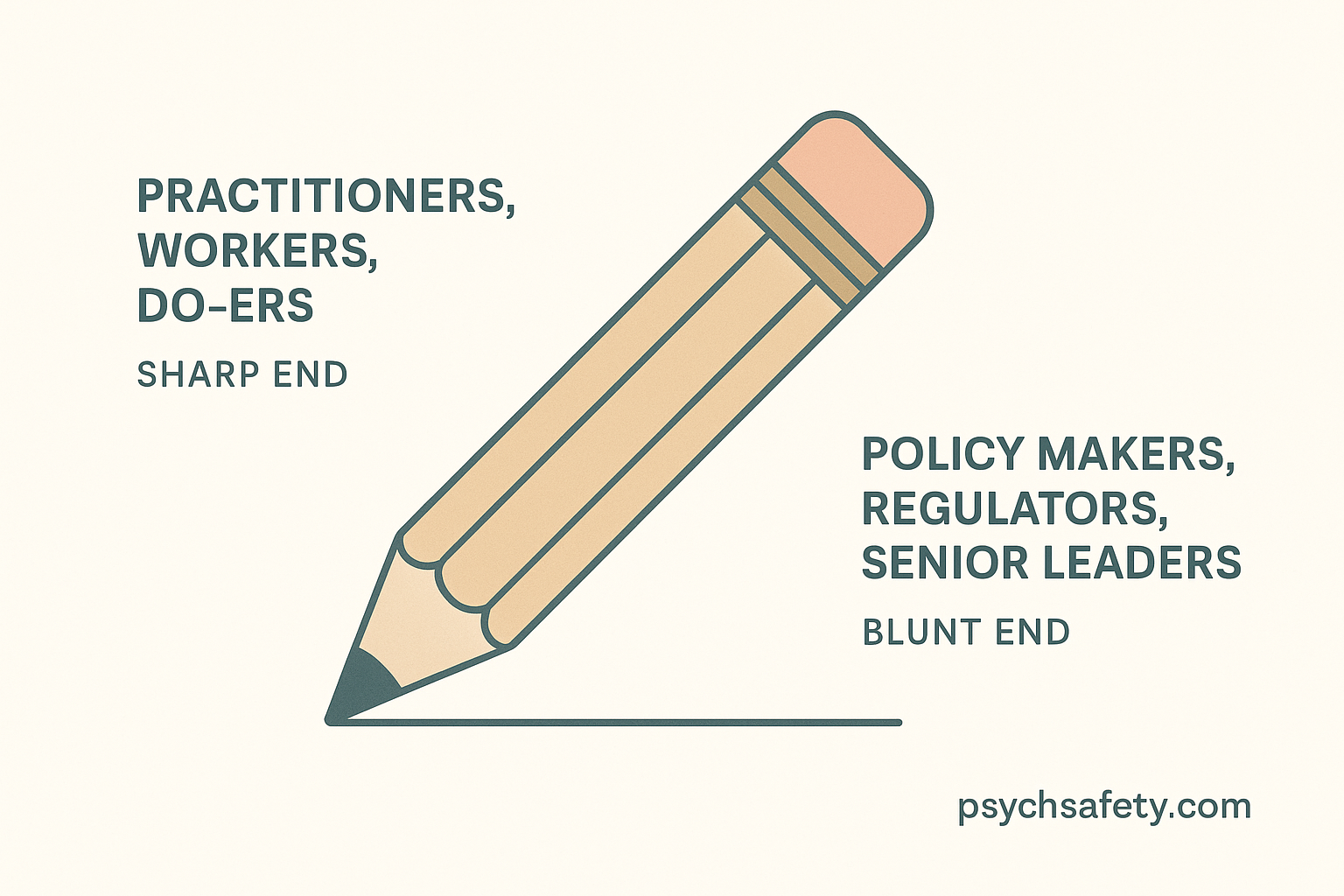
      The Sharp End & Blunt End of Education
      October 3, 2025
    • Forced Vulnerability
      Forced Vulnerability
      September 26, 2025
    • New Sticker Drop! "Zombies Are Scary"
      New Sticker Drop! "Zombies Are Scary"
      September 22, 2025
    • Reflections - Part Four: A Rights-Based Approach

      Reflections - Part Four: A Rights-Based Approach
      September 16, 2025
    • Reflections - Part Three: The Safety to Dissent
      Reflections - Part Three: The Safety to Dissent
      September 12, 2025
    • Reflections - Part Two: Power and Difference
      Reflections - Part Two: Power and Difference
      September 4, 2025
    • The Psychological Safety Trainer Toolkit
      The Psychological Safety Trainer Toolkit
      September 1, 2025
    • Reflections on Psychological Safety: Five Years of Learning
      Reflections on Psychological Safety: Five Years of Learning
      August 29, 2025
    • Not Feeling Seen: Eye Contact and Psychological Safety
      Not Feeling Seen: Eye Contact and Psychological Safety
      August 21, 2025
    • Psychological Safety Isn't Enough
      Psychological Safety Isn't Enough
      August 15, 2025
    • Psych Safety Day / Week 2026
      Psych Safety Day / Week 2026
      August 11, 2025
    • The Amagasaki Disaster
      The Amagasaki Disaster
      August 8, 2025
    • Psychological safety isn't the same for everyone
      Psychological safety isn't the same for everyone
      August 4, 2025
    • Psychological Safety Books for Children

      Psychological Safety Books for Children
      August 1, 2025
    • Psychological Safety and Creativity
      Psychological Safety and Creativity
      July 25, 2025
    • The State of Psychological Safety Survey: 2025
      The State of Psychological Safety Survey: 2025
      July 19, 2025
    • Barriers to Psychological Safety
      Barriers to Psychological Safety
      July 18, 2025
    • How you respond matters.
      How you respond matters.
      July 11, 2025
    • Practices that Foster Psychological Safety
      Practices that Foster Psychological Safety
      July 4, 2025
    • Feedback in the workplace
      Feedback in the workplace
      June 27, 2025
    • Psych Safety Day 2025
      Psych Safety Day 2025
      June 21, 2025
    • Job Security and Psychological Safety
      Job Security and Psychological Safety
      June 20, 2025
    • How familiar are people with the concept of psychological safety?
      How familiar are people with the concept of psychological safety?
      June 13, 2025
    • Learning at Psych Safety
      Learning at Psych Safety
      June 13, 2025
    • Why do We Foster Psychological Safety?
      Why do We Foster Psychological Safety?
      June 6, 2025
    • Psychological Safety in Aviation - Special Edition
      Psychological Safety in Aviation - Special Edition
      May 30, 2025
    • Rebuilding Psychological Safety When It's Broken
      Rebuilding Psychological Safety When It's Broken
      May 30, 2025
    • Just Culture
      Just Culture
      May 23, 2025
    • Transactional Analysis
      Transactional Analysis
      May 15, 2025
    • Comfort vs Need
      Comfort vs Need
      May 9, 2025
    • Sociological Safety
      Sociological Safety
      May 2, 2025
    • Humour and Psychological Safety
      Humour and Psychological Safety
      May 1, 2025
    • Safety-Organised Criticality
      Safety-Organised Criticality
      April 25, 2025
    • Leaders are not solely responsible for psychological safety.
      Leaders are not solely responsible for psychological safety.
      April 21, 2025
    • Psychological Safety in Our Personal Lives

      Psychological Safety in Our Personal Lives
      April 17, 2025
    • The Organisational Fabric of Psychological Safety

      The Organisational Fabric of Psychological Safety
      April 10, 2025
    • Colution
      April 7, 2025
    • All Feedback Is Subjective
      All Feedback Is Subjective
      April 4, 2025
    • Micromanagement
      Micromanagement
      March 21, 2025
    • Rewetting Organisations
      Rewetting Organisations
      March 14, 2025
    • Spectra of Participation
      Spectra of Participation
      March 7, 2025
    • Twitter
    • LinkedIn


Sign up to our newsletter & get weekly insights and research

About

The Psychological Safety Team
Our Mission
Our Core Principles
Privacy Policy
Terms of Business

Learn

Corporate Training
Online Workshops
Newsletter
Professional Certification

Tools

Tool Kits
Articles
What is Psychological Safety?
The History of Psychological Safety

Get Connected

Contact us
Attend a Meetup
Join the Community
Connect with us on LinkedIn
View our YouTube Channel
© 2025 Iterum Ltd
We support LGBTQ+ rights all year round. But we also celebrate pride too.
We support LGBTQ+ rights all year round. But we also celebrate pride!
Content on this website is CC BY-NC-SA
Written by humans, not by AI