• Psychological Safety
  • Organisational Training
    • – Ignite: Senior Leaders
    • – Impact: Team Workshop
    • – Delivering Feedback
    • – CRM for Non-Aviation Teams
    • – HOP: Human and Organisational Performance
  • Online Workshops
    • – Train the Trainer
    • – Fundamentals
    • – Practices
    • – Leadership
    • – Advanced
    • – Measurement
    • – Workshop Facilitation
    • – HOP
    • – Delivering Feedback
  • Resources
    • – Tool Kits
    • – Free Resources
    • – Newsletter
    • – Articles
    • – Research
    • – Shop
    • – Community
    • – Practices
    • – What is Psychological Safety?
  • About Us
  • Contact
  • Search
  • Tool Kits
    • Action Pack
    • Trainer Toolkit
    • Practitioner Bundle
    • Practice Playbook: Feedback​
    • Practice Playbook: Technology​
    • Practice Playbook: Inclusion​
    • Practice Playbook: Education​
    • Practice Playbook: Healthcare​
  • Organisational Training
    • Ignite for Senior Leaders
    • Impact Team Workshop
    • Management Masterclass
    • Delivering Effective Feedback
    • HOP: Human and Organisational Performance
    • CRM for Non-Aviation Teams
    • Train the Trainer
  • Online Workshops
    • Complete Online Course
    • Psychological Safety Fundamentals
    • Practice Masterclass
    • Leadership & Management
    • Advanced Psychological Safety
    • Measuring Psychological Safety
    • Workshop Design and Facilitation
    • HOP Fundamentals
    • Delivering Effective Feedback
psych safety logo white
  • Resources
    • Tool Kits
    • Free Resources
    • Newsletter
    • Research
    • Shop
    • Podcasts & Talks
    • Videos
    • Community
    • Events & Psych Safety Days
  • Articles
    • Search
    • What is Psychological Safety?
    • The History of Psychological Safety
    • Psychological Safety Practices
    • Psychological Safety In The Workplace
    • Research
    • Measure Psychological Safety
    • Human Organisational Performance (HOP)
  • The Psych Safety Team
    • Contact Us
    • About The Team
    • Tom Geraghty
    • Jade Garratt
  • Tool Kits
    • Action Pack
    • Trainer Toolkit
    • Practitioner Bundle
    • Practice Playbook: Feedback​
    • Practice Playbook: Technology​
    • Practice Playbook: Inclusion​
    • Practice Playbook: Education​
    • Practice Playbook: Healthcare​
  • Organisational Training
    • Ignite for Senior Leaders
    • Impact Team Workshop
    • Management Masterclass
    • Delivering Effective Feedback
    • HOP: Human and Organisational Performance
    • CRM for Non-Aviation Teams
    • Train the Trainer
  • Online Workshops
    • Complete Online Course
    • Psychological Safety Fundamentals
    • Practice Masterclass
    • Leadership & Management
    • Advanced Psychological Safety
    • Measuring Psychological Safety
    • Workshop Design and Facilitation
    • HOP Fundamentals
    • Delivering Effective Feedback
psych safety logo white
  • Resources
    • Tool Kits
    • Free Resources
    • Newsletter
    • Research
    • Shop
    • Podcasts & Talks
    • Videos
    • Community
    • Events & Psych Safety Days
  • Articles
    • Search
    • What is Psychological Safety?
    • The History of Psychological Safety
    • Psychological Safety Practices
    • Psychological Safety In The Workplace
    • Research
    • Measure Psychological Safety
    • Human Organisational Performance (HOP)
  • The Psych Safety Team
    • Contact Us
    • About The Team
    • Tom Geraghty
    • Jade Garratt
Human Organisational Performance (HOP)  ·  Newsletter  ·  Psychological Safety  ·  Psychological Safety In The Workplace

Conway’s Law

February 17, 2023

What is Conway’s Law?

This week we’re diving into the concept of Conway’s Law, and its relation to psychological safety. Conway’s Law essentially describes the “force” that means how a team or organisation is structured will affect what the organisation does.

In 1967, Mel Conway submitted an article titled “How Do Committees Invent?” to the Harvard Business Review. HBR rejected it, so Mel submitted it instead to an IT Magazine called Datamation, who published it in April 1968.

In that piece, which you can read here on Mel’s own website, Mel describes:

“Any organization that designs a system (defined broadly) will produce a design whose structure is a copy of the organization’s communication structure.”

I.e. we’re destined to build things that look like the teams that built them.

The Mythical Man Month

Fred Brooks then cited the piece in “The Mythical Man-Month,” (which we covered in a previous newsletter) and called it “Conway’s Law.” (See page 111 if you have the book). The name stuck.

Also known as the mirroring hypothesis, Conway’s Law shows the connection and the dependency between the social structures of an organisation, and what they create. The products created by organisations, which includes software, literature, machines, processes and governance all end up shaped like the organisational structure they are created in. Conway’s Law is best known in the field of software architecture, but Conway perceived it more broadly and applied it to most technical fields.

What this means in the real world is that even though we think we’re designing our products and systems, in practice, it’s often the organisational structure that designs them for us.
 

There’s a reasonable evidential basis showing Conway’s Law to be true at least in software development, as well as other fields. Here’s a great piece by Chris Fleming that addresses Conway’s Law in digital health.

There are a few key reasons for this:

Mechanisms Behind Conway’s Law:

  • The coupling of teams is reflected in the coupling of their products. If teams are tightly coupled to each other, the components of the system they produce will be too.
  • Teams build what they’re tasked to build. A database team builds a database, an electric motor team build an electric motor.
  • The size of the team influences the size of the product they create. Big teams may produce big (and more complex) products. Small teams tend to produce small (and less complex) products. 

I’ve illustrated this in the graphic below. Solid lines indicate tight coupling, dotted lines indicate looser (less dependent) coupling.


Personally, I prefer to think of Conway’s Law more as a “force” than a “law”. It’s something that we need to be aware of, and we can either try to ignore it, fight against it, or use it to our advantage, as in the table below.

How to work with Conway’s Law:

Our approach to Conway’s LawWhat happens as a result
We ignore it: We don’t believe in it, or maybe we don’t even know about it.We find ourselves building systems in a way that we didn’t intend.
We fight against it: We design systems that don’t align with our team structures.We experience high communication friction, lots of handoffs, and slow progress.
We use it to our advantage: The Inverse Conway Manoeuvre – we know what we want to build, and we design our team structures in alignment.By structuring teams and making communication protocols explicit, we reduce the friction between teams, work is easier, and we build what we actually want to build.

The Inverse Conway Manoeuvre

The Inverse Conway Manoeuvre requires us to think about what we want to create – whether it’s software, hardware, a book, a building or anything else, and design our teams, and our interaction modes to match. We can do that by using Team Charters, Team APIs and structuring our teams intelligently. It can be very powerful to define explicitly how teams are expected to communicate with each other, and a great way to do this is by using the Team Topologies “Interaction Modes”:

Collaboration requires us to be tightly bound: it’s a highly dependent way of working. Facilitation is rather more like coaching, assisting and guiding: less dependent but still very interactive. X-as-a-Service is the least dependent mode of interaction between teams, and is more like a customer/supplier relationship, where a team can provide and consume resources from another without the need for heavyweight communication.

The concept of DevOps practices reflects these different approaches well: as we saw through the history of DevOps, it emerged from the perceived need to break down the silos between “Dev” and “Ops” teams, and applying these principles to help define how teams can work more effectively together is one of the core principles of DevOps.

Conway’s Law and Psychological Safety

A neat side effect of defining how teams, and the people in them are expected to interact and depend on each other, is that it also fosters psychological safety. It makes it easier for us to know what’s expected of us in our communication, and if we do communicate, how it will be received, and what we can expect in return.


An excerpt from Matthew Skelton’s mini-book “How to choose tools for DevOps and Continuous Delivery“

Several studies have confirmed the core message of Conway’s Law. There are many subtleties to this in practice, but it boils down to this: If the intercommunication between teams does not reflect the actual or intended communication between software components, the software will be difficult to build and operate.

You can use “Reverse Conway”— changing the team structure to match the required system architecture —together with techniques such as domain-driven design (DDD) and code forensics, to reshape team responsibilities to align with the software architecture you need to produce in order to clarify boundaries and improve the development and operation of your systems.

We also need to be mindful of the effect of shared tools on the way in which teams interact. If we want teams to collaborate, then shared tools make sense, but if we need a clear responsibility boundary between teams, separate tools may be best.


This newsletter is sponsored by Conflux

Conflux is the leading business consultancy worldwide helping organizations to navigate fast flow in software. We help organizations to adopt and sustain proven, modern practices for delivering software rapidly and safely.

‘The Fearless Organization’ by Amy Edmondson is considered by many to be essential reading on the topic of psychological safety. In this article, Sophie Weston, Principal at Conflux, has put together some key takeaways from the book.


Psychological Safety in the Workplace

I was really honoured to be featured in this excellent piece on psychological safety in the Financial Times, by Andrew Hill. I spoke to Andrew, as did a few of my wonderful clients from Warner Music and Abri, along with Amy Edmondson, about how refreshing it is to see psychological safety being addressed seriously and so widely. But along with that surge in interest comes a risk of the term being watered down and misinterpreted. 


-Note: the FT is paywalled, so you may need a subscription to read the article in full. 
 

We often cite Google’s Project Aristotle as a key resource in psychological safety evidence and practice. Unfortunately, Google themselves have their own troubles, and this is an excellent piece from Praveen Seshadri on what those problems are, and what’s required to deal with them.


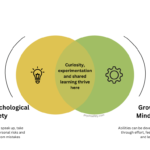
I love this graphic from happystrokes.in on Instagram. Reframing is key to moving from a fixed mindset to a growth mindset.
 

Here’s a great piece from Amy Gallo in HBR on psychological safety – what it is, what it isn’t, and busting some myths about it, including that psychological safety doesn’t mean feeling comfortable all the time.
 

Amy’s elves have been hard at work again! 


Amy’s elves have been hard at work again! 


Finally, this, from Work Chronicles. If we’re to be expected to stay late when there’s work to do, we can also expect to be able to finish early when there isn’t. 


Things to do and try:

Field Theory, based on social psychologist theories from Kurt Lewin in 1951, describes the current level of performance or being as a state of equilibrium between the driving forces that support change and the restraining forces that hamper it.

From that theory, Force Field Analysis is now used as a tool for making and communication decisions, and analysing decisions after the fact, to examine what may have contributed to that decision being made.  

Next time you’re making a difficult decision, or if you’re trying to work out why a decision was made, try this. Write the decision in the centre, and forces for on the arrows to the left, and forces against to the right. Consider how many forces are pushing one way or the other, and the relative strength of those forces.


This week’s poem:


“There will come Soft Rain” by Sara Teasdale

There will come soft rain and the smell of the ground,
And swallows circling with their shimmering sound;

And frogs in the pools singing at night,
And wild plum trees in tremulous white;

Robins will wear their feathery fire,
Whistling their whims on a low fence-wire;

And not one will know of the war, not one
Will care at last when it is done.

Not one would mind, neither bird nor tree,
If mankind perished utterly;

And Spring herself, when she woke at dawn
Would scarcely know that we were gone.


Practices that help foster psychological safetypsychological safetyteamstechnologywork

Tom Geraghty

Tom Geraghty, co-founder and delivery lead at Iterum Ltd, is an expert in high performing teams and psychological safety. Leveraging his unique background in ecological research and technology, Tom has held CIO/CTO roles in a range of sectors from tech startups to global finance firms. He holds a degree in Ecology, an MBA, and a Masters in Global Health. His mission is to make workplaces safer, higher performing, and more inclusive. Tom has shared his insights at major events such as The IT Leaders Summit, the NHS Senior Leadership Conference, and EHS Global Conferences. Connect with him on LinkedIn or email tom@psychsafety.com

Related Articles


The challenger explosion
Human Organisational Performance (HOP)  ·  Newsletter  ·  Psychological Safety
The Challenger Disaster: Normalisation of Deviance
November 24, 2023
mary parker follett ideas
Newsletter  ·  Psychological Safety  ·  Psychological Safety In The Workplace
Psych Safety Book List 2025
December 18, 2025
Resilience Engineering
Previous Article
psychological safety, diversity and inclusion
Psychological Safety and Privilege
Next Article
  • Subscribe to the Psychological Safety Newsletter

  • psychological safety train the trainer
  • Get Certified! Join online workshops, or explore training and consultancy for leaders, teams and organisations.

    Discover our training options for Human and Organisational Performance and CRM for non-aviation teams.

    If you're a trainer, consultant or facilitator, get certified in our Train the Trainer complete online programme and download the Training Materials for Facilitators and Trainers.

  • human and organisational performance training
  • building and maintaining psychological safety for your team
    Download the complete Practitioners' guide to psychological safety
  • psychological safety trainer toolkit
  • Download the Psychological Safety Trainer Toolkit. Containing powerful resources that you can use to deliver your own training and workshops!

  • psych safety logo

    Sponsorship and advertising. Reach over 11,000 weekly readers and 500,000 online visitors with your message in our newsletter.

  • theres no such thing as too much psychological safety
    Grab Psychological Safety Stickers from our Online Shop!
  • Psych Safety Day

    Find out more about our Psych Safety Days - in-person and virtual events to share, learn, and connect with other enthusiasts, practitioners and researchers on psychological safety and related topics.

  • Categories

    • Newsletter
    • Psychological Safety
      • Create and Maintain
      • Human Organisational Performance (HOP)
      • In Technology
      • Learning and Development
      • Measure
      • Psychological Safety In The Workplace
      • Theory and Research
    • Random
  • Recent Posts

    • The Streetlight Effect
      The Streetlight Effect
      January 8, 2026
    • The "Fist of Five"
      The "Fist of Five"
      December 19, 2025
    • Psychological Bravery
      Psychological Bravery
      December 18, 2025
    • Psych Safety Book List 2025
      Psych Safety Book List 2025
      December 18, 2025
    • Psych Safety 2025 Unwrapped
      Psych Safety 2025 Unwrapped
      December 15, 2025
    • Plan Continuation Bias
      Plan Continuation Bias
      December 12, 2025
    • Whistleblowing and Psychological Safety
      Whistleblowing and Psychological Safety
      December 4, 2025
    • How Childhood Socioeconomic Status Shapes Psychological Safety and Career Risk-Taking at Work
      How Childhood Socioeconomic Status Shapes Psychological Safety and Career Risk-Taking at Work
      November 27, 2025
    • Safety and the Myth of Self-Reliance
      Safety and the Myth of Self-Reliance
      November 24, 2025
    • The Watermelon Effect and "Greenwashing"

      The Watermelon Effect and "Greenwashing"
      November 7, 2025
    • Individual Resilience
      Individual Resilience
      October 31, 2025
    • Counterfactuals
      Counterfactuals
      October 24, 2025
    • Coaching and Psychological Safety
      Coaching and Psychological Safety
      October 17, 2025
    • Five Ecological Concepts for Working in Organisational Change

      Five Ecological Concepts for Working in Organisational Change
      October 9, 2025
    • The Sharp End & Blunt End of Education
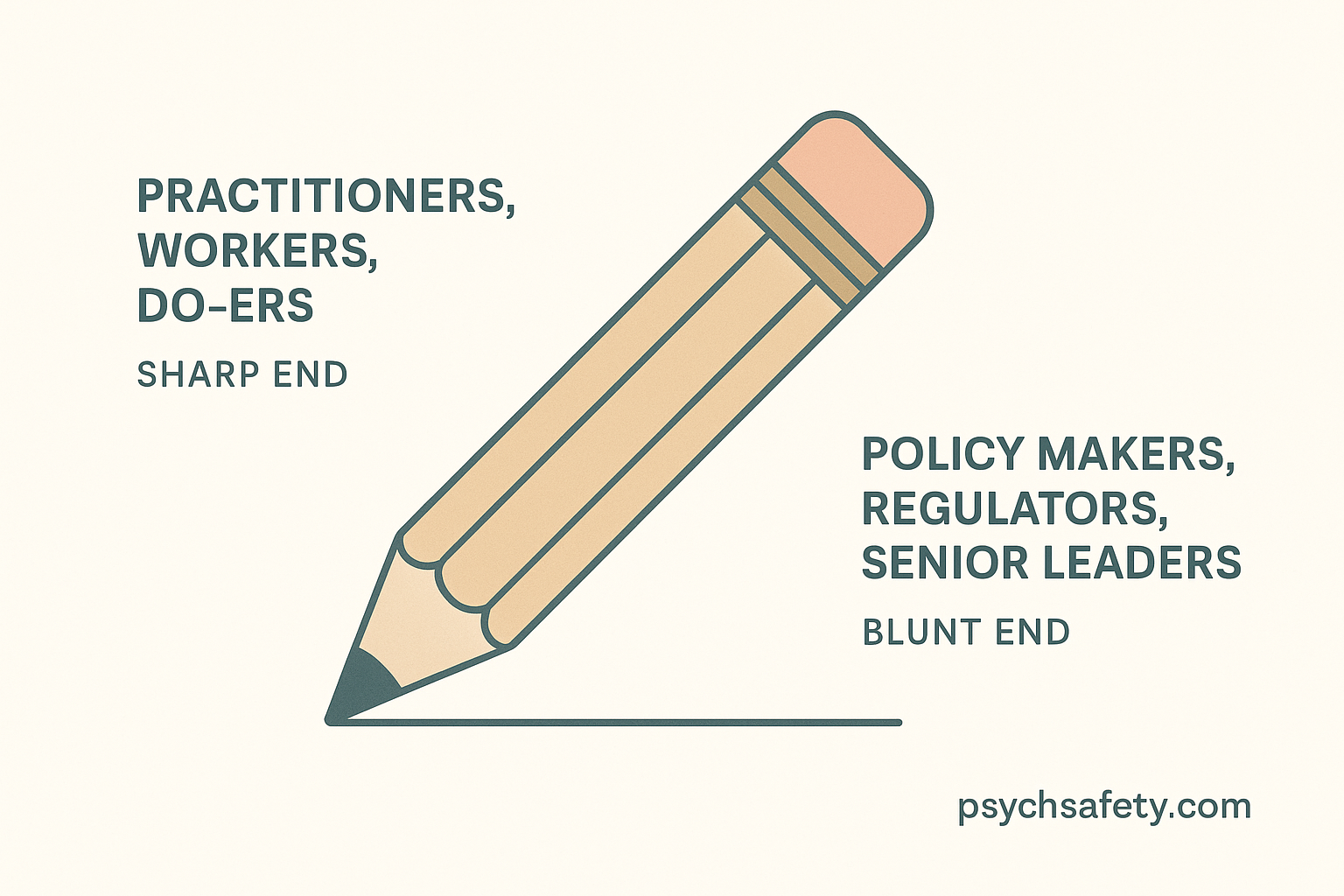
      The Sharp End & Blunt End of Education
      October 3, 2025
    • Forced Vulnerability
      Forced Vulnerability
      September 26, 2025
    • New Sticker Drop! "Zombies Are Scary"
      New Sticker Drop! "Zombies Are Scary"
      September 22, 2025
    • Reflections - Part Four: A Rights-Based Approach

      Reflections - Part Four: A Rights-Based Approach
      September 16, 2025
    • Reflections - Part Three: The Safety to Dissent
      Reflections - Part Three: The Safety to Dissent
      September 12, 2025
    • Reflections - Part Two: Power and Difference
      Reflections - Part Two: Power and Difference
      September 4, 2025
    • The Psychological Safety Trainer Toolkit
      The Psychological Safety Trainer Toolkit
      September 1, 2025
    • Reflections on Psychological Safety: Five Years of Learning
      Reflections on Psychological Safety: Five Years of Learning
      August 29, 2025
    • Not Feeling Seen: Eye Contact and Psychological Safety
      Not Feeling Seen: Eye Contact and Psychological Safety
      August 21, 2025
    • Psychological Safety Isn't Enough
      Psychological Safety Isn't Enough
      August 15, 2025
    • Psych Safety Day / Week 2026
      Psych Safety Day / Week 2026
      August 11, 2025
    • The Amagasaki Disaster
      The Amagasaki Disaster
      August 8, 2025
    • Psychological safety isn't the same for everyone
      Psychological safety isn't the same for everyone
      August 4, 2025
    • Psychological Safety Books for Children

      Psychological Safety Books for Children
      August 1, 2025
    • Psychological Safety and Creativity
      Psychological Safety and Creativity
      July 25, 2025
    • The State of Psychological Safety Survey: 2025
      The State of Psychological Safety Survey: 2025
      July 19, 2025
    • Barriers to Psychological Safety
      Barriers to Psychological Safety
      July 18, 2025
    • How you respond matters.
      How you respond matters.
      July 11, 2025
    • Practices that Foster Psychological Safety
      Practices that Foster Psychological Safety
      July 4, 2025
    • Feedback in the workplace
      Feedback in the workplace
      June 27, 2025
    • Psych Safety Day 2025
      Psych Safety Day 2025
      June 21, 2025
    • Job Security and Psychological Safety
      Job Security and Psychological Safety
      June 20, 2025
    • How familiar are people with the concept of psychological safety?
      How familiar are people with the concept of psychological safety?
      June 13, 2025
    • Learning at Psych Safety
      Learning at Psych Safety
      June 13, 2025
    • Why do We Foster Psychological Safety?
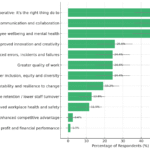
      Why do We Foster Psychological Safety?
      June 6, 2025
    • Psychological Safety in Aviation - Special Edition
      Psychological Safety in Aviation - Special Edition
      May 30, 2025
    • Rebuilding Psychological Safety When It's Broken
      Rebuilding Psychological Safety When It's Broken
      May 30, 2025
    • Just Culture
      Just Culture
      May 23, 2025
    • Transactional Analysis
      Transactional Analysis
      May 15, 2025
    • Comfort vs Need
      Comfort vs Need
      May 9, 2025
    • Sociological Safety
      Sociological Safety
      May 2, 2025
    • Humour and Psychological Safety
      Humour and Psychological Safety
      May 1, 2025
    • Safety-Organised Criticality
      Safety-Organised Criticality
      April 25, 2025
    • Leaders are not solely responsible for psychological safety.
      Leaders are not solely responsible for psychological safety.
      April 21, 2025
    • Psychological Safety in Our Personal Lives
      Psychological Safety in Our Personal Lives
      April 17, 2025
    • The Organisational Fabric of Psychological Safety
      The Organisational Fabric of Psychological Safety
      April 10, 2025
    • Colution
      April 7, 2025
    • All Feedback Is Subjective
      All Feedback Is Subjective
      April 4, 2025
    • Micromanagement
      Micromanagement
      March 21, 2025
    • Rewetting Organisations
      Rewetting Organisations
      March 14, 2025
    • Spectra of Participation
      Spectra of Participation
      March 7, 2025
    • Twitter
    • LinkedIn


Sign up to our newsletter & get weekly insights and research

About

The Psychological Safety Team
Our Mission
Our Core Principles
Privacy Policy
Terms of Business

Learn

Corporate Training
Online Workshops
Newsletter
Professional Certification

Tools

Tool Kits
Articles
What is Psychological Safety?
The History of Psychological Safety

Get Connected

Contact us
Attend a Meetup
Join the Community
Connect with us on LinkedIn
View our YouTube Channel
© 2025 Iterum Ltd
We support LGBTQ+ rights all year round. But we also celebrate pride too.
We support LGBTQ+ rights all year round. But we also celebrate pride!
Content on this website is CC BY-NC-SA
Written by humans, not by AI