
• Psychological Safety
  • Organisational Training
    • – Ignite: Senior Leaders
    • – Impact: Team Workshop
    • – Delivering Feedback
    • – CRM for Non-Aviation Teams
    • – HOP: Human and Organisational Performance
  • Online Workshops
    • – Train the Trainer
    • – Fundamentals
    • – Practices
    • – Leadership
    • – Advanced
    • – Measurement
    • – Workshop Facilitation
    • – HOP
    • – Delivering Feedback
  • Resources
    • – Tool Kits
    • – Free Resources
    • – Newsletter
    • – Articles
    • – Research
    • – Shop
    • – Community
    • – Practices
    • – What is Psychological Safety?
  • About Us
  • Contact
  • Search
  • Tool Kits
    • Action Pack
    • Trainer Toolkit
    • Practitioner Bundle
    • Practice Playbook: Feedback​
    • Practice Playbook: Technology​
    • Practice Playbook: Inclusion​
    • Practice Playbook: Education​
    • Practice Playbook: Healthcare​
  • Organisational Training
    • Ignite for Senior Leaders
    • Impact Team Workshop
    • Management Masterclass
    • Delivering Effective Feedback
    • HOP: Human and Organisational Performance
    • CRM for Non-Aviation Teams
    • Train the Trainer
  • Online Workshops
    • Complete Online Course
    • Psychological Safety Fundamentals
    • Practice Masterclass
    • Leadership & Management
    • Advanced Psychological Safety
    • Measuring Psychological Safety
    • Workshop Design and Facilitation
    • HOP Fundamentals
    • Delivering Effective Feedback
psych safety logo white
  • Resources
    • Tool Kits
    • Free Resources
    • Newsletter
    • Research
    • Shop
    • Podcasts & Talks
    • Videos
    • Community
    • Events & Psych Safety Days
  • Articles
    • Search
    • What is Psychological Safety?
    • The History of Psychological Safety
    • Psychological Safety Practices
    • Psychological Safety In The Workplace
    • Research
    • Measure Psychological Safety
    • Human Organisational Performance (HOP)
  • The Psych Safety Team
    • Contact Us
    • About The Team
    • Tom Geraghty
    • Jade Garratt
  • Tool Kits
    • Action Pack
    • Trainer Toolkit
    • Practitioner Bundle
    • Practice Playbook: Feedback​
    • Practice Playbook: Technology​
    • Practice Playbook: Inclusion​
    • Practice Playbook: Education​
    • Practice Playbook: Healthcare​
  • Organisational Training
    • Ignite for Senior Leaders
    • Impact Team Workshop
    • Management Masterclass
    • Delivering Effective Feedback
    • HOP: Human and Organisational Performance
    • CRM for Non-Aviation Teams
    • Train the Trainer
  • Online Workshops
    • Complete Online Course
    • Psychological Safety Fundamentals
    • Practice Masterclass
    • Leadership & Management
    • Advanced Psychological Safety
    • Measuring Psychological Safety
    • Workshop Design and Facilitation
    • HOP Fundamentals
    • Delivering Effective Feedback
psych safety logo white
  • Resources
    • Tool Kits
    • Free Resources
    • Newsletter
    • Research
    • Shop
    • Podcasts & Talks
    • Videos
    • Community
    • Events & Psych Safety Days
  • Articles
    • Search
    • What is Psychological Safety?
    • The History of Psychological Safety
    • Psychological Safety Practices
    • Psychological Safety In The Workplace
    • Research
    • Measure Psychological Safety
    • Human Organisational Performance (HOP)
  • The Psych Safety Team
    • Contact Us
    • About The Team
    • Tom Geraghty
    • Jade Garratt
Human Organisational Performance (HOP)  ·  In Technology  ·  Newsletter  ·  Psychological Safety  ·  Psychological Safety In The Workplace

Normal Accidents

August 24, 2023

Normal Accidents

Charles Perrow is regarded as a pivotal figure in the theory of why and how things fail. He served as a sociology professor at Yale and Stanford and was primarily focused on the influence of large organisations on society – his most referenced work is “Complex Organisations: A Critical Essay,” released in 1972. 

In this newsletter, we’re exploring ideas from the excellent book that he wrote whilst examining the causes of the Three Mile Island accident in 1979: “Normal Accidents: Living with High-Risk Technologies”. This was published in 1984, and effectively predicted the Chernobyl Disaster of 1986.

Perrow wrote, “If interactive complexity and tight coupling —system characteristics — inevitably will produce an accident, I believe we are justified in calling it a normal accident, or a system accident.”

He introduced the concept of “Normal Accidents“, which he also refers to as system accidents. These are near-inevitable catastrophic failures in highly complex and tightly coupled systems. In these complex systems, despite efforts to prevent them, component failures arise and can interact unpredictably with other components, particularly if components are dependent upon each other. Perrow also argues that many measures intended to bolster system resilience can inadvertently increase its complexity, leading to new potential failure states. This phenomenon is prevalent in software and technology (I’ve experienced and been responsible for it myself); efforts to enhance system robustness – through added redundancy, availability checks, failsafe mechanisms and protections – can actually render them more brittle. This added complexity can also impede prompt diagnosis of complex failures, making them not only more likely, but harder to resolve.

Perrow points out that mistakes made by human operators aren’t the sole cause of accidents. Many failures stem from organisational issues rather than technological ones, and major accidents often start with seemingly trivial events. These small incidents can unpredictably snowball through complex and tightly coupled systems, leading to disaster. He argued that technological failures weren’t just isolated incidents of malfunction, human error, or bad luck. Instead, they’re often the result of complex, interdependent systems, with organisational, cultural, and management factors playing a significant role.

Essentially, we can’t simply blame a machine breaking down, a person making a mistake, or an unforeseeable event for a disaster. Technology disasters are far more complex than that.

Complexity, Coupling and Catastrophe

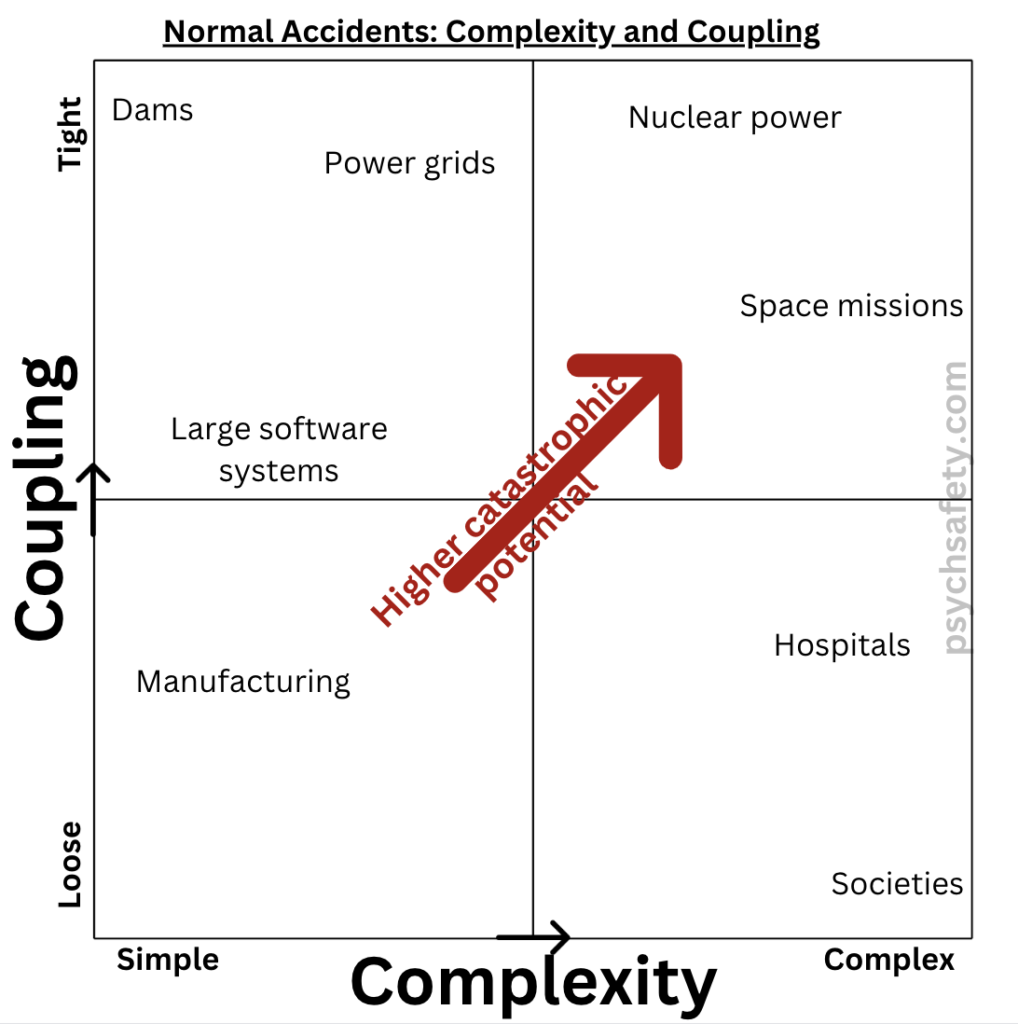
Perrow outlines three conditions that make any system more prone to suffering a “Normal Accident”:

  • The system is highly complex: Having lots of components with unpredictable interactions increases the likelihood of failures.
  • The system is tightly coupled: If elements within the system are closely connected and dependant, a failure in one part has a “prompt and major” impact on others.
  • The system has catastrophic potential: When the stakes are high, a failure can lead to severe consequences. 

In the book, Perrow warned of a likely major nuclear catastrophe. He attributed this risk to the intricate complexity and closely interlinked components of nuclear reactors. When these components fail, they can interact unpredictably, causing failure cascades that are challenging to comprehend, particularly under time pressure. Perrow even noted “unless we are very lucky, one or more [serious nuclear accidents] will appear within the next decade and breach containment“. He only needed to wait two years before his prediction came true with the Chernobyl disaster in 1986. Subsequent disasters such as Fukushima also followed the Perrowian script of high complexity combined with tight coupling of system components.

perrow normal accidents

An illustration of Normal Accident Theory and the relationship between complexity and coupling, with various domains represented as examples. Adapted from Etkin and Timmerman, 2013.


How do we mitigate against Normal Accidents?

What can we learn from Perrow? There are a number of tactics that can mitigate the risk of catastrophe in this kind of system:

  1. Reduce complexity. It’s very easy to add complexity to a system but much harder to make it simpler. For example, software engineers are often rewarded for adding features and functions, more rarely for removing them. Incentivise simplicity over complexity.
  2. Reduce coupling and dependencies. Whether we’re dealing with technological systems or social systems, ensure that if one component fails, others can continue to function as normal or in a safe-but-degraded state. 
  3. Move authority to where the information is. People and teams who are empowered to make rapid decisions in high-pressure situations will be able to mitigate and prevent catastrophe far more effectively than if they need to escalate decisions up a hierarchy.
  4. Create environments of psychological safety. Where people feel safe to raise concerns about potential risks, failures, and ideas for improvement, both the technological and social systems will be more resilient to shocks and less likely to “drift into failure”.

Drift Into Failure

Sidney Dekker later built on the idea of Normal Accidents with his concept of “Drift into Failure” (DIF) which describes a slow and gradual descent into catastrophe. Driven by production pressure, competition and scarcity, organisations find themselves inching closer to their safety limits, and social patterns can make taking growing risks seem normal. The incentive to push the boundaries can often overshadow the lurking and growing dangers. An example is the “normalisation of deviance” that led to the Challenger disaster – (see Vaughan, 1996). The Drift Into Failure concept suggests that organisations may end up failing not because something goes wrong, but rather because they appear to be performing well, and gradually adopting (or simply maintaining) high-risk practices without realising the potential for disaster. This drift into disaster isn’t a fluke: it’s a natural outcome of how sociotechnical systems function. 

Humans are the true adaptive element of a system

The principles outlined by Perrow are evident in aviation. Even as aircraft technical reliability improved, it didn’t necessarily lead to fewer accidents (as Hagen highlighted in 2013). Perrow argued that depending solely on technical fixes for safety simply increases the complexity that humans have to navigate. This increased complexity, combined with tightly coupled components, amplifies the potential for catastrophic failures. In reality, it is only humans that can adequately prepare and respond to disasters. Alongside technological developments, the advent of Crew Resource Management and Human Factors training for air and ground crew is ultimately what has made aviation so safe over the past few decades. 

In the safety domain, Perrow wasn’t regarded as “one of us” (due in significant part due to his anti-nuclear power stance), but his ideas have stood the test of time. His theories hold particular relevance for today’s global technological systems and cloud computing – which were preceded by Perrow’s theories on complexity and coupling. The fields of resilience engineering, human factors, and learning from incidents also possess strong Perrowian foundations.

Perrowian Relevance Today

As we develop ever-increasing complexity and interconnectedness in our organisations and world in general, the insights of Charles Perrow’s “Normal Accidents” have never been more relevant. We should work to simplify systems, empower people at the sharp end of work, and create cultures that foster psychological safety and open communication. Perrow’s work continues to remind us that the prevention of catastrophe doesn’t only lie in machinery and technology, but in the very fabric of how we communicate with each other and how we organise, manage, and understand the systems we create.

References:

Dekker, S. Drift into failure, 2014. https://safetydifferently.com/wp-content/uploads/2014/08/SDDriftPaper.pdf

Etkin, D. and Timmerman, P., 2013. Emergency management and ethics. International Journal of Emergency Management, 9(4), pp.277-297. https://www.researchgate.net/publication/264812137_Emergency_management_and_ethics

Hagen, J. Confronting Mistakes, 2013. Lessons from the Aviation Industry when Dealing with Error. https://amzn.to/3E8P3FW

NASA. The Cost of Silence: Normalization of Deviance and Groupthink, 2014. https://sma.nasa.gov/docs/default-source/safety-messages/safetymessage-normalizationofdeviance-2014-11-03b.pdf

Perrow, C. 1984. Normal Accidents – Living with High Risk Technologies https://amzn.to/3QRm40S

Price, M.R. and Williams, T.C., 2018. When doing wrong feels so right: normalization of deviance. Journal of patient safety, 14(1), pp.1-2. https://pubmed.ncbi.nlm.nih.gov/25742063/

Vaughan, D. 1996. The Challenger Launch Decision – Risky Technology, Culture, and Deviance at NASA: Risky Technology, Culture, and Deviance at NASA https://amzn.to/3QPRNPS 


More Psychological Safety Workshops!

We have places left on our upcoming workshops in October and November – you can choose from:

  • Intermediate: covering the essential theory and practice to help you level up your knowledge and practice.
  • In-depth: covering cultural impacts on psychological safety, complexity, sociotechnical and more.
  • Practices: From Empathy Mapping to TRIZ. Practical things to do with groups and teams.
  • Leadership: For managers and senior leaders: we cover effective management practices, senior leadership, reporting, 1-1s, work design and flow, managing neurodiverse people and much more. 


 Find out more and register here.


Psychological Safety at work

We cannot fully discuss psychological safety without discussing intersectionality and privilege. Here’s a fantastic guide to intersectionality from UN Women. This guide provides a fantastic description of intersectionality, a description of various enablers and how to apply them, with clear examples and instructions. 

AI and LLM tools are have taken over workplaces in a very short period of time. Many of us now use these tools to help with all sorts of tasks, from proof-reading to translation, and data analysis to research design. However, accuracy and quality issues notwithstanding, these tools are subject to significant biases, as this video from LIS, The London Interdisciplinary School shows. Of course, the algorithms and models are only returning the data they’ve been given, but the scale and speed that they’re being adopted means these biases are only being calcified into our practices and made worse by our tools, not better.


Business leaders have historically drawn inspiration from military strategies but have overlooked lessons from non-violent social and political movements. This excellent article by Greg Satell emphasises the importance of learning from both failures and successes, understanding multiple perspectives, and developing strategies to overcome resistance to change. 

Here’s a great podcast episode from the folks at BBC Analysis: “Does work have to be miserable?”. In this, Pauline Mason considers the impact the pandemic had on the workplace, how suddenly many of us transitioned to different (and often better) ways of working, and how “job design” focuses on people, their skills, their knowledge and how they interact with each other and technology in the workplace. “Good work is about much more than money.“


Finally, I’m just going to leave this here:


New stickers!

There are three ways that you can get your hands on some of our psychological safety stickers!

  1. Buy some at our online shop
  2. Attend a workshop
  3. Promote psychsafety.com on social media and send us your postal address!
psychological safety stickers

This week’s poem:


“From the soul’s point of view, you come to appreciate that each one of us is living out his or her own karma. We interact together, and those interactions are the grist for each other’s mill of awakening. From a personality point of view, you develop judgment, but from the soul’s point of view, you develop appreciation. This shift from judging to appreciating — to appreciating yourself and what your karmic predicament is, and who other beings are with their own karma — brings everything into a simple loving awareness. To be free means to open your heart and your being to the fullness of who you are because only when you are resting in the place of unity can you truly honour and appreciate others and the incredible diversity of the universe.”

From “Polishing the Mirror: How to Live from Your Spiritual Heart” by Baba Ram Dass


accidentsdekkerfailurehuman errornormal accidentsperformanceperrowpsychological safety

Tom Geraghty

Tom Geraghty, co-founder and delivery lead at Iterum Ltd, is an expert in high performing teams and psychological safety. Leveraging his unique background in ecological research and technology, Tom has held CIO/CTO roles in a range of sectors from tech startups to global finance firms. He holds a degree in Ecology, an MBA, and a Masters in Global Health. His mission is to make workplaces safer, higher performing, and more inclusive. Tom has shared his insights at major events such as The IT Leaders Summit, the NHS Senior Leadership Conference, and EHS Global Conferences. Connect with him on LinkedIn or email tom@psychsafety.com

Related Articles


Everything is an experiment poster
Learning and Development  ·  Psychological Safety  ·  Psychological Safety In The Workplace
Psychological Safety Poster Pack
September 21, 2020
peat bog in derbyshire
Newsletter  ·  Psychological Safety
Rewetting Organisations
March 14, 2025
researchdoodles on instagram: https://www.instagram.com/researchdoodles/
Psychological Safety in Teaching, plus Cognitive Load and Ed Sheeran
Previous Article
psychological safety - goodharts law
Choosing a psychometric tool
Next Article
  • Subscribe to the Psychological Safety Newsletter

  • psychological safety train the trainer
  • Get Certified! Join online workshops, or explore training and consultancy for leaders, teams and organisations.

    Discover our training options for Human and Organisational Performance and CRM for non-aviation teams.

    If you're a trainer, consultant or facilitator, get certified in our Train the Trainer complete online programme and download the Training Materials for Facilitators and Trainers.

  • human and organisational performance training
  • building and maintaining psychological safety for your team
    Download the complete Practitioners' guide to psychological safety
  • psychological safety trainer toolkit
  • Download the Psychological Safety Trainer Toolkit. Containing powerful resources that you can use to deliver your own training and workshops!

  • psych safety logo

    Sponsorship and advertising. Reach over 11,000 weekly readers and 500,000 online visitors with your message in our newsletter.

  • theres no such thing as too much psychological safety
    Grab Psychological Safety Stickers from our Online Shop!
  • Psych Safety Day

    Find out more about our Psych Safety Days - in-person and virtual events to share, learn, and connect with other enthusiasts, practitioners and researchers on psychological safety and related topics.

  • Categories

    • Newsletter
    • Psychological Safety
      • Create and Maintain
      • Human Organisational Performance (HOP)
      • In Technology
      • Learning and Development
      • Measure
      • Psychological Safety In The Workplace
      • Theory and Research
    • Random
  • Recent Posts

    • The "Fist of Five"
      The "Fist of Five"
      December 19, 2025
    • Psychological Bravery
      Psychological Bravery
      December 18, 2025
    • Psych Safety Book List 2025
      Psych Safety Book List 2025
      December 18, 2025
    • Psych Safety 2025 Unwrapped
      Psych Safety 2025 Unwrapped
      December 15, 2025
    • Plan Continuation Bias
      Plan Continuation Bias
      December 12, 2025
    • Whistleblowing and Psychological Safety
      Whistleblowing and Psychological Safety
      December 4, 2025
    • How Childhood Socioeconomic Status Shapes Psychological Safety and Career Risk-Taking at Work
      How Childhood Socioeconomic Status Shapes Psychological Safety and Career Risk-Taking at Work
      November 27, 2025
    • Safety and the Myth of Self-Reliance
      Safety and the Myth of Self-Reliance
      November 24, 2025
    • The Watermelon Effect and "Greenwashing"

      The Watermelon Effect and "Greenwashing"
      November 7, 2025
    • Individual Resilience
      Individual Resilience
      October 31, 2025
    • Counterfactuals
      Counterfactuals
      October 24, 2025
    • Coaching and Psychological Safety
      Coaching and Psychological Safety
      October 17, 2025
    • Five Ecological Concepts for Working in Organisational Change

      Five Ecological Concepts for Working in Organisational Change
      October 9, 2025
    • The Sharp End & Blunt End of Education
      The Sharp End & Blunt End of Education
      October 3, 2025
    • Forced Vulnerability
      Forced Vulnerability
      September 26, 2025
    • New Sticker Drop! "Zombies Are Scary"
      New Sticker Drop! "Zombies Are Scary"
      September 22, 2025
    • Reflections - Part Four: A Rights-Based Approach

      Reflections - Part Four: A Rights-Based Approach
      September 16, 2025
    • Reflections - Part Three: The Safety to Dissent
      Reflections - Part Three: The Safety to Dissent
      September 12, 2025
    • Reflections - Part Two: Power and Difference
      Reflections - Part Two: Power and Difference
      September 4, 2025
    • The Psychological Safety Trainer Toolkit
      The Psychological Safety Trainer Toolkit
      September 1, 2025
    • Reflections on Psychological Safety: Five Years of Learning
      Reflections on Psychological Safety: Five Years of Learning
      August 29, 2025
    • Not Feeling Seen: Eye Contact and Psychological Safety
      Not Feeling Seen: Eye Contact and Psychological Safety
      August 21, 2025
    • Psychological Safety Isn't Enough
      Psychological Safety Isn't Enough
      August 15, 2025
    • Psych Safety Day / Week 2026
      Psych Safety Day / Week 2026
      August 11, 2025
    • The Amagasaki Disaster
      The Amagasaki Disaster
      August 8, 2025
    • Psychological safety isn't the same for everyone
      Psychological safety isn't the same for everyone
      August 4, 2025
    • Psychological Safety Books for Children

      Psychological Safety Books for Children
      August 1, 2025
    • Psychological Safety and Creativity
      Psychological Safety and Creativity
      July 25, 2025
    • The State of Psychological Safety Survey: 2025
      The State of Psychological Safety Survey: 2025
      July 19, 2025
    • Barriers to Psychological Safety
      Barriers to Psychological Safety
      July 18, 2025
    • How you respond matters.
      How you respond matters.
      July 11, 2025
    • Practices that Foster Psychological Safety
      Practices that Foster Psychological Safety
      July 4, 2025
    • Feedback in the workplace
      Feedback in the workplace
      June 27, 2025
    • Psych Safety Day 2025
      Psych Safety Day 2025
      June 21, 2025
    • Job Security and Psychological Safety
      Job Security and Psychological Safety
      June 20, 2025
    • How familiar are people with the concept of psychological safety?
      How familiar are people with the concept of psychological safety?
      June 13, 2025
    • Learning at Psych Safety
      Learning at Psych Safety
      June 13, 2025
    • Why do We Foster Psychological Safety?
      Why do We Foster Psychological Safety?
      June 6, 2025
    • Psychological Safety in Aviation - Special Edition
      Psychological Safety in Aviation - Special Edition
      May 30, 2025
    • Rebuilding Psychological Safety When It's Broken
      Rebuilding Psychological Safety When It's Broken
      May 30, 2025
    • Just Culture
      Just Culture
      May 23, 2025
    • Transactional Analysis
      Transactional Analysis
      May 15, 2025
    • Comfort vs Need
      Comfort vs Need
      May 9, 2025
    • Sociological Safety
      Sociological Safety
      May 2, 2025
    • Humour and Psychological Safety
      Humour and Psychological Safety
      May 1, 2025
    • Safety-Organised Criticality
      Safety-Organised Criticality
      April 25, 2025
    • Leaders are not solely responsible for psychological safety.
      Leaders are not solely responsible for psychological safety.
      April 21, 2025
    • Psychological Safety in Our Personal Lives
      Psychological Safety in Our Personal Lives
      April 17, 2025
    • The Organisational Fabric of Psychological Safety
      The Organisational Fabric of Psychological Safety
      April 10, 2025
    • Colution
      April 7, 2025
    • All Feedback Is Subjective
      All Feedback Is Subjective
      April 4, 2025
    • Micromanagement
      Micromanagement
      March 21, 2025
    • Rewetting Organisations
      Rewetting Organisations
      March 14, 2025
    • Spectra of Participation
      Spectra of Participation
      March 7, 2025
    • Learning Types and Toxic Leadership
      Learning Types and Toxic Leadership
      February 28, 2025
    • Twitter
    • LinkedIn


Sign up to our newsletter & get weekly insights and research

About

The Psychological Safety Team
Our Mission
Our Core Principles
Privacy Policy
Terms of Business

Learn

Corporate Training
Online Workshops
Newsletter
Professional Certification

Tools

Tool Kits
Articles
What is Psychological Safety?
The History of Psychological Safety

Get Connected

Contact us
Attend a Meetup
Join the Community
Connect with us on LinkedIn
View our YouTube Channel
© 2025 Iterum Ltd
We support LGBTQ+ rights all year round. But we also celebrate pride too.
We support LGBTQ+ rights all year round. But we also celebrate pride!
Content on this website is CC BY-NC-SA
Written by humans, not by AI