


Barriers to Psychological Safety Executive Summary This research explores the experiential barriers to speaking up at work: not just structural or cultural factors, but the lived fears and beliefs tha...

How you respond matters “Everything you do is important to your organization People are watching you The people in your organization determine how to move forward after both successful work and how ...

Executive Summary This study examined which practices most effectively foster psychological safety in teams and organisations While behaviours such as listening and empathy underpin interpersonal safe...

Executive Summary This study explored how feedback in the workplace affects both performance and psychological safety While feedback is intended to drive growth and improvement, its delivery often has...

Executive Summary This study examined the relationship between job security and psychological safety, challenging the common assertion that “psychological safety is not job security” While the two...

Executive Summary In this Research Pulse, 121 respondents were asked how familiar people in their workplace are with the concept of psychological safety The results show a broadly “middle-ground” ...

How We Think About Learning at Psych Safety At Psych Safety, we care deeply about how learning happens Not just what people take away from a session, but how it feels to be there – what kind of ...

Executive Summary This study explored why people foster psychological safety, examining whether motivations are primarily moral, relational, or performance-driven While psychological safety is often d...

Cultural Diversity and Cockpit Communication Here’s a classic paper from 1999 – Cultural diversity and crew communication, by Fischer and Orasanu They examined how cultural background, ran...

By Jade Garratt Which of these do you think might damage psychological safety in a team The answer, of course, is that all of them can Sometimes it’s individual behaviours that cause harm to the psy...

Why Just Culture Isn’t Sticking by Tom Geraghty What Do We Mean by “Just” Culture The concept of a “Just Culture” was first developed in James Reason’s 1997 book Managing the Risks of ...

By Jade Garratt Have you ever found yourself reacting to something a colleague said as if you were a child being told off by their parents, even though you’re both adults and peers Or ever said some...

“Sociological” Safety By Tom Geraghty The term psychological safety has been in use since Carl Rogers’ work in the 1950s and was applied to organisational contexts by Schein and Bennis (...

Self-Organised Criticality (SOC) During my ecology degree, whilst studying ecosystem and habitat change, I learned about Self-Organised Criticality (SOC), and I was fascinated by how it explained the ...

by Jade Garratt At Psych Safety, our focus has always been on psychological safety in the workplace – helping teams and organisations become more inclusive, equitable, and high-performing throug...

Comfort vs Need by Tom Geraghty What do we do when the things that help some people in the team feel psychologically safer don’t work for everyone Perhaps one person says they need time away from th...

The Organisational Fabric of Psychological Safety (AKA psychological safety is more than just a team phenomenon) By Tom Geraghty When we talk about psychological safety, the definition we usually use ...

All Feedback Is Subjective By Jade Garratt … And Why That Matters for Psychological Safety “No person in the world is so privileged as to have access to a ‘ground truth’ against which ...

Psychological Safety and Micromanagement By Jade Garratt Those who have followed our work at Psych Safety for a while will know that we believe exploring not just what to do – the behaviours and...

Rewetting Organisations by Tom Geraghty Allowing the system to self-organise by improving the substrate: creating the underlying conditions for change When I was studying ecology at university, one of...
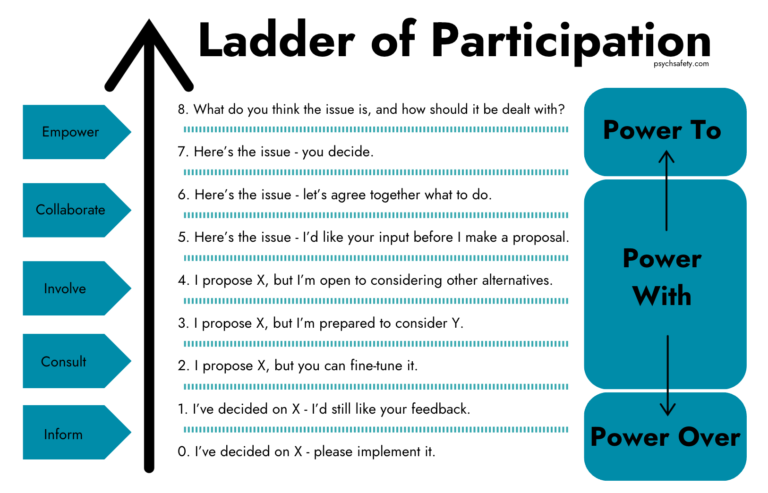
The Spectrum of Participation by Jade Garratt Engagement and participation are terms we often throw around to mean “getting people’s take on issues that affect them” But not all participation is...

Psychological Safety in Practice Team Learning in the Field: An Organizing Framework and Avenues for Future Research This excellent paper from Amy Edmondson and Jean-François Harvey affirms ...
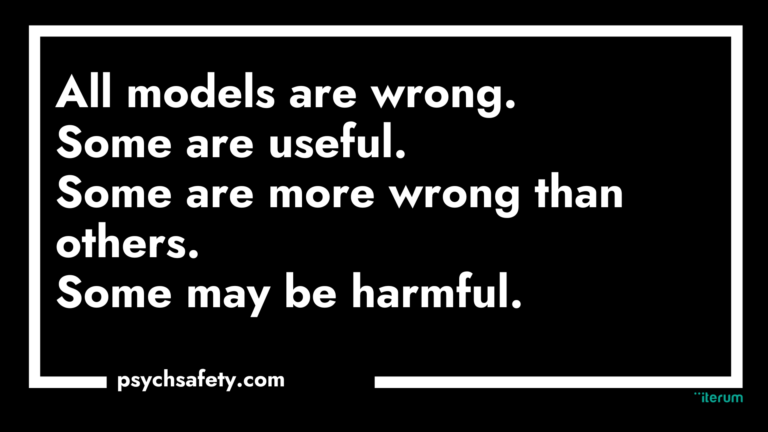
All Models Are Wrong, and Some Are Useful By Tom Geraghty This is one of my favourite, and most often used, aphorisms It’s attributed to George Box, a British statistician, from a 1976 paper on Scie...

Reducing Power Gradients By Jade Garratt In our experience, the most effective lever for increasing psychological safety within a team is flattening the power gradient – the gap between those wi...

Efficiency vs Resilience By Tom Geraghty Standardisation is often used as a way to increase organisational efficiency and scalability Through reducing variation, we can standardise our tools, tra...

The Speaking up Myth By Jade Garratt In the world of psychological safety, we focus a lot, maybe even too much, on the speaking up side of the equation How do we make sure people speak up with their i...

“what you love,” “what the world needs,” “what you can be paid for,” and “what you are good at”, the idea being that the intersection of all of these is where we find Ikigai ...

Addressing Power through “Flattening” Organisations Steep power gradients are one of the most significant factors that contribute to reducing psychological safety These steep differentials in perc...

Work doesn’t have to suck By Jade Garratt The start of a new year seems like a good time to reflect on how work feels, and how we feel about work For too many of us, going to work isn’t [&hell...

