
• Psychological Safety
  • Organisational Training
    • – Ignite: Senior Leaders
    • – Impact: Team Workshop
    • – Delivering Feedback
    • – CRM for Non-Aviation Teams
    • – HOP: Human and Organisational Performance
  • Online Workshops
    • – Train the Trainer
    • – Fundamentals
    • – Practices
    • – Leadership
    • – Advanced
    • – Measurement
    • – Workshop Facilitation
    • – HOP
    • – Delivering Feedback
  • Resources
    • – Tool Kits
    • – Free Resources
    • – Newsletter
    • – Articles
    • – Research
    • – Shop
    • – Community
    • – Practices
    • – What is Psychological Safety?
  • About Us
  • Contact
  • Search
  • Tool Kits
    • Action Pack
    • Trainer Toolkit
    • Practitioner Bundle
    • Practice Playbook: Feedback​
    • Practice Playbook: Technology​
    • Practice Playbook: Inclusion​
    • Practice Playbook: Education​
    • Practice Playbook: Healthcare​
  • Organisational Training
    • Ignite for Senior Leaders
    • Impact Team Workshop
    • Management Masterclass
    • Delivering Effective Feedback
    • HOP: Human and Organisational Performance
    • CRM for Non-Aviation Teams
    • Train the Trainer
  • Online Workshops
    • Complete Online Course
    • Psychological Safety Fundamentals
    • Practice Masterclass
    • Leadership & Management
    • Advanced Psychological Safety
    • Measuring Psychological Safety
    • Workshop Design and Facilitation
    • HOP Fundamentals
    • Delivering Effective Feedback
psych safety logo white
  • Resources
    • Tool Kits
    • Free Resources
    • Newsletter
    • Research
    • Shop
    • Podcasts & Talks
    • Videos
    • Community
    • Events & Psych Safety Days
  • Articles
    • Search
    • What is Psychological Safety?
    • The History of Psychological Safety
    • Psychological Safety Practices
    • Psychological Safety In The Workplace
    • Research
    • Measure Psychological Safety
    • Human Organisational Performance (HOP)
  • The Psych Safety Team
    • Contact Us
    • About The Team
    • Tom Geraghty
    • Jade Garratt
  • Tool Kits
    • Action Pack
    • Trainer Toolkit
    • Practitioner Bundle
    • Practice Playbook: Feedback​
    • Practice Playbook: Technology​
    • Practice Playbook: Inclusion​
    • Practice Playbook: Education​
    • Practice Playbook: Healthcare​
  • Organisational Training
    • Ignite for Senior Leaders
    • Impact Team Workshop
    • Management Masterclass
    • Delivering Effective Feedback
    • HOP: Human and Organisational Performance
    • CRM for Non-Aviation Teams
    • Train the Trainer
  • Online Workshops
    • Complete Online Course
    • Psychological Safety Fundamentals
    • Practice Masterclass
    • Leadership & Management
    • Advanced Psychological Safety
    • Measuring Psychological Safety
    • Workshop Design and Facilitation
    • HOP Fundamentals
    • Delivering Effective Feedback
psych safety logo white
  • Resources
    • Tool Kits
    • Free Resources
    • Newsletter
    • Research
    • Shop
    • Podcasts & Talks
    • Videos
    • Community
    • Events & Psych Safety Days
  • Articles
    • Search
    • What is Psychological Safety?
    • The History of Psychological Safety
    • Psychological Safety Practices
    • Psychological Safety In The Workplace
    • Research
    • Measure Psychological Safety
    • Human Organisational Performance (HOP)
  • The Psych Safety Team
    • Contact Us
    • About The Team
    • Tom Geraghty
    • Jade Garratt
Create and Maintain  ·  Newsletter  ·  Psychological Safety  ·  Psychological Safety In The Workplace  ·  Theory and Research

Icebreakers

April 12, 2024

Icebreakers

If you’re anything like me, when you see “icebreakers” on an agenda or schedule for a meeting, you immediately become a little anxious. Ice breakers are intended to make us feel more comfortable and at ease, increasing the overall productivity of the session, but when run poorly, they can be counterproductive. Not only do bad icebreakers eat into valuable session time, they can be awkward, stressful, or even harmful. 

Aims of Icebreakers

Given that they can go wrong, and sometimes very wrong, why do we bother with icebreakers? Well, they can be a very effective way to:

  • Introduce (or re-introduce) ourselves
  • Get people engaging and interacting with each other from the start.
  • Set the tone for the session – this might be playful, reflective or dynamic, depending on the context.
  • Shift the mood or energy within a space.
  • Check that everyone is present and able to access and engage with the learning (especially useful for online sessions).

Let’s delve into some of these ideas and how they interact with psychological safety…

Icebreakers and Psychological Safety

At their best, icebreakers can be an effective tool to increase the psychological safety of a team or space, especially if the people present haven’t yet met or don’t know each other well. Primarily, they help to create a more “known” collaborative space – where we know who’s present in the room (virtual or otherwise). It’s difficult to feel psychologically safe if we don’t know who’s in the group with us. 

Making it easier to speak up

Icebreakers aren’t just for groups who are unfamiliar with each other though. Even in a group who already work together and know each other, icebreakers increase psychological safety through encouraging engagement and contribution from all members of the team. Generally speaking, icebreakers exist to help people feel more comfortable being involved and speaking up in a way that suits them (which of course may or may not be verbal). Nancy Kline, who does some great work on creating “Thinking Environments”, has been quoted as saying that “No one has truly arrived until they have spoken.” Indeed, research suggests that if people don’t speak or contribute in the first few minutes, they are much less likely to speak at all. Icebreakers used in the first five minutes help to prime people for speaking up, presenting their ideas, or challenging something later in the meeting. 

There is even some evidence to suggest that if we provide the opportunity for women to speak up first, it creates a more equitable space where both men and women feel equally able to speak subsequently. We could unpack the reasons for that, but for now, let’s take the measures we can to level the playing field that we have influence over.

Setting the tone and expectations

Icebreakers can serve to set, or shift, the tone of the space – is it serious or light hearted, collaborative or informative, formal or informal? When we know this, we better understand how to behave, and what to expect of others in the space. Even with a group who already know each other well, an ice breaker can serve as an “energiser” to revitalise a group, or to mark a shift into a more creative, playful mode of working. This can be particularly important when teams are working remotely or when you need to raise the energy in a room.

Ensuring access

A final, but important, function of icebreakers, is that particularly in virtual and remote environments, they provide an opportunity to carry out a technical check to ensure that everyone can hear and be heard. I guarantee that in any group with ten or more participants, at least one will have microphone or speaker issues! Testing them out at the start helps the rest of the call run smoothly and help people feel confident that if they speak, we can actually hear them.

Key considerations with icebreakers

It’s worth bearing in mind that there are certain cases where finding out who’s in the room with us could actually lower our psychological safety – such as if we find out they’re from a competitor organisation, or a member of a group that campaigns against something important to us. Like any tool, icebreakers alone aren’t a “magic potion” to create instant psychological safety – they are best used alongside other practices, such as a social contract.

Importantly, we need to also be aware that not everyone can speak verbally, or cannot do so with ease. Icebreakers should make people feel more comfortable in the setting, not less. Choose icebreaker activities carefully to ensure they include everyone, don’t make people feel uncomfortable, spotlighted, singled out, or different from the rest of the group. 

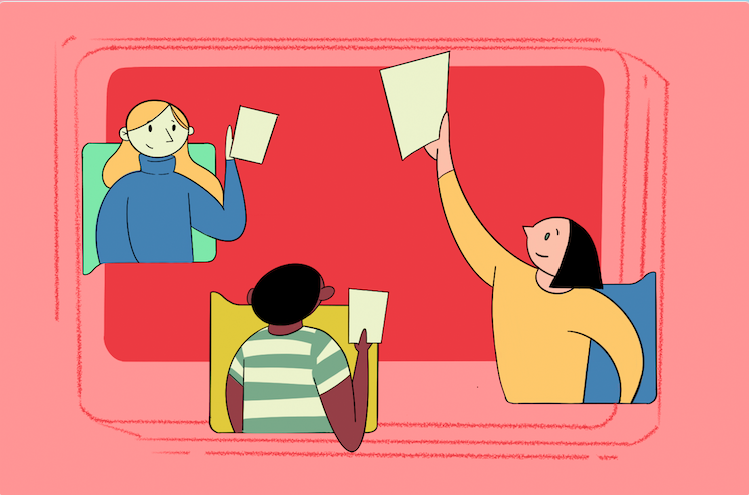
psychological safety icebreakers
Illustration by Deisa Tremarias

Characteristics of great icebreakers

Generally speaking, the best icebreakers are:

  • Accessible and inclusive – we want there to be a very low bar to engagement
  • Enjoyable – let’s not put people off from the start!
  • Aligned with the tone of the session – the icebreaker should feel appropriate to the topic and mood
  • Concise – we don’t need them to dominate the whole session

Some typical safe and effective icebreaker activities include:

  • If you were an animal, what would you be and why?
  • What is one goal you’d like to accomplish during your lifetime?
  • Who is your hero? (a parent, a celebrity, an influential person in one’s life)
  • If you were an ice cream flavour, which one would you be and why?
  • If you could teleport to any place in the world in the next hour, where would you choose to go and why?

And here are some more ideas along with the rationale for them…

Simply state your name (and, optionally, pronouns).

One of the most powerful purposes of icebreakers is to help people use their voice in a group. This simple icebreaker allows us to use our voice, and also informs others how to pronounce our name if they’re not sure. A lot of people (myself included) tend to get anxious at the thought of icebreakers, so asking people to do this, without any other expectations or demands, is perhaps the most effective and inclusive icebreaker practice. It’s a good place to share your pronouns too, but make sure it’s optional. If you’re facilitating, go first by sharing your pronouns, so that people know what you mean, but make it clear that it’s not mandatory.

Draw on a post-it note (for in-person sessions)

Ask participants to draw something on a post-it note or piece of paper, such as an animal, a fruit, or something else. What’s nice about this is that it gets people a little more comfortable doing something imperfect – which then makes it easier during the session to present unpolished, unfinished ideas and questions. You’ll probably hear a lot of excuses like “I can’t draw!” or “My drawing is terrible!” – use this as an opportunity to encourage a more playful, relaxed environment – shared laughter is good for bonding!

Emoji of the day or week (a great online practice)

Great for online facilitation, simply ask each participant to share an emoji that says something about their day or week so far. Depending on group size you might ask all to elaborate, or spotlight a few intriguing ones. If someone posts the aubergine emoji then I don’t know what to say. 🙂 

A series of emojis

I’m good, they’re good (for teams who already know each other).

This is a great way of increasing the psychological safety and strength in an existing team who already know and work with each other. The leader starts, and you say one thing that you’re good at. For example, in my case, I might choose mountain biking or certain yoga poses. Once you’ve said that, you choose someone in the room and describe something they’re good at. For example, I might say “I’m pretty good at Crook’s pose in yoga! And Chris – he’s an excellent graphic designer and I’m always impressed with his designs.” Then Chris would go next, and it continues around the table.

Simple counting (particularly effective online).

This sounds easy, but it really isn’t! Simply take turns counting from 1 and up sequentially – someone starts with “1”, and someone else has to say “2”, and so on, but you’re not allowed to confer, plan or discuss. If two people collide, you start again. My record in a group is 8.

What’s the weather like? (great for distributed groups online)

Such a typical British question (and I can say this because I’m British and we talk about the weather all the time), but it’s low risk and easy to answer. This is useful for distributed teams, especially widely distributed across different countries. It’s really interesting to hear about the weather all over the world, and helps us place other team members in real, physical contexts.

Share a boring fact about yourself

One of our workshop participants introduced us to this one, and I love it. Unlike the better know “two truths and a lie”, which can be both challenging and a little pressurised (who can on the spot think of 3 ‘interesting’ facts or fictions about themselves?!) this one is much easier to answer and usually generates some laughter too. Plus people can share as much or as little as they feel comfortable with.

Here be Dragons! Potentially harmful icebreakers.

As a general rule, and not just for icebreakers, we want to avoid asking people to share more than they feel comfortable with or are ready to share with the group.

This might seem obvious, but there are a number of very common icebreaker activities that risk doing this, and some that are actually potentially harmful or exclusionary.I’m going to list them here because they’re common enough that I think it’s worth pointing out the dangers, so we can either stop using them, or at least use them with more care and awareness.

What I had for breakfast.

I’ve used this before, particularly for geographically distributed teams because what people have for breakfast in other countries is always interesting! However, this may be one to avoid or only use with caution, since anyone in the group with experience of disordered eating may find this triggering and a difficult topic for conversation.

How tall am I?

If you’ve never met in person, and only see each other on video calls, we have no idea how tall our colleagues are, so it’s easy to see why we might think of this as a fun icebreaker. However, it can also uncomfortably highlight different physical characteristics, or spotlight people who use wheelchairs. Maybe avoid it unless you know it’s safe to do.

Where are you going/ where do you want to go on holiday?

A really popular icebreaker, but one to avoid. We may think that this is a great way to show off about the wonderful places we’ve been to, or live vicariously through the travels of others, but not everyone can afford holidays, or they may have responsibilities or demands on their time that prevent them from doing so. If some people in the group are talking about their trips to the Bahamas, whilst others have never holidayed, or usually resort to a rainy camping trip, it may only serve to increase the perceived distance between group members.

Childhood photos – guess who the child is

This is popular, but potentially very harmful. It involves asking people to find old childhood or baby photos, sharing them on a virtual whiteboard or printed out and picking one at a time to try to guess who it is. There are many people who will feel uncomfortably spotlighted in this activity – particularly if they’re the only woman, the only black person, or they possess a characteristic that marks them out as different to the other team members. This practice also risks outing any trans members of the group. Additionally, not everyone had happy childhoods, so it may be harmful or triggering for team members or for those who have suffered abuse or trauma. And of course it assumes that people have photos of their childhood, or that their family had access to a camera. 

Icebreakers can be a great way to improve the potential for communication and collaboration in a group, but require careful thought, facilitation, and care for everyone involved.

Other icebreakers

What other icebreakers do you use with your team? Which ones do you find create more psychological safety? Do you know of any more common icebreakers that are risky or harmful?

Thanks to many folks for their help with this article, including attendees of our Leadership and Practice workshops, and Jade Garratt and Elizabeth Stokoe. 

Further Links:

Psychological Safety in Remote and Virtual Teams
Speaking up at work
Psychological Safety #16: Social Contracts
Non-Violent Communication
“No-one has truly arrived until they have spoken.” 
Breaking the Ice: A Pre-intervention Strategy to Engage Research Participants
Scientific medical conferences can be easily modified to improve female inclusion: a prospective study
The Impact of Ice Breaking Exercises on Trainees’ Interactions and Skill Acquisition: An Experimental Study 
The Surprising Science of Meetings | Dr. Steven Rogelberg | Talks at Google
Quiet: The Power of Introverts in a World That Can’t Stop Talking


Psychological Safety in practice

Russ Ackoff on the right kind of wrong

In my reading this week, I came across this excellent Ackoff quote from “Turning Learning Right Side Up: Putting Education Back on Track“, by Russell Ackoff and Daniel Greenberg:

Almost all of the prevailing social problems in our society consist of trying to do the wrong things better. The better we become doing the wrong thing, the “wronger” we become. When we correct a mistake while doing the wrong thing, we become “wronger.” When we correct a mistake doing the right thing, we become “righter.” Therefore, it is better to do the right thing wrong than to the wrong thing right, because we can learn from the former. Exams are used to make students perceive mistakes as bad things, to be avoided or hidden.


Mental Health in Aviation

The FAA formed a Mental Health and Aviation Medical Clearances Aviation Rulemaking Committee (ARC) in December last year to address barriers that prevent pilots and air traffic controllers from disclosing and seeking care for mental health issues. We covered these issues facing pilots and ATC employees in an article last December.That Committee last week released their report “Mental Health & Aviation Medical Clearances”. It identifies various barriers that pilots and controllers face in reporting and seeking treatment for mental health concerns, categorised into: Culture, Trust, Fear, Stigma, Financial, Process, and Knowledge & Information Gap. Recommendations include creating non-punitive pathways for disclosing mental health conditions (analogous to ASRS), peer support programs, revising the requirements for reporting and certification, and enhancing education and awareness about mental health within the industry.

Thanks Andrew Doran for the tip off.


Team Teaching

I find it so incredible that our little psychological safety community has spread all around the world, including people from domains as diverse as maritime operations to primary education. This week, we had the pleasure of a visit from Heath McNeil, Principal at Ormiston Primary School, Auckland. Heath told us about their ecosystemic approach to primary education that sees children in learning environments called “habitats”, supported by multiple teachers or learning coaches. We forgot to take a photo in the cafe that we met in, so here’s a photo of us in the car park nearby! 🙂 


Psychological Safety in Highway Safety


I was honoured to be asked to speak at this year’s National Highways conference “Vehicles don’t crash – people do” event in Leicester. It was a great day, at a superb venue with some amazing speakers, plus myself. Here’s a recording of my talk from the event. It’s dark because the event was held in the National Space Centre, and the talks were in the incredible Sir Patrick Moore Planetarium.


This week’s poem:

The Eagle and the Mole, by Elinor Wylie

Avoid the reeking herd,
Shun the polluted flock,
Live like that stoic bird,
The eagle of the rock.

The huddled warmth of crowds
Begets and fosters hate;
He keeps above the clouds
His cliff inviolate.

When flocks are folded warm,
And herds to shelter run,
He sails above the storm,
He stares into the sun.

If in the eagle’s track
Your sinews cannot leap,
Avoid the lathered pack,
Turn from the steaming sheep.

If you would keep your soul
From spotted sight or sound,
Live like the velvet mole:
Go burrow underground.

And there hold intercourse
With roots of trees and stones,
With rivers at their source,
And disembodied bones.


engagementmeetingsPractices that help foster psychological safetypsychological safetyteamsvirtual teams

Tom Geraghty

Tom Geraghty, co-founder and delivery lead at Iterum Ltd, is an expert in high performing teams and psychological safety. Leveraging his unique background in ecological research and technology, Tom has held CIO/CTO roles in a range of sectors from tech startups to global finance firms. He holds a degree in Ecology, an MBA, and a Masters in Global Health. His mission is to make workplaces safer, higher performing, and more inclusive. Tom has shared his insights at major events such as The IT Leaders Summit, the NHS Senior Leadership Conference, and EHS Global Conferences. Connect with him on LinkedIn or email tom@psychsafety.com

Related Articles


Psychological safety and organisational politics
Newsletter  ·  Psychological Safety
Psychological Safety: Fighter Pilots and Champion Skateboarders
December 10, 2021
"People do reasonable things given their goals, knowledge, understanding of the situation and focus of attention at a particular moment."
Human Organisational Performance (HOP)  ·  Newsletter  ·  Psychological Safety
Types of Human Error
January 20, 2023
PACE - probe, alert, challenge, emergency
PACE: Graded Assertiveness
Previous Article
types of silence
Types of Silence
Next Article
  • Subscribe to the Psychological Safety Newsletter

  • psychological safety train the trainer
  • Get Certified! Join online workshops, or explore training and consultancy for leaders, teams and organisations.

    Discover our training options for Human and Organisational Performance and CRM for non-aviation teams.

    If you're a trainer, consultant or facilitator, get certified in our Train the Trainer complete online programme and download the Training Materials for Facilitators and Trainers.

  • human and organisational performance training
  • building and maintaining psychological safety for your team
    Download the complete Practitioners' guide to psychological safety
  • psychological safety trainer toolkit
  • Download the Psychological Safety Trainer Toolkit. Containing powerful resources that you can use to deliver your own training and workshops!

  • psych safety logo

    Sponsorship and advertising. Reach over 11,000 weekly readers and 500,000 online visitors with your message in our newsletter.

  • theres no such thing as too much psychological safety
    Grab Psychological Safety Stickers from our Online Shop!
  • Psych Safety Day

    Find out more about our Psych Safety Days - in-person and virtual events to share, learn, and connect with other enthusiasts, practitioners and researchers on psychological safety and related topics.

  • Categories

    • Newsletter
    • Psychological Safety
      • Create and Maintain
      • Human Organisational Performance (HOP)
      • In Technology
      • Learning and Development
      • Measure
      • Psychological Safety In The Workplace
      • Theory and Research
    • Random
  • Recent Posts

    • The "Fist of Five"
      The "Fist of Five"
      December 19, 2025
    • Psychological Bravery
      Psychological Bravery
      December 18, 2025
    • Psych Safety Book List 2025
      Psych Safety Book List 2025
      December 18, 2025
    • Psych Safety 2025 Unwrapped
      Psych Safety 2025 Unwrapped
      December 15, 2025
    • Plan Continuation Bias
      Plan Continuation Bias
      December 12, 2025
    • Whistleblowing and Psychological Safety
      Whistleblowing and Psychological Safety
      December 4, 2025
    • How Childhood Socioeconomic Status Shapes Psychological Safety and Career Risk-Taking at Work
      How Childhood Socioeconomic Status Shapes Psychological Safety and Career Risk-Taking at Work
      November 27, 2025
    • Safety and the Myth of Self-Reliance
      Safety and the Myth of Self-Reliance
      November 24, 2025
    • The Watermelon Effect and "Greenwashing"

      The Watermelon Effect and "Greenwashing"
      November 7, 2025
    • Individual Resilience
      Individual Resilience
      October 31, 2025
    • Counterfactuals
      Counterfactuals
      October 24, 2025
    • Coaching and Psychological Safety
      Coaching and Psychological Safety
      October 17, 2025
    • Five Ecological Concepts for Working in Organisational Change

      Five Ecological Concepts for Working in Organisational Change
      October 9, 2025
    • The Sharp End & Blunt End of Education
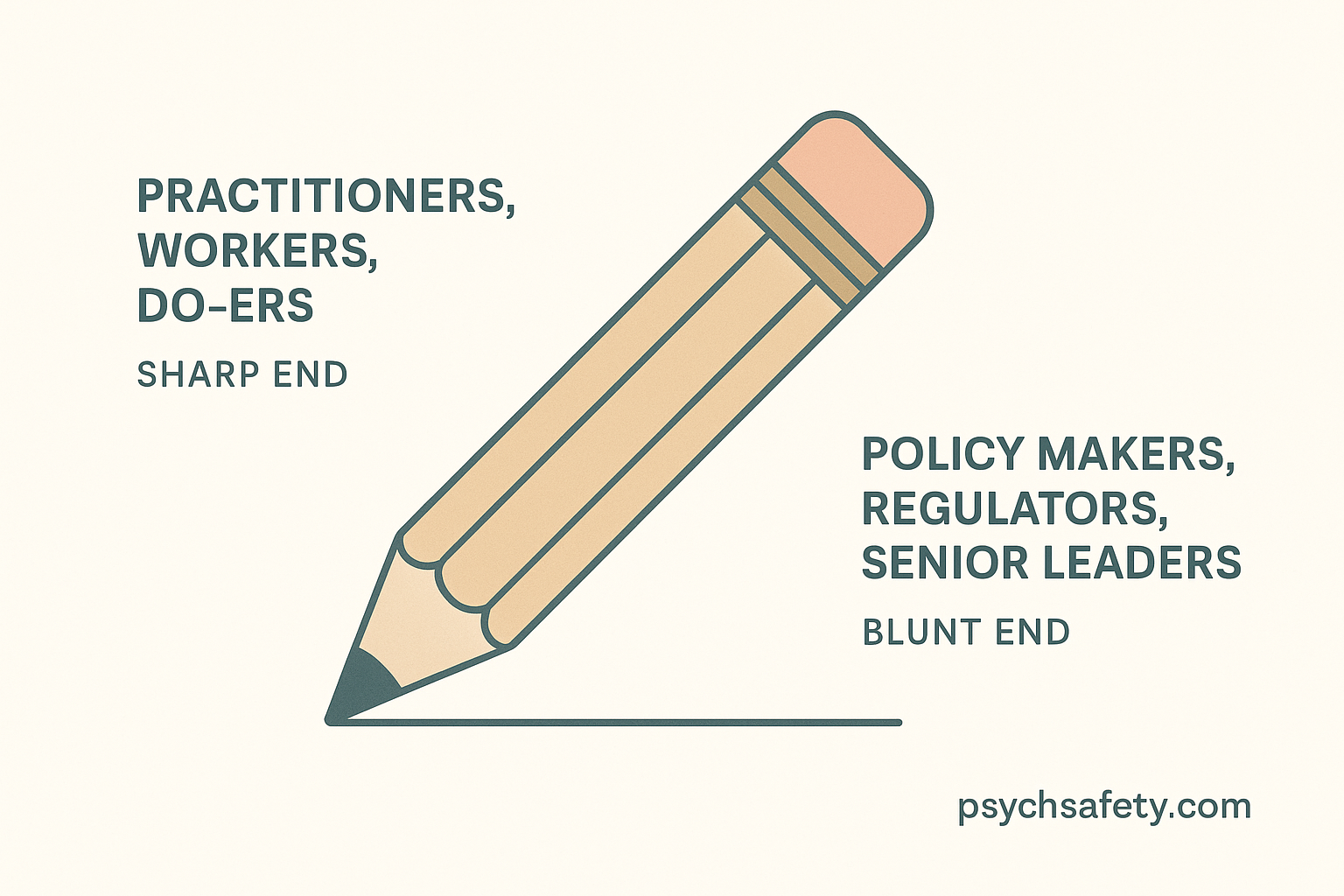
      The Sharp End & Blunt End of Education
      October 3, 2025
    • Forced Vulnerability
      Forced Vulnerability
      September 26, 2025
    • New Sticker Drop! "Zombies Are Scary"
      New Sticker Drop! "Zombies Are Scary"
      September 22, 2025
    • Reflections - Part Four: A Rights-Based Approach

      Reflections - Part Four: A Rights-Based Approach
      September 16, 2025
    • Reflections - Part Three: The Safety to Dissent
      Reflections - Part Three: The Safety to Dissent
      September 12, 2025
    • Reflections - Part Two: Power and Difference
      Reflections - Part Two: Power and Difference
      September 4, 2025
    • The Psychological Safety Trainer Toolkit
      The Psychological Safety Trainer Toolkit
      September 1, 2025
    • Reflections on Psychological Safety: Five Years of Learning
      Reflections on Psychological Safety: Five Years of Learning
      August 29, 2025
    • Not Feeling Seen: Eye Contact and Psychological Safety
      Not Feeling Seen: Eye Contact and Psychological Safety
      August 21, 2025
    • Psychological Safety Isn't Enough
      Psychological Safety Isn't Enough
      August 15, 2025
    • Psych Safety Day / Week 2026
      Psych Safety Day / Week 2026
      August 11, 2025
    • The Amagasaki Disaster
      The Amagasaki Disaster
      August 8, 2025
    • Psychological safety isn't the same for everyone
      Psychological safety isn't the same for everyone
      August 4, 2025
    • Psychological Safety Books for Children

      Psychological Safety Books for Children
      August 1, 2025
    • Psychological Safety and Creativity
      Psychological Safety and Creativity
      July 25, 2025
    • The State of Psychological Safety Survey: 2025
      The State of Psychological Safety Survey: 2025
      July 19, 2025
    • Barriers to Psychological Safety
      Barriers to Psychological Safety
      July 18, 2025
    • How you respond matters.
      How you respond matters.
      July 11, 2025
    • Practices that Foster Psychological Safety
      Practices that Foster Psychological Safety
      July 4, 2025
    • Feedback in the workplace
      Feedback in the workplace
      June 27, 2025
    • Psych Safety Day 2025
      Psych Safety Day 2025
      June 21, 2025
    • Job Security and Psychological Safety
      Job Security and Psychological Safety
      June 20, 2025
    • How familiar are people with the concept of psychological safety?
      How familiar are people with the concept of psychological safety?
      June 13, 2025
    • Learning at Psych Safety
      Learning at Psych Safety
      June 13, 2025
    • Why do We Foster Psychological Safety?
      Why do We Foster Psychological Safety?
      June 6, 2025
    • Psychological Safety in Aviation - Special Edition
      Psychological Safety in Aviation - Special Edition
      May 30, 2025
    • Rebuilding Psychological Safety When It's Broken
      Rebuilding Psychological Safety When It's Broken
      May 30, 2025
    • Just Culture
      Just Culture
      May 23, 2025
    • Transactional Analysis
      Transactional Analysis
      May 15, 2025
    • Comfort vs Need
      Comfort vs Need
      May 9, 2025
    • Sociological Safety
      Sociological Safety
      May 2, 2025
    • Humour and Psychological Safety
      Humour and Psychological Safety
      May 1, 2025
    • Safety-Organised Criticality
      Safety-Organised Criticality
      April 25, 2025
    • Leaders are not solely responsible for psychological safety.
      Leaders are not solely responsible for psychological safety.
      April 21, 2025
    • Psychological Safety in Our Personal Lives
      Psychological Safety in Our Personal Lives
      April 17, 2025
    • The Organisational Fabric of Psychological Safety
      The Organisational Fabric of Psychological Safety
      April 10, 2025
    • Colution
      April 7, 2025
    • All Feedback Is Subjective
      All Feedback Is Subjective
      April 4, 2025
    • Micromanagement
      Micromanagement
      March 21, 2025
    • Rewetting Organisations
      Rewetting Organisations
      March 14, 2025
    • Spectra of Participation
      Spectra of Participation
      March 7, 2025
    • Learning Types and Toxic Leadership
      Learning Types and Toxic Leadership
      February 28, 2025
    • Twitter
    • LinkedIn


Sign up to our newsletter & get weekly insights and research

About

The Psychological Safety Team
Our Mission
Our Core Principles
Privacy Policy
Terms of Business

Learn

Corporate Training
Online Workshops
Newsletter
Professional Certification

Tools

Tool Kits
Articles
What is Psychological Safety?
The History of Psychological Safety

Get Connected

Contact us
Attend a Meetup
Join the Community
Connect with us on LinkedIn
View our YouTube Channel
© 2025 Iterum Ltd
We support LGBTQ+ rights all year round. But we also celebrate pride too.
We support LGBTQ+ rights all year round. But we also celebrate pride!
Content on this website is CC BY-NC-SA
Written by humans, not by AI