
How you respond matters. “Everything you do is important to your organization. People are watching you. The people in your organization determine how to move forward after both successful work and how to recover after failure by watching how you […]

Psychological Safety In The Workplace

Executive Summary This study examined which practices most effectively foster psychological safety in teams and organisations. While behaviours such as listening and empathy underpin interpersonal safety, practices (structured, named activities like retrospectives or social contracts) create the scaffolds and shared […]

Executive Summary This study explored how feedback in the workplace affects both performance and psychological safety. While feedback is intended to drive growth and improvement, its delivery often has mixed results. Based on responses from 61 participants, the findings show […]

Psych Safety Day 2025 was wonderful! Malaga and Seville were gorgeous, very hot, and a fabulous way to wrap up 2025 and begin looking forward to what’s happening in Psych Safety for 2026. And if you’d like to have your […]

Executive Summary This study examined the relationship between job security and psychological safety, challenging the common assertion that “psychological safety is not job security.” While the two concepts are distinct, the findings suggest that perceptions of job insecurity (such as […]

Executive Summary In this Research Pulse, 121 respondents were asked how familiar people in their workplace are with the concept of psychological safety. The results show a broadly “middle-ground” distribution: most people have heard of it, but few would call […]

Executive Summary This study explored why people foster psychological safety, examining whether motivations are primarily moral, relational, or performance-driven. While psychological safety is often discussed in terms of its organisational benefits: innovation, learning, quality, and performance, this research highlights the […]

Why Just Culture Isn’t Sticking by Tom Geraghty What Do We Mean by “Just” Culture? The concept of a “Just Culture” was first developed in James Reason’s 1997 book Managing the Risks of Organisational Accidents. When we say “Just Culture”, […]

By Jade Garratt Have you ever found yourself reacting to something a colleague said as if you were a child being told off by their parents, even though you’re both adults and peers? Or ever said something to a teammate […]

Comfort vs Need by Tom Geraghty What do we do when the things that help some people in the team feel psychologically safer don’t work for everyone? Perhaps one person says they need time away from the main meeting group […]

Self-Organised Criticality (SOC) During my ecology degree, whilst studying ecosystem and habitat change, I learned about Self-Organised Criticality (SOC), and I was fascinated by how it explained the precursors to seemingly dramatic changes. We first discussed Self-Organised Criticality in this […]

We all are. Do only leaders influence psychological safety? Is psychological safety “done to us”? Well, yes and no. Leaders have a significant influence on psychological safety, but they’re not the only contributor, by a very long way. Firstly, psychological […]

The Organisational Fabric of Psychological Safety (AKA psychological safety is more than just a team phenomenon) By Tom Geraghty When we talk about psychological safety, the definition we usually use is something along the lines of “a shared belief that […]
Colution (noun)A solution that emerges through genuine collaboration, where all parties contribute ideas, insights, and perspectives to co-create an outcome that none could have achieved alone. Usage Examples in Sentences

All Feedback Is Subjective By Jade Garratt … And Why That Matters for Psychological Safety “No person in the world is so privileged as to have access to a ‘ground truth’ against which all other people’s understanding can be proven […]

Psychological Safety and Micromanagement By Jade Garratt Those who have followed our work at Psych Safety for a while will know that we believe exploring not just what to do – the behaviours and practices that support psychological safety – […]

The Spectrum of Participation by Jade Garratt Engagement and participation are terms we often throw around to mean “getting people’s take on issues that affect them.” But not all participation is created equal. Sometimes, “inviting participation” amounts to little more […]

Psychological Safety in Practice Team Learning in the Field: An Organizing Framework and Avenues for Future Research This excellent paper from Amy Edmondson and Jean-François Harvey affirms that teams learn most effectively when members feel safe to speak up, take interpersonal risks, […]

Déformation professionnelle By Tom Geraghty “Every specialist, owing to a well-known professional bias, believes that he understands the entire human being, while in reality he only grasps a tiny part of him.” Alexis Carrel, Nobel laureate We all see the […]

by Navya Adhikarla When we talk about creating inclusive workplaces, we often discuss accessibility and psychological safety as separate initiatives. Accessibility (also abbreviated as a11y) focuses on removing physical and digital barriers, while psychological safety addresses the emotional and social […]

Reducing Power Gradients By Jade Garratt In our experience, the most effective lever for increasing psychological safety within a team is flattening the power gradient – the gap between those with the most power and those with the least. In […]
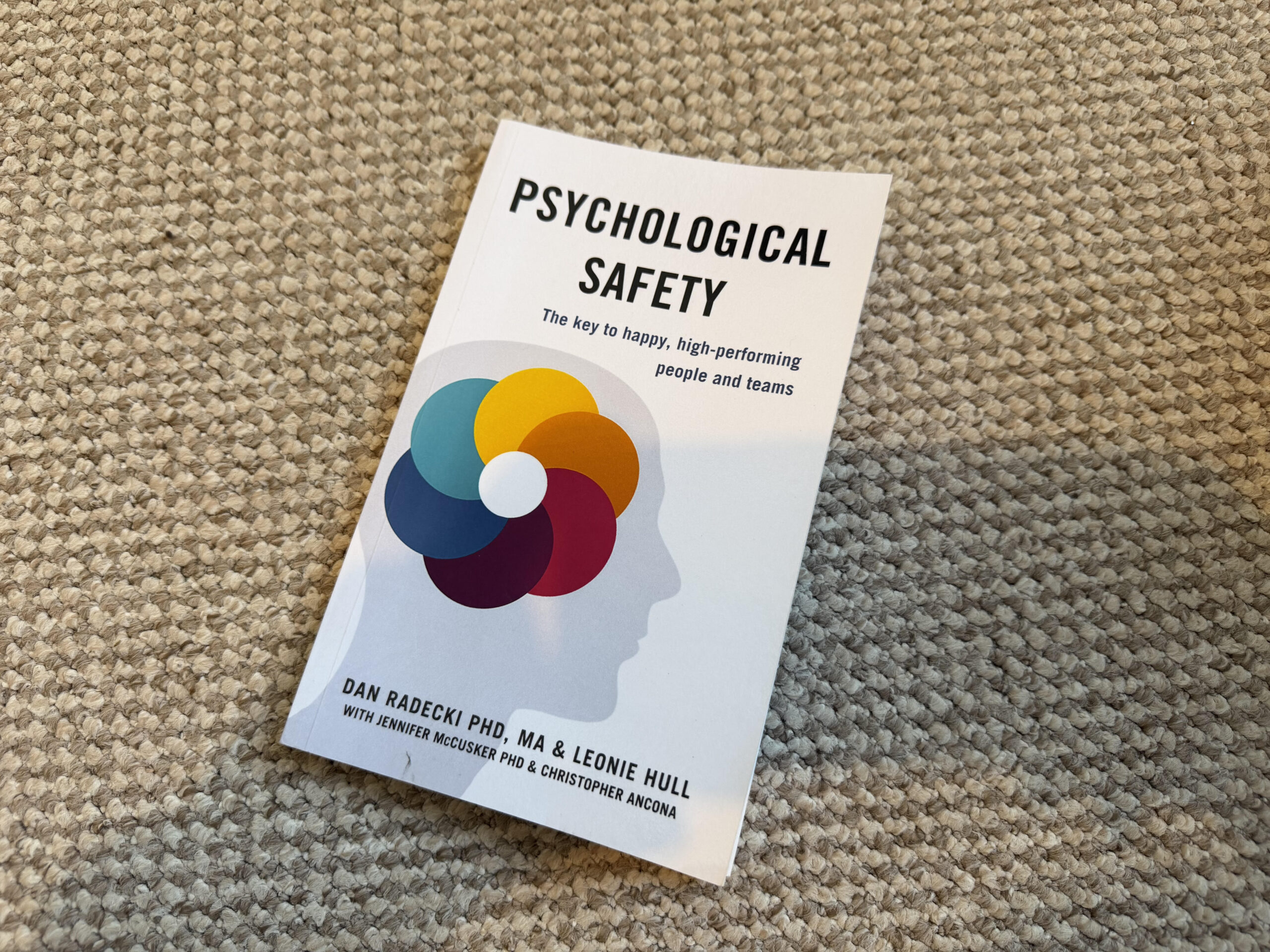
An Exploration of Dan Radecki’s S.A.F.E.T.Y.™ Model Psychological safety is a deceptively simple idea: people feel able to speak up with questions, concerns, or mistakes without fear of embarrassment or reprisal. Amy Edmondson’s now-canonical definition captures this precisely, grounding decades […]

The Speaking up Myth By Jade Garratt In the world of psychological safety, we focus a lot, maybe even too much, on the speaking up side of the equation. How do we make sure people speak up with their ideas, […]

Why silence often wins over voice When someone chooses not to speak up at work, whether it’s to raise a concern, ask a question, or offer a dissenting view, it’s easy to assume they’ve rationally weighed the pros and cons, […]

Addressing Power through “Flattening” Organisations Steep power gradients are one of the most significant factors that contribute to reducing psychological safety. These steep differentials in perceived power have contributed to many disasters including the Tenerife Airport disaster in 1977, Chernobyl, […]
Page 2 of 9

