Psychological Capital: Foundations, Team Dynamics and the Role of Leadership, Culture, and Neurodiversity AbstractPsychological capital (PsyCap) has emerged as a pivotal construct in organisational research, encapsulating the positive psychological resources that individuals draw upon to navigate work-related challenges. This article […]

Psychological Safety

An Unlikely Confidant: How AI Became My Private (PsychSafe) Oasis for Public Victory by Navya Adhikarla Psychological safety, a concept traditionally applied to group dynamics, refers to the feeling of being able to speak up, take risks, and make mistakes […]

I can say whatever I want! When I met up with Amy Edmondson recently in Boston (yes, this is a humblebrag and I’m owning it!) we discussed one of the prevalent misconceptions around psychological safety: that it means we can say […]

Making it safe(r) to fail in teaching By Jade Garratt, Director of Education, Iterum Years ago, I was lucky enough to teach in an amazing secondary school English department. Teachers’ enthusiasm for developing their practice was infectious and there was […]

The psychological safety newsletter is now three years old! The first issue went out on February 19th, 2021 to just 139 people, and you can read it online here. And this is issue 150! Over these 150 issues we’ve evolved […]

Psychological Safety Case Study: The Sales Team One of the most popular requests from the newsletter feedback survey was for some case studies of psychological safety in practice, so here’s the first one! It’s an interesting case that illustrates why […]

Psychological Safety at Work Psychological Safety in Schools This is an excellent piece on the EdCan Network website on the importance and dynamics of psychological safety for students. The authors make a few key points – psychological safety and inclusion […]

Civility Saves Lives If you wanted to completely destroy any psychological safety in the group, what would you do? If you wanted to create a culture of fear, where nobody felt safe to speak up, suggest ideas, highlight concerns, or […]

In a word, yes. The importance of mental health and well-being is now being recognised in the workplace. Some would even argue it’s being respected. Though not universal in its reach, this new attitude is seeing employers investing in a […]

A few issues ago, we covered various kinds of retrospective – the practice of looking back and learning from work, as well as some of the conditions and requirements for effective retrospectives. One of those points was about the “weak […]
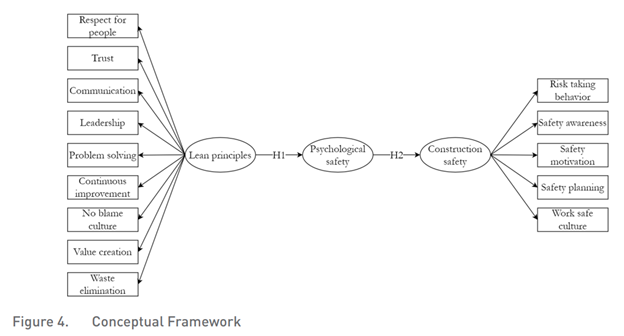
Psychological Safety at Work Lean and psychological safety Here’s a great analysis by Ben Hutchinson of a paper examining the relationship between Lean and psychological safety in construction projects in the US. This combines two of my favourite subjects so […]

John Boyd and The OODA Loop John Boyd’s OODA loops are more than just an esoteric strategic concept; they’ve earned a huge following online and around the world. In this article, I highlight key points about OODA loops along with a glimpse into […]

Telling the boss bad news twice. Soon after I graduated from university with my degree in ecology, I got a job as an Experimentalist at Jealott’s Hill Research Station, Berkshire. I worked in a department called “Weed Science” (yes, it does […]

Team performance isn’t the only reason that we foster psychological safety. We also do it because we want people to feel fulfilled in their jobs, we don’t want people to leave a team because they don’t feel included, we want people to experience less unnecessary stress and have greater mental wellbeing, we want to foster greater diversity and inclusion. Ultimately, we foster psychological safety because it’s fundamentally the right thing to do.

Crew Resource Management (CRM) and the Centrality of Psychological Safety CRM was developed in the 1970s and operationalised psychological safety in safety-critical, complex environments. Crew Resource Management (CRM) recognised, as a result of accidents such as Tenerife in 1977, that […]

Psychological Safety in 2023 Thanks so much for all your support, feedback, encouragement, ideas, insights and collaboration over 2023! It’s genuinely a privilege to be able to do this work, and I appreciate every single one of you. I recently […]

The Theory of Constraints (ToC) A long time ago, I read a book that profoundly changed the way I think about work. That book was The Goal, written by Eli Goldratt in 1984, The story revolves around Alex Rogo, a […]

Guest post by Nick Drage, Strategy Lead and Game Designer at Path Dependence Limited, co-author of “The Handbook of Cyber Wargames: Wargaming the 21st Century”. At its most abstract level a wargame is a “representation of conflict or competition in […]

Learning From Work In the spirit of looking back and learning, I thought it’d be nice to dive into a few different practices of learning from the work we do. In this issue, we’re going to have a look at […]

Selection Pressure and Psychological Safety Why has it taken so long for some industries to recognise the importance of psychological safety, whilst others have been doing it for decades? One possible answer: selection pressure. Over the past few decades, the […]

The Adaptive Cycle This is a great paper for the ecological and complexity geeks, like me. The adaptive cycle: More than a metaphor. Thanks to Christina Bowen for sharing. The adaptive cycle is a conceptual framework used to understand the dynamics […]

The Challenger Disaster: AKA The Normalisation of Risk In previous articles we’ve differentiated error into three types: slips and lapses, mistakes, and violations. This time, we’re exploring a certain type of violation called the “normalisation of deviance”, a term coined […]

Tool: Foster psychological safety We realised recently that the Google Project Aristotle page for their guide on team effectiveness and building psychological safety was 404’ing, so for anyone looking for it, we went over to the Way Back Machine and […]

The Whitehall Studies and The Social Gradient of Health The relationship between formal or positional power (seniority & status) and psychological safety is strong. In general, we know that people holding more senior and higher status roles often feel safer […]

The First Org Chart In 1855, Brigadier General Daniel McCallum, later to become a Civil War officer renowned for “strict precision and stern discipline” as well as for his innovative engineering, created the world’s first organisational chart. This chart was […]
Page 6 of 13

