


• Psychological Safety
  • Organisational Training
    • – Ignite: Senior Leaders
    • – Impact: Team Workshop
    • – Delivering Feedback
    • – Culture and Neurodiversity
    • – CRM for Non-Aviation Teams
    • – HOP: Human and Organisational Performance
    • – Train the Trainer
    • – Action Learning Sets
  • Online Workshops
    • – Train the Trainer
    • – Fundamentals
    • – Practices
    • – Leadership
    • – Advanced
    • – Measurement
    • – Workshop Facilitation
    • – HOP
    • – Delivering Feedback
    • – Thinking Like an Ecologist
  • Resources
    • – Tool Kits
    • – Free Resources
    • – Newsletter
    • – Articles
    • – Research
    • – Shop
    • – Community
    • – Practices
    • – What is Psychological Safety?
  • Measure Psychological Safety
  • About Us
  • Contact
  • Search
  • Org Training
    • Ignite for Senior Leaders
    • Impact Team Workshop
    • Management Masterclass
    • Delivering Effective Feedback
    • Cultural and Neurodiversity
    • HOP: Human and Organisational Performance
    • CRM for Non-Aviation Teams
    • Train the Trainer
    • Action Learning Sets
  • Live Workshops
    • Full Live Course
    • Psychological Safety Fundamentals
    • Practice Masterclass
    • Leadership & Management
    • Advanced Psychological Safety
    • Measuring Psychological Safety
    • Workshop Design and Facilitation
    • HOP Fundamentals
    • Delivering Effective Feedback
    • Thinking Like an Ecologist: A Field Guide for Organisational change
  • On-Demand
    • Psychological Safety 101
psych safety logo white
  • Resources
    • Measure Psychological Safety
    • Tool Kits
    • Free Resources
    • Newsletter
    • Shop
    • Podcasts & Talks
    • Videos
    • Community
    • Events & Psych Safety Days
    • The Field Guide
  • Articles
    • What is Psychological Safety?
    • The History of Psychological Safety
    • Psychological Safety Practices
    • Psychological Safety In The Workplace
    • Research
    • Human and Organisational Performance (HOP)
  • The Psych Safety Team
    • Contact Us
    • About The Team
    • Tom Geraghty
    • Jade Garratt
  • Org Training
    • Ignite for Senior Leaders
    • Impact Team Workshop
    • Management Masterclass
    • Delivering Effective Feedback
    • Cultural and Neurodiversity
    • HOP: Human and Organisational Performance
    • CRM for Non-Aviation Teams
    • Train the Trainer
    • Action Learning Sets
  • Live Workshops
    • Full Live Course
    • Psychological Safety Fundamentals
    • Practice Masterclass
    • Leadership & Management
    • Advanced Psychological Safety
    • Measuring Psychological Safety
    • Workshop Design and Facilitation
    • HOP Fundamentals
    • Delivering Effective Feedback
    • Thinking Like an Ecologist: A Field Guide for Organisational change
  • On-Demand
    • Psychological Safety 101
psych safety logo white
  • Resources
    • Measure Psychological Safety
    • Tool Kits
    • Free Resources
    • Newsletter
    • Shop
    • Podcasts & Talks
    • Videos
    • Community
    • Events & Psych Safety Days
    • The Field Guide
  • Articles
    • What is Psychological Safety?
    • The History of Psychological Safety
    • Psychological Safety Practices
    • Psychological Safety In The Workplace
    • Research
    • Human and Organisational Performance (HOP)
  • The Psych Safety Team
    • Contact Us
    • About The Team
    • Tom Geraghty
    • Jade Garratt
Human and Organisational Performance (HOP)  ·  Psychological Safety  ·  Psychological Safety In The Workplace  ·  Theory and Research

Hofstede’s Cultural Dimensions

August 1, 2022 • by Tom Geraghty

Hofstede’s Cultural Dimensions

The 6 Cultural Dimensions is a framework in cross-cultural psychology developed by Geert Hofstede. It elucidates the influence of a society’s culture on its members’ values and behaviors using a structure derived from factor analysis. This theory has profoundly impacted how we understand cultural differences in various fields, including international business and communication. This article delves into the development, dimensions, and applications of Hofstede’s cultural dimensions theory, highlighting its significance and limitations.

Development of the Theory

Hofstede’s journey began in 1965 when he founded the personnel research department of IBM Europe. Between 1967 and 1973, Hofstede conducted a comprehensive survey study on national values differences across IBM’s worldwide subsidiaries, comparing the responses of 117,000 IBM employees from different countries. This extensive data collection led to the identification of systematic differences in national cultures along four primary dimensions: power distance (PDI), individualism (IDV), uncertainty avoidance (UAI), and masculinity (MAS).

6 Dimensions of National Cultures

Hofstede’s model, later expanded to six dimensions, provides a framework for comparing national cultures. These dimensions are:

  1. Power Distance Index (PDI):
    • Definition: The extent to which the less powerful members of organizations and institutions accept and expect that power is distributed unequally.
    • High PDI: Societies with high PDI accept hierarchical order and authority without much question (e.g., Latin American and Asian countries).
    • Low PDI: Societies with low PDI strive for equality and question authority (e.g., Germanic countries).
  2. Individualism vs. Collectivism (IDV):
    • Definition: The degree to which people in a society are integrated into groups.
    • Individualistic Societies: Emphasize personal achievements and individual rights (e.g., the US, Australia).
    • Collectivist Societies: Emphasize group loyalty and cohesive in-groups (e.g., Hong Kong, Malaysia).
  3. Uncertainty Avoidance Index (UAI):
    • Definition: A society’s tolerance for ambiguity and uncertainty.
    • High UAI: Societies with high UAI prefer structured conditions and clear rules (e.g., Belgium, Germany).
    • Low UAI: Societies with low UAI are more accepting of different opinions and ambiguous situations (e.g., Sweden, Denmark).
  4. Motivation Towards Achievement and Success (MAS):
    • Definition: The preference in society for achievement, heroism, assertiveness, and material rewards for success versus cooperation, modesty, caring for the weak, and quality of life.
    • High MAS: Societies value competitiveness and success (e.g., Japan).
    • Low MAS: Societies value quality of life and caring for others (e.g., Norway, Sweden).
  5. Long-term Orientation vs. Short-term Normative Orientation (LTO):
    • Definition: The connection of the past with current and future actions.
    • Long-term Oriented Societies: Focus on future rewards, perseverance, and thrift (e.g., South Korea, Japan).
    • Short-term Oriented Societies: Focus on past and present, respect for tradition (e.g., the US).
  6. Indulgence vs. Restraint (IVR):
    • Definition: The degree of freedom societal norms give to citizens in fulfilling their human desires.
    • Indulgent Societies: Allow relatively free gratification of natural human desires (e.g., The US).
    • Restrained Societies: Regulate gratification by means of strict social norms (e.g., East Asia).
By Piotrus – Own work, CC BY-SA 4.0, https://commons.wikimedia.org/w/index.php?curid=76074311

Applications and Importance

Hofstede’s dimensions have significant practical applications, especially in international business and communication.

  1. International Communication:
    • Understanding cultural differences in communication styles is crucial for international business professionals. For instance, what might be acceptable in one culture could be offensive in another. Hofstede’s model provides insights into these nuances, helping professionals navigate cross-cultural interactions effectively.
  2. International Negotiation:
    • Cultural dimensions influence negotiation styles. For example, in some cultures, establishing a personal relationship is crucial before business discussions, while in others, getting straight to the point is preferred. Recognizing these differences can lead to more successful negotiations.
  3. International Management:
    • Managers working in multinational companies need to be aware of cultural differences to tailor their management strategies accordingly. For example, in collectivist cultures, emphasizing team unity is more effective, whereas in individualistic cultures, promoting individual responsibility and initiative works better.
  4. International Marketing:
    • Marketing strategies need to be adapted to fit the cultural values of different regions. For instance, advertising focusing on safety features of cars might be more effective in high UAI countries, while highlighting the social status might work better in individualistic societies.

Correlations with Other Country Differences

Researchers have explored correlations between Hofstede’s dimensions and other country differences, such as geographical proximity, shared language, and historical background. For example, low power distance is associated with consultative political practices and income equity, whereas high power distance correlates with unequal income distribution and corruption.

Limitations of Hofstede’s Model

Despite its widespread use, Hofstede’s model has faced criticism:

  1. Questionable Choice of National Level:
    • Critics argue that using national averages to represent cultural values overlooks within-country variations. The data from a specific demographic, like IBM employees, might not represent the entire population accurately.
  2. Individual vs. National Level:
    • Hofstede’s model focuses on national cultures but does not account for individual differences. People within a country can exhibit significant variation in values and behaviors.
  3. Gender Level:
    • The model does not adequately consider gender differences within cultures. Gender roles and responses can vary significantly, affecting cross-cultural interactions.
  4. Temporal Changes:
    • Cultural values can evolve over time, influenced by economic, political, and social changes. Hofstede’s model may not fully capture these dynamic shifts.

Conclusion

Hofstede’s cultural dimensions theory remains a fundamental framework for understanding cultural differences. Its applications in international business, communication, and management have helped professionals navigate the complexities of global interactions. However, it is essential to consider the model’s limitations and complement it with other cultural analyses to gain a comprehensive understanding of cultural dynamics. As cultures continue to evolve, ongoing research and adaptation of these theories will be crucial in maintaining their relevance and applicability in a globalized world.

See how this article connects
Explore its relationships with other ideas in the knowledge network.
Explore in network →

6 cultural dimensionsculture

Tom Geraghty

Tom Geraghty, co-founder and organisational ecologist. Tom has previously held CTO roles in a range of sectors and holds a degree in Ecology, and postgraduate degrees in business and Global Health. Now studying for a PhD. Email tom@psychsafety.com

Related Articles


Woman smiling in a work meeting
Psychological Safety  ·  Psychological Safety In The Workplace
Overcoming Toxic Work Culture: 4 Tips to Improve Psychological Safety
August 19, 2022
Sal Paradise
Human and Organisational Performance (HOP)  ·  Newsletter  ·  Psychological Safety
Psychological Safety: Just Culture and the Met Police
March 31, 2023
emergency checklist
Psychological Safety: Drive, Dissent and Checklists
Previous Article
danny hart champery 2011
Psychological Safety: When Everything Seems To Be Against You...
Next Article
  • Subscribe to the Psychological Safety Newsletter

  • organisational training
  • Discover our training options for Human and Organisational Performance and CRM for non-aviation teams.

    If you're a trainer, consultant or facilitator, get certified in our Train the Trainer complete online programme and download the Training Materials for Facilitators and Trainers.

  • theres no such thing as too much psychological safety
    Grab Psychological Safety Stickers from our Online Shop!
  • psychological safety trainer toolkit
  • Psych Safety Day

    Find out more about our Psych Safety Days - in-person and virtual events.

  • psych safety knowledge map measurement trail

    Use the Trail Guide to Psychological Safety to explore hundreds of articles, papers, resources and tools. 

  • Categories

    • Newsletter
    • Psychological Safety
      • Create and Maintain
      • Human and Organisational Performance (HOP)
      • In Technology
      • Learning and Development
      • Measure
      • Psychological Safety In The Workplace
      • Theory and Research
  • Recent Posts

    • Mistaks we've made (so far)
      Mistaks we've made (so far)
      October 7, 2026
    • The Case for Less Eye Contact
      The Case for Less Eye Contact
      September 11, 2026
    • New to psychological safety? Start here.
      New to psychological safety? Start here.
      September 8, 2026
    • The Organisational Substrate
      The Organisational Substrate
      September 1, 2026
    • Crisis-Ready Teams
      Crisis-Ready Teams
      August 27, 2026
    • Measuring psychological safety - the Psych Safety Survey Tool
      Measuring psychological safety - the Psych Safety Survey Tool
      August 25, 2026
    • Body Language and Non-Verbal Communication

      Body Language and Non-Verbal Communication
      August 20, 2026
    • The Four Stages of Psychological Safety: a Six-Stage Critique

      The Four Stages of Psychological Safety: a Six-Stage Critique
      August 7, 2026
    • Organisational Indicator Species: being an Organisational Ecologist

      Organisational Indicator Species: being an Organisational Ecologist
      August 6, 2026
    • Psych Safety Day / Week 2027
      Psych Safety Day / Week 2027
      August 4, 2026
    • Parachutes and “Evidence based” thinking

      Parachutes and “Evidence based” thinking
      July 31, 2026
    • The Psychological Safety Fieldbook
      The Psychological Safety Fieldbook
      July 31, 2026
    • Principles of Ethical Measurement in Organisations

      Principles of Ethical Measurement in Organisations
      July 10, 2026
    • Safety, Stat!
      Safety, Stat!
      June 26, 2026
    • The Strange Confidence of 360 Degree Feedback

      The Strange Confidence of 360 Degree Feedback
      June 25, 2026
    • Reading the air: high and low context communication in teams

      Reading the air: high and low context communication in teams
      June 8, 2026
    • Who gets to decide if psychological safety matters?
      Who gets to decide if psychological safety matters?
      June 5, 2026
    • Accountability
      Accountability
      May 29, 2026
    • Qualitative Measurement of Psychological Safety

      Qualitative Measurement of Psychological Safety
      May 22, 2026
    • The Field Guide to Psychological Safety
      The Field Guide to Psychological Safety
      May 15, 2026
    • Ambiguity, predictability, and psychological safety

      Ambiguity, predictability, and psychological safety
      May 1, 2026
    • The Calculus of Voice
      The Calculus of Voice
      April 23, 2026
    • Contracting and recontracting
      Contracting and recontracting
      April 16, 2026
    • The Vasa
      The Vasa
      April 1, 2026
    • Learning from Error, or Punishing It?
      Learning from Error, or Punishing It?
      March 27, 2026
    • The “Utility” of Psychological Safety
      The “Utility” of Psychological Safety
      March 20, 2026
    • Psychological Flexibility
      Psychological Flexibility
      March 19, 2026
    • Be soft to each other, and hard on the system

      Be soft to each other, and hard on the system
      March 12, 2026
    • "Fake it till you make it"
      "Fake it till you make it"
      March 12, 2026
    • The SANE Effect
      The SANE Effect
      February 20, 2026
    • Learning Teams
      Learning Teams
      January 30, 2026
    • The Tenerife Disaster of 1977: “We're Going”

      The Tenerife Disaster of 1977: “We're Going”
      January 23, 2026
    • ST.R.E.A.M: Status Rules Everything Around Me

      ST.R.E.A.M: Status Rules Everything Around Me
      January 23, 2026
    • Growth Mindset
      Growth Mindset
      January 16, 2026
    • The Streetlight Effect
      The Streetlight Effect
      January 8, 2026
    • The "Fist of Five"
      The "Fist of Five"
      December 19, 2025
    • Psychological Bravery
      Psychological Bravery
      December 18, 2025
    • Psych Safety Book List 2025
      Psych Safety Book List 2025
      December 18, 2025
    • Psych Safety 2025 Unwrapped
      Psych Safety 2025 Unwrapped
      December 15, 2025
    • Plan Continuation Bias
      Plan Continuation Bias
      December 12, 2025
    • Whistleblowing and Psychological Safety
      Whistleblowing and Psychological Safety
      December 4, 2025
    • How Childhood Socioeconomic Status Shapes Psychological Safety and Career Risk-Taking at Work
      How Childhood Socioeconomic Status Shapes Psychological Safety and Career Risk-Taking at Work
      November 27, 2025
    • Safety and the Myth of Self-Reliance
      Safety and the Myth of Self-Reliance
      November 24, 2025
    • The Watermelon Effect and "Greenwashing"

      The Watermelon Effect and "Greenwashing"
      November 7, 2025
    • Individual Resilience
      Individual Resilience
      October 31, 2025
    • Counterfactuals
      Counterfactuals
      October 24, 2025
    • Coaching and Psychological Safety
      Coaching and Psychological Safety
      October 17, 2025
    • Five Ecological Concepts for Working in Organisational Change

      Five Ecological Concepts for Working in Organisational Change
      October 9, 2025
    • The Sharp End & Blunt End of Education
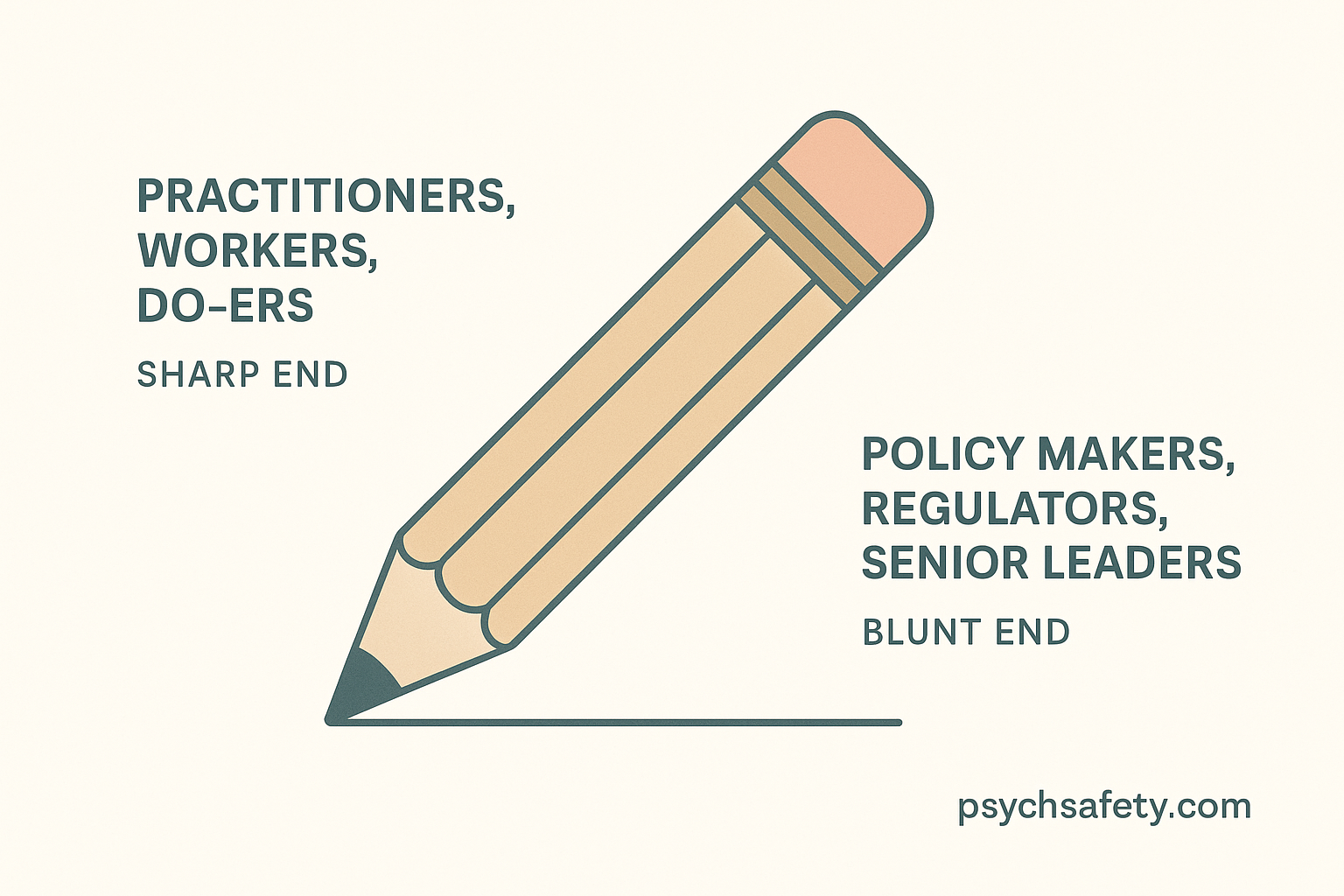
      The Sharp End & Blunt End of Education
      October 3, 2025
    • Forced Vulnerability
      Forced Vulnerability
      September 26, 2025
    • New Sticker Drop! "Zombies Are Scary"
      New Sticker Drop! "Zombies Are Scary"
      September 22, 2025
    • Reflections - Part Four: A Rights-Based Approach

      Reflections - Part Four: A Rights-Based Approach
      September 16, 2025
    • Reflections - Part Three: The Safety to Dissent
      Reflections - Part Three: The Safety to Dissent
      September 12, 2025
    • Reflections - Part Two: Power and Difference
      Reflections - Part Two: Power and Difference
      September 4, 2025
    • The Psychological Safety Trainer Toolkit
      The Psychological Safety Trainer Toolkit
      September 1, 2025
    • Twitter
    • LinkedIn


Sign up to our newsletter & get weekly insights and research

About

The Psych Safety™ Team
Our Mission
Our Core Principles
Privacy Policy
Terms of Business

Learn

Corporate Training
Online Workshops
Newsletter
Professional Certification
Explore our semantic knowledge map

Tools

Tool Kits
Articles
What is Psychological Safety?
The History of Psychological Safety

Get Connected

Contact us
Attend a Meetup
Join the Community
Connect with us on LinkedIn
View our YouTube Channel
© Iterum Ltd. Psych Safety™ is an unregistered trade mark of Iterum Ltd.
We support LGBTQ+ rights all year round. But we also celebrate pride too.
We support LGBTQ+ rights all year round. But we also celebrate pride!
Content on this website is CC BY-NC-SA
Written by humans, not by AI