

• Psychological Safety
  • Organisational Training
    • – Ignite: Senior Leaders
    • – Impact: Team Workshop
    • – Delivering Feedback
    • – CRM for Non-Aviation Teams
    • – HOP: Human and Organisational Performance
  • Online Workshops
    • – Train the Trainer
    • – Fundamentals
    • – Practices
    • – Leadership
    • – Advanced
    • – Measurement
    • – Workshop Facilitation
    • – HOP
    • – Delivering Feedback
  • Resources
    • – Tool Kits
    • – Free Resources
    • – Newsletter
    • – Articles
    • – Research
    • – Shop
    • – Community
    • – Practices
    • – What is Psychological Safety?
  • About Us
  • Contact
  • Search
  • Tool Kits
    • Action Pack
    • Trainer Toolkit
    • Practitioner Bundle
    • Practice Playbook: Feedback​
    • Practice Playbook: Technology​
    • Practice Playbook: Inclusion​
    • Practice Playbook: Education​
    • Practice Playbook: Healthcare​
  • Organisational Training
    • Ignite for Senior Leaders
    • Impact Team Workshop
    • Management Masterclass
    • Delivering Effective Feedback
    • HOP: Human and Organisational Performance
    • CRM for Non-Aviation Teams
    • Train the Trainer
  • Online Workshops
    • Complete Online Course
    • Psychological Safety Fundamentals
    • Practice Masterclass
    • Leadership & Management
    • Advanced Psychological Safety
    • Measuring Psychological Safety
    • Workshop Design and Facilitation
    • HOP Fundamentals
    • Delivering Effective Feedback
psych safety logo white
  • Resources
    • Tool Kits
    • Free Resources
    • Newsletter
    • Research
    • Shop
    • Podcasts & Talks
    • Videos
    • Community
    • Events & Psych Safety Days
  • Articles
    • Search
    • What is Psychological Safety?
    • The History of Psychological Safety
    • Psychological Safety Practices
    • Psychological Safety In The Workplace
    • Research
    • Measure Psychological Safety
    • Human Organisational Performance (HOP)
  • The Psych Safety Team
    • Contact Us
    • About The Team
    • Tom Geraghty
    • Jade Garratt
  • Tool Kits
    • Action Pack
    • Trainer Toolkit
    • Practitioner Bundle
    • Practice Playbook: Feedback​
    • Practice Playbook: Technology​
    • Practice Playbook: Inclusion​
    • Practice Playbook: Education​
    • Practice Playbook: Healthcare​
  • Organisational Training
    • Ignite for Senior Leaders
    • Impact Team Workshop
    • Management Masterclass
    • Delivering Effective Feedback
    • HOP: Human and Organisational Performance
    • CRM for Non-Aviation Teams
    • Train the Trainer
  • Online Workshops
    • Complete Online Course
    • Psychological Safety Fundamentals
    • Practice Masterclass
    • Leadership & Management
    • Advanced Psychological Safety
    • Measuring Psychological Safety
    • Workshop Design and Facilitation
    • HOP Fundamentals
    • Delivering Effective Feedback
psych safety logo white
  • Resources
    • Tool Kits
    • Free Resources
    • Newsletter
    • Research
    • Shop
    • Podcasts & Talks
    • Videos
    • Community
    • Events & Psych Safety Days
  • Articles
    • Search
    • What is Psychological Safety?
    • The History of Psychological Safety
    • Psychological Safety Practices
    • Psychological Safety In The Workplace
    • Research
    • Measure Psychological Safety
    • Human Organisational Performance (HOP)
  • The Psych Safety Team
    • Contact Us
    • About The Team
    • Tom Geraghty
    • Jade Garratt
Newsletter  ·  Psychological Safety  ·  Psychological Safety In The Workplace  ·  Theory and Research

Lean Coffee

January 6, 2023

Lean Coffee and Agenda-less Meetings


In this issue, we’re discussing a way to run effective, agenda-less meetings, which helps to foster psychologically safe environments by ensuring everyone has the opportunity to speak up.

You may have heard of Lean (as in Lean Manufacturing), and you’ve almost certainly heard of coffee, but what is Lean Coffee?

Lean Coffee started in Seattle in 2009 when Jim Benson and Jeremy Lightsmith wanted to create a group to discuss Lean techniques but didn’t want to start a whole new cumbersome committee or heavyweight meeting. They wanted to create something that didn’t rely on anything other than people showing up and getting involved.

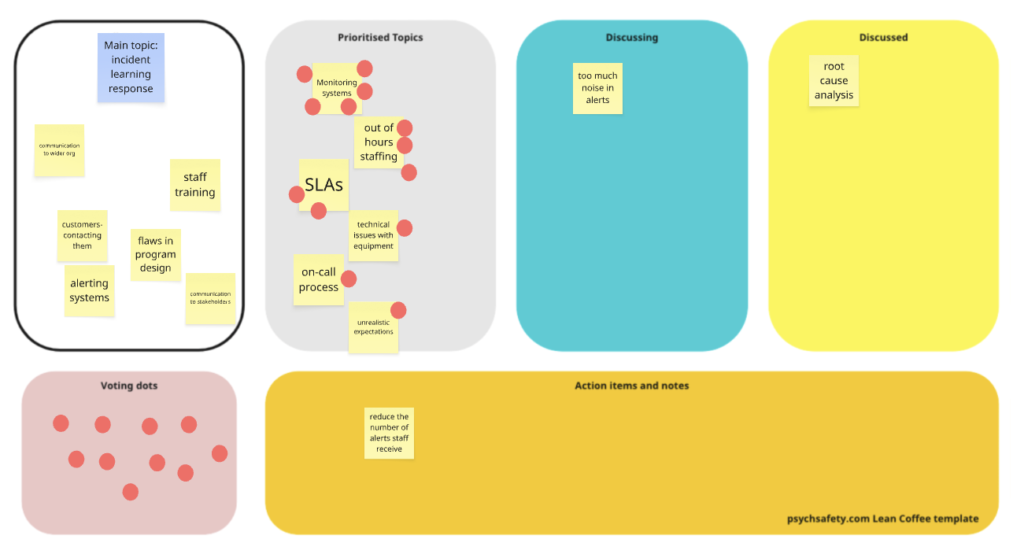
Lean Coffee is really easy to facilitate and is one of my favourite ways of running psychologically safe, agenda-less, engaging meetings with almost any number of attendees. The “agenda” is created in the meeting itself, by the attendees. Every step of a Lean Coffee meeting is time-boxed, with the option to extend as necessary. This maintains the “Lean” aspect, by ensuring that the meeting doesn’t derail, or dive too deep into a topic. Lean Coffee sessions require a chair or facilitator who simply manages timing and may introduce topics or record actions. Here’s a  Lean Coffee Canvas to use for your own sessions.


The essential Lean Coffee steps are below:

  1. Introduce the practice to all the attendees and confirm who is going to act as chair for the session.
  2. Gather all the possible topics. Ask everyone to come up with topics they’d like to discuss. If the meeting is about a particular theme (e.g. psychological safety), these are likely to be aspects of that theme, but it could be wide open, with any topic up for discussion (which can be an effective team meeting practice). You can gather the ideas in advance, or at the start of the meeting, setting a time limit of 3-5 minutes. You may wish to ensure the creator of the topic remains anonymous, or it might not be a concern. There probably won’t be time to discuss every topic, so the next step is important.
  3. Aggregate and remove duplicate topics. A time limit of a couple of minutes would be appropriate.
  4. Prioritise the topics for discussion. Applying the Pareto principle (the 80/20 rule, that 80% of the value is in 20% of the work), we want to collectively surface the most important topics. We do this via voting: each attendee has a limited number of votes (usually 3-5), and places votes on the topics they feel are most important to discuss. They may spend all their votes on a single topic if they wish to. A short time limit, of a minute or two, is probably best here. Then order the topics from most-voted to least-voted.
  5. Discussion time! Set a timer of 3-5 minutes and begin discussing the most voted-for topic. You may ask for the person who wrote the topic to introduce it, or have the chair do so. When the timer is up, take a quick thumbs-up or thumbs-down vote whether or not to continue on the topic. If the consensus is to continue, reset the timer and continue the process until the consensus is to move on to the next one.
  6. Consider having someone record minutes or actions, depending on the aim of the meeting. Alternatively you might invite people to make their own notes.
  7. Wrap up! Allow a few minutes at the end of the meeting for a wrap-up, or even a mini retrospective on the meeting, so that it can be even better next time.

All the above can be done easily in-person with some pens, post-it notes and a timer, but if you’re meeting virtually, you might want to use a tool for the meeting such as Jamboard, Miro, Mural or something else. I love the excellent Lean Coffee Table app, which is designed specifically for the job, and it’s what I use regularly for Lean Coffee sessions.

Having a Go Yourself

In fact, if you’d like to experience it, take part, and join us for a discussion, we host regular Lean Coffee meetings for free for our community. Join us on Discord or subscribe to our newsletter to make sure you’re first to know.

Lean Coffee is a great way to run team meetings, planning sessions, retrospectives, community groups and meetups, or almost any other group session. It’s also a great practice for folks who are neurodiverse, or anyone else who prefers to have well-established rules of engagement in a meeting.

I’m interested to hear how you get on, so please let me know if you try it out!


Psychological Safety in the Workplace


Check out this episode of Agile Table Topics with Omar McNeil, who was kind enough to invite Tim Beattie of Stellafai and myself over to talk about Agile, DevOps and Psychological safety. Omar asked us:

  1. Are you providing probability distributions to set expectations, why and why not?
  2. How do you do the fine dance between meeting the team where they are at and getting them to follow the framework?
  3. Was the second Death Star an Agile project, why?
  4. How have you seen Knowledge Centered Services (KCS) successfully implemented while developing an Agile environment?
  5. What’s the best retrospective format you’ve ever used and why was it effective? 

This was a great discussion, and I had a fantastic time learning from Omar and Tim.

Here’s an interesting article in The Washington Post: Incentives can lead employees to cheat or lie at work. I like this insight from Bill Becker, Associate Professor of Management at Virginia Tech, who points out that companies often “incentivise one thing and hope for something else,” and that “money brings out the worst in people, and it almost never brings out their best.” Deming and many others have made the point that extrinsic motivation is rarely as effective as intrinsic motivation, and incentives usually result in unintended and counterproductive consequences. What’s interesting in this piece is the suggestion, by Tae-Youn Park, that team-based incentives can result in more unethical behaviour than individual targets. Park’s original research paper, Incentive Effects on Ethics, is here (sorry, not open access).


Dyslexic Disclaimers


This is a great idea, shared by Kate Halpin on Linkedin: dyslexia disclaimers on email signatures. Made by Dyslexia have some fab suggestions on their website which can be added to your email signature such as:

I’m #MadeByDyslexia
I’m #MadeByDyslexia – expect creative thinking & creative spelling.
I’m #MadeByDyslexia – expect big thinking & small typos.
I’m #MadeByDyslexia – expect curious ideas & curious spelling.

There are loads of other great resources on the Made By Dyslexia website, and worth checking out.


This week’s poem:


When I Am Gone, by Shel Silverstein

When I am gone what will you do?
Who will write and draw for you?
Someone smarter—someone new?
Someone better—maybe YOU!


Thanks to Amy Hoy for the poet suggestion 🙂


collaborationcommunicationmeetingsPractices that help foster psychological safetypsychological safety

Tom Geraghty

Tom Geraghty, co-founder and delivery lead at Iterum Ltd, is an expert in high performing teams and psychological safety. Leveraging his unique background in ecological research and technology, Tom has held CIO/CTO roles in a range of sectors from tech startups to global finance firms. He holds a degree in Ecology, an MBA, and a Masters in Global Health. His mission is to make workplaces safer, higher performing, and more inclusive. Tom has shared his insights at major events such as The IT Leaders Summit, the NHS Senior Leadership Conference, and EHS Global Conferences. Connect with him on LinkedIn or email tom@psychsafety.com

Related Articles


New York
Psychological Safety  ·  Psychological Safety In The Workplace
Psych Safety Day 2022 – USA
July 18, 2022
psychological safety and trust
Newsletter  ·  Psychological Safety
Psychological Safety: Capacities of Leadership
June 6, 2022
static work vs generative work
Psychological Safety: The Top 7
Previous Article
work types
Psychological Safety & Agile
Next Article
  • Subscribe to the Psychological Safety Newsletter

  • psychological safety train the trainer
  • Get Certified! Join online workshops, or explore training and consultancy for leaders, teams and organisations.

    Discover our training options for Human and Organisational Performance and CRM for non-aviation teams.

    If you're a trainer, consultant or facilitator, get certified in our Train the Trainer complete online programme and download the Training Materials for Facilitators and Trainers.

  • human and organisational performance training
  • building and maintaining psychological safety for your team
    Download the complete Practitioners' guide to psychological safety
  • psychological safety trainer toolkit
  • Download the Psychological Safety Trainer Toolkit. Containing powerful resources that you can use to deliver your own training and workshops!

  • psych safety logo

    Sponsorship and advertising. Reach over 11,000 weekly readers and 500,000 online visitors with your message in our newsletter.

  • theres no such thing as too much psychological safety
    Grab Psychological Safety Stickers from our Online Shop!
  • Psych Safety Day

    Find out more about our Psych Safety Days - in-person and virtual events to share, learn, and connect with other enthusiasts, practitioners and researchers on psychological safety and related topics.

  • Categories

    • Newsletter
    • Psychological Safety
      • Create and Maintain
      • Human Organisational Performance (HOP)
      • In Technology
      • Learning and Development
      • Measure
      • Psychological Safety In The Workplace
      • Theory and Research
    • Random
  • Recent Posts

    • The "Fist of Five"
      The "Fist of Five"
      December 19, 2025
    • Psychological Bravery
      Psychological Bravery
      December 18, 2025
    • Psych Safety Book List 2025
      Psych Safety Book List 2025
      December 18, 2025
    • Psych Safety 2025 Unwrapped
      Psych Safety 2025 Unwrapped
      December 15, 2025
    • Plan Continuation Bias
      Plan Continuation Bias
      December 12, 2025
    • Whistleblowing and Psychological Safety
      Whistleblowing and Psychological Safety
      December 4, 2025
    • How Childhood Socioeconomic Status Shapes Psychological Safety and Career Risk-Taking at Work
      How Childhood Socioeconomic Status Shapes Psychological Safety and Career Risk-Taking at Work
      November 27, 2025
    • Safety and the Myth of Self-Reliance
      Safety and the Myth of Self-Reliance
      November 24, 2025
    • The Watermelon Effect and "Greenwashing"

      The Watermelon Effect and "Greenwashing"
      November 7, 2025
    • Individual Resilience
      Individual Resilience
      October 31, 2025
    • Counterfactuals
      Counterfactuals
      October 24, 2025
    • Coaching and Psychological Safety
      Coaching and Psychological Safety
      October 17, 2025
    • Five Ecological Concepts for Working in Organisational Change

      Five Ecological Concepts for Working in Organisational Change
      October 9, 2025
    • The Sharp End & Blunt End of Education
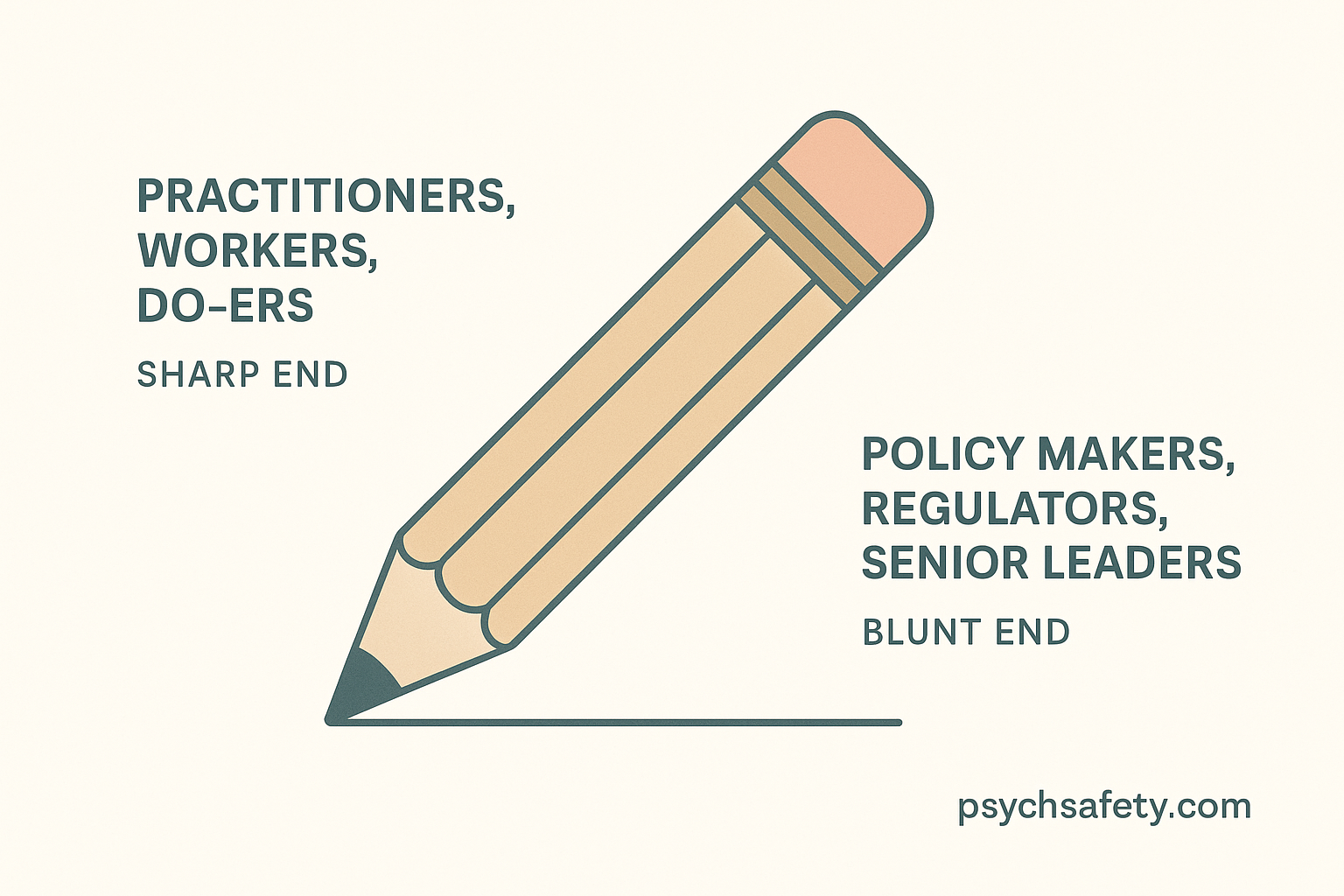
      The Sharp End & Blunt End of Education
      October 3, 2025
    • Forced Vulnerability
      Forced Vulnerability
      September 26, 2025
    • New Sticker Drop! "Zombies Are Scary"
      New Sticker Drop! "Zombies Are Scary"
      September 22, 2025
    • Reflections - Part Four: A Rights-Based Approach

      Reflections - Part Four: A Rights-Based Approach
      September 16, 2025
    • Reflections - Part Three: The Safety to Dissent
      Reflections - Part Three: The Safety to Dissent
      September 12, 2025
    • Reflections - Part Two: Power and Difference
      Reflections - Part Two: Power and Difference
      September 4, 2025
    • The Psychological Safety Trainer Toolkit
      The Psychological Safety Trainer Toolkit
      September 1, 2025
    • Reflections on Psychological Safety: Five Years of Learning
      Reflections on Psychological Safety: Five Years of Learning
      August 29, 2025
    • Not Feeling Seen: Eye Contact and Psychological Safety
      Not Feeling Seen: Eye Contact and Psychological Safety
      August 21, 2025
    • Psychological Safety Isn't Enough
      Psychological Safety Isn't Enough
      August 15, 2025
    • Psych Safety Day / Week 2026
      Psych Safety Day / Week 2026
      August 11, 2025
    • The Amagasaki Disaster
      The Amagasaki Disaster
      August 8, 2025
    • Psychological safety isn't the same for everyone
      Psychological safety isn't the same for everyone
      August 4, 2025
    • Psychological Safety Books for Children
      Psychological Safety Books for Children
      August 1, 2025
    • Psychological Safety and Creativity
      Psychological Safety and Creativity
      July 25, 2025
    • The State of Psychological Safety Survey: 2025
      The State of Psychological Safety Survey: 2025
      July 19, 2025
    • Barriers to Psychological Safety
      Barriers to Psychological Safety
      July 18, 2025
    • How you respond matters.
      How you respond matters.
      July 11, 2025
    • Practices that Foster Psychological Safety
      Practices that Foster Psychological Safety
      July 4, 2025
    • Feedback in the workplace
      Feedback in the workplace
      June 27, 2025
    • Psych Safety Day 2025
      Psych Safety Day 2025
      June 21, 2025
    • Job Security and Psychological Safety
      Job Security and Psychological Safety
      June 20, 2025
    • How familiar are people with the concept of psychological safety?
      How familiar are people with the concept of psychological safety?
      June 13, 2025
    • Learning at Psych Safety
      Learning at Psych Safety
      June 13, 2025
    • Why do We Foster Psychological Safety?
      Why do We Foster Psychological Safety?
      June 6, 2025
    • Psychological Safety in Aviation - Special Edition
      Psychological Safety in Aviation - Special Edition
      May 30, 2025
    • Rebuilding Psychological Safety When It's Broken
      Rebuilding Psychological Safety When It's Broken
      May 30, 2025
    • Just Culture
      Just Culture
      May 23, 2025
    • Transactional Analysis
      Transactional Analysis
      May 15, 2025
    • Comfort vs Need
      Comfort vs Need
      May 9, 2025
    • Sociological Safety
      Sociological Safety
      May 2, 2025
    • Humour and Psychological Safety
      Humour and Psychological Safety
      May 1, 2025
    • Safety-Organised Criticality
      Safety-Organised Criticality
      April 25, 2025
    • Leaders are not solely responsible for psychological safety.
      Leaders are not solely responsible for psychological safety.
      April 21, 2025
    • Psychological Safety in Our Personal Lives
      Psychological Safety in Our Personal Lives
      April 17, 2025
    • The Organisational Fabric of Psychological Safety
      The Organisational Fabric of Psychological Safety
      April 10, 2025
    • Colution
      April 7, 2025
    • All Feedback Is Subjective
      All Feedback Is Subjective
      April 4, 2025
    • Micromanagement
      Micromanagement
      March 21, 2025
    • Rewetting Organisations
      Rewetting Organisations
      March 14, 2025
    • Spectra of Participation
      Spectra of Participation
      March 7, 2025
    • Learning Types and Toxic Leadership
      Learning Types and Toxic Leadership
      February 28, 2025
    • Twitter
    • LinkedIn


Sign up to our newsletter & get weekly insights and research

About

The Psychological Safety Team
Our Mission
Our Core Principles
Privacy Policy
Terms of Business

Learn

Corporate Training
Online Workshops
Newsletter
Professional Certification

Tools

Tool Kits
Articles
What is Psychological Safety?
The History of Psychological Safety

Get Connected

Contact us
Attend a Meetup
Join the Community
Connect with us on LinkedIn
View our YouTube Channel
© 2025 Iterum Ltd
We support LGBTQ+ rights all year round. But we also celebrate pride too.
We support LGBTQ+ rights all year round. But we also celebrate pride!
Content on this website is CC BY-NC-SA
Written by humans, not by AI