

• Psychological Safety
  • Organisational Training
    • – Ignite: Senior Leaders
    • – Impact: Team Workshop
    • – Delivering Feedback
    • – CRM for Non-Aviation Teams
    • – HOP: Human and Organisational Performance
  • Online Workshops
    • – Train the Trainer
    • – Fundamentals
    • – Practices
    • – Leadership
    • – Advanced
    • – Measurement
    • – Workshop Facilitation
    • – HOP
    • – Delivering Feedback
  • Resources
    • – Tool Kits
    • – Free Resources
    • – Newsletter
    • – Articles
    • – Research
    • – Shop
    • – Community
    • – Practices
    • – What is Psychological Safety?
  • About Us
  • Contact
  • Search
  • Tool Kits
    • Action Pack
    • Trainer Toolkit
    • Practitioner Bundle
    • Practice Playbook: Feedback​
    • Practice Playbook: Technology​
    • Practice Playbook: Inclusion​
    • Practice Playbook: Education​
    • Practice Playbook: Healthcare​
  • Organisational Training
    • Ignite for Senior Leaders
    • Impact Team Workshop
    • Management Masterclass
    • Delivering Effective Feedback
    • HOP: Human and Organisational Performance
    • CRM for Non-Aviation Teams
    • Train the Trainer
  • Online Workshops
    • Complete Online Course
    • Psychological Safety Fundamentals
    • Practice Masterclass
    • Leadership & Management
    • Advanced Psychological Safety
    • Measuring Psychological Safety
    • Workshop Design and Facilitation
    • HOP Fundamentals
    • Delivering Effective Feedback
psych safety logo white
  • Resources
    • Tool Kits
    • Free Resources
    • Newsletter
    • Research
    • Shop
    • Podcasts & Talks
    • Videos
    • Community
    • Events & Psych Safety Days
  • Articles
    • Search
    • What is Psychological Safety?
    • The History of Psychological Safety
    • Psychological Safety Practices
    • Psychological Safety In The Workplace
    • Research
    • Measure Psychological Safety
    • Human Organisational Performance (HOP)
  • The Psych Safety Team
    • Contact Us
    • About The Team
    • Tom Geraghty
    • Jade Garratt
  • Tool Kits
    • Action Pack
    • Trainer Toolkit
    • Practitioner Bundle
    • Practice Playbook: Feedback​
    • Practice Playbook: Technology​
    • Practice Playbook: Inclusion​
    • Practice Playbook: Education​
    • Practice Playbook: Healthcare​
  • Organisational Training
    • Ignite for Senior Leaders
    • Impact Team Workshop
    • Management Masterclass
    • Delivering Effective Feedback
    • HOP: Human and Organisational Performance
    • CRM for Non-Aviation Teams
    • Train the Trainer
  • Online Workshops
    • Complete Online Course
    • Psychological Safety Fundamentals
    • Practice Masterclass
    • Leadership & Management
    • Advanced Psychological Safety
    • Measuring Psychological Safety
    • Workshop Design and Facilitation
    • HOP Fundamentals
    • Delivering Effective Feedback
psych safety logo white
  • Resources
    • Tool Kits
    • Free Resources
    • Newsletter
    • Research
    • Shop
    • Podcasts & Talks
    • Videos
    • Community
    • Events & Psych Safety Days
  • Articles
    • Search
    • What is Psychological Safety?
    • The History of Psychological Safety
    • Psychological Safety Practices
    • Psychological Safety In The Workplace
    • Research
    • Measure Psychological Safety
    • Human Organisational Performance (HOP)
  • The Psych Safety Team
    • Contact Us
    • About The Team
    • Tom Geraghty
    • Jade Garratt
Human Organisational Performance (HOP)  ·  Newsletter  ·  Psychological Safety  ·  Psychological Safety In The Workplace

Guardrails and Failure

November 4, 2022

Safety Guardrails, Mechanisms and Culture.


In working with psychological safety, we often touch on “real” or physical safety and how the two are related. By “real” safety, I mean not only safety from the risk of injurious accidents but also all risks of *things going wrong*. This includes everything from compromised patient safety to product defects and system outages. All these risks are unintended consequences of work: indeed, much of the time, the “safest” thing for a worker to do (the thing that incurs least risk of failure) is nothing at all. But of course, doing nothing is rarely a good long term strategy for success.

I often refer to Paul O’Neill at Alcoa in my workshops, about his laser-focus on worker safety at Alcoa, and how that led to a cultural shift towards far greater psychological safety across the organisation.


We need people to actually *do* work, despite the risk of failure, which is never zero. One way to do that is to accept a certain amount of failure, or redefine failure completely as a learning opportunity. However, not everything is “safe to fail” – for example, it isn’t safe to fail when failure would result in worker injuries or the collapse of large scale, safety critical, or business critical technological systems. In these cases, we need to implement tooling, systems, and mechanisms that prevent failure, or mitigate the impact of failure should it occur. We should remember though, as we discussed in the Safety I and Safety II issue, mechanisms to prevent accidents are necessary, but not sufficient, for high performance.
 

I’ve recently read the excellent Investments Unlimited book about security and compliance in technology. Investments Unlimited is a novel that describes the technological tooling and processes (i.e. guardrails) that work to both reduce the risk of failure and enable the fast flow of value. Definitely worth a read if you’re into DevOps, infosec and software development. Even though the book focusses primarily on the practical tools and technologies required for what some people call “DevSecOps”, and rarely mentions culture, it struck me that the tooling and equipment itself are catalysts of safety cultures.

Culture is essentially the manifestation of what we do, how we do it, and how we communicate. Tools and equipment influence how we work, and how we think about work too. Guardrails that make it safer to work, either through reduced risk of injury or reduced risk of failing, not only protect us from actual risk but send a strong cultural signal to people. That signal is something along the lines of:

“We recognise that humans are fallible. We acknowledge there are risks involved in work, and we want to protect you from them. If you do the right thing, and failure occurs, we will not hold you responsible.” 

(In fact, I’d love to see more teams adopt this as part of their team principles)
 

Photo by Harry Grout on Unsplash


There are various types of safety “guardrails”

  • Physical – such as the yellow railing in the image above
  • Technological – such unit tests and security scans in software teams
  • Procedural – such as checklists
  • Behavioural – such as a social contract or team charter

The thinking behind these is that if you adhere to the guardrails, and failure still occurs, it is the system that failed, not you. And this is important – psychological safety is strongly linked to cultures that consider failure to be a system problem rather than a person problem.

A correlation I observe frequently is that teams who put effort in to building effective mechanisms to prevent and mitigate failure tend to also demonstrate strong safety cultures – that is, they look for systemic causes of failure rather than blaming people for mistakes. I theorise that this improved psychological safety is in large part because of the critical conversations and practices that are required in order to put those safety measures into place. In order to create the guardrails, they have to have conversations about failures – what might go wrong. 

Psychological safety is a prerequisite for physical safety. I believe if you were measuring psychological safety alongside real world safety (through for instance the number of accidents, or failures), you’d find that psychological safety metrics are a leading indicator of real-world safety (the lagging metric).

Back to guardrails. Whatever your guardrails look like – from yellow barriers to a team charter – they reinforce the belief that failure is a system problem, not a people problem. They signal that whilst humans are part of the sociotechnical system, people (and “human error”) will not be held to blame for failures.

Psychological Safety 101

I love this piece on psychological safety from the fantastic Elizabeth Ayer. The essence of this piece is on the micro-behaviours – the subtle, less overt, “small things” that anyone on a team, but particularly those in management and leadership roles do when people speak up to raise concerns, challenge ideas or suggest alternatives. As Elizabeth points out, sometimes managers blatantly and overtly shut people down when they speak up, but at least because it’s overt, we can address and try to adjust that behaviour. What can be more insidious and difficult to address, partly because we are often unaware that we are doing them, are micro-behaviours, such as sighing when we hear bad news, changing the subject, or neglecting to thank someone for contributing.

Practices to address these include sitting with and examining your own biases, practising listening, seeking out the voices of those who are marginalised, and inspecting your own reactions.  Elizabeth also suggests three useful tips to foster greater psychological safety:

Tip 1 Take it seriously and be grateful when someone says something they find uncomfortable to you.

Tip 2 Take the small things as seriously as the big things (almost).

Tip 3 Make spaces that are as comfortable as possible for voicing meaningful dissent.


Here’s a fab podcast episode of Why Would Anyone, with Amy Edmondson. I particularly like the points made about different national cultures, and the emphasis on how we deal with failure.

This is a decent piece about psychological safety that highlights HROs (High Reliability Organisations) and looking for the “weak signals” of failure. This takes skill and expertise as well as psychological safety to speak up when your spidey sense is tingling.

Here’s a piece from Tim Clarke and Alistair Aitchison about some leaders who are afraid of psychological safety. I like this point: psychological safety “…redistributes influence. For leaders who feed on title and status, it threatens their positional power.“

Roberto Ferraro was inspired by my recent piece on Team Charters to write and draw this, shared on LinkedIn. I love it! We all make mistaks. 


Garry Browne is a psychological safety evangelist, and Head of Learning and Development at Nestle. He’s studying an MSc in Coaching & Behavioural Change, and researching inclusive leadership as a predictor of psychological safety for his dissertation. He’s looking for people to share their experiences of inclusive leadership in this 5-10 minute survey, so if you have a little time, it would be much appreciated! 

Finally (well done for making it this far by the way, I appreciate this week is a big one!), here’s a fantastic piece by Gareth Lock about psychological safety in diving debriefs. They use a DEBrIEF model based upon work by Robert Teschner and Amy Edmondson, and Gareth describes eloquently how modelling vulnerability, admitting mistakes, and demonstrating learning from mistakes, as a leader, is so powerful in debriefing situations. The rest of the site is worth a dig around, there’s some great stuff here, whether you’re a diver or not.

Things to do and try:


Accessible Social by Alexa Heinrich is a fantastic resource for any content creator – whether you’re creating internal corporate communications, building websites or writing a blog. It’s a free resource hub for anyone who wants to learn how to make their content inclusive and accessible for people with disabilities. There is so much useful and insightful information here, from how to best make use of emojis, to Alt text writing tips. There’s even a downloadable (or buyable) beginners guide to creating inclusive social media content.

This week’s poem:

Bread and Roses, by James Oppenheim, 1911.

As we come marching, marching, in the beauty of the day,
A million darkened kitchens, a thousand mill-lofts gray
Are touched with all the radiance that a sudden sun discloses,
For the people hear us singing, “Bread and Roses, Bread and Roses.”

As we come marching, marching, we battle, too, for men—
For they are women’s children and we mother them again.
Our days shall not be sweated from birth until life closes—
Hearts starve as well as bodies: Give us Bread, but give us Roses.

As we come marching, marching, unnumbered women dead
Go crying through our singing their ancient song of Bread;
Small art and love and beauty their trudging spirits knew—
Yes, it is Bread we fight for—but we fight for Roses, too.

As we come marching, marching, we bring the Greater Days—
The rising of the women means the rising of the race.
No more the drudge and idler—ten that toil where one reposes—
But a sharing of life’s glories: Bread and Roses, Bread and Roses.


I love the line in this poem, “Hearts starve as well as bodies: Give us Bread, but give us Roses.” James Oppenheim drew inspiration from Helen Todd’s speech campaigning for women’s suffrage in 1911 in which she used the concept of life needing both “bread” and “roses”: 

“Not at once; but woman is the mothering element in the world and her vote will go toward helping forward the time when life’s Bread, which is home, shelter and security, and the Roses of life, music, education, nature and books, shall be the heritage of every child that is born in the country, in the government of which she has a voice.“
 
Mission statement

The mission of this newsletter is to make the world of work a better, safer, more inclusive and equitable place. We work towards this by sharing, as widely as possible, new research and opinion, case studies, news, practices and methods related to psychological safety. 

This includes topics such as inclusion, human factors, facilitation, safety critical environments, systems thinking, leadership and management, diversity and equity, mental health, organisational dynamics, culture, ethics, and more. 

A core goal is to amplify the voices of minoritised groups and those who are less represented in this field. This includes (but is not limited to) voices of people of colour, neurodiverse people, LGBTQ+ people, women in leadership and tech, and more.

Another goal is to share insights and best practices across different domains: for example, so that those of us in tech may learn from healthcare, and those of us in education can learn from aviation.

I believe knowledge is worthless unless it’s accessible. A key principle of this newsletter is to only share content that everyone can access. This excludes content behind paywalls, research papers that are not open-access, and proprietary tools that don’t open source their algorithms (preventing us from observing how systems make decisions about us). There may be some exceptions to this principle in practice, for example, where authors are able to share original texts of papers.

Whilst this statement will evolve this over time, the core principles of equity, amplification, and progressive & humanistic leadership shouldn’t change. 

failurepsychological safetyteamstechnology

Tom Geraghty

Tom Geraghty, co-founder and delivery lead at Iterum Ltd, is an expert in high performing teams and psychological safety. Leveraging his unique background in ecological research and technology, Tom has held CIO/CTO roles in a range of sectors from tech startups to global finance firms. He holds a degree in Ecology, an MBA, and a Masters in Global Health. His mission is to make workplaces safer, higher performing, and more inclusive. Tom has shared his insights at major events such as The IT Leaders Summit, the NHS Senior Leadership Conference, and EHS Global Conferences. Connect with him on LinkedIn or email tom@psychsafety.com

Related Articles


motorbike
Human Organisational Performance (HOP)  ·  Newsletter  ·  Psychological Safety In The Workplace
Safe To Fail Experiments
May 26, 2023
human and organisational performance training
Human Organisational Performance (HOP)  ·  Newsletter  ·  Psychological Safety  ·  Psychological Safety In The Workplace
How you respond matters.
July 11, 2025
no such thing as too much psychological safety
Can a team be too psychologically safe?
Previous Article
Joan Cornellà - do nothing and you won't be wrong
Learning From Failure
Next Article
  • Subscribe to the Psychological Safety Newsletter

  • psychological safety train the trainer
  • Get Certified! Join online workshops, or explore training and consultancy for leaders, teams and organisations.

    Discover our training options for Human and Organisational Performance and CRM for non-aviation teams.

    If you're a trainer, consultant or facilitator, get certified in our Train the Trainer complete online programme and download the Training Materials for Facilitators and Trainers.

  • human and organisational performance training
  • building and maintaining psychological safety for your team
    Download the complete Practitioners' guide to psychological safety
  • psychological safety trainer toolkit
  • Download the Psychological Safety Trainer Toolkit. Containing powerful resources that you can use to deliver your own training and workshops!

  • psych safety logo

    Sponsorship and advertising. Reach over 11,000 weekly readers and 500,000 online visitors with your message in our newsletter.

  • theres no such thing as too much psychological safety
    Grab Psychological Safety Stickers from our Online Shop!
  • Psych Safety Day

    Find out more about our Psych Safety Days - in-person and virtual events to share, learn, and connect with other enthusiasts, practitioners and researchers on psychological safety and related topics.

  • Categories

    • Newsletter
    • Psychological Safety
      • Create and Maintain
      • Human Organisational Performance (HOP)
      • In Technology
      • Learning and Development
      • Measure
      • Psychological Safety In The Workplace
      • Theory and Research
    • Random
  • Recent Posts

    • The Streetlight Effect
      The Streetlight Effect
      January 8, 2026
    • The "Fist of Five"
      The "Fist of Five"
      December 19, 2025
    • Psychological Bravery
      Psychological Bravery
      December 18, 2025
    • Psych Safety Book List 2025
      Psych Safety Book List 2025
      December 18, 2025
    • Psych Safety 2025 Unwrapped
      Psych Safety 2025 Unwrapped
      December 15, 2025
    • Plan Continuation Bias
      Plan Continuation Bias
      December 12, 2025
    • Whistleblowing and Psychological Safety
      Whistleblowing and Psychological Safety
      December 4, 2025
    • How Childhood Socioeconomic Status Shapes Psychological Safety and Career Risk-Taking at Work
      How Childhood Socioeconomic Status Shapes Psychological Safety and Career Risk-Taking at Work
      November 27, 2025
    • Safety and the Myth of Self-Reliance
      Safety and the Myth of Self-Reliance
      November 24, 2025
    • The Watermelon Effect and "Greenwashing"

      The Watermelon Effect and "Greenwashing"
      November 7, 2025
    • Individual Resilience
      Individual Resilience
      October 31, 2025
    • Counterfactuals
      Counterfactuals
      October 24, 2025
    • Coaching and Psychological Safety
      Coaching and Psychological Safety
      October 17, 2025
    • Five Ecological Concepts for Working in Organisational Change

      Five Ecological Concepts for Working in Organisational Change
      October 9, 2025
    • The Sharp End & Blunt End of Education
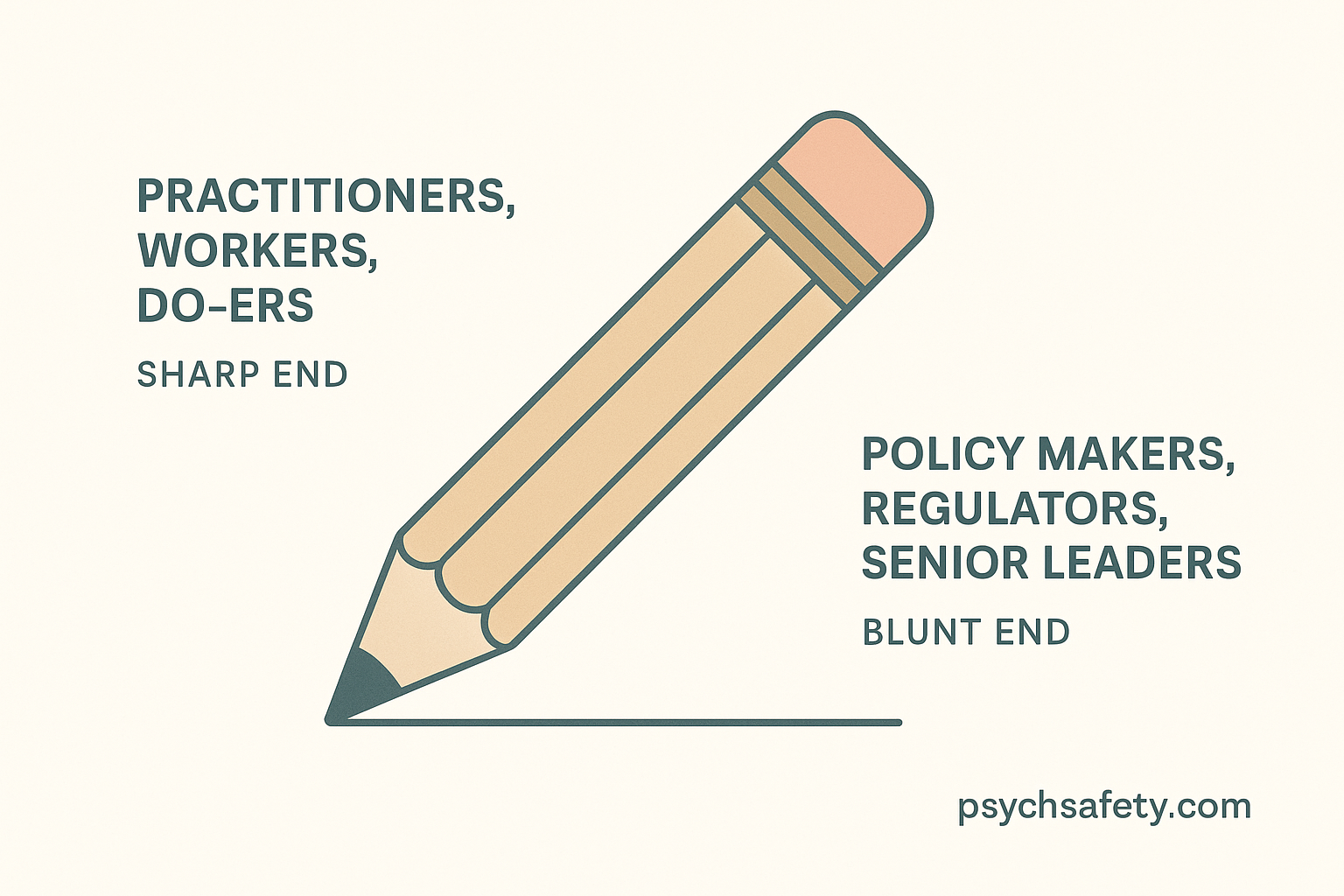
      The Sharp End & Blunt End of Education
      October 3, 2025
    • Forced Vulnerability
      Forced Vulnerability
      September 26, 2025
    • New Sticker Drop! "Zombies Are Scary"
      New Sticker Drop! "Zombies Are Scary"
      September 22, 2025
    • Reflections - Part Four: A Rights-Based Approach

      Reflections - Part Four: A Rights-Based Approach
      September 16, 2025
    • Reflections - Part Three: The Safety to Dissent
      Reflections - Part Three: The Safety to Dissent
      September 12, 2025
    • Reflections - Part Two: Power and Difference
      Reflections - Part Two: Power and Difference
      September 4, 2025
    • The Psychological Safety Trainer Toolkit
      The Psychological Safety Trainer Toolkit
      September 1, 2025
    • Reflections on Psychological Safety: Five Years of Learning
      Reflections on Psychological Safety: Five Years of Learning
      August 29, 2025
    • Not Feeling Seen: Eye Contact and Psychological Safety
      Not Feeling Seen: Eye Contact and Psychological Safety
      August 21, 2025
    • Psychological Safety Isn't Enough
      Psychological Safety Isn't Enough
      August 15, 2025
    • Psych Safety Day / Week 2026
      Psych Safety Day / Week 2026
      August 11, 2025
    • The Amagasaki Disaster
      The Amagasaki Disaster
      August 8, 2025
    • Psychological safety isn't the same for everyone
      Psychological safety isn't the same for everyone
      August 4, 2025
    • Psychological Safety Books for Children
      Psychological Safety Books for Children
      August 1, 2025
    • Psychological Safety and Creativity
      Psychological Safety and Creativity
      July 25, 2025
    • The State of Psychological Safety Survey: 2025
      The State of Psychological Safety Survey: 2025
      July 19, 2025
    • Barriers to Psychological Safety
      Barriers to Psychological Safety
      July 18, 2025
    • How you respond matters.
      How you respond matters.
      July 11, 2025
    • Practices that Foster Psychological Safety
      Practices that Foster Psychological Safety
      July 4, 2025
    • Feedback in the workplace
      Feedback in the workplace
      June 27, 2025
    • Psych Safety Day 2025
      Psych Safety Day 2025
      June 21, 2025
    • Job Security and Psychological Safety
      Job Security and Psychological Safety
      June 20, 2025
    • How familiar are people with the concept of psychological safety?
      How familiar are people with the concept of psychological safety?
      June 13, 2025
    • Learning at Psych Safety
      Learning at Psych Safety
      June 13, 2025
    • Why do We Foster Psychological Safety?
      Why do We Foster Psychological Safety?
      June 6, 2025
    • Psychological Safety in Aviation - Special Edition
      Psychological Safety in Aviation - Special Edition
      May 30, 2025
    • Rebuilding Psychological Safety When It's Broken
      Rebuilding Psychological Safety When It's Broken
      May 30, 2025
    • Just Culture
      Just Culture
      May 23, 2025
    • Transactional Analysis
      Transactional Analysis
      May 15, 2025
    • Comfort vs Need
      Comfort vs Need
      May 9, 2025
    • Sociological Safety
      Sociological Safety
      May 2, 2025
    • Humour and Psychological Safety
      Humour and Psychological Safety
      May 1, 2025
    • Safety-Organised Criticality
      Safety-Organised Criticality
      April 25, 2025
    • Leaders are not solely responsible for psychological safety.
      Leaders are not solely responsible for psychological safety.
      April 21, 2025
    • Psychological Safety in Our Personal Lives
      Psychological Safety in Our Personal Lives
      April 17, 2025
    • The Organisational Fabric of Psychological Safety
      The Organisational Fabric of Psychological Safety
      April 10, 2025
    • Colution
      April 7, 2025
    • All Feedback Is Subjective
      All Feedback Is Subjective
      April 4, 2025
    • Micromanagement
      Micromanagement
      March 21, 2025
    • Rewetting Organisations
      Rewetting Organisations
      March 14, 2025
    • Spectra of Participation
      Spectra of Participation
      March 7, 2025
    • Twitter
    • LinkedIn


Sign up to our newsletter & get weekly insights and research

About

The Psychological Safety Team
Our Mission
Our Core Principles
Privacy Policy
Terms of Business

Learn

Corporate Training
Online Workshops
Newsletter
Professional Certification

Tools

Tool Kits
Articles
What is Psychological Safety?
The History of Psychological Safety

Get Connected

Contact us
Attend a Meetup
Join the Community
Connect with us on LinkedIn
View our YouTube Channel
© 2025 Iterum Ltd
We support LGBTQ+ rights all year round. But we also celebrate pride too.
We support LGBTQ+ rights all year round. But we also celebrate pride!
Content on this website is CC BY-NC-SA
Written by humans, not by AI