

• Psychological Safety
  • Organisational Training
    • – Ignite: Senior Leaders
    • – Impact: Team Workshop
    • – Delivering Feedback
    • – CRM for Non-Aviation Teams
    • – HOP: Human and Organisational Performance
  • Online Workshops
    • – Train the Trainer
    • – Fundamentals
    • – Practices
    • – Leadership
    • – Advanced
    • – Measurement
    • – Workshop Facilitation
    • – HOP
    • – Delivering Feedback
  • Resources
    • – Tool Kits
    • – Free Resources
    • – Newsletter
    • – Articles
    • – Research
    • – Shop
    • – Community
    • – Practices
    • – What is Psychological Safety?
  • About Us
  • Contact
  • Search
  • Tool Kits
    • Action Pack
    • Trainer Toolkit
    • Practitioner Bundle
    • Practice Playbook: Feedback​
    • Practice Playbook: Technology​
    • Practice Playbook: Inclusion​
    • Practice Playbook: Education​
    • Practice Playbook: Healthcare​
  • Organisational Training
    • Ignite for Senior Leaders
    • Impact Team Workshop
    • Management Masterclass
    • Delivering Effective Feedback
    • HOP: Human and Organisational Performance
    • CRM for Non-Aviation Teams
    • Train the Trainer
  • Online Workshops
    • Complete Online Course
    • Psychological Safety Fundamentals
    • Practice Masterclass
    • Leadership & Management
    • Advanced Psychological Safety
    • Measuring Psychological Safety
    • Workshop Design and Facilitation
    • HOP Fundamentals
    • Delivering Effective Feedback
psych safety logo white
  • Resources
    • Tool Kits
    • Free Resources
    • Newsletter
    • Research
    • Shop
    • Podcasts & Talks
    • Videos
    • Community
    • Events & Psych Safety Days
  • Articles
    • Search
    • What is Psychological Safety?
    • The History of Psychological Safety
    • Psychological Safety Practices
    • Psychological Safety In The Workplace
    • Research
    • Measure Psychological Safety
    • Human Organisational Performance (HOP)
  • The Psych Safety Team
    • Contact Us
    • About The Team
    • Tom Geraghty
    • Jade Garratt
  • Tool Kits
    • Action Pack
    • Trainer Toolkit
    • Practitioner Bundle
    • Practice Playbook: Feedback​
    • Practice Playbook: Technology​
    • Practice Playbook: Inclusion​
    • Practice Playbook: Education​
    • Practice Playbook: Healthcare​
  • Organisational Training
    • Ignite for Senior Leaders
    • Impact Team Workshop
    • Management Masterclass
    • Delivering Effective Feedback
    • HOP: Human and Organisational Performance
    • CRM for Non-Aviation Teams
    • Train the Trainer
  • Online Workshops
    • Complete Online Course
    • Psychological Safety Fundamentals
    • Practice Masterclass
    • Leadership & Management
    • Advanced Psychological Safety
    • Measuring Psychological Safety
    • Workshop Design and Facilitation
    • HOP Fundamentals
    • Delivering Effective Feedback
psych safety logo white
  • Resources
    • Tool Kits
    • Free Resources
    • Newsletter
    • Research
    • Shop
    • Podcasts & Talks
    • Videos
    • Community
    • Events & Psych Safety Days
  • Articles
    • Search
    • What is Psychological Safety?
    • The History of Psychological Safety
    • Psychological Safety Practices
    • Psychological Safety In The Workplace
    • Research
    • Measure Psychological Safety
    • Human Organisational Performance (HOP)
  • The Psych Safety Team
    • Contact Us
    • About The Team
    • Tom Geraghty
    • Jade Garratt
Human Organisational Performance (HOP)  ·  Newsletter  ·  Psychological Safety In The Workplace

15/5 Reports

October 27, 2023

15/5 Reports

To manage teams in a way that fosters psychological safety requires clear communication and feedback channels. Team members should have well-defined platforms to share achievements, voice concerns, and seek assistance. Ideally, these feedback mechanisms will be consistent, high-cadence and light-touch, enabling early identification of issues in a manner that’s straightforward, low-risk, and routine for team members.

What are 15/5 Reports?

15/5 reports are a great example of a practical tool to achieve this, and this week, we’re going to dive into them, as a way to improve performance and error-catching in a team, alongside fostering psychological safety.

These 15/5 reports were originally created by Yvon Chouinard, founder of Patagonia, and (I think) were inspired by the Scrum standup questions. Yvon Chouinard recognised that he was out of the office a lot, so he needed a way to get the information he needed quickly without placing too much burden on those reporting. By asking team members to complete 15/5s on a weekly basis, he could keep a regular information pulse across teams and the organisation. They’re called 15/5s because they should take no more than 15 minutes to write, and 5 minutes to read.

Ensuring that everyone knows what’s going on in an organisation is hard. Finding time for regular synchronous meetings in busy calendars can be really hard, especially when colleagues are working across different time zones or have different working patterns. No one wants onerous reports to write (or read!) but many people do find it easier to communicate in writing because it gives them more time to think about what they’re saying and how to say it. 15/5s can provide an ideal vehicle for easy, concise sharing.

15/5 reports consist essentially of a few core questions, such as the ones below. These are the core questions (or variations of) that I’ve used throughout my career as a manager since I first came across 15/5s in 2013. 

15/5 Report Core Questions

1. What are your main achievements this week? What are you most proud of or satisfied with?

This question kicks the report off with a positive note. Team members can be invited to add non-work achievements too – whatever they feel good about that week. In tough times, it might simply be “I’ve made it through so far.”

2. Is there anything worrying or concerning you in or outside of work?

This is a critical question. And it’s ok if the answer is “nothing”, but make sure you keep asking it, because the time will come when people have concerns and this makes it clear that it’s ok, and expected, that they raise them.

You can address anything raised here in your regular 1-1s (you are having regular weekly or biweekly 1-1s, right?…) and if multiple people raise the same concern, you can get in front of it before it becomes too big.

Of course, team members should also know they don’t need to wait for a 15/5 to raise any major or urgent concerns.

3. How are you feeling, and what is the morale of your team around you?

This is a good temperature check for individual wellbeing and team culture. It will also highlight if and where there are differences between team members – some may feel everything is great, while others are struggling. It may take weeks or months before people begin to answer this question honestly, but it’s really important. 

4. Is there anything I could do better or differently that would help you?

As a leader, it’s critical that you frequently and consistently ask for feedback. Again, this question may take many weeks or months before you receive anything constructive, because it may take time for people to recognise that it’s safe to give you feedback. Remember that when you do get it, it’s essential you visibly welcome it and act on it. 

Implementing 15/5 Reports in your team

In their first few 15/5s, people may not be particularly candid or open. But as time progresses, and this becomes a habit, people will begin to feel psychologically safer to be more honest. This only works, however, if you respond productively and with kindness to what people write – even (especially) if it’s feedback for you. Be sure to respond to every single report – even if it’s a quick acknowledgement and thanks – because it’s very demotivating for people to write 15/5s without receiving a response, and will rapidly mean people stop sending them or send very dry reports without substance.

I encourage team members to send 15/5s on a Thursday afternoon, but to start writing them on a Monday morning, and add bits in as they occurred to them, but it’s not a hard and fast rule. You can choose the timing that works best for your team. Ideally, the cadence should align with your 1-1 meeting cadence, so that the reports inform your 1-1s. 

Even if you have around ten or more people sending reports to you, this is a great, and very lean, method of ensuring you can support your team as effectively as possible. If you provide your manager with a 15/5, it also means you can push information upwards (or backwards, depending on how you think about your org structure!) or across to other team members and managers. 

As a team member, you don’t need permission to start doing 15/5 reports.

There’s no reason you can’t start doing these for your manager. Chances are, once you start doing them, your manager will recognise the value and begin to love them (and you for starting them)! At worst, if your manager doesn’t engage, they can be a great format for your own regular reflections on work.

Variations in 15/5 implementation:

You might decide that everyone in the team shares their 15/5 with everyone else. This is fantastic, but be aware that there are often personal issues that are brought up in 15/5 reports that people may not want other team members to know about. Especially if those issues concern other team members.

Some folks might not want to write stuff down. In some cases, people could record 15/5s in a video or audio. This can work especially well in environments where people do most of their work away from desks.

And of course there might be things that people want to talk about that they don’t want to write down or record in any way. That’s fine – never insist that feedback or concerns are recorded because you risk not hearing about them at all. 

Alongside the standard questions, you can include optional questions to add context, such as

  • What are you working on next? What’s your next priority?
  • What are you NOT working on? Why?
  • Where are you facing any challenges or blockages?
  • What’s the most important thing for us to talk about in our next 1-1?
  • Are you working on anything that wasn’t planned? How is that affecting your workload?
  • What have you learned or discovered this week?
  • What would you change about the work environment, the team, or the organisation?
  • What small thing would improve your day?
  • What are you grateful for?

15/5 Reports and Psychological Safety

I’d argue that 1-1 meetings (as we’ve discussed in previous issues) are the primary protocol for effective communication in teams, but 15/5s can be fantastic way to feed into 1-1s and make them even more effective. In my experience, 15/5s are one of the most practical, and easy-to-implement practices that a manager can adopt with their teams, fostering psychological safety whilst improving performance.

I’d love to hear your thoughts and experiences of using 15/5s, or variations thereof, with your teams.


More Psychological Safety Workshops!

We have a few places left on our upcoming workshops – you can choose from:

  • Intermediate: essential theory and practice to help you level up your knowledge and skills.
  • In-depth: examining elements such as cultural impacts on psychological safety, complexity, sociotechnicality, organisational scale and more.
  • Practices: From Empathy Mapping to TRIZ. You learn practices and take away canvases and templates too.
  • Leadership: Specifically for managers and senior leaders (or folks on that journey): we cover effective management practices, strategic leadership, reporting, 1-1s, work design and flow, managing neurodiverse people and more. [More sessions coming in the new year]

 Find out more and register here.

psychological safety workshop certification


Even more exciting is the news that psychsafety.com courses all now come with Credly Badges! After completion of the course, you’ll receive an email to claim your badge, which you can use to evidence your CPD and share on your LinkedIn profile.

If you’ve previously attended any psychsafety.com workshops, you’ll soon receive an email to retrospectively claim your badges as well!


Psychological Safety at Work


I’m a huge Audre Lorde fan. In 2016, poet, editor and assistant professor Divya Victor created this Audre Lorde Questionnaire to Oneself, for students of her Creative Writing courses at Nanyang Technological University. Adapted from Lorde’s “The Transformation of Silence into Language and Action“, Divya distilled Lorde’s insights into this powerful set of questions – note in particular question 4: 

  1. What are the words you do not have yet? [Or, “for what do you not have words, yet?”]
  2. What do you need to say? [List as many things as necessary]
  3. “What are the tyrannies you swallow day by day and attempt to make your own, until you will sicken and die of them, still in silence?”  [List as many as necessary today. Then write a new list tomorrow. And the day after.]
  4. If we have been “socialized to respect fear more than our own needs for language and definition”, ask yourself: “What’s the worst that could happen to me if I tell this truth?”* [So, answer this today. And every day.]

In this LinkedIn post, community member and friend Roberto Ferraro shared an illustration reminding introverts to speak, and extroverts to think. What I especially like about the post is Roberto’s crucial point of “Introverted individuals make up about half of the world’s population. However, 96% of senior executives prefer to define themselves as extroverts because of prejudice.” It’s worth noting that the idea that some people are extroverts and others are introverts, is somewhat a false binary. Evidence strongly suggests that there is a spectrum, or curve, of extroversion at one end, and introversion at the other, upon which we all sit – but in different places in different contexts. We may be introverted at work, but extroverted with friends, for example. Ultimately, Roberto’s illustration is useful, and helps to remind us to reflect and consider our approach in group contexts. Equally as important, for me, is Roberto’s normalisation of introversion as a positive leadership trait. 

Thanks to Chris Baynham-Hughes for sharing this – on the Radio 4 Today show this week, Melissa Mead and Rob Behrens were discussing sepsis, and how whilst improvements have been made, culture in the UK NHS means that patients are not always listened to when they have concerns about sepsis. People who don’t speak English as a first language or are members of oppressed and under-served communities may also not feel able to speak up with their concerns. There are steps to introduce new complaints frameworks, which aim to encourage learning in the healthcare system, and personally, I’m hopeful that the implementation of PSIRF will also contribute to a more progressive culture. However, whilst budgets are inadequate, resources are scarce, and frontline healthcare workers are under incredible strain, it’s going to be difficult. Skip to 2:46:40 to find the relevant part.

I sometimes get pushback on the concept of psychological safety. Sometimes people will say that we don’t need it, want it, or that people should just speak up even without psychological safety. My observation is that it tends to be men who are most vocal on this point. Of course, this may just be chance, it may be my own echo chamber, or it may be that men are more inclined to disagree in public. When I saw “the man box” though, a concept coined by Tony Porter and shared by Elliot Rae on Linkedin, I wondered whether some of the resistance to the idea of psychological safety comes from this concept of masculinity – the notion that men must be seen to be brave and suffer in silence? Food for thought maybe.


An estimated 50,000 pregnant women are caught up in the conflict in Gaza, with around 5,500 due to give birth within the next 30 days. These women are facing extreme challenges in accessing safe maternity services, as hospitals are overwhelmed with patients and running out of medicines and basic supplies. Psychsafety.com is donating to the UNFPA crisis fund for Gaza, and if you wish to, and are able to, you can do so here.


This week’s poem:


“Life, I knew, was supposed to be more joyful than this, more real, more meaningful, and the world was supposed to be more beautiful. We were not supposed to hate Mondays and live for the weekends and holidays. We were not supposed to have to raise our hands to be allowed to pee. We were not supposed to be kept indoors on a beautiful day, day after day.”

Charles Eisenstein, from The More Beautiful World Our Hearts Know Is Possible


leadershipmanagementperformancePractices that help foster psychological safetypsychological safetyreportsteamswork

Tom Geraghty

Tom Geraghty, co-founder and delivery lead at Iterum Ltd, is an expert in high performing teams and psychological safety. Leveraging his unique background in ecological research and technology, Tom has held CIO/CTO roles in a range of sectors from tech startups to global finance firms. He holds a degree in Ecology, an MBA, and a Masters in Global Health. His mission is to make workplaces safer, higher performing, and more inclusive. Tom has shared his insights at major events such as The IT Leaders Summit, the NHS Senior Leadership Conference, and EHS Global Conferences. Connect with him on LinkedIn or email tom@psychsafety.com

Related Articles


psychological safety in aviation - a go around
Human Organisational Performance (HOP)  ·  Newsletter  ·  Psychological Safety  ·  Theory and Research
Psychological Safety in Aviation
April 7, 2023
prospect theory and psychological safety
Psychological Safety  ·  Psychological Safety In The Workplace
Prospect Theory and Psychological Safety
January 21, 2025
Tom Geraghty (age 5)
Stuttering and Stammering
Previous Article
Navya Adhikarla
(Don’t) Look me in the Eye: The Challenge of Eye Contact
Next Article
  • Subscribe to the Psychological Safety Newsletter

  • psychological safety train the trainer
  • Get Certified! Join online workshops, or explore training and consultancy for leaders, teams and organisations.

    Discover our training options for Human and Organisational Performance and CRM for non-aviation teams.

    If you're a trainer, consultant or facilitator, get certified in our Train the Trainer complete online programme and download the Training Materials for Facilitators and Trainers.

  • human and organisational performance training
  • building and maintaining psychological safety for your team
    Download the complete Practitioners' guide to psychological safety
  • psychological safety trainer toolkit
  • Download the Psychological Safety Trainer Toolkit. Containing powerful resources that you can use to deliver your own training and workshops!

  • psych safety logo

    Sponsorship and advertising. Reach over 11,000 weekly readers and 500,000 online visitors with your message in our newsletter.

  • theres no such thing as too much psychological safety
    Grab Psychological Safety Stickers from our Online Shop!
  • Psych Safety Day

    Find out more about our Psych Safety Days - in-person and virtual events to share, learn, and connect with other enthusiasts, practitioners and researchers on psychological safety and related topics.

  • Categories

    • Newsletter
    • Psychological Safety
      • Create and Maintain
      • Human Organisational Performance (HOP)
      • In Technology
      • Learning and Development
      • Measure
      • Psychological Safety In The Workplace
      • Theory and Research
    • Random
  • Recent Posts

    • The "Fist of Five"
      The "Fist of Five"
      December 19, 2025
    • Psychological Bravery
      Psychological Bravery
      December 18, 2025
    • Psych Safety Book List 2025
      Psych Safety Book List 2025
      December 18, 2025
    • Psych Safety 2025 Unwrapped
      Psych Safety 2025 Unwrapped
      December 15, 2025
    • Plan Continuation Bias
      Plan Continuation Bias
      December 12, 2025
    • Whistleblowing and Psychological Safety
      Whistleblowing and Psychological Safety
      December 4, 2025
    • How Childhood Socioeconomic Status Shapes Psychological Safety and Career Risk-Taking at Work
      How Childhood Socioeconomic Status Shapes Psychological Safety and Career Risk-Taking at Work
      November 27, 2025
    • Safety and the Myth of Self-Reliance
      Safety and the Myth of Self-Reliance
      November 24, 2025
    • The Watermelon Effect and "Greenwashing"

      The Watermelon Effect and "Greenwashing"
      November 7, 2025
    • Individual Resilience
      Individual Resilience
      October 31, 2025
    • Counterfactuals
      Counterfactuals
      October 24, 2025
    • Coaching and Psychological Safety
      Coaching and Psychological Safety
      October 17, 2025
    • Five Ecological Concepts for Working in Organisational Change

      Five Ecological Concepts for Working in Organisational Change
      October 9, 2025
    • The Sharp End & Blunt End of Education
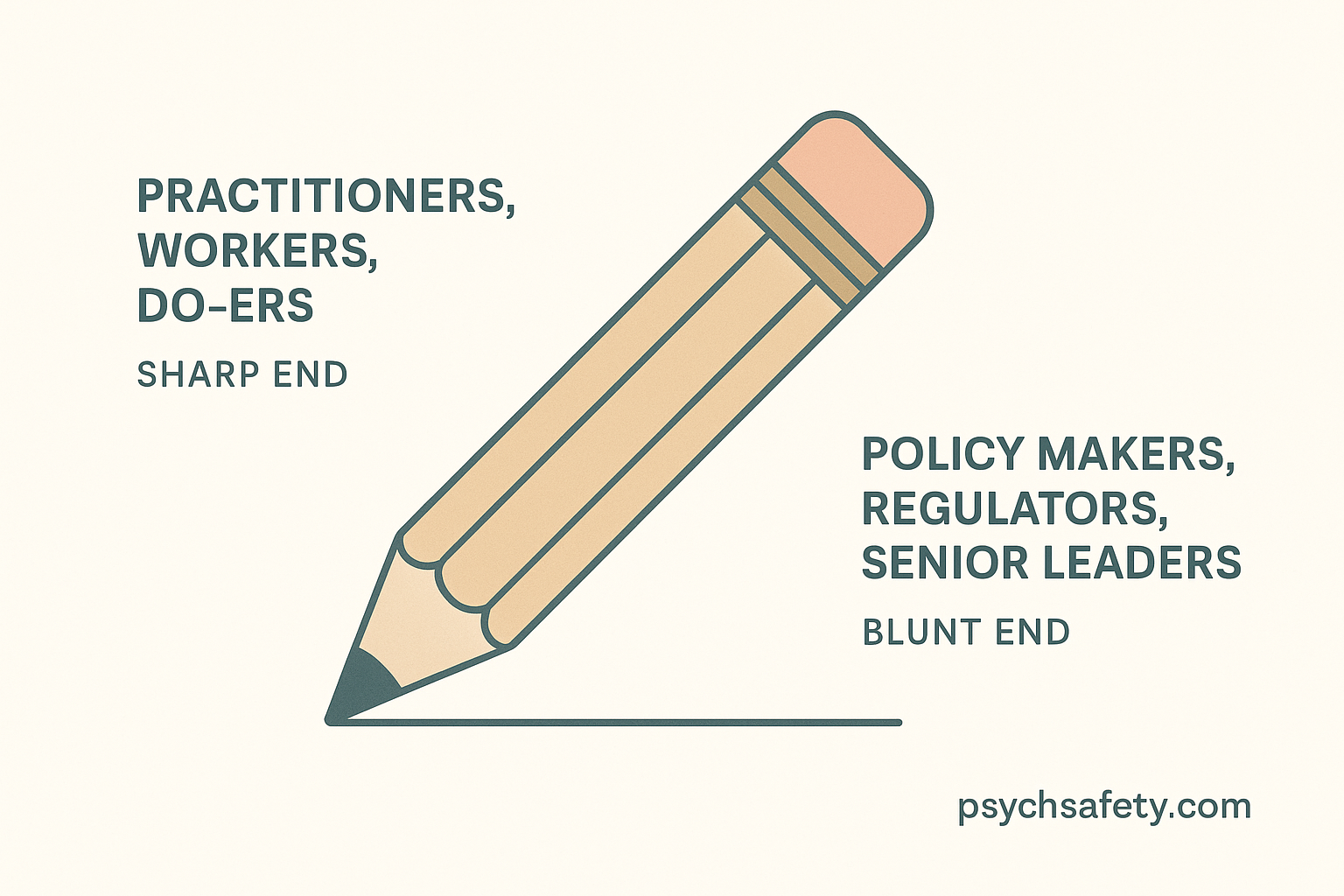
      The Sharp End & Blunt End of Education
      October 3, 2025
    • Forced Vulnerability
      Forced Vulnerability
      September 26, 2025
    • New Sticker Drop! "Zombies Are Scary"
      New Sticker Drop! "Zombies Are Scary"
      September 22, 2025
    • Reflections - Part Four: A Rights-Based Approach

      Reflections - Part Four: A Rights-Based Approach
      September 16, 2025
    • Reflections - Part Three: The Safety to Dissent
      Reflections - Part Three: The Safety to Dissent
      September 12, 2025
    • Reflections - Part Two: Power and Difference
      Reflections - Part Two: Power and Difference
      September 4, 2025
    • The Psychological Safety Trainer Toolkit
      The Psychological Safety Trainer Toolkit
      September 1, 2025
    • Reflections on Psychological Safety: Five Years of Learning
      Reflections on Psychological Safety: Five Years of Learning
      August 29, 2025
    • Not Feeling Seen: Eye Contact and Psychological Safety
      Not Feeling Seen: Eye Contact and Psychological Safety
      August 21, 2025
    • Psychological Safety Isn't Enough
      Psychological Safety Isn't Enough
      August 15, 2025
    • Psych Safety Day / Week 2026
      Psych Safety Day / Week 2026
      August 11, 2025
    • The Amagasaki Disaster
      The Amagasaki Disaster
      August 8, 2025
    • Psychological safety isn't the same for everyone
      Psychological safety isn't the same for everyone
      August 4, 2025
    • Psychological Safety Books for Children
      Psychological Safety Books for Children
      August 1, 2025
    • Psychological Safety and Creativity
      Psychological Safety and Creativity
      July 25, 2025
    • The State of Psychological Safety Survey: 2025
      The State of Psychological Safety Survey: 2025
      July 19, 2025
    • Barriers to Psychological Safety
      Barriers to Psychological Safety
      July 18, 2025
    • How you respond matters.
      How you respond matters.
      July 11, 2025
    • Practices that Foster Psychological Safety
      Practices that Foster Psychological Safety
      July 4, 2025
    • Feedback in the workplace
      Feedback in the workplace
      June 27, 2025
    • Psych Safety Day 2025
      Psych Safety Day 2025
      June 21, 2025
    • Job Security and Psychological Safety
      Job Security and Psychological Safety
      June 20, 2025
    • How familiar are people with the concept of psychological safety?
      How familiar are people with the concept of psychological safety?
      June 13, 2025
    • Learning at Psych Safety
      Learning at Psych Safety
      June 13, 2025
    • Why do We Foster Psychological Safety?
      Why do We Foster Psychological Safety?
      June 6, 2025
    • Psychological Safety in Aviation - Special Edition
      Psychological Safety in Aviation - Special Edition
      May 30, 2025
    • Rebuilding Psychological Safety When It's Broken
      Rebuilding Psychological Safety When It's Broken
      May 30, 2025
    • Just Culture
      Just Culture
      May 23, 2025
    • Transactional Analysis
      Transactional Analysis
      May 15, 2025
    • Comfort vs Need
      Comfort vs Need
      May 9, 2025
    • Sociological Safety
      Sociological Safety
      May 2, 2025
    • Humour and Psychological Safety
      Humour and Psychological Safety
      May 1, 2025
    • Safety-Organised Criticality
      Safety-Organised Criticality
      April 25, 2025
    • Leaders are not solely responsible for psychological safety.
      Leaders are not solely responsible for psychological safety.
      April 21, 2025
    • Psychological Safety in Our Personal Lives
      Psychological Safety in Our Personal Lives
      April 17, 2025
    • The Organisational Fabric of Psychological Safety
      The Organisational Fabric of Psychological Safety
      April 10, 2025
    • Colution
      April 7, 2025
    • All Feedback Is Subjective
      All Feedback Is Subjective
      April 4, 2025
    • Micromanagement
      Micromanagement
      March 21, 2025
    • Rewetting Organisations
      Rewetting Organisations
      March 14, 2025
    • Spectra of Participation
      Spectra of Participation
      March 7, 2025
    • Learning Types and Toxic Leadership
      Learning Types and Toxic Leadership
      February 28, 2025
    • Twitter
    • LinkedIn


Sign up to our newsletter & get weekly insights and research

About

The Psychological Safety Team
Our Mission
Our Core Principles
Privacy Policy
Terms of Business

Learn

Corporate Training
Online Workshops
Newsletter
Professional Certification

Tools

Tool Kits
Articles
What is Psychological Safety?
The History of Psychological Safety

Get Connected

Contact us
Attend a Meetup
Join the Community
Connect with us on LinkedIn
View our YouTube Channel
© 2025 Iterum Ltd
We support LGBTQ+ rights all year round. But we also celebrate pride too.
We support LGBTQ+ rights all year round. But we also celebrate pride!
Content on this website is CC BY-NC-SA
Written by humans, not by AI