psychological safety

psychological safety timeline

Psychological Safety – A Timeline

The increase in awareness and popularity of psychological safety I thought it would be interesting to look at the frequency of the search term “psychological safety” over time, and map certain events onto that. If you head to Google Trends,

Read More »
Photo by Seven Shooter on Unsplash

Reading Fiction Builds Empathy

Leadership and Empathy One of the most powerful capabilities that leaders and managers can possess is empathy. Arguably, the same could be said for anyone – we can best understand and help others when we’re able to see the world

Read More »
Photo by Brett Jordan on Unsplash

Hard to Say I’m Sorry

Hard to Say I’m Sorry: Apologies in the Workplace Guest post by Jonathan Cohen, MD It shouldn’t be a surprise that good apologies are not the norm. There are several reasons for this. Most of us have not undergone formal

Read More »
types of silence

Types of Silence

Types of Silence The authors of this literature review “Silence in organizations and psychological safety” from 2015, describe a number of group dynamics that can lead to silence, and more interestingly, describe a few different types of silence, drawn from

Read More »
psychological safety icebreakers

Icebreakers

Icebreakers If you’re anything like me, when you see “icebreakers” on an agenda or schedule for a meeting, you immediately become a little anxious. Ice breakers are intended to make us feel more comfortable and at ease, increasing the overall

Read More »
PACE - probe, alert, challenge, emergency

PACE: Graded Assertiveness

Psychological safety is about creating a climate in which we feel able to take interpersonal risks in order to communicate our ideas, concerns and issues – and we want to be able to speak up in a way that we

Read More »
Image shows a student holding her books in a classroom. She is smiling while other students are sat at their desks.

Psychological Safety for Students

Personal Experiences of Psychological Safety through Education By Beatriz Poyton In schools, psychological safety is hard to create but easy to destroy. My own feelings of psychological safety, and willingness to put myself and my ideas forward at school were

Read More »
Man sitting at desk - Tom Geraghty psychological safety

Psychological Safety is Political

In the real world, psychological safety is political. There are some who say that psychological safety isn’t political. We think it is.  What does “political” mean? At its broadest level, politics determine the ways people in groups make decisions. This

Read More »
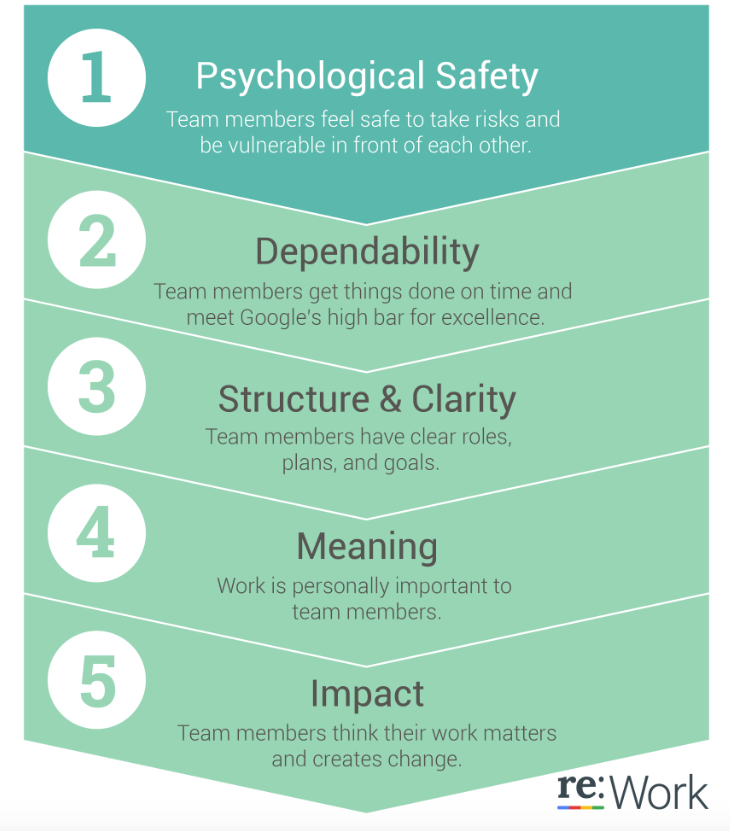
Diagram showing the findings of Google's Project Aristotle and the five characteristics of high performing teams - 1. Psychological safety, 2. Dependability, 3. Structure and Clarity, 4. Meaning, 5. Impact

Google’s Project Aristotle

How psychological safety captured the world’s attention For a while, from around 1999 to 2014, the term ‘psychological safety‘ was relatively well known in academia, but barely mentioned, let alone understood in the world of practice, the world of work

Read More »
road safety

Psychological Safety Newsletter 153

Psychological Safety in the World Soft SkillsWhilst I’m not really keen on the term “soft skills” (because really, the soft stuff is the hard stuff), this is a good article by Rebecca Knight on improving your soft skills as a remote

Read More »

I can say whatever I want! 

I can say whatever I want!  When I met up with Amy Edmondson recently in Boston (yes, this is a humblebrag and I’m owning it!) we discussed one of the prevalent misconceptions around psychological safety: that it means we can say

Read More »
Photo by Kenny Eliason on Unsplash

Making it safe(r) to fail in teaching 

Making it safe(r) to fail in teaching  By Jade Garratt, Director of Education, Iterum Years ago, I was lucky enough to teach in an amazing secondary school English department. Teachers’ enthusiasm for developing their practice was infectious and there was

Read More »
Tom Geraghty

Psychological Safety Case Study

Psychological Safety Case Study: The Sales Team One of the most popular requests from the newsletter feedback survey was for some case studies of psychological safety in practice, so here’s the first one! It’s an interesting case that illustrates why

Read More »

Psychological Safety and the Ancient World

Guest Post by Beatriz Poyton The term psychological safety is believed to have originated in 1954 by clinical psychologist Carl Rogers. William Kahn has since defined psychological safety as “the sense of being able to show and employ one’s self

Read More »

Psychological Safety Newsletter #148

Psychological Safety at Work Psychological Safety in Schools This is an excellent piece on the EdCan Network website on the importance and dynamics of psychological safety for students. The authors make a few key points – psychological safety and inclusion

Read More »
civility saves lives

Civility Saves Lives

Civility Saves Lives If you wanted to completely destroy any psychological safety in the group, what would you do? If you wanted to create a culture of fear, where nobody felt safe to speak up, suggest ideas, highlight concerns, or

Read More »
amplifying weak signals

Amplifying Weak Signals

A few issues ago, we covered various kinds of retrospective – the practice of looking back and learning from work, as well as some of the conditions and requirements for effective retrospectives. One of those points was about the “weak

Read More »
lean and psychological safety

Psychological Safety Newsletter #145

Psychological Safety at Work Lean and psychological safety Here’s a great analysis by Ben Hutchinson of a paper examining the relationship between Lean and psychological safety in construction projects in the US. This combines two of my favourite subjects so

Read More »