

What does Cognitive Load have to do with Psychological Safety Psychological safety helps to reduce our cognitive load by allowing us to ask for help and worry less about the interpersonal risks we tak...

AKA: When you’re accustomed to privilege, equality feels like oppression Not everyone is a fan of psychological safety Sometimes that’s because people don’t yet understand what it...

What is Conway’s Law This week we’re diving into the concept of Conway’s Law, and its relation to psychological safety Conway’s Law essentially describes the “force” th...

Resilience Engineering Today we’re diving into the field of Resilience Engineering This subject ticks a lot of my interest boxes: from complexity and sociotechnicality to psychological safety and le...

1- Artefacts These describe any overt, visible, describable aspects of the organisation Think things like branding and logos, office design, dress code, policies and tools Things that you can see 2-...

Team charters are a fantastic way of creating alignment, cohesion and psychological safety in a team They also help to onboard new team members, and enable teams to work together more effectively This...
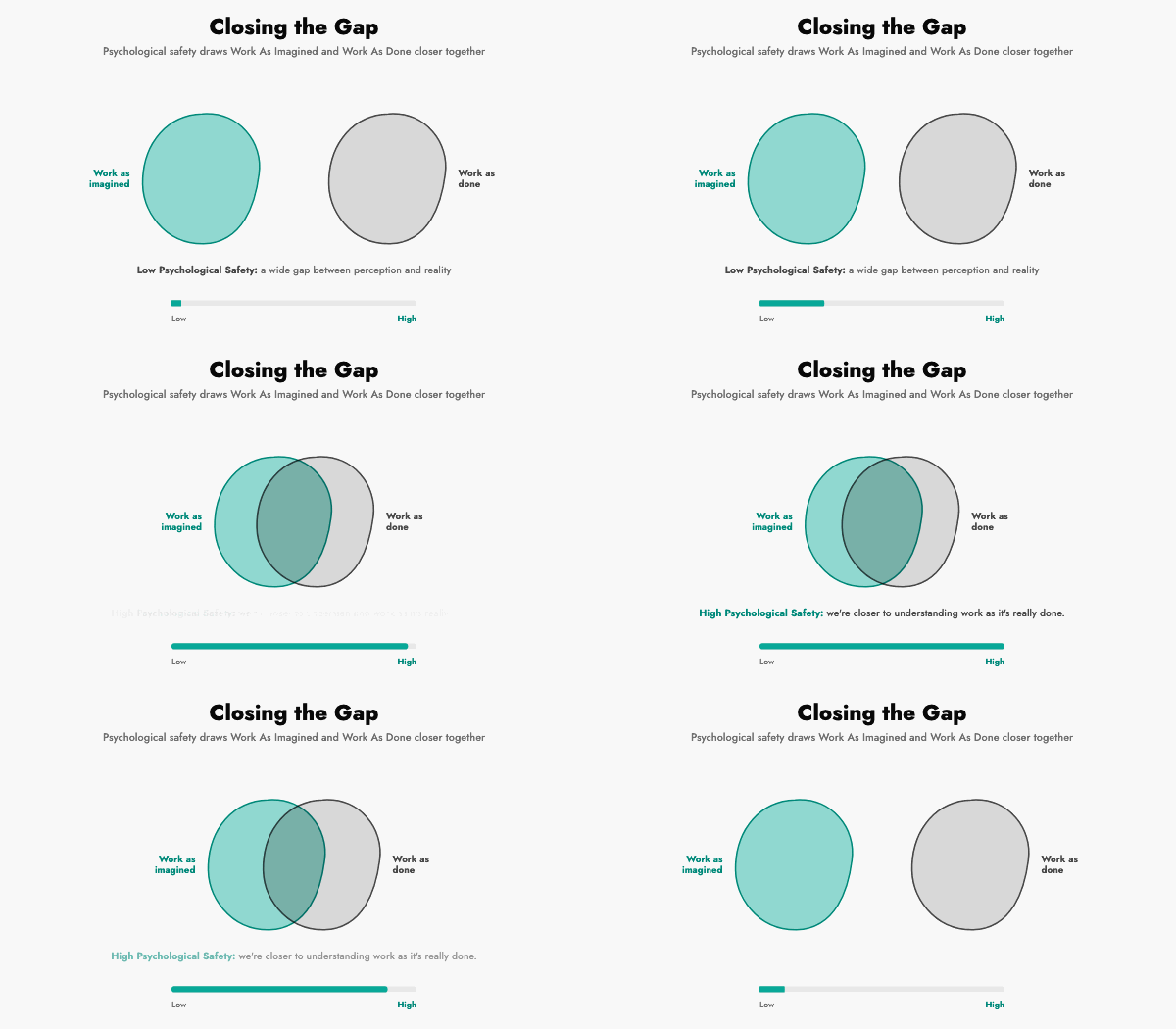
Work as Imagined vs Work as Done In last week’s newsletter about human error, we looked at why and how people make mistakes One of the categories of error we explored was â€...

Human Error We’ve covered failures before, but this week we’re focusing on errors Failures can be preventable, complex, or “intelligent” – such as those resultin...

Agile It seems like the word “Agile” gets thrown about a lot Sometimes it refers to a more flexible approach to working hours and locations, sometimes it refers to Scrum practice...

Lean Coffee and Agenda-less Meetings In this issue, we’re discussing a way to run effective, agenda-less meetings, which helps to foster psychologically safe environments by ensuring e...

Welcome to the psychological safety newsletter and thanks for subscribing You are amazing This week discusses the top seven issues of 2022 Find out which ones were most popular below, a...
Welcome to the psychological safety newsletter and thanks for subscribing You are amazing This week discusses how not to be Brent (Static work vs Generative work), plus great resources ...

Welcome to the psychological safety newsletter and thanks for subscribing You are amazing This week discusses artificial intelligence and psychological safety Psychological safety and safety...
Psychological Safety vs a “Safe Space” This tweet from Amy Edmondson asks a really important question: what’s the difference between “psychological safety”...

Welcome to the psychological safety newsletter and thanks for subscribing You are amazing This week discusses the way in which aiming for zero defects can actually result in more defects, no...

Tuckman’s Model We’ve recently covered team size, Dunbars number, and the effect that team sizes has on performance and psychological safety In this issue, we’re going to t...

Welcome to the psychological safety newsletter and thanks for subscribing You are amazing This week discusses some things to think about before measuring psychological safety Measu...

Welcome to the psychological safety newsletter and thanks for subscribing You are amazing This week discusses failure archetypes, human factors, more Elon Musk, stinky fish and more Hum...

With companies such as Facebook, Twitter, Stripe and many others announcing redundancies and layoffs, it’s crucial to consider the impact that this has on both the people who are leaving compani...

Welcome to the psychological safety newsletter and thanks for subscribing You are amazing This week discusses dealing with learning from incidents, plus Elon Musk, share of voice, and Extrem...

Safety Guardrails, Mechanisms and Culture In working with psychological safety, we often touch on “real” or physical safety and how the two are related By “real” safety, I mean...
Can a team be too psychologically safe A question I get asked in many (maybe even most) workshops is “Can a team be too psychologically safe” Or sometimes framed, “What’s the impact o...

As much as Dunbar's limits on group sizes might seem to be common sense, and reflected in many real world examples, Dunbar's theories on group size boundaries have been deconstructed and shown to po...

Westrum’s Cultural Typologies Dr Ron Westrum wrote in the BMJ Quality & Safety Journal in 2004 about The Three Typologies of Organisational Culture He was looking at how information flo...

Team Charters In a previous newsletter, we discussed “personal readmes” or “user manuals” I’m a huge fan of personal readmes as a way to foster psychological safety and cohesion in a g...

The Andon Cord: Stopping The Line Being able to “stop the line” to prevent an issue getting worse, stop a defect passing downstream, suggest an idea for improvement when it can endow maxim...

Dr Richard Cook I was recently saddened to learn of the passing of Dr Richard Cook, and felt it appropriate that I dedicate this issue of the newsletter to Richard and his achievements I was...

Welcome to the psychological safety newsletter and thanks for subscribing You are amazing This week discusses 1-1 meetings, diversity, experiments, scrum masters and design principles 1-1 Me...

Non-Violent Communication Last week, in talking about the Yamas and Niyamas from Patanjali’s Yoga Sutras, I mentioned Non-Violent Communication (NVC), and I thought it’d be good ...

Yogic Philosophy: Ahimsa and Satya You’ve probably realised by now that I love drawing together ideas from diverse fields and disciplines to examine what they can teach us about psychologi...

