
The problem with the “Fist to Five” for psychological safety. Often, with good intent, we find facilitators and teams adopting a practice called “Fist of Five”, where, at the start of a meeting or workshop, participants are asked to hold […]

Create and Maintain

Executive Summary This study explored why people foster psychological safety, examining whether motivations are primarily moral, relational, or performance-driven. While psychological safety is often discussed in terms of its organisational benefits: innovation, learning, quality, and performance, this research highlights the […]

By Jade Garratt Which of these do you think might damage psychological safety in a team? The answer, of course, is that all of them can. Sometimes it’s individual behaviours that cause harm to the psychological safety experienced by members […]

Guest Post By Jason Rawding Humour and Psychological Safety Being funny at work can feel a bit risky – especially in front of a group, or in an email that many people will see. In trying to make others laugh, […]

The Organisational Fabric of Psychological Safety (AKA psychological safety is more than just a team phenomenon) By Tom Geraghty When we talk about psychological safety, the definition we usually use is something along the lines of “a shared belief that […]

All Feedback Is Subjective By Jade Garratt … And Why That Matters for Psychological Safety “No person in the world is so privileged as to have access to a ‘ground truth’ against which all other people’s understanding can be proven […]

The Spectrum of Participation by Jade Garratt Engagement and participation are terms we often throw around to mean “getting people’s take on issues that affect them.” But not all participation is created equal. Sometimes, “inviting participation” amounts to little more […]

Psychological Safety in Practice Team Learning in the Field: An Organizing Framework and Avenues for Future Research This excellent paper from Amy Edmondson and Jean-François Harvey affirms that teams learn most effectively when members feel safe to speak up, take interpersonal risks, […]

We’ve been rather busy this week, in the midst of this round of psychological safety online workshops, including fundamentals, practices, leadership, measurement, advanced, and workshop design and facilitation. With that in mind, we thought it would be a good time […]

Psychological Safety Doesn’t Mean Feeling Comfortable By Jade Garratt There are many misconceptions about psychological safety. One is that if we “achieve” psychological safety, it means that people will feel comfortable all the time. It’s understandable to see how that […]

A team is only as safe as the least safe person When measuring the psychological safety in a team, we often are asked which measurement should be considered the “group measurement,” given that different individuals will likely experience rather different […]
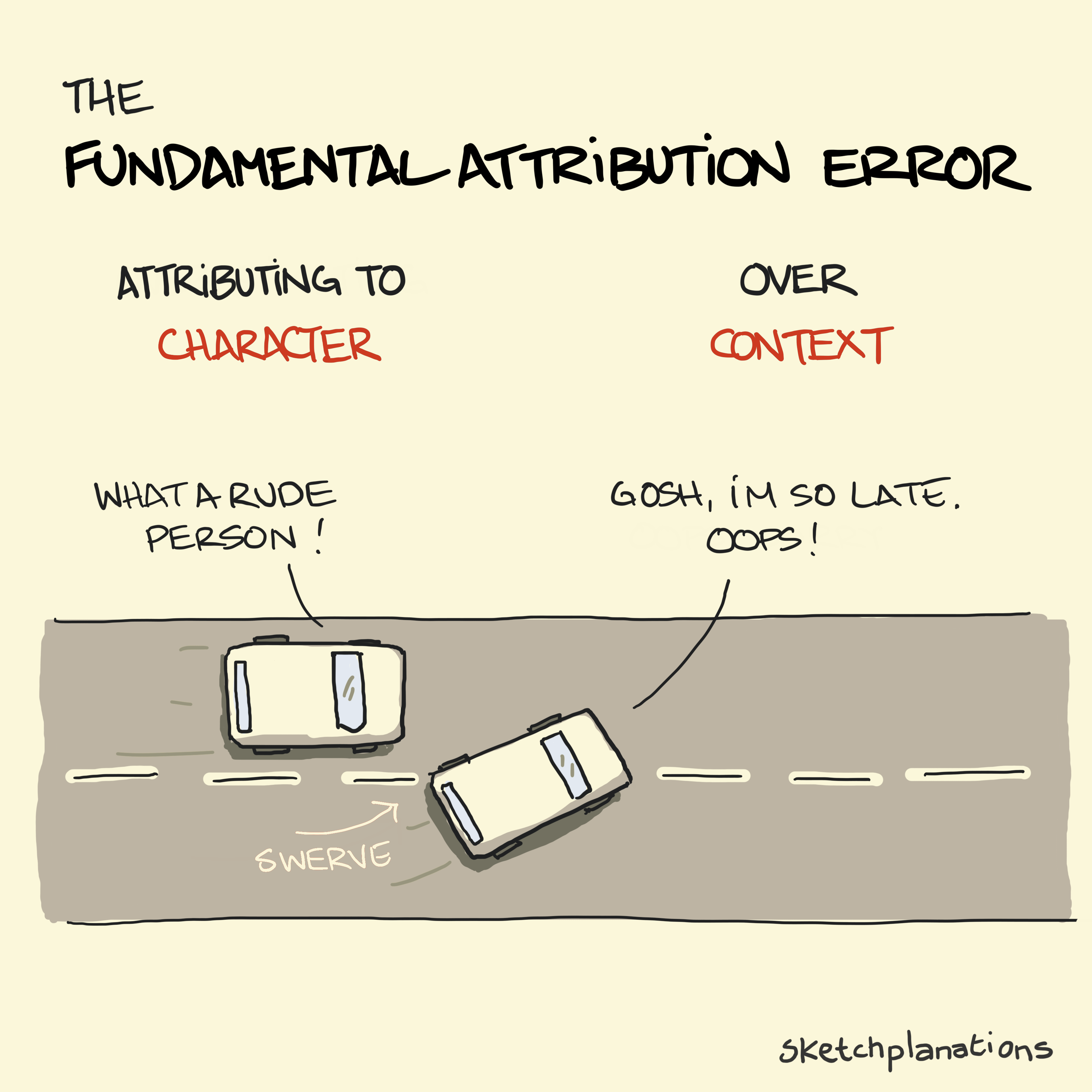
The Fundamental Attribution Error We address the Fundamental Attribution Error in most of our workshops, particularly our Feedback ones, because it’s such a common bias and it causes so many problems. Essentially, the Fundamental Attribution Error occurs when we attribute […]

How to foster psychological safety with your own manager. By Jade Garratt Psychological safety isn’t only the responsibility of those in leadership positions. We believe that if you have the power to destroy psychological safety for someone – if you […]
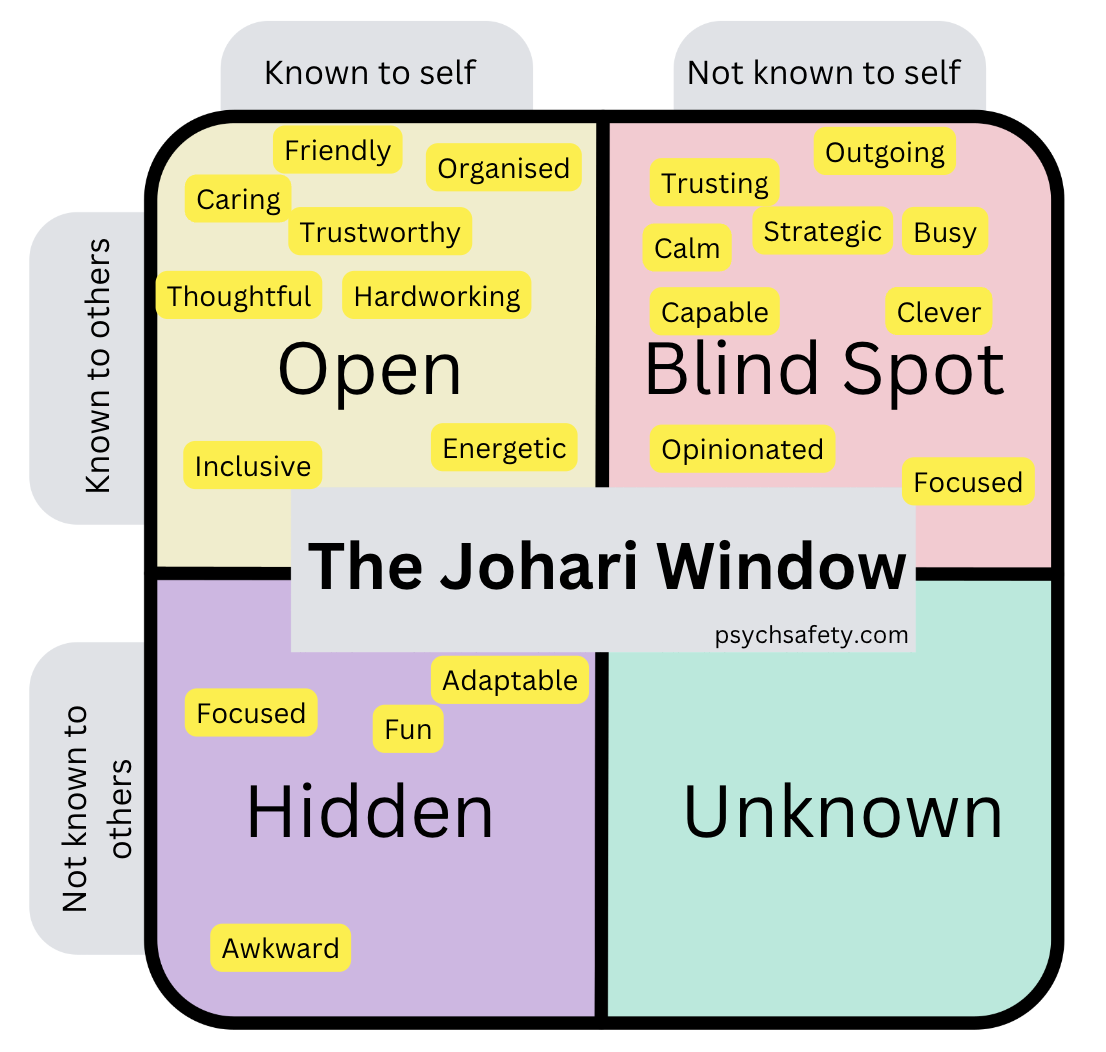
The Johari Window Many people first encounter the Johari Window in leadership or personal development training. I was introduced to it in exactly that way – it was presented as a simple but powerful tool for self-awareness and managing feedback. […]
Read here about our research on most impactful practices that foster psychological safety. For over one hundred more activities and behaviours, check out our big list of behaviours that foster psychological safety.
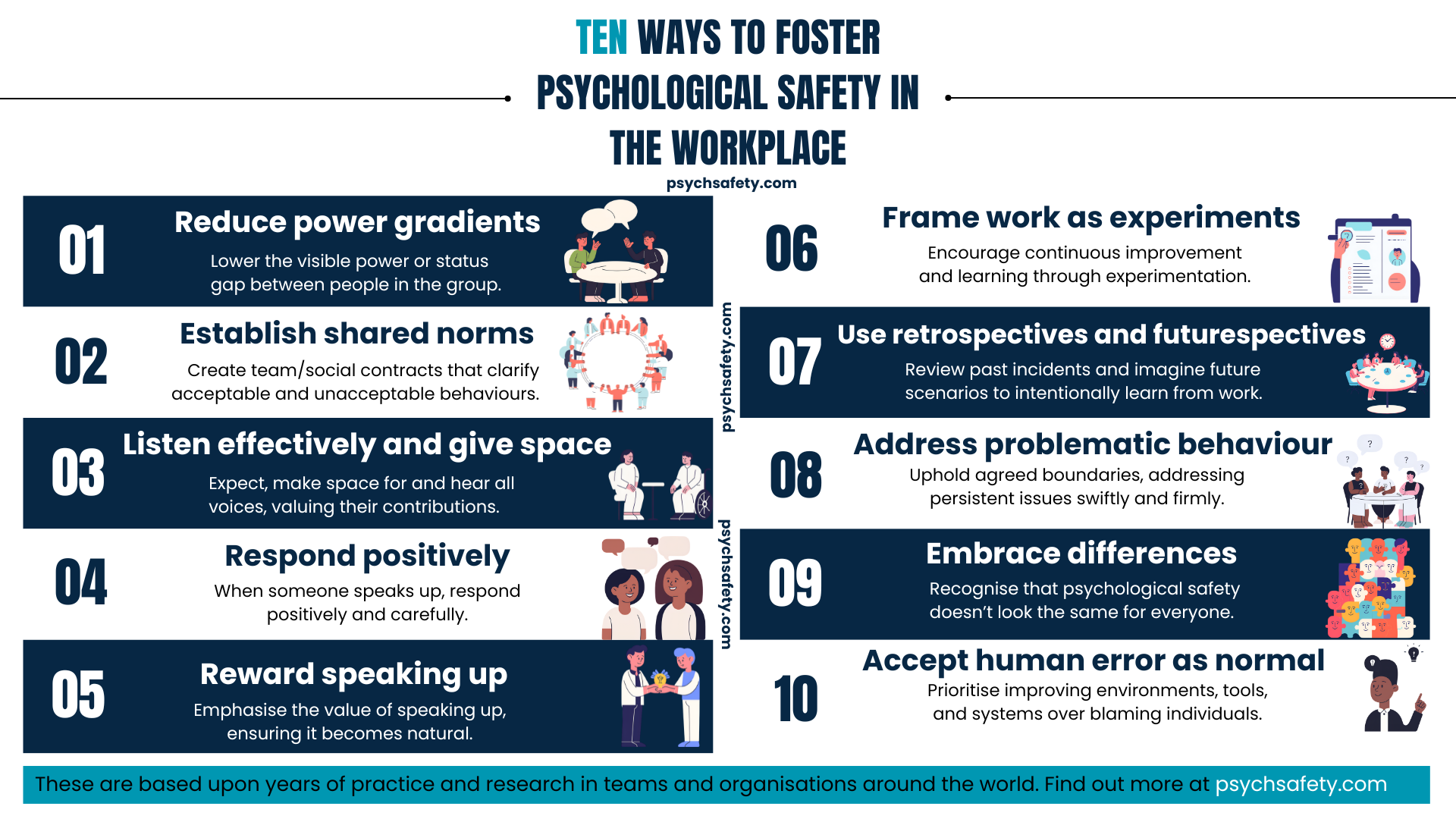
Ten Ways to Foster Psychological Safety in the Workplace We’ve been reflecting on our last few years of experience delivering psychological safety workshops, training and consultancy in organisations around the world. Based on all those wonderful experiences, working with industries […]
Icebreakers If you’re anything like me, when you see “icebreakers” on an agenda or schedule for a meeting, you immediately become a little anxious. Ice breakers are intended to make us feel more comfortable and at ease, increasing the overall […]

Psychological safety is about creating a climate in which we feel able to take interpersonal risks in order to communicate our ideas, concerns and issues – and we want to be able to speak up in a way that we […]

Team performance isn’t the only reason that we foster psychological safety. We also do it because we want people to feel fulfilled in their jobs, we don’t want people to leave a team because they don’t feel included, we want people to experience less unnecessary stress and have greater mental wellbeing, we want to foster greater diversity and inclusion. Ultimately, we foster psychological safety because it’s fundamentally the right thing to do.

Psychological Safety in 2023 Thanks so much for all your support, feedback, encouragement, ideas, insights and collaboration over 2023! It’s genuinely a privilege to be able to do this work, and I appreciate every single one of you. I recently […]

Learning From Work In the spirit of looking back and learning, I thought it’d be nice to dive into a few different practices of learning from the work we do. In this issue, we’re going to have a look at […]

Tool: Foster psychological safety We realised recently that the Google Project Aristotle page for their guide on team effectiveness and building psychological safety was 404’ing, so for anyone looking for it, we went over to the Way Back Machine and […]

Interpersonal vs. Intrapersonal Dynamics in Psychological Safety: Balancing Self and Others in Organisational Contexts In the organisational behaviour and dynamics, understanding the interplay between interpersonal and intrapersonal dynamics is crucial for fostering a culture of psychological safety. While these terms […]

Team charters are a fantastic way of creating alignment, cohesion and psychological safety in a team. They also help to onboard new team members, and enable teams to work together more effectively. This Psychological Safety Practice Playbook Add-on for the […]
Psychological safety is “The belief that one will not be punished or humiliated for speaking up with ideas, questions, concerns, or mistakes, and that the team is safe for interpersonal risk taking” (Edmondson, 1999) Also stated as “A belief that […]
12
Page 1 of 2

