management

reduce plan continuation bias with these 6 practices

Plan Continuation Bias

Plan Continuation Bias, or “Get-There-Itis” I got pretty sick this week. I was wiped out with a nasty bout of tonsillitis – high temperature, exhausted and felt awful. The doctor put me on strong antibiotics, painkillers, and told me, in


Read More »

Comfort vs Need

Comfort vs Need by Tom Geraghty What do we do when the things that help some people in the team feel psychologically safer don’t work for everyone? Perhaps one person says they need time away from the main meeting group

Read More »
micromanagement

Micromanagement

Psychological Safety and Micromanagement By Jade Garratt Those who have followed our work at Psych Safety for a while will know that we believe exploring not just what to do – the behaviours and practices that support psychological safety –

Read More »
Human and organisational performance (HOP) core principles

How We Respond Matters

The Speaking up Myth By Jade Garratt In the world of psychological safety, we focus a lot, maybe even too much, on the speaking up side of the equation. How do we make sure people speak up with their ideas,

Read More »
whose fault is this?

The Seven Deadly Sins of Psychological Safety

The Seven Deadly Sins of Psychological Safety I recently tried to work out how many people have attended one or more of our workshops on psychological safety, including our workshops for teams and organisations, our online workshops, and any we’ve

Read More »
Photo by Kelly Sikkema on Unsplash

Building Psychological Safety Upwards

How to foster psychological safety with your own manager. By Jade Garratt Psychological safety isn’t only the responsibility of those in leadership positions. We believe that if you have the power to destroy psychological safety for someone – if you

Read More »
Edgar Schein Humble Enquiry

Edgar Schein’s Humble Inquiry

Humble Inquiry By Jade Garratt When was the last time someone told you something you already knew? How did it make you feel? Edgar Schein opens his book “Humble Inquiry” with a story about his own experiences of this while

Read More »
devops and psychological safety

The Psychological Safety Community Relaunch

The online Psychological Safety Community has been live since early 2021, and currently has around 800 members. It’s completely free to join, and we have some great conversations there. A lot of newsletter topics and sharing items come from discussions

Read More »
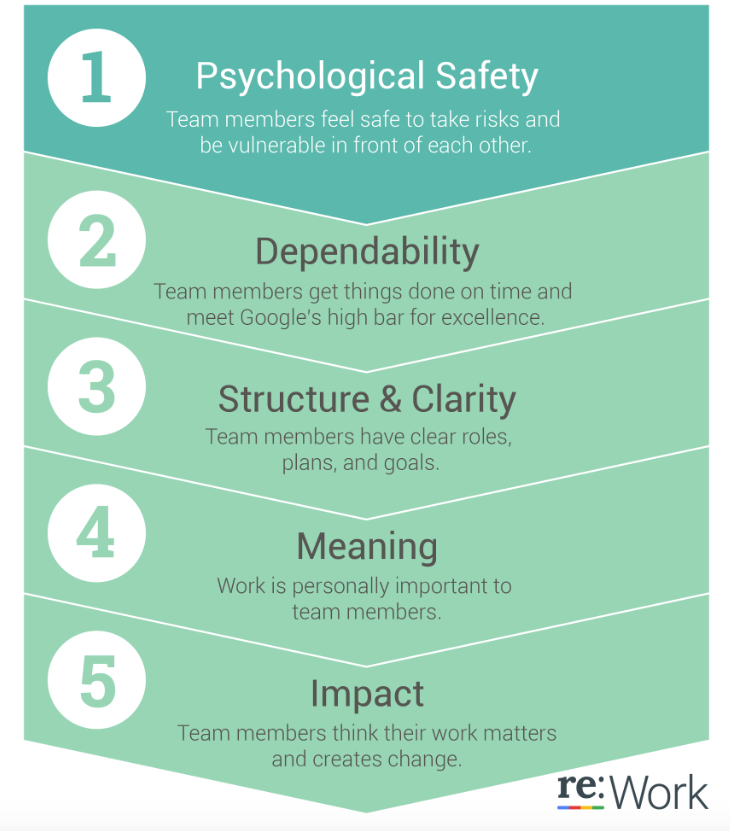
Diagram showing the findings of Google's Project Aristotle and the five characteristics of high performing teams - 1. Psychological safety, 2. Dependability, 3. Structure and Clarity, 4. Meaning, 5. Impact

Google’s Project Aristotle

How psychological safety captured the world’s attention For a while, from around 1999 to 2014, the term ‘psychological safety‘ was relatively well known in academia, but barely mentioned, let alone understood in the world of practice, the world of work

Read More »
psychological safety word cloud

Psychological Safety in 2023: unwrapped!

Psychological Safety in 2023 Thanks so much for all your support, feedback, encouragement, ideas, insights and collaboration over 2023! It’s genuinely a privilege to be able to do this work, and I appreciate every single one of you. I recently

Read More »
The first organisation chart

The First Organisational Chart

The First Org Chart In 1855, Brigadier General Daniel McCallum, later to become a Civil War officer renowned for “strict precision and stern discipline” as well as for his innovative engineering, created the world’s first organisational chart. This chart was

Read More »
wait time vs utilisation

Queuing Theory, Slack and Utilisation.

We cannot adequately respond to changes, incidents or threats if we’re operating at capacity. And it applies to people, machines, computers, traffic and more – whether you’re running a factory floor, a busy kitchen, a software development team, or a hospital ER, percentage utilisation is impacting how well your team can adapt to a changing environment. 

Read More »
audre lorde questionnaire to oneself

15/5 Reports

15/5 Reports To manage teams in a way that fosters psychological safety requires clear communication and feedback channels. Team members should have well-defined platforms to share achievements, voice concerns, and seek assistance. Ideally, these feedback mechanisms will be consistent, high-cadence and

Read More »
cognitive bias

Bad Management

Bad Management It’s important that we learn from our own mistakes and failures, and self-reflect in order to improve. However, there’s also a lot we can learn from things others get wrong. That, after all, is partly why psychological safety is such

Read More »
sociotechnical theory

Sociotechnical Theory

If we think about how we can apply sociotechnical theory in practice, we realise that organisational change or technological change will fail if we focus on one component (social or technical) in isolation and to the exclusion of others. We must consider how people are affected by technologies, and likewise, how technologies affect the way people behave.

Read More »
leadership vs management

Leadership and Management

https://youtu.be/QhwHGfws1-c Or Leadership vs Management? Leadership and management are not the same thing. But they’re not mutually exclusive either. In order to be a truly effective leader, we must also possess strong competency and capability in our respective domains. We

Read More »
psychological safety feedback sketchnote

Psychological Safety & Giving Feedback

Providing constructive feedback is one powerful way you can help people excel, achieve their goals and be happier in their work.  Done well, it can create psychological safety and help teams and organisations perform at their best. However, feedback can

Read More »
psychological safety and diversity

1-1 Meetings

Welcome to the psychological safety newsletter and thanks for subscribing. You are amazing. This week discusses 1-1 meetings, diversity, experiments, scrum masters and design principles. 1-1 Meetings Every great manager I’ve ever met adhered to a strong and principled practice of regular

Read More »
ecotones and the edge effect

Ecotones & The Edge Effect

Welcome to the psychological safety newsletter and thanks for subscribing. You are amazing. This week discusses Ecotones and the Edge Effect, as well as polarisation at work, relational contracts and internal conferences. If you enjoy reading this newsletter, please share it via your social networks

Read More »
The swedish warship Vasa - psychological safety

Psychological Safety: Servant Leadership

Welcome to the psychological safety newsletter and thanks for subscribing. You are amazing. This week discusses servant leadership, Swedish warships, being “neurodistinct”, and product development. If you enjoy reading this newsletter, please share it via your social networks and/or forward it to other people

Read More »
psychological safety and trust

Psychological Safety: Capacities of Leadership

Welcome to the psychological safety newsletter and thanks for subscribing. You are awesome. This week discusses leadership and trust, job role expansion, intersectionality, autonomy, healthcare, education, sport, trust and dysfunctions If you enjoy reading this newsletter, please share it via your social networks and/or

Read More »
t shaped vs broken comb

Psychological Safety: Command & Control

Welcome to the psychological safety newsletter and thanks for subscribing. You are awesome. This week discusses command-control management, a lot of LEGO, autism, trans inclusion, and speaking up. If you enjoy reading this newsletter, please share it via your social networks and/or forward it to

Read More »