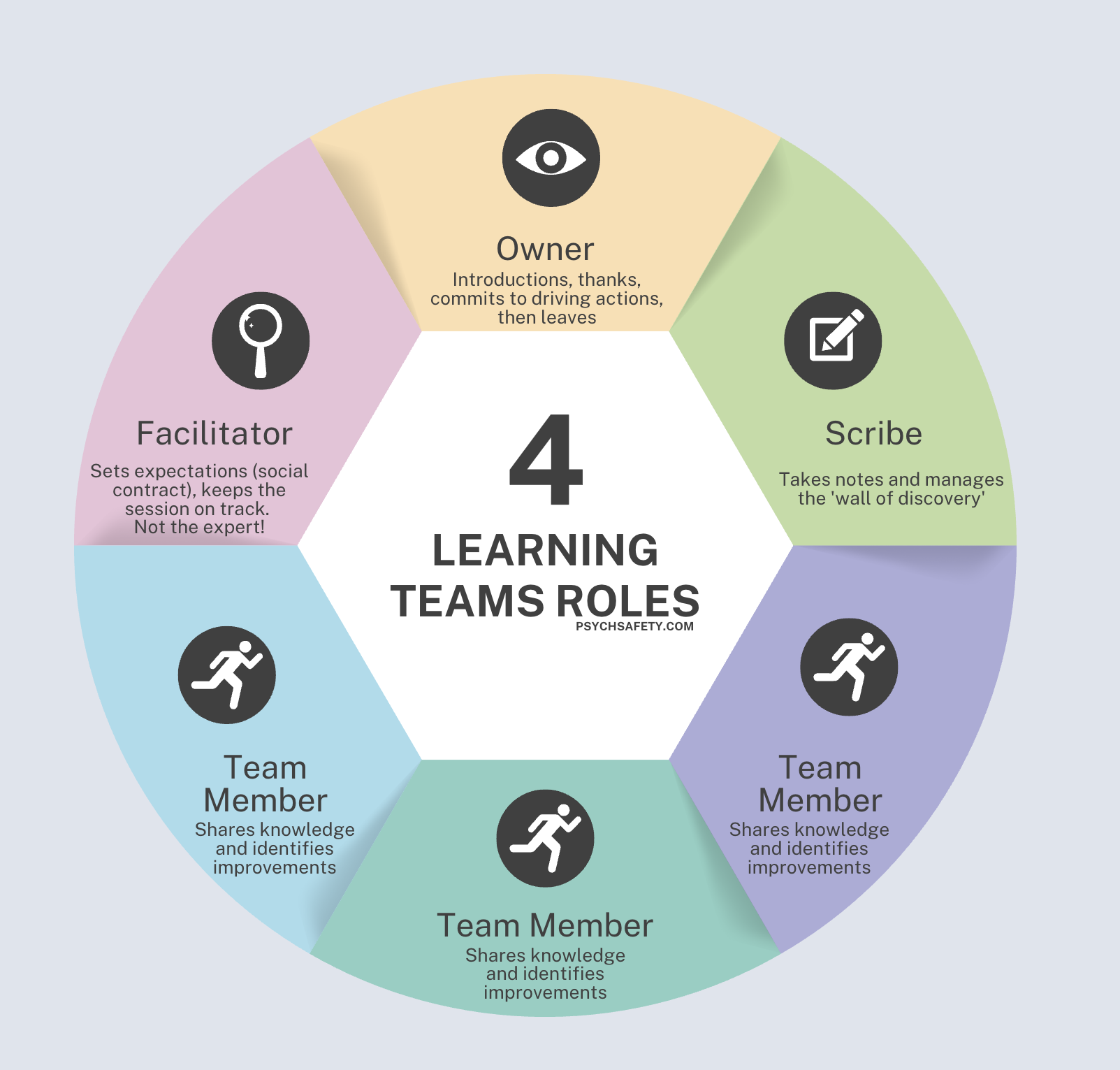
Learning Teams
Learning Teams Often, when we’re trying to improve how work gets done, we start with principles. We agree what we believe in, or are working towards, at a high level, and then figure out how those ideas translate into day-to-day

Learning Teams Often, when we’re trying to improve how work gets done, we start with principles. We agree what we believe in, or are working towards, at a high level, and then figure out how those ideas translate into day-to-day

The problem with the “Fist to Five” for psychological safety. Often, with good intent, we find facilitators and teams adopting a practice called “Fist of Five”, where, at the start of a meeting or workshop, participants are asked to hold
Psychological Safety Is Necessary But Not Sufficient. We sometimes hear “But psychological safety isn’t enough!”, and well… Obviously. It’s rather like saying that having a fully functioning car isn’t enough to make a road trip – and of course it

Executive Summary This study explored why people foster psychological safety, examining whether motivations are primarily moral, relational, or performance-driven. While psychological safety is often discussed in terms of its organisational benefits: innovation, learning, quality, and performance, this research highlights the

The Organisational Fabric of Psychological Safety (AKA psychological safety is more than just a team phenomenon) By Tom Geraghty When we talk about psychological safety, the definition we usually use is something along the lines of “a shared belief that

by Navya Adhikarla I am a neurodivergent engineering manager who loves to innovate and solve problems. But, I am also a neurodivergent person who navigates daily hurdles that stem from processing social cues differently, managing sensory sensitivities, and requiring support

Reducing Power Gradients By Jade Garratt In our experience, the most effective lever for increasing psychological safety within a team is flattening the power gradient – the gap between those with the most power and those with the least. In

Addressing Power through “Flattening” Organisations Steep power gradients are one of the most significant factors that contribute to reducing psychological safety. These steep differentials in perceived power have contributed to many disasters including the Tenerife Airport disaster in 1977, Chernobyl,

A team is only as safe as the least safe person When measuring the psychological safety in a team, we often are asked which measurement should be considered the “group measurement,” given that different individuals will likely experience rather different

How psychological safety emerges and changes over time in the workplace. Given that psychological safety itself is a relatively young field, there’s not a huge amount of published research that addresses the longitudinal dynamics of psychological safety in the workplace:
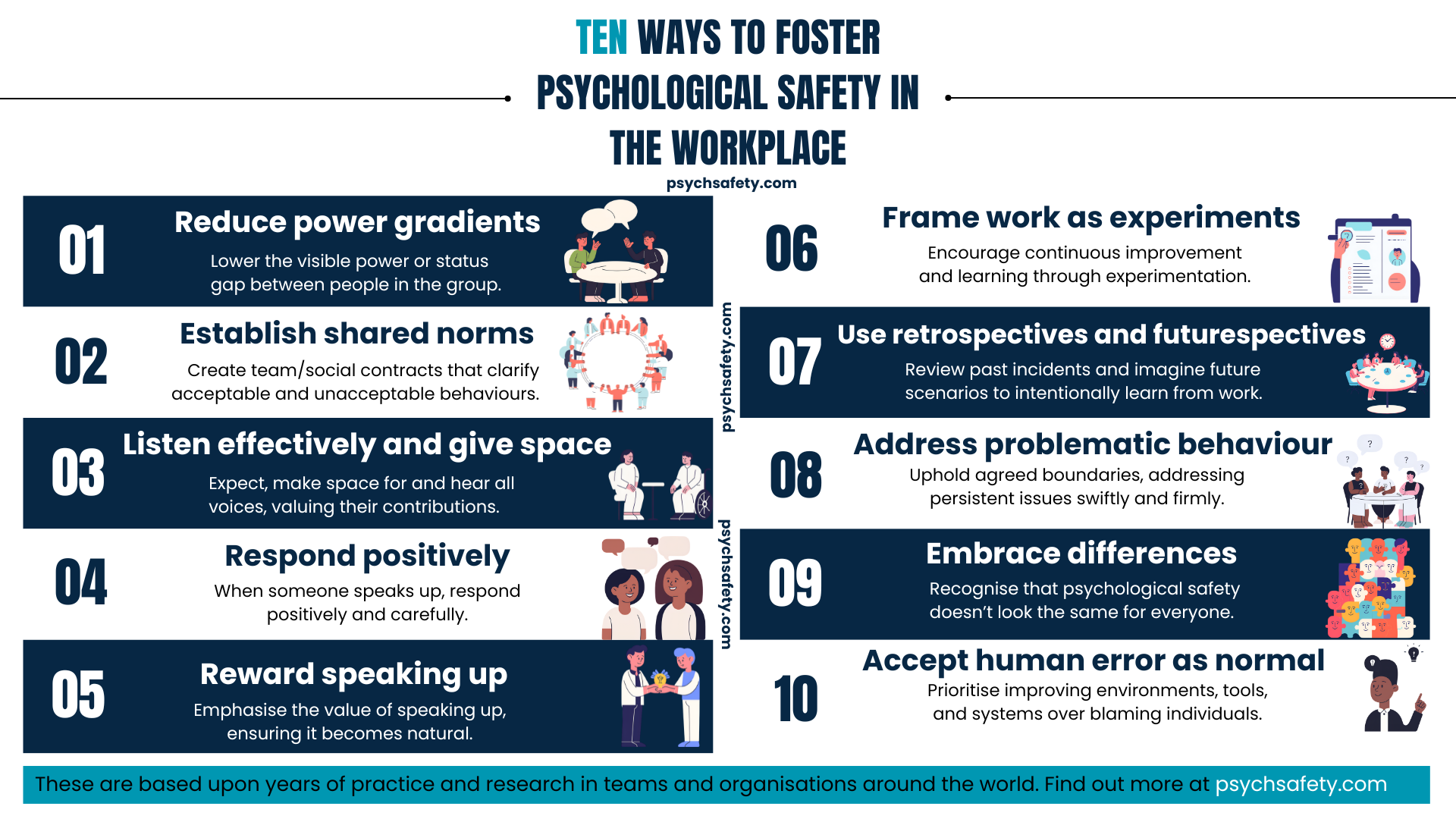
Ten Ways to Foster Psychological Safety in the Workplace We’ve been reflecting on our last few years of experience delivering psychological safety workshops, training and consultancy in organisations around the world. Based on all those wonderful experiences, working with industries

Psychological Safety and DevOps Practices This is a special edition article by Balázs Szakmáry Developing software of any real complexity is a task that goes well beyond one person and one computer. The people, the machines, and the processes involved
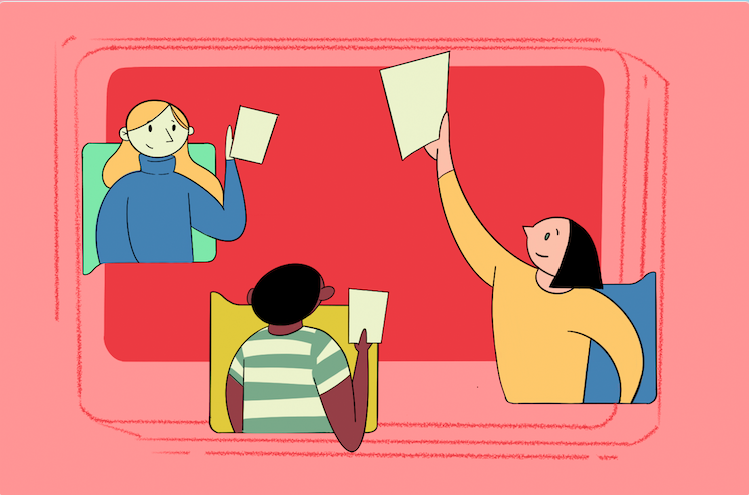
Icebreakers If you’re anything like me, when you see “icebreakers” on an agenda or schedule for a meeting, you immediately become a little anxious. Ice breakers are intended to make us feel more comfortable and at ease, increasing the overall
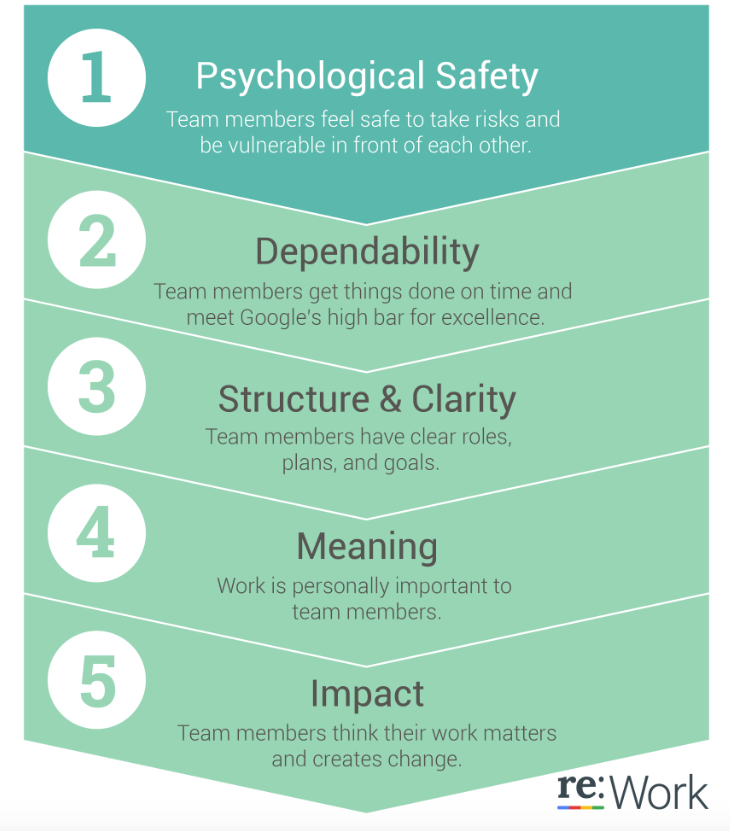
How psychological safety captured the world’s attention For a while, from around 1999 to 2014, the term ‘psychological safety‘ was relatively well known in academia, but barely mentioned, let alone understood in the world of practice, the world of work

Psychological Safety Case Study: The Sales Team One of the most popular requests from the newsletter feedback survey was for some case studies of psychological safety in practice, so here’s the first one! It’s an interesting case that illustrates why

Guest Post by Beatriz Poyton The term psychological safety is believed to have originated in 1954 by clinical psychologist Carl Rogers. William Kahn has since defined psychological safety as “the sense of being able to show and employ one’s self

Civility Saves Lives If you wanted to completely destroy any psychological safety in the group, what would you do? If you wanted to create a culture of fear, where nobody felt safe to speak up, suggest ideas, highlight concerns, or

Team performance isn’t the only reason that we foster psychological safety. We also do it because we want people to feel fulfilled in their jobs, we don’t want people to leave a team because they don’t feel included, we want people to experience less unnecessary stress and have greater mental wellbeing, we want to foster greater diversity and inclusion. Ultimately, we foster psychological safety because it’s fundamentally the right thing to do.

Psychological Safety in 2023 Thanks so much for all your support, feedback, encouragement, ideas, insights and collaboration over 2023! It’s genuinely a privilege to be able to do this work, and I appreciate every single one of you. I recently

The Theory of Constraints (ToC) A long time ago, I read a book that profoundly changed the way I think about work. That book was The Goal, written by Eli Goldratt in 1984, The story revolves around Alex Rogo, a

Guest post by Nick Drage, Strategy Lead and Game Designer at Path Dependence Limited, co-author of “The Handbook of Cyber Wargames: Wargaming the 21st Century”. At its most abstract level a wargame is a “representation of conflict or competition in

Tool: Foster psychological safety We realised recently that the Google Project Aristotle page for their guide on team effectiveness and building psychological safety was 404’ing, so for anyone looking for it, we went over to the Way Back Machine and

15/5 Reports To manage teams in a way that fosters psychological safety requires clear communication and feedback channels. Team members should have well-defined platforms to share achievements, voice concerns, and seek assistance. Ideally, these feedback mechanisms will be consistent, high-cadence and

Bad Management It’s important that we learn from our own mistakes and failures, and self-reflect in order to improve. However, there’s also a lot we can learn from things others get wrong. That, after all, is partly why psychological safety is such

Crew Resource Management In preparing for my conference talk this week, I was reading up further on the 1977 Tenerife disaster and the history of Crew Resource Management (CRM), and came across this excellent paper: The Evolution of Crew Resource Management Training

