
Safe To Fail Experiments
What is “Safe to Fail”? Recently, I failed a motorbike test. This might sound like a mistake, but I fully expected to fail. In the UK, you must pass multiple tests before you’re allowed out on the roads on a

 Here you’ll find our ever-growing collection of practices that help to foster psychological safety and collective learning and performance.
From the Andon Cord and the Pac-Man Rule to Local Rationality and Spectra of Participation, there’s something for everyone here.
There are also some things that aren’t quite practices, but are, at least, practical – like the Fundamental Attribution Error. More something to avoid than to do, but still useful!
For over one hundred more activities and behaviours, check out our big list of behaviours that foster psychological safety.
What is “Safe to Fail”? Recently, I failed a motorbike test. This might sound like a mistake, but I fully expected to fail. In the UK, you must pass multiple tests before you’re allowed out on the roads on a

What is Conway’s Law? This week we’re diving into the concept of Conway’s Law, and its relation to psychological safety. Conway’s Law essentially describes the “force” that means how a team or organisation is structured will affect what the organisation

Team charters are a fantastic way of creating alignment, cohesion and psychological safety in a team. They also help to onboard new team members, and enable teams to work together more effectively. This Psychological Safety Practice Playbook Add-on for the

Work as Imagined vs Work as Done In last week’s newsletter about human error, we looked at why and how people make mistakes. One of the categories of error we explored was “violations”, where people don’t carry out the work as per protocol or procedure. This

Lean Coffee and Agenda-less Meetings In this issue, we’re discussing a way to run effective, agenda-less meetings, which helps to foster psychologically safe environments by ensuring everyone has the opportunity to speak up. You may have heard of Lean (as in Lean Manufacturing),

Tuckman’s Model We’ve recently covered team size, Dunbars number, and the effect that team sizes has on performance and psychological safety. In this issue, we’re going to take a little look at team longevity, the difference between short-lived and long-lived teams, and how the

Team Charters In a previous newsletter, we discussed “personal readmes” or “user manuals”. I’m a huge fan of personal readmes as a way to foster psychological safety and cohesion in a group. Through making explicit our own needs, desires, preferences and

The Andon Cord: Stopping The Line Being able to “stop the line” to prevent an issue getting worse, stop a defect passing downstream, suggest an idea for improvement when it can endow maximum benefit, or ask for help in the

Welcome to the psychological safety newsletter and thanks for subscribing. You are amazing. This week discusses 1-1 meetings, diversity, experiments, scrum masters and design principles. 1-1 Meetings Every great manager I’ve ever met adhered to a strong and principled practice of regular

Non-Violent Communication Last week, in talking about the Yamas and Niyamas from Patanjali’s Yoga Sutras, I mentioned Non-Violent Communication (NVC), and I thought it’d be good to dive into it here a bit. I was first introduced to NVC a few years ago

Personal User Manuals (aka “Personal README” or “Manual of Me”) What is a “Personal User Manual”? One of our favourite practices for building psychological safety is the use of personal “user manuals” (also know as README’s, manager guides and other names). These

This week we have Open Leadership, “What’s ok”, Whistleblowing, Equality, Boeing, safety science, Invisible Knapsacks, Wardley Mapping, and more.Note: There won’t be a newsletter next week as I’m taking a short break, so there’s extra content in this to keep you

Silence in a meeting can be a warning sign of very low psychological safety, but that’s not always, or even usually, the case. We all have our own, very different, preferences for how we speak up, contribute and communicate, especially

Psychological safety is an emergent phenomenon: a property and state of a group that is felt (differently) by members of the group. For this reason, it’s a difficult (but worthwhile) concept to study, and many efforts have been made to

Thanks for subscribing to the psychological safety newsletter! This week, “Me Days”, social contracts, next-gen organisations and more.In the Workplace: This deserves the headline this week: “Me Days” at Aula. Ozzie Clarke-Binns, People Lead at Aula describes so well in this LinkedIn

The Psychological Safety Quadrant Exercise This is a really powerful (and fun!) exercise that helps participants learn and understand psychological safety, as well as an opportunity to qualitatively measure psychological safety, and can be carried out remotely or in-person. We’ve

Meetings, whether in-person or virtual (or the worst kind – a hybrid of the two, where some attendees are together in a room, and the others are remote), are a fact of life for many of us. In fact, many

Trust is not the same as psychological safety. Trust and psychological safety are sometimes confused with each other, and whilst they are related, trust is actually a foundational component of psychological safety, rather than the same thing. Interpersonal trust can
Updated June 2024 The switch to remote and virtual teams Cast your mind back to 2019, before the Covid 19 pandemic. Remote working was still relatively rare, with the vast majority of workers travelling to physical locations and office spaces

It’s a long and worthwhile journey to build high levels of psychological safety in your organisation, and much of the hard work involves excellent leadership, clarity of direction, effective support, vulnerability, curiosity and much more. However there are some simple

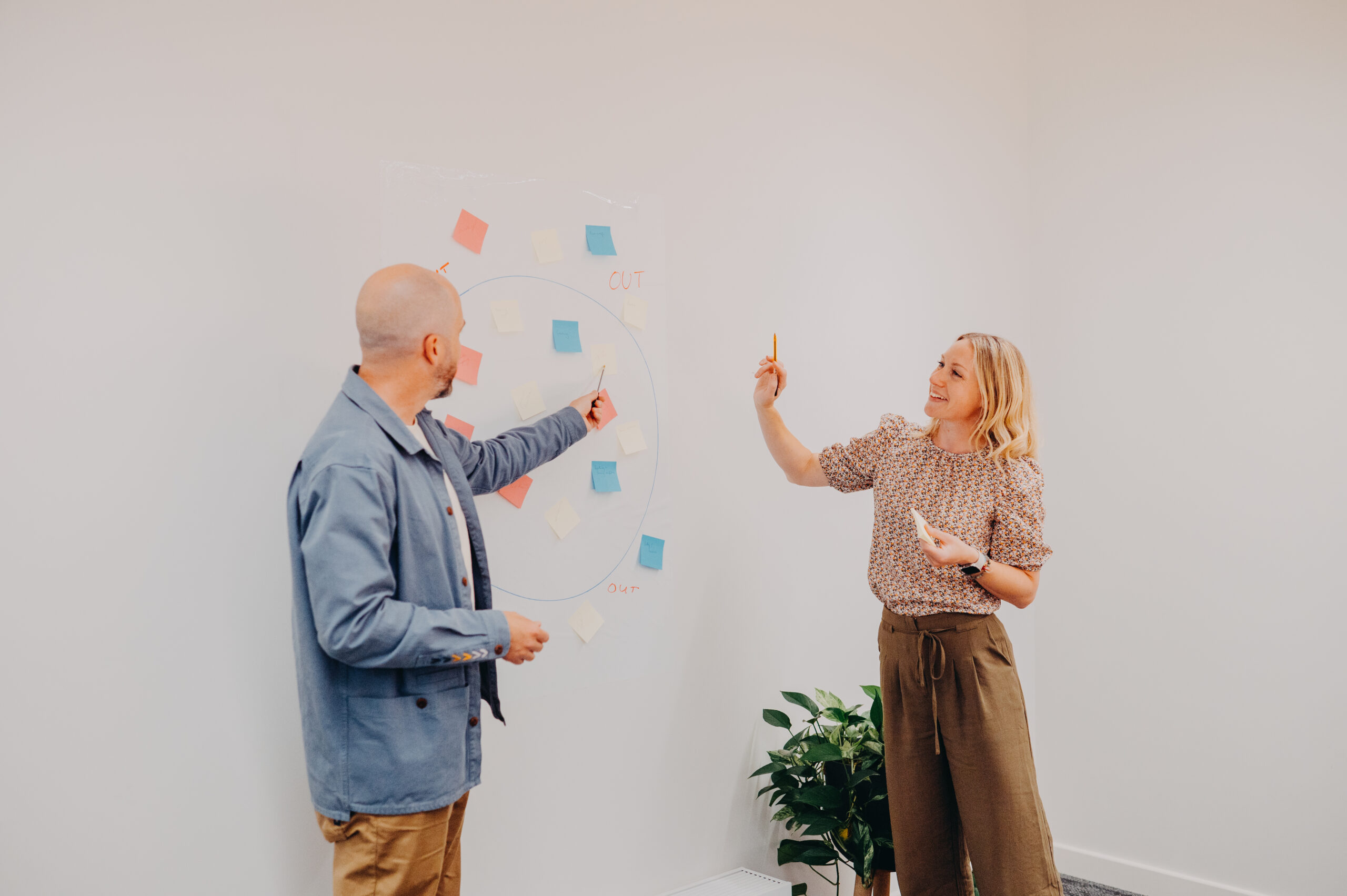
The Circle of Safety is a great way to surface the things that help foster psychological safety in a group, as well as the things that can damage it. By agreeing what is “in” and what is “out”, groups can

