performance

top reasons for fostering psychological safety inc confidence intervals

Why do We Foster Psychological Safety?

Executive Summary This study explored why people foster psychological safety, examining whether motivations are primarily moral, relational, or performance-driven. While psychological safety is often discussed in terms of its organisational benefits: innovation, learning, quality, and performance, this research highlights the


Read More »
personality feedback by gender

All Feedback Is Subjective

All Feedback Is Subjective By Jade Garratt … And Why That Matters for Psychological Safety “No person in the world is so privileged as to have access to a ‘ground truth’ against which all other people’s understanding can be proven

Read More »
micromanagement

Micromanagement

Psychological Safety and Micromanagement By Jade Garratt Those who have followed our work at Psych Safety for a while will know that we believe exploring not just what to do – the behaviours and practices that support psychological safety –

Read More »
Group of people talking in business attire

Reducing Power Gradients

Reducing Power Gradients By Jade Garratt In our experience, the most effective lever for increasing psychological safety within a team is flattening the power gradient – the gap between those with the most power and those with the least. In

Read More »
ridge and furrow fields, leicestershire

Efficiency versus Resilience

Efficiency vs Resilience By Tom Geraghty Standardisation is often used as a way to increase organisational efficiency and scalability. Through reducing variation, we can standardise our tools, training, processes and more, enabling us to optimise systems and better achieve our desired

Read More »
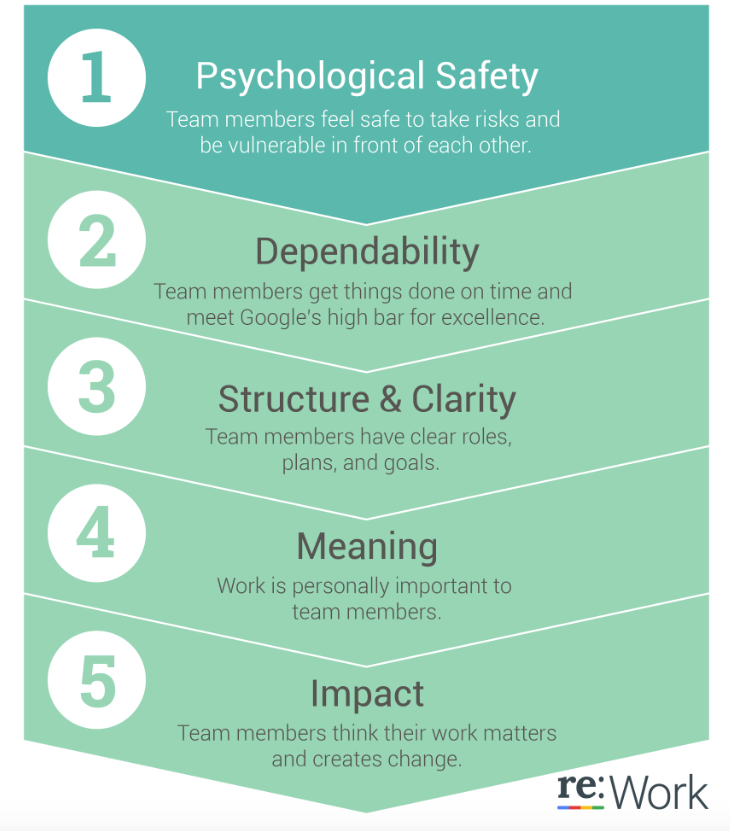
Diagram showing the findings of Google's Project Aristotle and the five characteristics of high performing teams - 1. Psychological safety, 2. Dependability, 3. Structure and Clarity, 4. Meaning, 5. Impact

Google’s Project Aristotle

How psychological safety captured the world’s attention For a while, from around 1999 to 2014, the term ‘psychological safety‘ was relatively well known in academia, but barely mentioned, let alone understood in the world of practice, the world of work

Read More »
Tom Geraghty

Psychological Safety Case Study

Psychological Safety Case Study: The Sales Team One of the most popular requests from the newsletter feedback survey was for some case studies of psychological safety in practice, so here’s the first one! It’s an interesting case that illustrates why

Read More »

Psychological Safety and the Ancient World

Guest Post by Beatriz Poyton The term psychological safety is believed to have originated in 1954 by clinical psychologist Carl Rogers. William Kahn has since defined psychological safety as “the sense of being able to show and employ one’s self

Read More »
amplifying weak signals

Amplifying Weak Signals

A few issues ago, we covered various kinds of retrospective – the practice of looking back and learning from work, as well as some of the conditions and requirements for effective retrospectives. One of those points was about the “weak

Read More »
John Boyd OODA loops

John Boyd and The OODA Loop

John Boyd and The OODA Loop John Boyd’s OODA loops are more than just an esoteric strategic concept; they’ve earned a huge following online and around the world. In this article, I highlight key points about OODA loops along with a glimpse into

Read More »
ivory tower of academia

Can Workplaces Have Too Much Psychological Safety?

Team performance isn’t the only reason that we foster psychological safety. We also do it because we want people to feel fulfilled in their jobs, we don’t want people to leave a team because they don’t feel included, we want people to experience less unnecessary stress and have greater mental wellbeing, we want to foster greater diversity and inclusion. Ultimately, we foster psychological safety because it’s fundamentally the right thing to do. 

Read More »
audre lorde questionnaire to oneself

15/5 Reports

15/5 Reports To manage teams in a way that fosters psychological safety requires clear communication and feedback channels. Team members should have well-defined platforms to share achievements, voice concerns, and seek assistance. Ideally, these feedback mechanisms will be consistent, high-cadence and

Read More »
Normal accident theory

Normal Accidents

Normal Accidents Charles Perrow is regarded as a pivotal figure in the theory of why and how things fail. He served as a sociology professor at Yale and Stanford and was primarily focused on the influence of large organisations on

Read More »
psychological safety playbooks

Psychological Safety & High-Performing Teams

High Performing Teams & Psychological Safety at Work: Psychological safety is the foundation for team performance, whether we’re oriented towards consistent quality, innovation, adaptation, safety or a combination of all outcomes. When people feel psychologically safe, they feel more able

Read More »
motorbike

Safe To Fail Experiments

What is “Safe to Fail”? Recently, I failed a motorbike test. This might sound like a mistake, but I fully expected to fail. In the UK, you must pass multiple tests before you’re allowed out on the roads on a

Read More »
someone climbing and being belayed by someone else

How to Foster Psychological Safety: Behaviours

Psychological Safety Behaviours: The Big List (Updated Oct 2025) Psychological safety is a belief that the group is safe for interpersonal risk taking (Edmondson, 1999). There are many ways we can help to foster these environments, but it’s important to

Read More »
b17 bomber checklist

Psychological Safety: Checklists

Checklists I read Atul Gawande’s “Better” some time around 2008 and absolutely loved it, so when he published “The Checklist Manifesto” in 2009, I grabbed a copy immediately. The Checklist Manifesto describes the power of checklists in reducing human error and increasing effectiveness across various industries,

Read More »
psychological safety in aviation - a go around

Psychological Safety in Aviation

Psychological Safety, Aviation Disasters and Crew Resource Management This week I’ve been reading “Confronting Mistakes” by Jan Hagen. This is a fantastic book, focusing on the human factors behind a multitude of aviation incidents. Jan highlights how miscommunication and failures to speak up

Read More »
work types

Psychological Safety & Agile

Agile It seems like the word “Agile” gets thrown about a lot. Sometimes it refers to a more flexible approach to working hours and locations, sometimes it refers to Scrum practices, and sometimes it means taking an iterative, incremental project management style

Read More »
static work vs generative work

Psychological Safety: Static work vs Generative work

Welcome to the psychological safety newsletter and thanks for subscribing. You are amazing. This week discusses how not to be Brent (Static work vs Generative work), plus great resources on autonomy, pedagogy, nursing, software engineering and human factors. Static Work vs Generative Work,

Read More »